
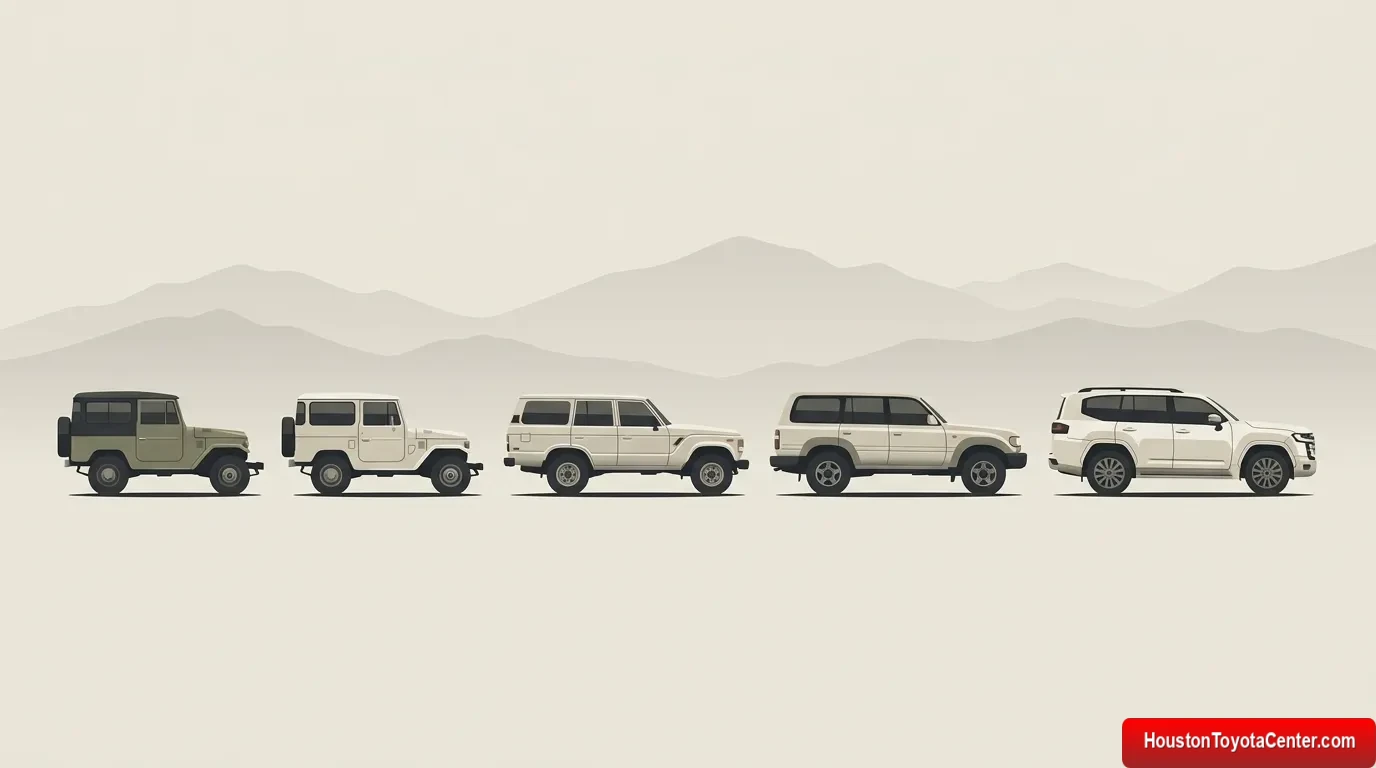
There are plenty of vehicles that can rack up impressive mileage. Reaching 200,000 miles is no longer an extraordinary achievement for a well-maintained modern car. But when a vehicle approaches 500,000 miles and is still being used as a dependable daily driver, it enters a different category entirely.
The Toyota Land Cruiser has earned a reputation for doing exactly that.
Across deserts, mountain roads, construction sites, rural communities and city streets, Land Cruisers have accumulated extraordinary mileage while continuing to perform the basic job they were designed to do: transport people and equipment reliably, often in places where mechanical failure is more than an inconvenience.
The question is not simply why some Land Cruisers reach 500,000 miles. It is why the platform has developed such a strong reputation for surviving mileage that would be considered extreme for many other vehicles.
FREE: Quickly identify and understand problems with your vehicle 🚘
CLICK HEREThe answer is not one magical component. It is a combination of engineering philosophy, conservative design, drivetrain durability, serviceability and, perhaps most importantly, the conditions under which Toyota developed the vehicle.
Built for the Worst Roads, Not the Best Ones
The Land Cruiser was never conceived simply as a luxury vehicle with an adventurous image.
Its history is closely connected to demanding environments where roads can be rough, fuel quality can vary, temperatures can be extreme and access to specialized repair facilities can be limited. That reality influenced the way Toyota approached durability.
Instead of optimizing every component for minimum weight, maximum performance or the lowest possible manufacturing cost, Land Cruiser engineering has traditionally placed substantial emphasis on robustness.
That philosophy has consequences.
A component designed with generous strength margins may be heavier and less sophisticated than an aggressively optimized alternative. But when subjected to years of vibration, heat cycles, heavy loads and rough terrain, that extra margin can become valuable.
This is one of the central ideas behind the Land Cruiser’s longevity: durability is not created by a single indestructible part. It comes from designing the entire vehicle so that individual components are not constantly operating at their absolute limits.
The Engine Is Only Part of the Story
When people discuss high-mileage Land Cruisers, the engine usually receives much of the attention. That is understandable. Toyota has produced several engines associated with exceptional durability, including inline-six and V8 designs used in different generations and markets.
But an engine capable of running for hundreds of thousands of miles would not matter much if the transmission, cooling system, axles, transfer case and electrical systems were constantly failing.
The Land Cruiser’s reputation therefore comes from the durability of the complete mechanical package.
The drivetrain is particularly important.
A four-wheel-drive vehicle designed to carry heavy loads and operate away from paved roads needs more than an engine that produces adequate power. Its transmission, transfer case, driveshafts, differentials and axles must tolerate shock loads and repeated stress.
That requirement has historically encouraged Toyota to use substantial mechanical hardware.
The result is a vehicle that may feel overbuilt compared with an ordinary passenger car. That apparent excess is part of the explanation for its longevity.
Conservative Engineering Can Be a Strength
Modern automotive engineering often focuses on extracting more performance from smaller and lighter components.
Turbocharging, lightweight materials, sophisticated electronics and tightly optimized powertrains have allowed manufacturers to produce vehicles that are faster, more efficient and cleaner than vehicles from previous generations.
But there is a trade-off.
The more aggressively a component is engineered, the more important precise operating conditions can become. Higher temperatures, greater cylinder pressures and more complex systems can create additional points of failure.
Land Cruisers have certainly evolved with automotive technology. Modern generations contain sophisticated electronics, advanced safety systems and complex powertrains. Yet the fundamental durability philosophy remains visible in the vehicle’s reputation.
Historically, many Land Cruiser powertrains have prioritized predictable operation over extracting every possible unit of performance.
That matters over 500,000 miles.
A vehicle does not need to produce the highest horsepower figure in its class to be durable. In fact, operating an engine, transmission or axle well within its mechanical limits can contribute to long-term reliability.
Cooling Is Critical
Heat is one of the great enemies of mechanical longevity.
Engine oil, transmission fluid, seals, bearings and electronic components all have to deal with temperature. Repeated overheating can accelerate deterioration, warp components and degrade lubricants.
For a vehicle expected to operate in hot climates, at altitude, while towing or carrying heavy loads, thermal management becomes especially important.
Land Cruisers have traditionally been engineered with demanding operating conditions in mind. Their cooling systems and mechanical layouts reflect the expectation that the vehicle may spend long periods working hard.
This is one reason maintenance matters so much.
Even a highly durable engine cannot ignore cooling-system problems. A failing radiator, thermostat, water pump or fan system can turn an otherwise durable vehicle into a major repair bill.
Longevity is therefore partly a consequence of design and partly a consequence of preserving that design through maintenance.
The Chassis Has to Survive Too
A 500,000-mile vehicle is not merely an engine with a body attached.
The chassis experiences every pothole, bump, load and off-road impact throughout the vehicle’s life. Suspension components move thousands upon thousands of times. Bushings deteriorate. Bearings wear. Steering components experience repeated stress.
Land Cruisers have historically been designed with serious off-road use in mind, which gives their underlying mechanical architecture a different set of priorities from a typical road car.
This does not mean that every suspension component lasts 500,000 miles. It does not.
A high-mileage Land Cruiser will almost certainly have had suspension components, seals, bearings, belts, hoses and other wear items replaced multiple times.
That distinction is important.
The vehicle reaching 500,000 miles does not mean that every original component survived. It means the fundamental platform can remain viable while normal wear components are periodically renewed.
Serviceability Matters More Than People Think
There is another reason some Land Cruisers survive for decades: they can often be kept running.
A vehicle’s theoretical lifespan and its practical lifespan are two different things.
If repairing a 15-year-old vehicle is prohibitively expensive or requires specialized equipment for every problem, owners have an incentive to replace it.
But if a vehicle can be diagnosed, repaired and maintained by experienced mechanics, its useful life can continue long after its depreciation has reached its lowest point.
Land Cruisers have developed extensive global support networks in many regions. Their popularity also means that mechanics in numerous countries are familiar with their mechanical systems.
This creates a feedback loop.
The more vehicles remain on the road, the more knowledge accumulates about repairing them. The more knowledge exists, the easier it becomes to keep aging examples operational.
That is a major but often overlooked component of longevity.
Parts Availability Creates a Second Life
A durable vehicle can survive for decades only if its owner can continue replacing the parts that wear out.
No vehicle escapes physics.
Rubber deteriorates. Fluids become contaminated. Bearings wear. Electrical connections corrode. Seals lose elasticity. Suspension components eventually require replacement.
What separates a vehicle capable of reaching extraordinary mileage from one that disappears from the road is often the ability to economically rebuild and renew it.
Land Cruisers benefit from a large international market and a long production history. Depending on the generation and region, replacement parts, aftermarket components and specialist knowledge can remain available long after the original vehicle has become old.
This means a 300,000-mile Land Cruiser may not be the same mechanically as it was when new.
It may have received a rebuilt transmission, refreshed suspension, replacement cooling components, new axles or extensive electrical work.
Yet the underlying chassis and architecture can continue serving as the foundation for another chapter of its life.
The Owner Is Part of the Equation
The mythology surrounding 500,000-mile Land Cruisers sometimes creates the impression that the vehicles simply refuse to die.
Reality is less romantic.
Maintenance is crucial.
A neglected Land Cruiser can fail. An abused Land Cruiser can fail. A vehicle that has spent years overheating or running without proper lubrication can develop expensive problems regardless of its reputation.
The examples that reach extraordinary mileage often have something else in common: owners who understand that durability is preserved rather than granted.
Regular oil changes, fluid inspections, cooling-system maintenance, transmission servicing, proper tire pressures and attention to unusual noises can prevent relatively small problems from becoming catastrophic failures.
The owner’s relationship with the vehicle becomes particularly important as mileage increases.
At 50,000 miles, a strange vibration might be an annoyance.
At 400,000 miles, it could be a warning that prevents a much larger repair.
Why Simplicity Still Matters
There is a persistent belief that older Land Cruisers are reliable simply because they are mechanically simple.
There is some truth in that idea, but it needs context.
Older vehicles generally have fewer electronic systems than modern vehicles. Fewer systems can mean fewer potential failure points.
However, simplicity alone does not create durability.
The engineering behind the mechanical components matters. Manufacturing quality matters. Material selection matters. Lubrication matters. Cooling matters. Assembly quality matters. Maintenance matters.
The combination is what produces exceptional service life.
Modern Land Cruisers are considerably more technologically sophisticated than their predecessors, so it would be inaccurate to assume that every new model will automatically reproduce the exact mileage records associated with older generations.
Nevertheless, the reputation of the nameplate was built on decades of engineering for demanding use.
Five Hundred Thousand Miles Is Not the Finish Line
Perhaps the most interesting aspect of a 500,000-mile Land Cruiser is what the number represents.
It is not necessarily proof that the vehicle has never broken down.
It is proof that the vehicle can be repaired, maintained and returned to useful service repeatedly over an exceptionally long period.
That is a different definition of reliability.
Reliability is often interpreted as never needing repairs. In the real world, especially with heavy-duty vehicles, a more useful definition is the ability to remain functional over time despite the repairs and maintenance that inevitably occur.
Land Cruisers have become famous because their owners often consider major maintenance an investment in continued service rather than a reason to abandon the vehicle.
The Real Secret
So, why can a Land Cruiser reach 500,000 miles?
There is no single answer.
It is the result of conservative engineering, robust drivetrains, substantial chassis components, effective thermal management, global parts availability, widespread mechanical knowledge and owners willing to maintain aging vehicles.
Most importantly, the vehicle was designed around a demanding mission.
That mission created an engineering culture in which durability mattered.
A Land Cruiser does not have to be indestructible to last 500,000 miles. It has to be strong enough to survive repeated use, well designed enough to tolerate wear, serviceable enough to be repaired and supported well enough that owners have a reason to keep repairing it.
That combination is rare.
And it explains why, decades after leaving the factory, some Land Cruisers are still crossing continents, climbing mountain roads and carrying families to places where reliability is not a marketing slogan.
It is the entire point of the vehicle.
Leave a Reply