
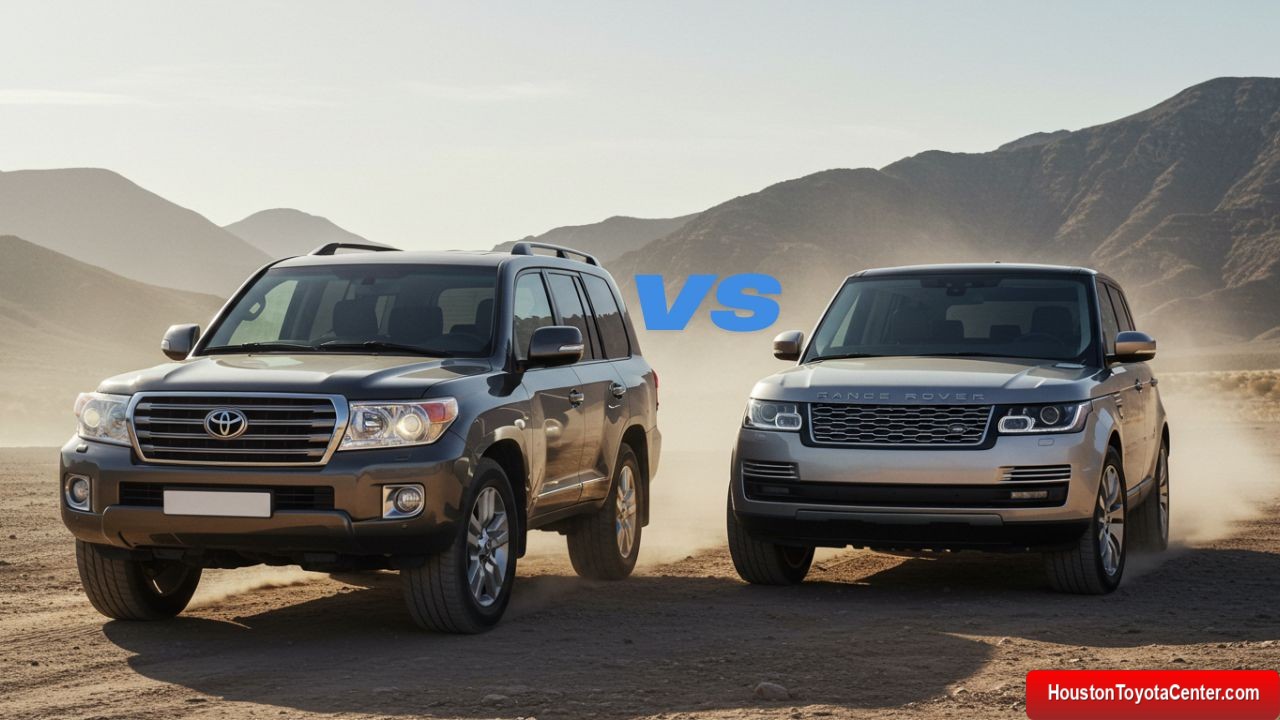
When it comes to legendary SUVs, few names carry as much weight as the Toyota Land Cruiser and the Range Rover. Both have earned global recognition for their capability, luxury, and prestige. Yet one question continues to divide enthusiasts and owners alike.
Which SUV is built to last?
A durability comparison reveals two very different engineering philosophies. One prioritizes mechanical simplicity and long-term dependability. The other focuses on innovation, refinement, and premium driving comfort.
Built for the Toughest Conditions
The Toyota Land Cruiser has developed a reputation for surviving some of the harshest environments on Earth. From deserts in the Middle East to mining operations in Australia and humanitarian missions across Africa, the vehicle has consistently demonstrated exceptional resilience.
FREE: Quickly identify and understand problems with your vehicle 🚘
CLICK HEREIts reputation is not based solely on impressive specifications. Instead, it comes from decades of real-world performance where reliability often matters more than luxury.
Many Land Cruisers remain operational after 300,000 to 500,000 miles with proper maintenance, making them a benchmark for long-term durability.
Luxury Comes at a Cost
The Range Rover approaches the SUV market from a different direction.
It combines outstanding off-road capability with premium materials, advanced electronics, sophisticated suspension systems, and exceptional on-road comfort. Few SUVs deliver such a refined driving experience.
However, increased technological complexity introduces additional components that require maintenance over time.
Owners often praise the vehicle’s comfort and performance while acknowledging that repairs can become expensive as mileage increases.
The Mechanical Advantage
Durability is influenced by more than engine strength.
Factors such as transmission longevity, suspension design, electrical reliability, cooling systems, and ease of maintenance all contribute to how well a vehicle ages.
The Land Cruiser traditionally emphasizes proven engineering solutions that remain dependable for decades.
The Range Rover prioritizes cutting-edge technology and driving sophistication, offering impressive capability while relying on more advanced systems.
Performance Under Pressure
Extreme environments quickly expose engineering weaknesses.
Long-distance expeditions, severe temperatures, rough terrain, and heavy towing place enormous stress on every mechanical component.
The Land Cruiser has repeatedly demonstrated an ability to withstand these demanding conditions with minimal mechanical drama.
The Range Rover is equally capable in challenging terrain, but its advanced air suspension and electronic systems require careful maintenance to perform at their best over the long term.
Ownership Experience
For buyers planning to keep an SUV for many years, durability extends beyond mechanical reliability.
Maintenance costs, parts availability, repair complexity, and resale value all influence total ownership costs.
The Land Cruiser consistently ranks among the strongest performers in long-term ownership, supported by its reputation for reliability and global service network.
The Range Rover delivers an unmistakably premium experience but typically demands a larger maintenance budget throughout its lifetime.
Final Verdict
Both SUVs represent engineering excellence, but they excel in different areas.
The Range Rover stands out as a luxury SUV that combines comfort, technology, and off-road capability in an exceptionally refined package.
The Toyota Land Cruiser remains the benchmark for durability, dependability, and longevity under demanding conditions.
For drivers seeking maximum long-term reliability, the Land Cruiser continues to set the standard.
For those who prioritize luxury and sophistication without sacrificing capability, the Range Rover remains one of the industry’s most desirable SUVs.
Leave a Reply