
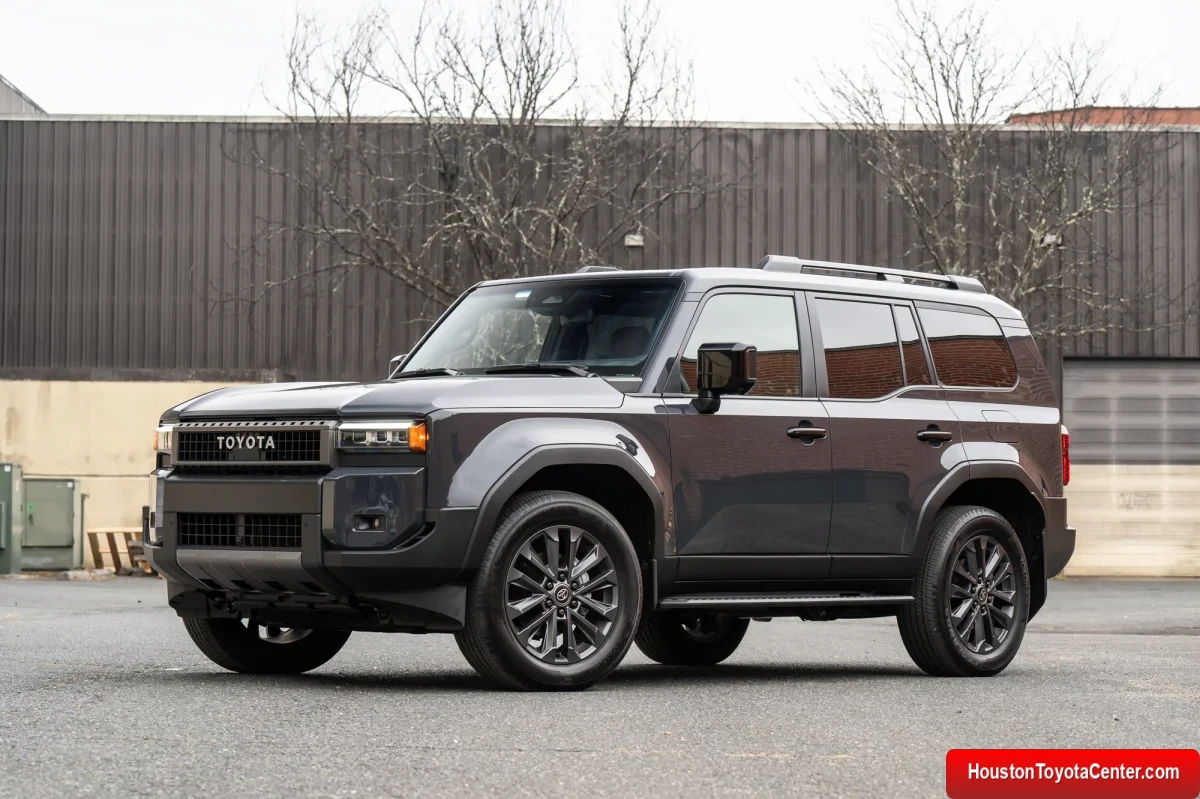
Toyota’s flagship SUV enters a new phase, combining decades of off-road heritage with electrification, advanced technology and a changing definition of luxury
For more than seven decades, the Toyota Land Cruiser has represented a very specific idea of the automobile: a vehicle designed to take people into difficult places and bring them back safely. Its reputation was not built primarily on luxury, speed or styling. It was built on reliability, durability and off-road capability.
The Land Cruiser 300 represents a significant evolution of that philosophy. Introduced in 2021 as the successor to the long-running 200 Series, the 300 Series was developed as the flagship of the Land Cruiser family. Toyota retained the traditional body-on-frame architecture while introducing a new platform, new powertrains and a more sophisticated approach to comfort, technology and driving performance.
Now, the Land Cruiser 300 is entering another important chapter.
In September 2026, Toyota announced a partial update for the Land Cruiser 300 in Japan, including the introduction of hybrid versions of the ZX and GR SPORT grades. The updated models are scheduled to go on sale on October 1, 2026. The announcement signals an important shift for a vehicle whose identity has historically been closely associated with conventional internal-combustion power.
FREE: Quickly identify and understand problems with your vehicle 🚘
CLICK HEREThis is not simply a story about adding a hybrid powertrain. It is about how Toyota is attempting to move one of its most recognizable vehicles into a new era without abandoning the principles that made the Land Cruiser a global icon.
A legacy built on going anywhere
The Land Cruiser story began in 1951, when Toyota introduced the four-wheel-drive Toyota BJ. From the beginning, the vehicle was developed around the ability to operate in demanding environments. Toyota’s own history describes reliability, durability and off-road performance as the fundamental elements of the Land Cruiser identity.
That philosophy survived as the Land Cruiser evolved through multiple generations. The model became increasingly comfortable and sophisticated, but Toyota repeatedly returned to the same fundamental objective: creating a vehicle capable of handling difficult terrain while remaining dependable for everyday use.
By the time the 300 Series arrived, the Land Cruiser had become much more than a utilitarian four-wheel-drive vehicle. It had developed into a global flagship, combining rugged engineering with high levels of comfort and technology.
Toyota says cumulative Land Cruiser sales had reached approximately 10.4 million units across more than 170 countries and regions when the 300 Series was introduced in 2021. More recent Toyota figures, released in connection with the broader Land Cruiser family, put cumulative sales at approximately 12.15 million units across more than 190 countries and regions.
Few vehicles have such a long connection between engineering reputation and global recognition.
The 300 Series changes the formula
When Toyota developed the Land Cruiser 300, the company faced a difficult engineering challenge. The vehicle had to evolve without losing the qualities that had defined previous generations.
The answer was the GA-F platform, developed under Toyota’s TNGA philosophy while retaining a frame-based architecture. According to Toyota, the new structure helped reduce weight, lower the center of gravity and improve driving performance while preserving the characteristics required for demanding off-road conditions.
The result was a Land Cruiser that looked familiar but was engineered around a considerably more modern technical foundation.
Under the hood, the 300 Series introduced new V6 twin-turbo engines. Depending on the market, Toyota offered a 3.5-liter gasoline V6 producing up to 305 kW, or 415 PS, and 650 Nm of torque, while the 3.3-liter diesel V6 produced up to 227 kW, or 309 PS, and 700 Nm. Both were paired with a 10-speed automatic transmission in the specifications presented by Toyota.
The decision to move away from the previous generation’s V8 engines was significant. Toyota’s engineering objective was not simply to increase output. The company sought to combine strong low-speed torque, improved drivability and greater efficiency with the durability expected from the Land Cruiser name.
That approach illustrates the central idea behind the 300 Series: modernization without abandoning its original purpose.
Technology designed for difficult terrain
Modern luxury SUVs often measure technological sophistication through screens, connectivity and automated features. The Land Cruiser takes a different approach.
Technology in the 300 Series is also designed to help the driver understand and control the vehicle when the road disappears.
Toyota introduced systems such as Multi-Terrain Select and Multi-Terrain Monitor. The former can help optimize vehicle behavior for different terrain conditions, while the latter uses cameras to provide the driver with a view of obstacles around the vehicle.
This philosophy reflects an important distinction between a luxury SUV and an off-road flagship. The Land Cruiser’s technology is not merely about adding features. It is intended to expand the driver’s ability to operate the vehicle in challenging environments.
The same principle can be seen in the design of the cabin.
Toyota retained a horizontal dashboard concept intended to help drivers understand the vehicle’s position when navigating difficult terrain. Controls are arranged around functionality and ease of operation, reflecting the idea that the driver should be able to concentrate on the road rather than search through complicated menus.
Design that respects its past
The Land Cruiser 300 does not attempt to reinvent the visual identity of the nameplate.
Instead, it evolves familiar elements.
The vehicle has a tall, commanding profile, a substantial front end and a body designed around its four-wheel-drive architecture. Its proportions communicate strength without relying entirely on aggressive styling.
That restraint is important because the Land Cruiser has accumulated a visual language of its own.
The design philosophy follows what Toyota describes as functional beauty. Exterior elements such as the position of the lights and the shape of the bumpers were developed with consideration for off-road use. The goal was to reduce the risk of damaging vulnerable components when the vehicle is operating on rough terrain.
This is a different interpretation of premium design.
Instead of hiding the vehicle’s mechanical purpose, the 300 Series makes that purpose part of its appearance.
Luxury takes a different meaning
The Land Cruiser 300 also demonstrates how the definition of luxury has changed.
In previous decades, luxury in a large SUV could be associated primarily with leather, wood trim, powerful engines and a quiet cabin. Today, buyers increasingly expect advanced driver assistance, digital interfaces, connectivity and sophisticated powertrain technology.
The Land Cruiser incorporates these expectations, but its version of luxury remains closely connected to capability.
The idea is simple: the vehicle should be comfortable on a highway, refined in an urban environment and capable of continuing when the pavement ends.
That combination helps explain why the Land Cruiser occupies a distinctive position in Toyota’s global portfolio.
The company describes the 300 Series as the flagship of the Land Cruiser lineup. Meanwhile, the 70 Series continues to represent the heavy-duty side of the family, while the 250 Series focuses on a different balance between practicality and everyday usability. Toyota’s introduction of the smaller Land Cruiser FJ in 2026 further expanded this family structure.
The result is no longer a single Land Cruiser concept. It is an ecosystem of vehicles built around the same fundamental philosophy.
The arrival of electrification
The most important development for the Land Cruiser 300 in 2026 may be the move toward hybrid technology.
Toyota announced in September that hybrid versions would be added to the Japanese Land Cruiser 300 lineup, initially for the ZX and GR SPORT grades. The announcement also includes other updates to the model.
For a vehicle whose identity has traditionally been linked to large internal-combustion engines, electrification represents a meaningful technological transition.
Yet hybridization does not necessarily mean abandoning the Land Cruiser formula.
Toyota has already demonstrated in other Land Cruiser models that electrification can be integrated with off-road capability. In the North American market, for example, the 2026 Land Cruiser uses a turbocharged i-FORCE MAX hybrid system producing 326 horsepower and 465 lb-ft of torque, combined with full-time four-wheel drive. Toyota also equips the model with off-road systems including locking differentials, Multi-Terrain Select and CRAWL Control.
The exact specifications and market availability of Land Cruiser 300 hybrid configurations vary by region, so the Japanese announcement should not automatically be interpreted as a global specification.
What is clear, however, is the direction of travel.
Electrification is becoming part of the Land Cruiser story.
A new era without abandoning the old one
The phrase “new era” can easily become a marketing cliché in the automotive industry. In the case of the Land Cruiser 300, however, there is a measurable transformation taking place.
The vehicle has moved from the 200 Series’ engineering architecture to the GA-F platform. It replaced traditional V8 powertrains with twin-turbo V6 engines in many markets. It introduced increasingly sophisticated off-road electronics. It expanded its technological and luxury credentials. And now, Toyota is bringing hybrid technology into the 300 Series itself.
At the same time, the fundamentals remain remarkably consistent.
The Land Cruiser is still built around a frame-based structure. It remains focused on four-wheel drive and difficult terrain. Its design continues to prioritize functionality. And Toyota continues to describe reliability, durability and off-road performance as central to the vehicle’s identity.
That continuity may be the most important part of its evolution.
The Land Cruiser does not need to become a completely different vehicle to enter the future. Instead, Toyota’s strategy appears to be one of gradual technological transformation while protecting the attributes that customers associate with the name.
The road ahead
The automotive industry is changing rapidly. Electrification, software, connectivity, emissions regulations and changing consumer expectations are reshaping the SUV market.
For a vehicle such as the Land Cruiser, the challenge is particularly complex.
Its customers may expect modern efficiency and technology, but they also expect the vehicle to perform in environments where reliability is not simply a matter of convenience. In remote areas, durability can be fundamental to the vehicle’s purpose.
That makes the Land Cruiser 300 an interesting case study in automotive evolution.
It represents an attempt to reconcile two seemingly different worlds: the mechanical heritage of a legendary off-roader and the technological demands of a new generation of vehicles.
The 300 Series began this process in 2021. The addition of hybrid technology in 2026 marks another step in that journey.
The Land Cruiser’s future, therefore, is unlikely to be defined by abandoning its past.
Instead, its next chapter may be about proving that a vehicle born from the age of mechanical four-wheel drive can adapt to an era increasingly shaped by electrification and digital technology.
The mission remains familiar: go where others cannot, carry people safely and return home.
The technology is changing.
The purpose is not.
Leave a Reply