
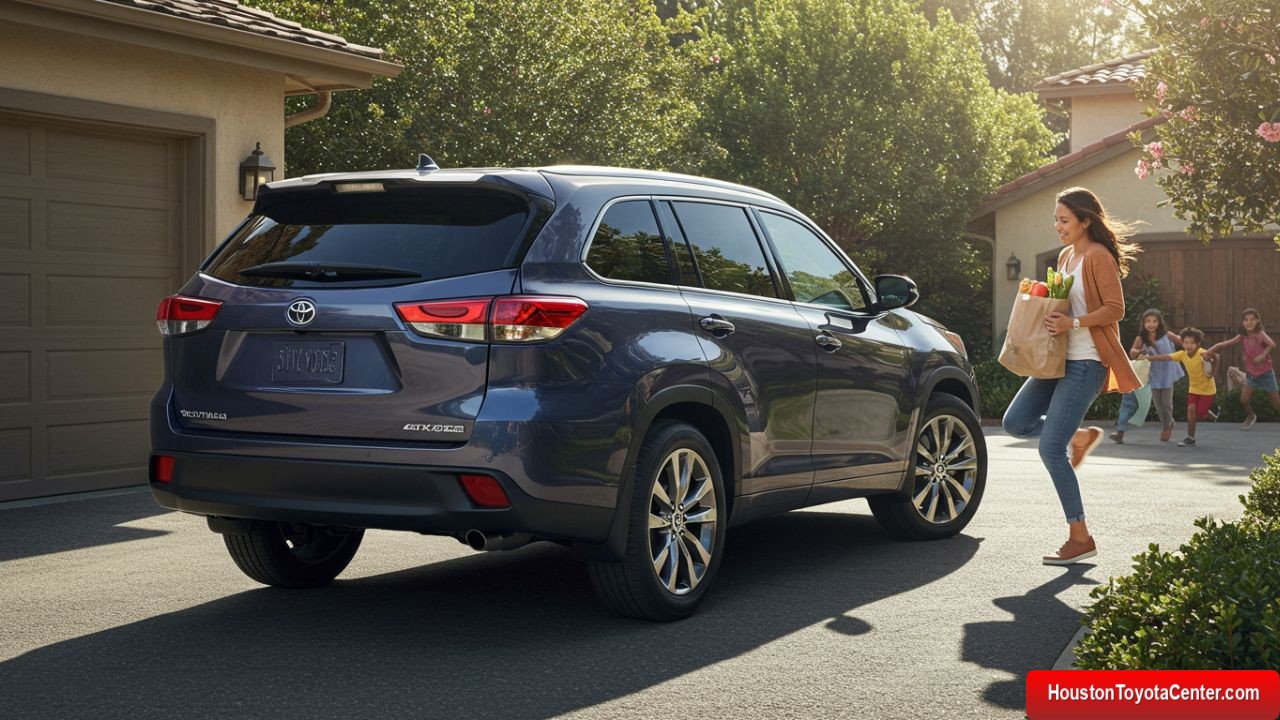
How Toyota’s midsize SUV helped redefine what families expected from an SUV:
When the Toyota Highlander appeared at the 2001 model year, the midsize SUV market looked very different from the one consumers know today. Sport utility vehicles were still strongly associated with truck-based engineering, rugged construction, and a driving experience that often prioritized capability over comfort. The idea of combining SUV practicality with the road manners of a passenger car was gaining momentum, but the formula had not yet become the dominant language of the family SUV.
The Highlander arrived at precisely that moment.
Rather than treating the SUV as a truck that had been adapted for family transportation, Toyota approached the concept from the opposite direction. The first-generation Highlander used a unibody architecture related to the Toyota Camry, combined with four-wheel independent suspension. The result was an SUV designed around the needs of everyday drivers rather than traditional truck-based expectations.
FREE: Quickly identify and understand problems with your vehicle 🚘
CLICK HEREThat distinction mattered.
The Highlander did not invent the crossover SUV. Models such as the Toyota RAV4 had already demonstrated that buyers could be attracted to vehicles that combined elevated seating and utility with car-based engineering. But the Highlander took that philosophy into the midsize family category and helped establish a formula that would become one of the most important recipes in the automotive industry.
The central idea was simple: an SUV did not have to feel like a truck to be useful.
A Different Kind of SUV
When the Highlander was first revealed at the New York International Auto Show in April 2000, Toyota was entering a category where body-on-frame construction remained common. The company positioned the new vehicle as its first major move into the midsize unibody SUV category.
The engineering philosophy was immediately apparent. Instead of relying on a traditional truck-derived chassis, the Highlander employed a unibody structure. This construction allowed Toyota to pursue a lower floor, efficient use of interior space, and a more controlled ride.
Contemporary testing reflected that difference. Car and Driver described the Highlander as a tall car wearing SUV clothing, emphasizing its connection to the passenger-car world rather than traditional truck architecture. The publication also noted the advantages of the unibody approach, including interior space, lower weight, and a more refined driving character.
For consumers, those engineering decisions translated into something more tangible: an SUV that could be used every day without requiring the compromises associated with many traditional sport utility vehicles.
It was spacious enough for a family. It offered the commanding seating position buyers wanted. It had available all-wheel drive. Yet it also aimed to deliver the comfort and predictable road behavior of a car.
That balance would become the Highlander’s defining characteristic.
The Family SUV Becomes the Main Event
The timing was important.
American consumers were increasingly embracing SUVs, but the definition of an SUV was changing. Buyers did not necessarily need a vehicle designed to conquer difficult trails. They wanted room for children, luggage, groceries, sports equipment and weekend trips. They wanted safety and visibility, but they also wanted comfort during a daily commute.
The Highlander was built around that reality.
Its proportions and packaging made it more approachable than many truck-based SUVs, while its styling retained enough visual toughness to satisfy customers attracted to the SUV image. Toyota had effectively separated the idea of SUV utility from the mechanical requirements of a truck.
That concept became increasingly important as the market evolved.
The Highlander was also designed to grow with its customers. Over successive generations, Toyota expanded its dimensions, improved its interior, increased seating capacity and introduced additional technology. The vehicle gradually moved from being a relatively compact alternative to traditional midsize SUVs into a fully developed three-row family vehicle.
By 2011, three-row seating and rear climate control had become standard equipment across the Highlander lineup.
The change reflected a broader transformation in consumer expectations. A midsize SUV was no longer simply expected to transport five people and their belongings. It increasingly needed to function as a family transportation system.
The Third Row Changed the Equation
Adding a third row was one of the most important developments in the Highlander’s evolution.
The third row changed what the vehicle could represent to a buyer. It was no longer simply an alternative to a sedan or wagon. It could serve as the family’s primary vehicle.
The third-generation Highlander, introduced for the 2014 model year, pushed this idea further. Toyota designed the vehicle to accommodate up to eight passengers while increasing cargo capacity and improving interior packaging. The company also focused on easier access to the third row, improved comfort and a quieter driving experience.
This was an important shift in the midsize SUV formula.
Instead of forcing consumers to choose between a large, truck-oriented SUV and a smaller crossover, vehicles like the Highlander occupied a new middle ground. They offered substantial passenger capacity without abandoning the comfort-oriented characteristics of a unibody vehicle.
The concept proved influential because it addressed a practical problem. Families often wanted three rows, but they did not necessarily want a massive vehicle.
The Highlander made the compromise more manageable.
Hybrid Power Arrives Early
Another chapter in the Highlander’s history began with electrification.
For the 2006 model year, Toyota introduced the Highlander Hybrid. According to Toyota, it was the brand’s first hybrid-powered SUV and followed the Prius as the second Toyota model to receive a hybrid powertrain.
The significance of that decision goes beyond a single model.
At a time when hybrid technology was still strongly associated with compact cars, Toyota demonstrated that electrification could be integrated into a midsize SUV without abandoning the vehicle’s fundamental purpose.
The Highlander Hybrid became an early example of a family SUV that could combine passenger capacity with improved fuel efficiency. Years later, hybrid powertrains would become increasingly common throughout the SUV market.
In retrospect, the decision looks like another example of Toyota anticipating where the category was heading.
The company was not simply making an SUV smaller or more comfortable. It was continually redefining what the SUV could be.
From Practical to Premium
As the generations progressed, the Highlander also changed visually.
The early model had a relatively simple, functional appearance. Later generations became more sculpted and sophisticated, reflecting the growing importance of design in the crossover market.
The third-generation Highlander, unveiled in 2013, introduced a more assertive exterior, a more refined cabin and additional technology. Toyota emphasized the balance between comfort, capability, performance and efficiency.
That evolution mirrored the market.
As crossovers became mainstream, buyers began expecting more than utility. They wanted quiet cabins, premium materials, advanced infotainment systems, driver-assistance technology and attractive styling.
The Highlander followed that trajectory without abandoning its original mission.
It remained a family-oriented vehicle, but the definition of family-oriented had expanded.
A modern family SUV could be practical and comfortable, but it could also be stylish, technologically sophisticated and increasingly efficient.
The 2020 Generation: Refining the Formula
The fourth-generation Highlander arrived for the 2020 model year, built on Toyota’s TNGA-K platform. Toyota described the redesign as a ground-up transformation that combined a stronger visual presence with improved comfort, safety and technology.
By this point, the market that the Highlander had helped shape was enormous.
Three-row crossovers had become a central part of the automotive landscape. Vehicles from multiple manufacturers were competing for buyers who wanted family practicality without the size and truck-like character of a traditional full-size SUV.
The Highlander’s formula had effectively become an industry template.
Unibody construction. Three rows. Comfortable road manners. Flexible cargo space. Available all-wheel drive. Hybrid technology. A growing collection of safety and driver-assistance features.
None of these elements existed in isolation. Their importance came from how they were combined.
The Highlander demonstrated that consumers could have many of the qualities they associated with an SUV without accepting all of the compromises traditionally associated with one.
More Than a Toyota Story
The Highlander’s influence is easier to understand when viewed as part of a broader change in automotive culture.
The SUV market moved away from a simple distinction between cars and trucks. Instead, manufacturers began creating vehicles around specific lifestyles and use cases.
Compact crossovers targeted urban drivers. Midsize crossovers targeted families. Larger three-row SUVs provided additional passenger and cargo capacity. Luxury brands adapted the same architecture for premium customers. Electrification eventually became another layer of the formula.
The Highlander occupied an important position in this transition because it arrived early enough to help establish the concept, then remained in the category long enough to evolve with it.
Toyota itself has described the original Highlander as having redefined the midsize family SUV and noted that its unibody architecture and independent suspension helped establish a new template for comfortable, family-friendly SUVs.
The company’s historical account also points to another important milestone: by 2016, the Highlander had become the best-selling retail model in its segment according to Toyota’s stated retail-sales measurement.
That achievement illustrates how far the concept had traveled.
What began as an alternative to truck-based SUVs had become a reference point for the family crossover category itself.
The Highlander Legacy
The most significant legacy of the Highlander may not be any single engine, feature or generation.
It is the idea behind the vehicle.
The Highlander helped demonstrate that an SUV could be designed primarily around the people inside it.
That sounds obvious today. At the beginning of the 2000s, it was not.
The vehicle challenged the assumption that family utility required truck-based engineering. It showed that a midsize SUV could prioritize ride comfort, interior flexibility and everyday drivability while retaining the proportions, seating position and visual character that consumers associated with an SUV.
Over time, the formula became almost universal.
Three-row crossovers became a mainstream choice for families. Hybrid SUVs moved from novelty to established alternatives. Advanced safety systems became increasingly common. Interior packaging became just as important as towing or off-road capability for many buyers.
The Highlander evolved alongside all of those changes.
And that may be the clearest explanation for its lasting relevance.
It did not remain successful by staying exactly the same. It remained relevant by adapting the original idea to a changing market.
A Quiet Revolution
Automotive history often celebrates dramatic vehicles. Performance icons. Off-road legends. Revolutionary sports cars. Cars that changed design or introduced entirely new technologies.
The Highlander represents a different kind of automotive influence.
Its revolution was quieter.
It was about making the SUV more compatible with everyday life.
It helped normalize the idea that a family vehicle could have three rows without feeling like a truck. It helped establish the midsize unibody SUV as a mainstream category. It helped bring hybrid technology into the SUV conversation at an early stage. And generation after generation, it refined the relationship between utility and comfort.
More than two decades after its introduction, Toyota is still evolving the Highlander concept. The fifth-generation 2027 Highlander represents another major transition, with Toyota introducing an all-electric, three-row version for the U.S. market. The new model is positioned as the brand’s first three-row battery-electric vehicle for American customers.
That development brings the story full circle.
The original Highlander challenged the conventional idea of what a midsize SUV needed to be. Its latest evolution is now addressing another question: what should a family SUV become in an electrified era?
The answer is still being written.
But the central philosophy remains recognizable.
A useful family vehicle does not have to choose between comfort and capability, practicality and refinement, or everyday usability and SUV character.
That was the Highlander’s original proposition.
And it is the reason the Highlander changed the segment.
Leave a Reply