
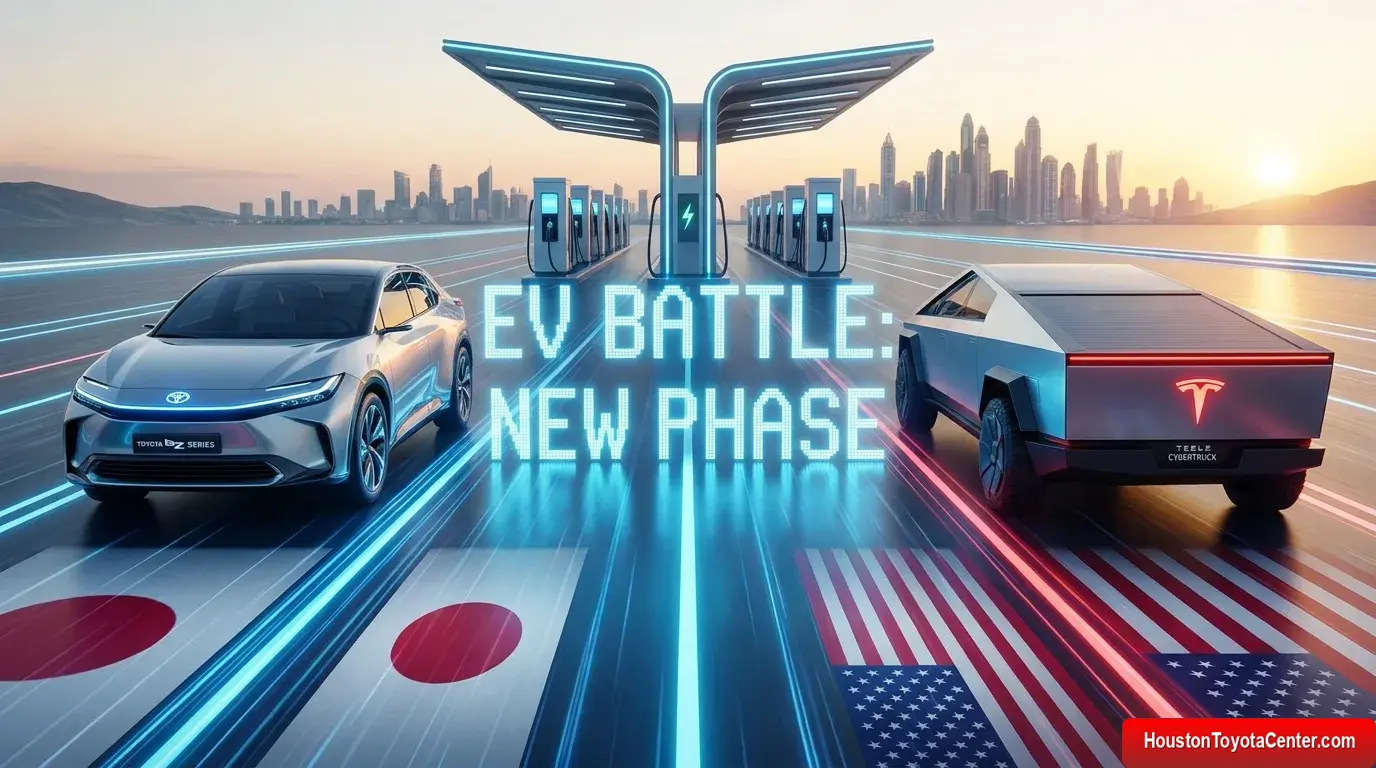
For years, Tesla has been the company most closely associated with electric cars. Toyota, meanwhile, built its reputation on hybrids and a cautious approach to battery-electric vehicles. In 2026, that contrast is becoming less clear.
Toyota is expanding its battery-electric lineup in the United States with the 2026 bZ, the bZ Woodland and the all-new C-HR. Tesla remains one of the world’s most established electric vehicle manufacturers, led by the Model 3 and Model Y. The result is a more interesting question for consumers: is Tesla still the obvious choice for an EV, or has Toyota finally become a serious alternative?
Tesla Still Has the Scale
Tesla’s biggest advantage is experience at scale.
The company delivered 1.64 million vehicles worldwide in 2025, including more than 1.58 million Model 3 and Model Y vehicles. Those two models accounted for the overwhelming majority of Tesla’s deliveries.
FREE: Quickly identify and understand problems with your vehicle 🚘
CLICK HEREThat scale gives Tesla a significant presence in the EV market. The company has also built its identity around electric vehicles rather than adapting an existing gasoline-focused business to electrification.
For drivers who want a familiar EV formula, Tesla continues to offer a straightforward proposition: long-range electric vehicles, a software-centered user experience and a charging ecosystem designed around road trips.
But Tesla’s dominance is no longer operating in a vacuum.
Toyota Is Changing Its EV Strategy
Toyota’s approach has traditionally been different. Rather than betting exclusively on battery-electric vehicles, the Japanese automaker has pursued a broad electrification strategy involving hybrids, plug-in hybrids, battery EVs and fuel-cell vehicles.
That strategy is now being extended with a larger BEV portfolio.
For 2026, Toyota’s U.S. lineup includes the bZ, bZ Woodland and C-HR. The company lists the bZ with up to 314 miles of estimated range, while the bZ Woodland offers up to 281 miles and the C-HR reaches up to 287 miles, depending on configuration.
The 2026 bZ is particularly important because it represents a substantial evolution from the model previously known as the bZ4X. Toyota says the updated vehicle benefits from a larger battery, improved range and charging upgrades, while adding a North American Charging Standard, or NACS, port.
That last detail matters. Access to widely available fast charging has become one of the most important factors in the everyday usability of an EV.
Toyota Is Playing to Its Strengths
Toyota does not appear to be trying to become another Tesla.
Instead, it is bringing its traditional strengths into the electric market: practicality, broad vehicle choice and a strong focus on everyday usability.
The bZ Woodland illustrates that strategy clearly. It combines all-electric power with standard all-wheel drive, 375 horsepower, 281 miles of estimated range and a towing capacity of up to 3,500 pounds.
The C-HR takes a different route. It is a compact electric crossover with standard dual-motor all-wheel drive, 338 horsepower and an EPA-estimated range of up to 287 miles. Toyota says it can accelerate from zero to 60 mph in approximately 4.9 seconds.
This is significant because Toyota is no longer presenting EVs as a single experiment. It is building a family of vehicles aimed at different types of drivers.
Tesla Still Has a Major Advantage
Toyota’s growing EV lineup does not erase Tesla’s head start.
Tesla has spent years refining its electric powertrains, vehicle software and charging strategy. Its Model 3 and Model Y remain the center of its business, with 2025 deliveries exceeding 1.58 million units for the two models combined.
Tesla’s biggest advantage may therefore be integration. The company developed its vehicles, software and charging ecosystem around electric mobility from the beginning.
Toyota, by comparison, is managing a much larger transition. It still sells hybrids, plug-in hybrids, gasoline-powered vehicles and other electrified technologies alongside its BEVs.
That creates flexibility, but it also makes Toyota’s EV strategy fundamentally different from Tesla’s.
The Real Competition Is Not Just Range
Range remains one of the easiest specifications to compare, but it is not necessarily the most important.
A buyer choosing between a Toyota EV and a Tesla is also comparing charging access, vehicle size, interior design, driving dynamics, software, dealer support, practicality and personal preferences about how an automaker approaches the transition to electric mobility.
Toyota’s latest EVs show that the company is closing some of the gap. The 2026 bZ, for example, offers up to 314 miles of estimated range, while the C-HR and bZ Woodland target buyers who want different combinations of performance, utility and style.
Tesla, meanwhile, continues to benefit from a highly recognizable EV product portfolio and years of experience selling electric vehicles at global scale.
Toyota vs. Tesla: Two Different Visions of the EV
The most interesting part of this competition is that Toyota and Tesla are not pursuing exactly the same vision.
Tesla’s identity is built around the idea that the automobile is becoming a software-driven electric platform.
Toyota’s strategy is broader. The company is treating electrification as one part of a larger transformation involving multiple powertrain technologies and different types of customers.
Neither strategy is guaranteed to win.
Tesla has the advantage of specialization and experience. Toyota has the advantage of manufacturing scale, a huge existing customer base and a diversified approach to electrification.
The question for the next few years is whether Toyota can turn its growing EV lineup into meaningful market share while Tesla continues to expand beyond its core models.
The Verdict
For consumers, the Toyota versus Tesla rivalry is becoming much more interesting.
Tesla remains the more established pure-play EV brand, with enormous experience in battery-electric vehicles and a delivery volume that Toyota’s BEV business has not yet approached.
Toyota, however, is no longer simply watching the EV revolution from the sidelines. Its 2026 lineup shows a more serious commitment to battery-electric vehicles, with multiple models covering mainstream, sporty and adventure-oriented segments.
The battle may ultimately come down to something bigger than which company makes the better electric car.
Tesla is betting on an electric-first future.
Toyota is betting that the future will offer more than one way to get there.
For drivers, that competition could be exactly what the EV market needs.
Leave a Reply