
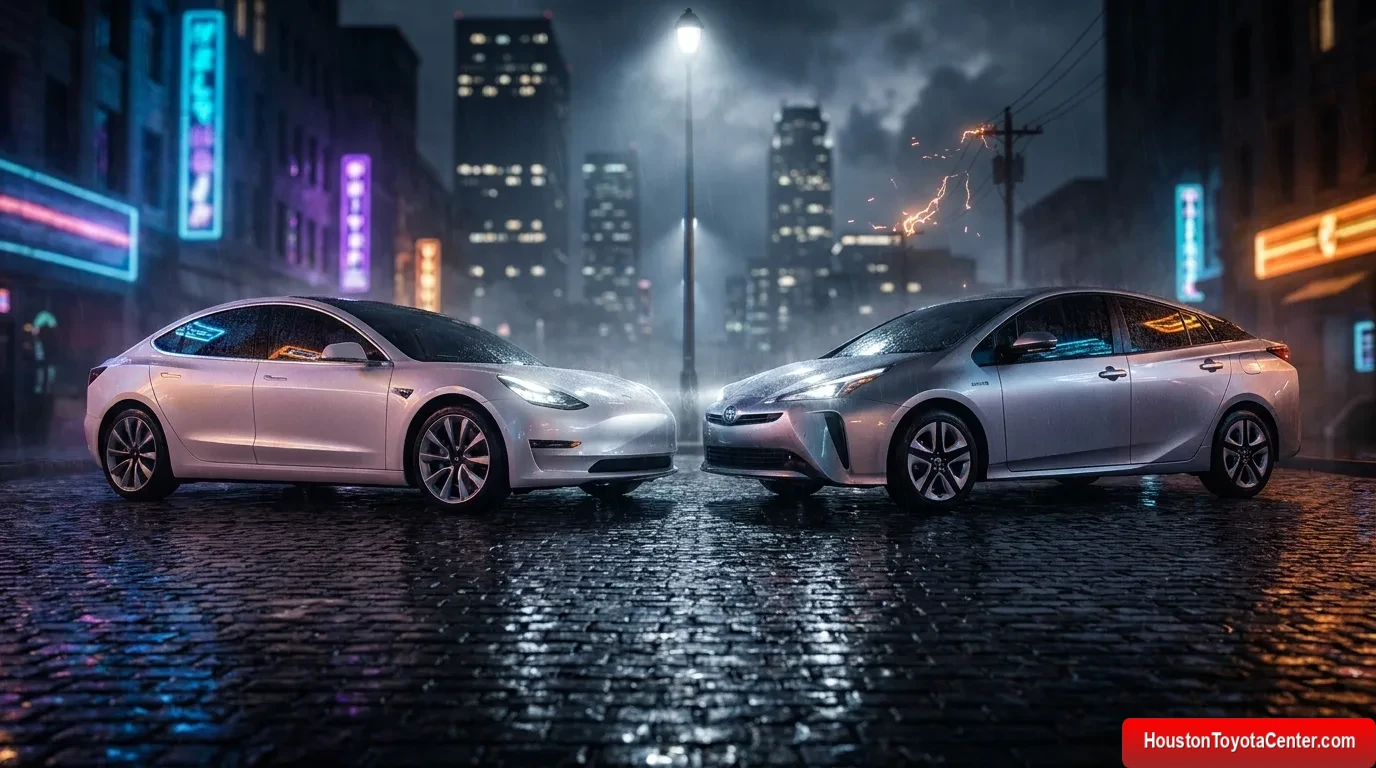
The automotive industry is in the middle of one of the biggest transformations in modern transportation history. For decades, fuel efficiency was the benchmark for environmentally conscious drivers. Then fully electric vehicles entered the mainstream conversation and completely shifted expectations around performance, technology, and long-term ownership costs.
Two vehicles often appear in the same buying conversation despite representing different philosophies: the Toyota Prius and the Tesla Model 3.
At first glance, comparing them might seem unfair. The Prius is a hybrid icon designed around practicality, reliability, and efficiency. The Tesla Model 3 is a fully electric sedan built around advanced software, high performance, and futuristic driving experiences. Yet many buyers still find themselves choosing between the two.
Why?
FREE: Quickly identify and understand problems with your vehicle 🚘
CLICK HEREBecause both vehicles appeal to people who want lower fuel costs, reduced environmental impact, modern technology, and smarter transportation choices.
The Prius attracts drivers who want simplicity, proven reliability, and freedom from charging anxiety. The Model 3 attracts drivers who want to leave gasoline behind entirely while gaining access to cutting-edge features and impressive acceleration.
The practical question becomes this:
Which car makes more sense for real-world daily life?
This comparison explores the differences between the Prius and the Tesla Model 3 across ownership costs, driving experience, maintenance, charging and fueling, reliability, comfort, road trips, resale value, environmental impact, and long-term practicality.
Rather than focusing only on specifications, this article examines how these vehicles fit into everyday life.
The Core Philosophy Behind Each Vehicle
Before comparing numbers and features, it helps to understand what each vehicle was designed to accomplish.
The Toyota Prius Philosophy
The Toyota Prius was created to solve one major problem: fuel efficiency.
When it first entered the market, the Prius became the symbol of hybrid transportation. Toyota focused on maximizing miles per gallon while maintaining the familiarity of a traditional gasoline-powered vehicle.
The Prius uses both a gasoline engine and an electric motor. The electric system supports the engine during low-speed driving and improves efficiency, while the gasoline engine eliminates the need for external charging.
Toyota engineered the Prius to minimize stress for the owner:
- Excellent fuel economy
- Minimal maintenance surprises
- Long-term reliability
- Practical interior space
- Low operating costs
- Familiar ownership experience
The Prius is less about excitement and more about consistency.
For millions of drivers, that approach works perfectly.
The Tesla Model 3 Philosophy
The Tesla Model 3 approaches transportation from the opposite direction.
Tesla’s mission was not simply improving gasoline efficiency. The company wanted to replace gasoline entirely.
The Model 3 is a fully electric vehicle powered entirely by battery packs and electric motors. There is no gasoline engine.
Tesla designed the Model 3 around:
- High efficiency through electrification
- Fast acceleration
- Software-driven ownership
- Advanced technology integration
- Autonomous driving development
- Minimalist interior design
- Continuous updates through software
The Model 3 feels less like a traditional car and more like a technology platform on wheels.
This difference in philosophy affects nearly every aspect of ownership.
Purchase Price and Financial Accessibility
For many buyers, the first practical question is cost.
Initial Pricing
The Prius generally has a lower starting price than the Tesla Model 3.
Although prices vary by trim level, region, incentives, and taxes, the Prius is usually positioned as a more affordable entry point.
The Tesla Model 3 often costs significantly more upfront.
However, the financial picture becomes more complicated when considering:
- Fuel savings
- Electricity costs
- Maintenance
- Tax incentives
- Insurance
- Resale value
Practical Buyer Profiles
Buyers More Likely to Prefer the Prius
- Budget-conscious households
- First-time hybrid owners
- Drivers without home charging access
- Long-distance commuters in rural areas
- Families prioritizing reliability over performance
Buyers More Likely to Prefer the Model 3
- Tech-focused consumers
- Drivers with home charging
- Urban and suburban owners
- People wanting to eliminate gasoline entirely
- Buyers comfortable with software-heavy vehicles
Financing Considerations
Tesla financing can sometimes be less flexible depending on local dealer networks and lender partnerships.
Toyota dealerships, by contrast, are widespread and often provide numerous financing and leasing options.
The Prius may also produce lower monthly insurance costs depending on region and driver history.
For buyers prioritizing predictable affordability, the Prius often wins the initial financial comparison.
Fuel Economy vs. Electricity Efficiency
One of the most important practical comparisons is operational efficiency.
Prius Fuel Efficiency
The Prius is famous for exceptional fuel economy.
Modern Prius models can achieve fuel efficiency numbers that dramatically outperform traditional gasoline vehicles.
Real-world owners frequently experience:
- Extremely low fuel consumption in city driving
- Strong efficiency during stop-and-go traffic
- Lower fuel expenses during long commutes
The hybrid system continuously switches between electric assistance and gasoline power.
The result is a vehicle that stretches every gallon remarkably far.
Tesla Model 3 Energy Efficiency
The Tesla Model 3 eliminates gasoline costs entirely.
Electricity is usually cheaper than gasoline on a per-mile basis.
Charging at home overnight can dramatically reduce transportation expenses.
The Model 3 is also highly efficient among electric vehicles due to:
- Aerodynamic design
- Efficient battery management
- Regenerative braking
- Advanced software optimization
For drivers with affordable electricity rates, the Model 3 can become significantly cheaper to operate than the Prius.
The Reality of Regional Differences
Practical efficiency depends heavily on local conditions.
Prius Advantages in Certain Regions
The Prius may be more practical where:
- Gasoline prices are moderate
- Charging infrastructure is weak
- Winters are severe
- Apartment charging is difficult
- Rural distances are long
Model 3 Advantages in Certain Regions
The Tesla becomes especially practical where:
- Electricity is inexpensive
- Public chargers are common
- Home charging is available
- Governments support EV ownership
- Traffic congestion rewards regenerative braking
Efficiency Comparison Table
| Category | Toyota Prius | Tesla Model 3 |
|---|---|---|
| Energy Source | Gasoline + Electric Hybrid | Fully Electric |
| Refueling Time | Minutes | Varies by charging speed |
| Daily Operating Cost | Low | Often lower |
| Home Energy Option | No | Yes |
| Long Road Trip Convenience | Excellent | Depends on charging network |
| Urban Efficiency | Excellent | Excellent |
| Rural Convenience | Strong | Can vary |
| Fuel Station Dependency | Yes | No |
Daily Driving Experience
The driving experience between these vehicles differs dramatically.
Prius Driving Characteristics
The Prius prioritizes comfort and efficiency.
The suspension is tuned for smooth commuting rather than sporty handling.
The steering is light and predictable.
Acceleration is adequate for daily driving but generally not exciting.
Drivers who appreciate calm, relaxed transportation often enjoy the Prius because it minimizes stress.
The cabin experience feels familiar to anyone who has driven a conventional car.
Tesla Model 3 Driving Characteristics
The Tesla Model 3 delivers a completely different experience.
Electric torque provides instant acceleration.
Even the standard versions feel quick compared to many gasoline vehicles.
The Model 3 also offers:
- Responsive steering
- Strong low-end acceleration
- Quiet cabin operation
- One-pedal driving capability
- Aggressive regenerative braking
For many first-time EV owners, the acceleration becomes addictive.
The vehicle feels technologically advanced in ways the Prius intentionally avoids.
Ride Comfort Comparison
Ride comfort depends on trim level and wheel size.
The Prius often provides a softer ride over rough roads.
The Tesla Model 3 may feel firmer, especially with larger wheels.
Some drivers prefer the more connected road feel of the Tesla.
Others prefer the relaxed nature of the Prius.
Noise Levels
The Model 3 is extremely quiet at lower speeds because there is no engine noise.
However, at highway speeds, tire and wind noise can become more noticeable.
The Prius benefits from years of refinement in reducing cabin noise, though engine sounds remain present during acceleration.
Interior Design and Cabin Philosophy
The interior experience reveals the biggest philosophical difference between the two vehicles.
Prius Interior Design
The Prius cabin focuses on functionality.
Toyota emphasizes:
- Physical controls
- Storage practicality
- Visibility
- Familiar layouts
- Everyday usability
The design may not feel futuristic, but many drivers appreciate its simplicity.
Buttons and knobs are intuitive.
Learning the vehicle takes very little time.
Tesla Model 3 Interior Design
The Tesla Model 3 takes a minimalist approach.
Most functions are controlled through a large central touchscreen.
The dashboard is intentionally sparse.
Traditional controls are reduced dramatically.
This creates a modern aesthetic but also changes how drivers interact with the vehicle.
Some people love the clean futuristic design.
Others dislike relying heavily on touchscreen menus for basic functions.
Material Quality
Toyota interiors are known for durability.
The Prius generally uses practical materials designed to age well.
Tesla interiors emphasize visual simplicity and modern styling.
Some owners praise the premium atmosphere.
Others criticize inconsistent build quality or material durability.
Passenger Space
Both vehicles provide comfortable seating for daily use.
The Prius often surprises people with practical cargo flexibility.
The hatchback design improves storage convenience.
The Model 3 offers strong passenger room and front trunk storage, but the traditional sedan trunk opening may reduce practicality for larger cargo.
Technology and Software
Technology is one of Tesla’s greatest strengths.
It is also one of the largest differences separating these vehicles.
Prius Technology Features
Toyota includes modern features such as:
- Driver assistance systems
- Adaptive cruise control
- Infotainment systems
- Smartphone connectivity
- Safety technologies
However, Toyota generally prioritizes reliability and simplicity over radical experimentation.
The software experience tends to be stable and predictable.
Tesla Technology Features
Tesla treats software as a central component of ownership.
Features include:
- Large touchscreen interface
- Over-the-air software updates
- Integrated navigation with charging support
- Advanced driver assistance systems
- App-based vehicle controls
- Real-time energy monitoring
- Entertainment features
Tesla vehicles can gain new features years after purchase through software updates.
This approach is rare in traditional automotive manufacturing.
Autopilot and Driver Assistance
Tesla’s Autopilot system remains one of the company’s biggest attractions.
The system can assist with:
- Highway lane keeping
- Adaptive cruise control
- Traffic-aware driving
- Parking assistance in some configurations
However, drivers must remain attentive.
Despite the advanced branding, the system does not make the car fully autonomous.
Toyota’s driver assistance systems are generally more conservative but highly dependable.
Long-Term Technology Concerns
Software-heavy ownership introduces new considerations.
Tesla owners may experience:
- Feature changes after updates
- Interface redesigns
- Connectivity dependencies
- Subscription feature discussions
The Prius avoids much of this complexity.
Some buyers see that simplicity as an advantage.
Maintenance and Reliability
Reliability is one of the strongest arguments in favor of the Prius.
Prius Reliability Reputation
Toyota has spent decades building a reputation for dependable vehicles.
The Prius specifically has become famous for:
- Long lifespan
- Durable hybrid systems
- Low maintenance costs
- Strong resale confidence
- Proven engineering
Many Prius vehicles remain on the road with extremely high mileage.
Owners often report years of trouble-free operation.
Tesla Reliability Reality
Tesla reliability discussions are more complicated.
The Model 3 has improved significantly since early production years.
Electric vehicles inherently eliminate many maintenance items associated with gasoline engines:
- Oil changes
- Spark plugs
- Exhaust systems
- Transmission servicing
However, Tesla has also faced criticism involving:
- Panel gaps
- Build consistency
- Service delays
- Parts availability
- Software glitches
Some owners report flawless experiences.
Others report frustrating service interactions.
Maintenance Cost Comparison
Prius Maintenance
Expected maintenance includes:
- Oil changes
- Brake service
- Tire replacement
- Engine maintenance
- Hybrid battery considerations over very long ownership
Tesla Model 3 Maintenance
Expected maintenance includes:
- Tire replacement
- Brake fluid checks
- Cabin filters
- Battery cooling system maintenance
- Tire wear from strong acceleration
In many cases, the Tesla requires less routine maintenance.
However, repair costs outside warranty can sometimes be expensive.
Service Network Differences
Toyota has one of the largest dealership and service networks in the world.
Finding qualified Prius service is usually easy.
Tesla’s service infrastructure continues expanding but remains less extensive in many regions.
This can become important after accidents or mechanical issues.
Charging vs. Refueling Convenience
This is one of the most practical ownership considerations.
Prius Refueling Experience
The Prius uses gasoline.
Refueling takes only a few minutes.
Gas stations are nearly everywhere.
Drivers rarely think about fuel logistics.
This convenience remains one of gasoline’s strongest advantages.
Tesla Charging Experience
Charging changes vehicle ownership behavior.
Most EV owners charge at home overnight.
Instead of visiting gas stations weekly, the vehicle begins each morning with a near-full battery.
For many people, this becomes incredibly convenient.
However, charging practicality depends heavily on living situation.
Home Charging Advantages
The Model 3 becomes much easier to own when drivers have:
- Private parking
- Garage access
- Dedicated charging installation
- Stable electricity pricing
Apartment residents may face more challenges.
Public Charging Reality
Tesla’s charging network remains one of the company’s greatest strengths.
The Supercharger network significantly improves long-distance travel practicality.
Still, charging requires more planning than gasoline refueling.
Winter and Charging
Cold weather affects EV range.
Heating systems and battery temperature management can reduce efficiency during winter.
The Prius experiences less dramatic range reduction because the gasoline engine compensates.
This makes the Prius particularly attractive in cold climates.
Long Road Trips
Road trip practicality remains a major decision point.
Prius Road Trip Experience
The Prius excels at long-distance travel.
Advantages include:
- Rapid refueling
- Excellent highway fuel economy
- Massive fuel station availability
- Predictable travel logistics
- Comfortable cruising
Drivers can cover large distances with minimal interruption.
Tesla Model 3 Road Trip Experience
Tesla road trips are very different.
The navigation system intelligently routes drivers through charging stations.
Charging stops become part of the travel experience.
Some drivers enjoy the slower, more deliberate pace.
Others find charging interruptions frustrating.
Charging Stop Psychology
A fascinating difference emerges during long travel.
Gasoline drivers typically stop only when necessary.
EV drivers often plan around charging opportunities.
This changes travel rhythm.
For some people, mandatory breaks improve comfort and reduce fatigue.
For others, they feel restrictive.
Rural Travel Concerns
The Prius generally provides greater flexibility in remote areas.
Gasoline availability is widespread.
EV infrastructure continues improving but remains inconsistent in certain rural regions.
This matters greatly for:
- Outdoor travelers
- Rural residents
- Frequent cross-country drivers
- Areas with limited charging infrastructure
Environmental Impact
Both vehicles aim to reduce environmental impact, but they approach the problem differently.
Prius Environmental Strategy
The Prius reduces gasoline consumption dramatically compared to conventional cars.
This lowers:
- Carbon emissions
- Fuel consumption
- Urban pollution
Toyota’s hybrid system allows drivers to reduce environmental impact without depending entirely on charging infrastructure.
Tesla Environmental Strategy
The Tesla Model 3 eliminates tailpipe emissions entirely.
However, environmental discussions around EVs are more nuanced.
Important considerations include:
- Battery production emissions
- Electricity generation sources
- Mining for battery materials
- Long-term battery recycling
Despite these concerns, EVs often produce lower lifetime emissions overall, especially in regions with cleaner electrical grids.
Manufacturing Impact
Battery manufacturing requires substantial resources.
Hybrid batteries in the Prius are smaller than full EV battery packs.
Tesla batteries are larger and more resource-intensive.
However, Tesla’s larger battery enables complete elimination of gasoline usage.
Urban Air Quality
The Model 3 contributes no direct tailpipe pollution in cities.
This can significantly improve local air quality.
The Prius still burns gasoline, though far more efficiently than traditional vehicles.
Insurance Costs
Insurance is often overlooked during vehicle comparisons.
Prius Insurance Trends
The Prius frequently benefits from:
- Lower repair complexity
- Established parts availability
- Predictable repair costs
- Broad insurance familiarity
As a result, insurance rates are often moderate.
Tesla Insurance Trends
Tesla insurance can be more expensive.
Reasons may include:
- Expensive battery systems
- Specialized repairs
- Sensor calibration costs
- Higher vehicle values
- Limited repair networks in some regions
Insurance experiences vary heavily by location and driver history.
However, buyers should absolutely compare quotes before making a decision.
Resale Value and Depreciation
Both vehicles can perform strongly in resale markets, though for different reasons.
Prius Resale Strength
The Prius benefits from:
- Toyota reliability reputation
- Fuel economy demand
- Long-term consumer trust
- Affordable ownership appeal
Used Prius models often maintain impressive value over time.
Tesla Resale Complexity
Tesla resale value can fluctuate more dramatically.
Factors include:
- Rapid software evolution
- New battery improvements
- Price cuts on new vehicles
- EV market competition
- Changing tax incentives
Still, demand for Tesla vehicles remains strong in many markets.
Battery Degradation Concerns
Battery longevity affects both vehicles.
The Prius hybrid battery is smaller and generally proven reliable over long periods.
Tesla batteries also show impressive durability, but replacement costs remain a concern for some buyers.
Modern EV battery degradation is usually slower than many early critics predicted.
Safety Comparison
Safety is another area where both vehicles perform well.
Prius Safety
Toyota consistently emphasizes safety engineering.
The Prius includes:
- Collision avoidance systems
- Lane assistance
- Adaptive cruise control
- Strong crash performance
The vehicle’s predictable handling characteristics also contribute to safety.
Tesla Safety
Tesla places heavy emphasis on structural safety.
The low battery placement creates a low center of gravity, reducing rollover risk.
The Model 3 has received strong crash-test performance in multiple markets.
Tesla also aggressively develops active safety software.
Driver Attention Debate
One ongoing debate involves advanced driver assistance systems.
Some critics argue that highly automated features may encourage driver complacency.
Others believe they reduce accidents significantly.
This remains one of the most controversial areas in modern automotive technology.
Which Vehicle Fits Different Lifestyles?
The practical winner depends heavily on the driver.
The Prius Is Often Better For:
Long-Distance Commuters
Especially those covering huge mileage in regions with limited charging infrastructure.
Apartment Residents
Without reliable charging access.
Buyers Prioritizing Reliability
Toyota’s reputation remains extremely strong.
Budget-Conscious Drivers
Lower purchase costs and insurance can matter greatly.
Rural Drivers
Gasoline convenience still matters in remote areas.
The Tesla Model 3 Is Often Better For:
Homeowners With Charging Access
This transforms daily convenience.
Technology Enthusiasts
Tesla ownership feels software-driven and futuristic.
Drivers Wanting Full Electrification
No gasoline required.
Urban Drivers
Charging infrastructure and regenerative braking excel in cities.
Performance-Oriented Buyers
The acceleration difference is dramatic.
Ownership Stress and Simplicity
An underrated factor in vehicle ownership is mental simplicity.
Prius Simplicity
The Prius is highly predictable.
Drivers understand how it works.
Maintenance systems are familiar.
Fueling is easy.
Repair infrastructure is widespread.
For many people, this predictability reduces stress.
Tesla Ownership Psychology
Tesla ownership can feel exciting and modern.
However, it may also introduce:
- Charging planning
- Software learning curves
- Update-related changes
- Service center concerns
- Range monitoring during trips
Some owners love these aspects.
Others eventually prefer simpler transportation.
The Emotional Side of Ownership
Cars are not purely rational purchases.
Emotion matters.
Prius Emotional Appeal
The Prius appeals to practicality.
Owners often appreciate:
- Smart financial decisions
- Environmental responsibility
- Dependability
- Efficiency mastery
The Prius represents disciplined practicality.
Tesla Emotional Appeal
The Tesla Model 3 creates excitement.
Owners frequently describe:
- Futuristic experiences
- Enjoyment of acceleration
- Technology fascination
- Pride in electrification
- Software innovation excitement
Tesla ownership often feels emotionally engaging in ways traditional vehicles rarely achieve.
Real-World Cost of Ownership
Long-term ownership costs involve many variables.
Prius Cost Factors
Potential costs include:
- Gasoline
- Oil changes
- Engine maintenance
- Hybrid system servicing
- Routine repairs
However, Toyota reliability often minimizes surprise expenses.
Tesla Cost Factors
Potential costs include:
- Home charger installation
- Tire wear
- Insurance
- Electricity
- Potential out-of-warranty repairs
Routine maintenance is lower, but major repairs can be expensive.
Five-Year Ownership Thinking
For many owners:
- The Prius delivers predictability.
- The Tesla delivers lower energy costs and advanced experiences.
The financially superior option depends heavily on:
- Electricity prices
- Gasoline prices
- Insurance rates
- Local incentives
- Mileage driven annually
Cultural Perception and Brand Identity
Both vehicles carry strong cultural identities.
Prius Identity
The Prius became associated with:
- Eco-conscious driving
- Practicality
- Rational decision-making
- Conservative efficiency
Some buyers appreciate the understated image.
Others find it less emotionally exciting.
Tesla Identity
Tesla developed a reputation for:
- Innovation
- Disruption
- Technology leadership
- High performance EVs
- Futuristic branding
For some buyers, the brand itself becomes part of the appeal.
Reliability Over 10 Years
Long-term ownership creates one of the most interesting comparisons.
Prius Longevity
The Prius has a long track record.
Many examples exceed extremely high mileage with proper maintenance.
Toyota’s reputation for longevity is difficult to match.
Tesla Long-Term Questions
Tesla vehicles are still relatively young compared to decades of Prius ownership data.
Battery durability appears promising.
However, long-term repair ecosystems continue evolving.
Questions remain regarding:
- Aging electronics
- Software support longevity
- Battery replacement economics
- Independent repair access
The Prius currently benefits from greater long-term predictability.
Charging Infrastructure Expansion
One major variable influencing future practicality is infrastructure growth.
EV charging networks continue expanding rapidly.
As charging becomes more common:
- Apartment charging may improve
- Rural charging gaps may shrink
- Public charging reliability may improve
- Fast charging times may decrease
This could gradually eliminate some advantages currently held by hybrids like the Prius.
However, infrastructure development varies dramatically by country and region.
The Hybrid Middle Ground
One reason the Prius remains relevant is because it represents a middle ground.
Many buyers are interested in reducing fuel usage but are not ready to commit fully to electric ownership.
The Prius solves many concerns simultaneously:
- No charging anxiety
- Lower fuel costs
- Proven reliability
- Familiar ownership
- Reduced emissions
For transitional buyers, hybrids remain highly attractive.
The Future of Both Vehicles
The future automotive landscape may eventually favor full electrification.
Governments worldwide increasingly support EV adoption.
Charging networks continue expanding.
Battery technology continues improving.
However, hybrids may remain important for decades in regions where:
- Charging infrastructure develops slowly
- Electricity access is inconsistent
- Rural travel distances are large
- Consumers prioritize affordability
The Prius and Model 3 therefore represent two different stages of automotive evolution.
Final Verdict: Which One Is More Practical?
The answer depends entirely on the driver’s lifestyle.
The Toyota Prius remains one of the most practical vehicles ever created.
It is efficient, reliable, easy to maintain, simple to fuel, and financially predictable.
For drivers wanting low-stress ownership with exceptional fuel economy, the Prius continues to make enormous sense.
The Tesla Model 3 represents a different kind of practicality.
For drivers with home charging access and strong EV infrastructure, it can dramatically reduce fuel expenses while delivering superior performance, advanced software features, and a modern driving experience.
The Model 3 feels like transportation designed for the future.
The Prius feels like transportation optimized for dependable everyday life.
Neither approach is universally better.
Instead, they reveal two competing visions of practical transportation.
The Prius says:
“Improve the familiar.”
The Tesla Model 3 says:
“Replace the familiar.”
For some drivers, practicality means avoiding complexity.
For others, practicality means embracing technological change.
That is why this comparison remains so compelling.
Both vehicles succeed brilliantly at what they were designed to accomplish.
The challenge is determining which philosophy fits your life better.
Leave a Reply