
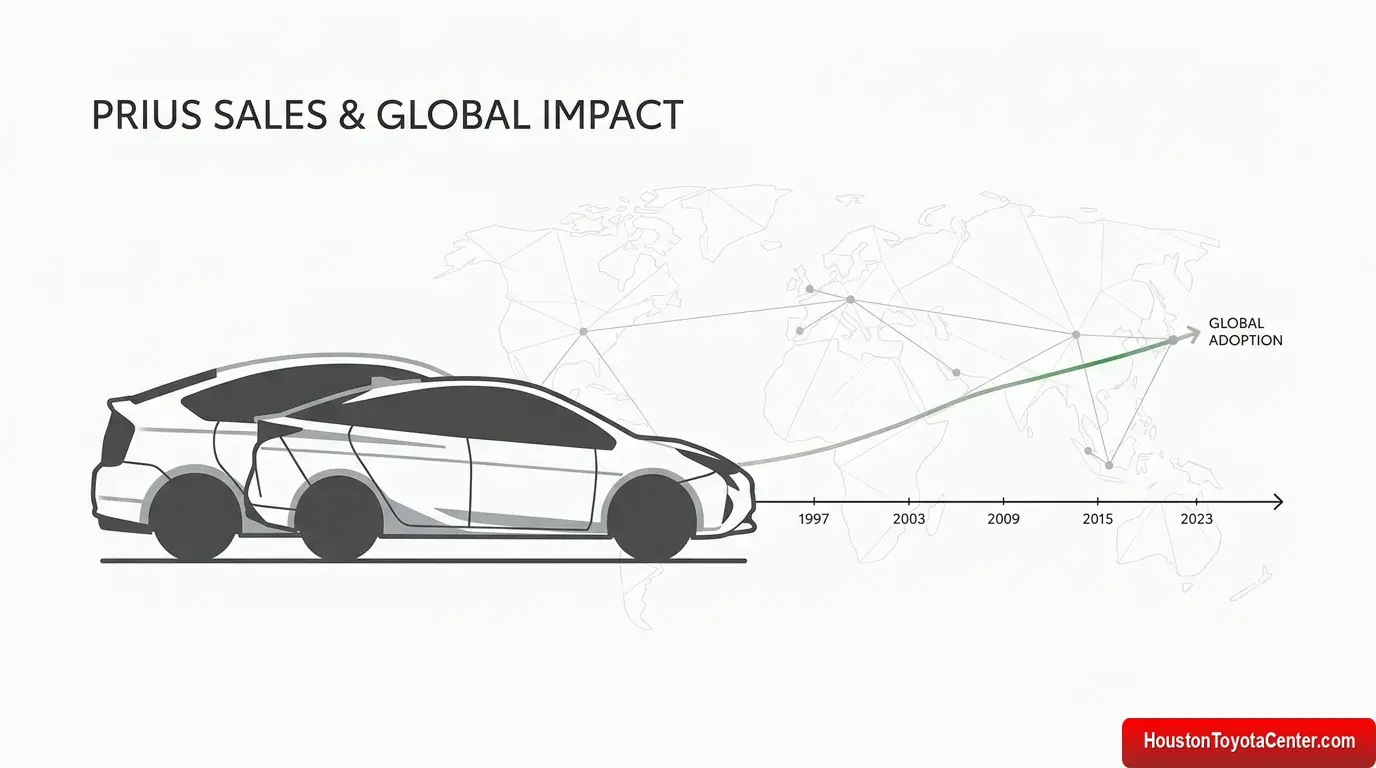
When the Toyota Prius arrived in Japan in 1997, it entered a market dominated by conventional gasoline-powered cars. Its proposition was simple but unconventional for the time: combine a gasoline engine with an electric motor to reduce fuel consumption without requiring drivers to change the way they used a car.
Nearly three decades later, the Prius has become more than a successful automobile model. It has become a reference point in the history of automotive electrification, a symbol of hybrid technology, and one of the vehicles most closely associated with the transition toward lower-emission transportation.
Toyota describes the Prius, whose name comes from the Latin word meaning “to go before,” as the world’s first mass-produced hybrid car. By September 2022, cumulative global sales had reached approximately 5.05 million units. Toyota also estimated that Prius and Prius Plug-in Hybrid sales had generated a cumulative reduction equivalent to more than 82 million tons of CO2 by March 2022.
The story behind those numbers is one of gradual adoption, technological improvement, changing consumer attitudes and a profound transformation in the automotive industry.
FREE: Quickly identify and understand problems with your vehicle 🚘
CLICK HEREThe Beginning of a New Automotive Era
The first-generation Prius was launched in Japan in December 1997. At a time when electric vehicles were still far from mainstream and fuel efficiency was rarely the central theme of automobile marketing, Toyota positioned the Prius as a new kind of vehicle.
Its hybrid system combined an internal combustion engine with an electric motor and battery. Instead of asking consumers to abandon gasoline entirely, the technology offered a middle path. Drivers could continue refueling at conventional gas stations while benefiting from electric assistance and regenerative braking.
That approach proved important because it addressed one of the biggest obstacles facing emerging automotive technologies: infrastructure.
A fully electric vehicle required a new ecosystem of charging infrastructure and raised concerns about driving range. The Prius did not require either. It could operate within the familiar gasoline-based transportation system while using electric propulsion to improve efficiency.
The concept gradually moved from technological experiment to commercial product.
The second-generation Prius, introduced in the early 2000s, gave the model its now-famous aerodynamic, wedge-shaped silhouette. Toyota also introduced an evolved version of its Hybrid Synergy Drive system, improving efficiency while making the technology more practical for everyday drivers.
The third generation followed with a larger 1.8-liter engine and further improvements to the hybrid system. The fourth generation later adopted Toyota’s New Global Architecture platform, bringing additional changes to efficiency, driving characteristics and vehicle engineering.
Each generation therefore represented more than a new model year. It represented another stage in the normalization of hybrid technology.
From Niche Product to Global Success
The Prius initially faced a significant challenge: convincing consumers to pay attention to fuel economy and environmental performance when conventional vehicles were already familiar, affordable and widely available.
Sales gradually changed that equation.
Toyota’s historical data show how quickly its hybrid business expanded during the 2000s. Toyota reported cumulative sales of more than 2 million hybrid vehicles by 2009, with the Prius accounting for a substantial share of those early sales. By the end of 2012, Toyota’s cumulative global hybrid sales had exceeded 4 million units.
The Prius was particularly successful in markets where fuel efficiency, urban driving and environmental considerations carried significant weight.
Japan became the model’s home market, but North America emerged as another critical region. By January 2017, Toyota reported cumulative Prius sales of approximately 3.98 million units worldwide. Of those, about 1.81 million had been sold in Japan and approximately 1.75 million in North America. Europe accounted for roughly 299,000 units at that point.
Those figures reveal an important feature of the Prius story. The car did not remain a Japanese technological curiosity. It became a genuinely international product.
North America, in particular, helped transform the Prius into a cultural phenomenon. Its distinctive design and association with fuel efficiency made it highly recognizable, while its presence among environmentally conscious consumers, technology professionals and urban drivers reinforced its image as a symbol of a changing automotive culture.
The Prius and the Expansion of Hybrid Technology
The Prius’s most important contribution may not be the number of vehicles sold under its own name.
Its larger influence can be seen in the expansion of hybrid technology throughout Toyota’s product range and across the automotive industry.
Toyota’s own historical data demonstrate the evolution. In 2017, Prius sales had already approached 4 million units, while Toyota was selling hybrid versions of numerous other models, including the Camry, RAV4, Yaris and Corolla.
The Prius effectively helped prove that hybrid propulsion could move from an experimental concept into mass-market transportation.
Toyota later stated that, since the first-generation Prius was introduced, the company had sold more than 20 million hybrid vehicles globally and estimated that those hybrids had reduced CO2 emissions by approximately 162 million tons.
This distinction matters.
A car can be commercially successful without changing its industry. The Prius did something broader. It helped establish the idea that electrified propulsion could be integrated into ordinary passenger vehicles at enormous scale.
The result was a gradual expansion of hybrid systems into sedans, compact cars, SUVs, minivans and commercial vehicles.
Toyota itself eventually acknowledged that hybrid technology had spread so widely that the Prius’s original role as the company’s primary hybrid technology ambassador had reached a new stage.
Environmental Impact
The environmental case for the Prius has always been central to its identity.
Unlike a conventional gasoline vehicle, a hybrid can recover energy during braking and use an electric motor to assist the engine. The result can be lower fuel consumption and lower tailpipe emissions under many driving conditions.
Toyota estimates that the global Prius fleet produced an emissions reduction equivalent to more than 82 million tons of CO2 by March 2022, based on approximately 4.99 million Prius and Prius Plug-in Hybrid vehicles sold by that date.
That figure should be understood as a manufacturer calculation rather than an independent lifecycle assessment. It is based on Toyota’s methodology and assumptions concerning vehicle use and comparison with conventional vehicles.
Even with that qualification, the scale is significant.
Five million vehicles represent millions of individual purchasing decisions made over more than two decades. Each vehicle remained on the road for years, meaning the environmental effect was not concentrated at the moment of purchase. Fuel consumption, driving patterns and vehicle lifespan all contributed to the cumulative result.
The Prius also demonstrated an important principle in environmental technology: impact can come from improving an existing system rather than replacing it completely.
Instead of waiting for charging infrastructure and battery technology to become sufficiently mature for mass-market electric vehicles, hybrid technology reduced fuel consumption using components that could be incorporated into the existing transportation system.
A Bridge Between Gasoline and Electric Vehicles
The Prius occupies an unusual position in automotive history because it sits between two eras.
The first era was dominated by internal combustion engines. The emerging era is increasingly defined by battery-electric vehicles, plug-in hybrids and other forms of electrification.
The Prius helped establish the bridge between them.
Toyota’s 2025 Integrated Report describes the global 2024 market for hybrid electric vehicles at approximately 12 million units and the plug-in hybrid market at approximately 6 million units. The company continues to position hybrids as a technology capable of reducing fuel consumption without requiring new charging infrastructure.
That strategy illustrates why hybrid technology remained relevant even as battery-electric vehicles gained attention.
A battery-electric vehicle eliminates tailpipe emissions during operation, but it requires charging infrastructure and depends on battery capacity and electricity availability. A conventional hybrid, by contrast, can operate without external charging while still using electrification to improve efficiency.
The Prius helped make that compromise familiar to millions of drivers.
The Fifth Generation and a New Identity
By the time Toyota unveiled the fifth-generation Prius in 2022, the automotive market had changed dramatically.
Electric vehicles had become increasingly visible. Battery costs had fallen substantially compared with the early 2000s. Governments were introducing stricter emissions regulations, while consumers were becoming more familiar with electrified transportation.
The Prius therefore faced a different problem from the one it confronted in 1997.
Originally, the challenge was to convince consumers that a hybrid vehicle made sense.
By the 2020s, the challenge was to demonstrate why a hybrid still mattered in a market increasingly interested in fully electric vehicles.
Toyota responded by giving the fifth-generation Prius a more dynamic exterior design and emphasizing performance alongside efficiency. The new generation was presented under the concept of “Hybrid Reborn,” reflecting an attempt to redefine the Prius for a new automotive environment.
This transformation is significant because it reflects how the meaning of the Prius has changed.
The early Prius was marketed primarily as an environmental technology statement. Later versions increasingly had to function as desirable cars in their own right.
That shift suggests that electrification was moving from a niche characteristic to a baseline expectation.
Sales History as a Measure of Cultural Change
The Prius sales curve tells a broader story about consumer behavior.
Early adoption was relatively modest. As technology improved and awareness increased, sales expanded rapidly. By the 2010s, the Prius had become one of the world’s best-known hybrid nameplates.
Its cumulative sales surpassed 5 million units in the early 2020s. Toyota’s official figure of approximately 5.05 million global Prius sales by September 2022 marks a remarkable trajectory from the original 1997 launch.
The model’s importance, however, cannot be measured only by its final sales total.
The Prius also influenced the expectations consumers brought into dealerships. Fuel economy became a more visible purchasing criterion. Hybrid technology became less exotic. Automakers increasingly developed electrified versions of mainstream vehicles rather than treating electrification as an isolated experiment.
In that sense, the Prius helped change the definition of an ordinary automobile.
Global Impact Beyond Toyota
The Prius’s influence extended beyond Toyota.
Once consumers demonstrated that they were willing to purchase hybrid vehicles in significant numbers, other manufacturers had stronger incentives to develop their own electrified drivetrains.
The competitive landscape eventually expanded to include conventional hybrids, plug-in hybrids, mild hybrids and battery-electric vehicles.
The Prius did not create every one of these technologies, nor did it single-handedly cause the automotive industry’s transition. The shift also depended on advances in batteries, electronics, regulations, fuel prices, government incentives and consumer preferences.
Nevertheless, the Prius provided an important commercial demonstration.
It showed that electrification could be packaged into a vehicle that ordinary consumers could buy, drive and maintain within the existing transportation ecosystem.
That may be its most enduring contribution.
A Complicated Legacy
The Prius is sometimes portrayed as either a perfect environmental solution or an outdated technology. Both descriptions are too simplistic.
Hybrid vehicles still rely on internal combustion engines and liquid fuels. Their batteries and electronic components require materials and manufacturing energy. Their environmental performance therefore cannot be understood solely through tailpipe emissions.
At the same time, dismissing the Prius because battery-electric vehicles have become more advanced overlooks the historical role the model played.
The transition to cleaner transportation does not happen through a single technology introduced at a single moment. It happens through successive improvements that gradually change consumer expectations, industrial capabilities and infrastructure.
The Prius was one of those pivotal technologies.
Its significance lies partly in timing. It arrived before the current electric-vehicle boom, at a moment when the idea of combining gasoline and electric propulsion at mass-market scale was still unfamiliar.
The Prius Legacy
Almost thirty years after its debut, the Prius occupies a unique place in automotive history.
It began as a technological gamble in Japan and became a global nameplate. It surpassed 5 million cumulative sales, helped popularize hybrid propulsion and became closely associated with fuel efficiency and environmental awareness. Toyota’s broader hybrid fleet subsequently reached tens of millions of vehicles, illustrating how a technology introduced through one model could spread throughout an entire product portfolio.
The significance of the Prius is therefore larger than its sales chart.
Its history represents a transition from the conventional automobile toward electrified mobility. It demonstrated that consumers could accept a vehicle whose defining technology was designed not simply to produce more power, but to use less fuel.
As the global automotive industry moves further toward battery-electric vehicles and other low-carbon technologies, the Prius may eventually be remembered less as the destination and more as the bridge.
Its greatest achievement was not necessarily being the final answer to automotive emissions.
It was proving that the future of the automobile could be different from its past.
Leave a Reply