
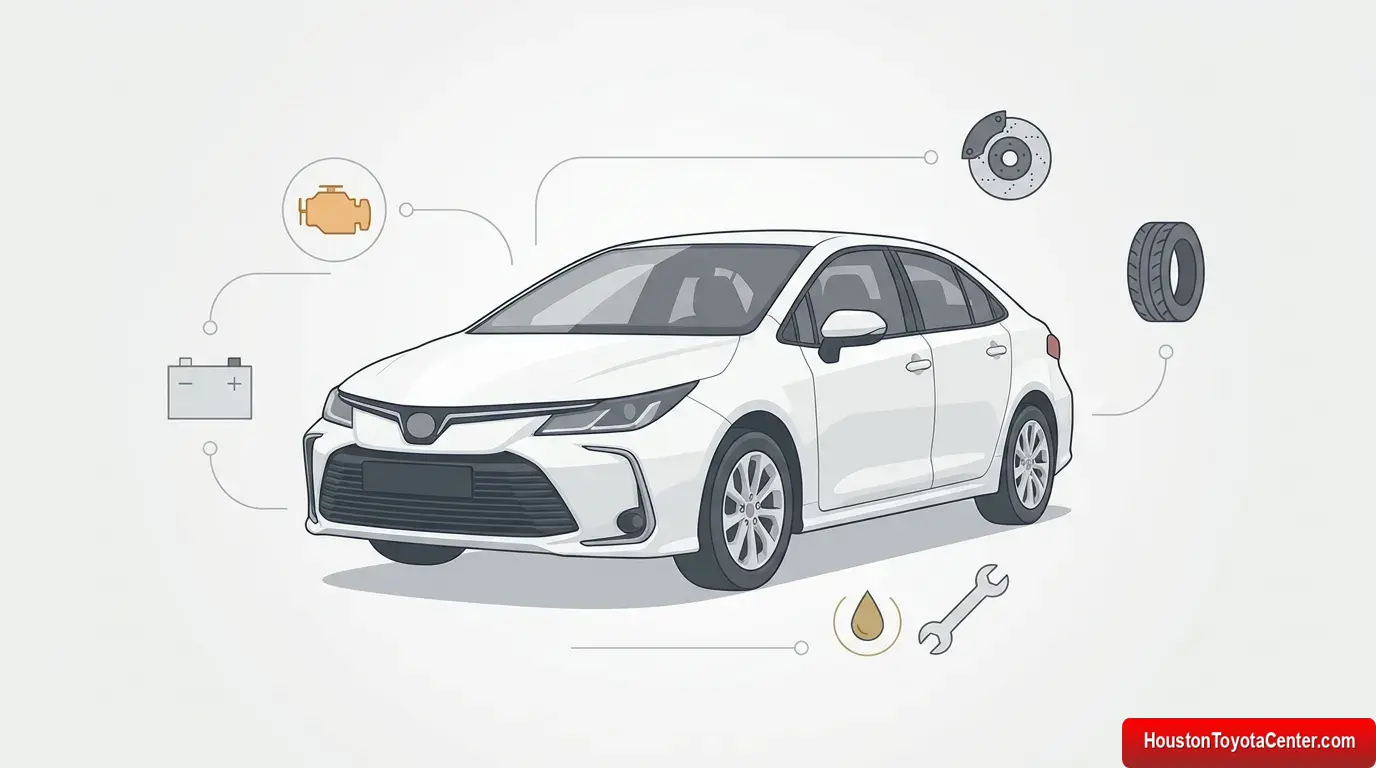
The Toyota Corolla has built a reputation for reliability, practicality, and relatively low ownership costs. For decades, it has been one of the most familiar names in the automotive market, appealing to drivers who want dependable transportation without unnecessary complexity. But even one of the world’s best-known reliable cars can develop problems.
A Corolla is not immune to mechanical wear, electrical faults, maintenance oversights, or age-related failures. The specific problems can vary considerably depending on the model year, engine, transmission, mileage, climate, and maintenance history. Some issues are inexpensive and straightforward to address, while others can become costly if ignored.
The good news is that many common Corolla problems provide warning signs before they become major failures. Knowing what to look for can help owners diagnose symptoms earlier, choose the right repair, and avoid unnecessary expenses.
Here are some of the most common Toyota Corolla issues and what owners should know about fixing them.
FREE: Quickly identify and understand problems with your vehicle 🚘
CLICK HERE1. Battery and Starting Problems
One of the simplest reasons a Corolla may refuse to start is also one of the most common: a weak or failing battery.
A battery nearing the end of its service life can cause slow engine cranking, clicking sounds when the ignition is turned, dim interior lights, or intermittent starting problems. Modern Corollas also rely on numerous electronic systems, so low battery voltage can sometimes produce unusual warning lights or electronic behavior.
How to fix it
Start by checking the battery terminals. Corrosion, loose connections, or damaged cables can interfere with the electrical connection. If the battery itself is old or cannot hold a proper charge, replacement may be necessary.
It is also important to check the charging system. A new battery will not solve the problem for long if the alternator or another part of the charging system is failing.
For drivers experiencing repeated dead batteries, the best approach is to have the entire starting and charging system tested rather than simply replacing the battery.
2. Oil Consumption and Oil Leaks
Engine oil is essential for protecting internal components from friction and excessive heat. As a Corolla ages, owners may notice that the oil level drops between scheduled oil changes.
There are two fundamentally different possibilities: the engine may be consuming oil internally, or oil may be leaking externally.
External leaks can develop around gaskets, seals, the oil pan, or other engine components. Internal oil consumption can be more difficult to identify because there may be little or no visible oil underneath the vehicle.
How to fix it
The first step is determining where the oil is going.
Inspect the engine and the area underneath the vehicle for signs of leakage. If there is no obvious external leak but the oil level continues to fall, a mechanic may need to investigate internal consumption.
Regardless of the cause, checking the oil level regularly is one of the simplest ways to protect a high-mileage Corolla. Driving with insufficient oil can cause severe engine damage and turn a relatively manageable maintenance problem into a major repair.
3. Brake Wear and Brake Noise
Brake components are designed to wear. Eventually, brake pads and rotors will require replacement, particularly on vehicles that spend a lot of time in urban traffic.
Common warning signs include squealing, grinding, vibration while braking, a brake pedal that feels unusual, or a vehicle that pulls to one side.
A small amount of brake noise does not always mean there is a serious failure. However, persistent or worsening noise should never be ignored.
How to fix it
A technician should inspect the brake pads, rotors, calipers, brake fluid, and related components.
If the brake pads are worn, replacing them before they reach a critically low thickness can prevent additional damage to the rotors. If the rotors are excessively worn, warped, or damaged, they may also require replacement or machining, depending on their condition and manufacturer specifications.
Because braking is a safety-critical system, repairs should be performed promptly when significant symptoms appear.
4. Check Engine Light
Few dashboard warnings cause more anxiety than the check engine light. On a Corolla, however, the light can be triggered by a wide range of problems, from relatively minor emissions-related faults to issues requiring immediate attention.
A loose or defective fuel cap, an emissions system problem, an oxygen sensor fault, ignition problems, or other engine-related issues can all trigger the warning.
How to fix it
The most important rule is simple: do not guess.
A diagnostic scanner can retrieve the trouble code stored by the vehicle’s computer. That code provides an important clue, but it is not always a direct diagnosis. A code associated with a particular sensor, for example, does not necessarily mean the sensor itself is defective.
If the check engine light is flashing, the situation is more urgent because a severe misfire or other problem may be occurring. Continued driving under those circumstances can potentially cause additional damage.
A steady warning light still deserves attention, but the urgency depends on the symptoms and the diagnostic results.
5. Transmission Shifting Problems
Transmission behavior can change as a Corolla accumulates mileage. Depending on the generation and transmission type, owners may experience delayed engagement, harsh shifting, slipping, unusual noises, or hesitation during acceleration.
Some drivers may initially assume that every transmission problem requires a complete transmission replacement. That is not necessarily the case.
How to fix it
Diagnosis should come first.
Transmission fluid condition and level should be checked when applicable, while leaks and electronic control systems may also need inspection. Some shifting complaints can be related to sensors, software, solenoids, fluid condition, or other components rather than catastrophic internal damage.
Following the correct maintenance requirements for the specific Corolla model is essential. Using the wrong fluid or following generic service advice can create additional problems.
6. Worn Suspension Components
A Corolla that once felt smooth and controlled can become noticeably less comfortable as suspension components wear.
Drivers may hear clunking sounds over bumps, experience excessive body movement, notice uneven tire wear, or feel that the vehicle no longer tracks as confidently as it once did.
Shock absorbers, struts, bushings, ball joints, and other suspension components can deteriorate over time.
How to fix it
A proper inspection should identify which component is responsible for the symptoms.
Replacing one worn part may be enough in some situations. In other cases, several components may have reached the end of their useful lives at approximately the same time.
After certain suspension repairs, a wheel alignment may also be necessary. This is particularly important if uneven tire wear or steering changes were part of the original complaint.
7. Air Conditioning Problems
A properly functioning air conditioning system is more than a comfort feature, especially in hot climates. Corolla owners may eventually notice weak airflow, warm air from the vents, unusual noises, or intermittent cooling.
The cause could range from a dirty cabin air filter to a refrigerant issue, compressor problem, electrical fault, or restriction in the system.
How to fix it
Start with the simplest possibilities.
A clogged cabin air filter can reduce airflow and make the air conditioning system appear weaker than it actually is. If airflow is strong but the air is not cold, further diagnosis may be necessary.
Refrigerant should not simply be added without investigating why the system is low. A leak may be responsible, and repeatedly recharging a leaking system is not a proper long-term repair.
Because air conditioning systems operate under pressure and involve specialized equipment, professional diagnosis is usually the better option for refrigerant and compressor-related problems.
8. Power Window and Door Lock Issues
Electrical accessories can become unreliable as a Corolla gets older. Power windows may move slowly or stop working, while door locks may become intermittent.
These problems can involve switches, motors, wiring, fuses, actuators, or control modules.
How to fix it
The symptoms can provide useful clues.
If only one window stops working while the others operate normally, the problem may be localized to that window’s switch, motor, wiring, or regulator. If several electrical features fail simultaneously, a fuse, power supply, wiring issue, or control module may deserve attention.
Replacing parts without testing the electrical circuit first can become an expensive guessing game. A basic electrical diagnosis can often narrow down the problem considerably.
9. Worn Engine Mounts and Increased Vibration
Engine mounts hold the engine and transmission in position while isolating normal engine vibration from the vehicle’s cabin.
As mounts deteriorate, owners may notice excessive vibration at idle, unusual movement when shifting into gear, or a noticeable thump during acceleration or deceleration.
How to fix it
A technician can inspect the mounts for deterioration, cracking, or excessive movement.
If a mount has failed, replacement can restore smoothness and prevent excessive stress on other components. Because several mounts work together, the condition of the complete mounting system should be considered during diagnosis.
10. Tire Pressure and Uneven Tire Wear
Not every Corolla problem is actually a mechanical failure. Tires can create symptoms that drivers mistakenly attribute to suspension or steering components.
Underinflation, overinflation, improper alignment, worn suspension parts, and inconsistent tire maintenance can all contribute to uneven wear.
How to fix it
Check tire pressures regularly and follow the pressure specification recommended for the vehicle rather than relying on the maximum pressure printed on the tire sidewall.
Inspect the tread for unusual patterns. Wear concentrated on one edge, for example, can indicate an alignment or suspension issue.
Regular tire rotations, when appropriate for the vehicle and tire setup, can also help promote more even wear.
Prevention Is Often Cheaper Than Repair
The biggest advantage Corolla owners have is predictability. Many expensive repairs begin with symptoms that were noticeable weeks or months earlier.
Regular oil changes, fluid inspections, brake checks, tire maintenance, battery testing, and scheduled servicing can catch problems before they become major failures.
Owners should also pay attention to changes in the way the vehicle feels. A new vibration, unfamiliar noise, unusual smell, warning light, fluid spot, or change in fuel economy may be worth investigating.
Ignoring a small symptom does not necessarily save money. In some cases, it simply gives the underlying problem more time to develop.
When to See a Mechanic
Some Corolla repairs are suitable for experienced DIY owners, particularly basic maintenance tasks such as checking fluids, replacing certain filters, or inspecting tire pressure.
More complex repairs require appropriate tools, technical knowledge, and safety procedures. Brakes, suspension components, transmission problems, electrical faults, and engine issues should be approached carefully.
The most useful information an owner can provide a mechanic is often surprisingly simple: what happened, when it happened, and under what conditions.
For example, “the car vibrates” is less useful than “the car vibrates only when braking from highway speeds.” Likewise, “the transmission is bad” is less helpful than “the car hesitates for two seconds before moving when shifting from Park into Drive.”
Specific symptoms can significantly improve the diagnostic process.
The Bottom Line
The Toyota Corolla’s reputation for reliability does not mean it will never need repairs. Like every vehicle, it contains components that wear out, electrical systems that can fail, and mechanical parts that eventually require attention.
The most common problems often involve batteries, brakes, oil leaks or consumption, warning lights, transmissions, suspension components, air conditioning, electrical accessories, engine mounts, and tires.
The key is not to expect a Corolla to be problem-free forever. The key is to recognize problems early and address them before they become expensive or compromise safety.
For Corolla owners, preventive maintenance remains one of the smartest investments. A vehicle that receives regular inspections and timely repairs is far more likely to remain dependable for years to come.
If your Corolla is showing a warning light, unusual noise, vibration, fluid leak, or change in performance, diagnosing the cause early is usually the best place to start.
Leave a Reply