
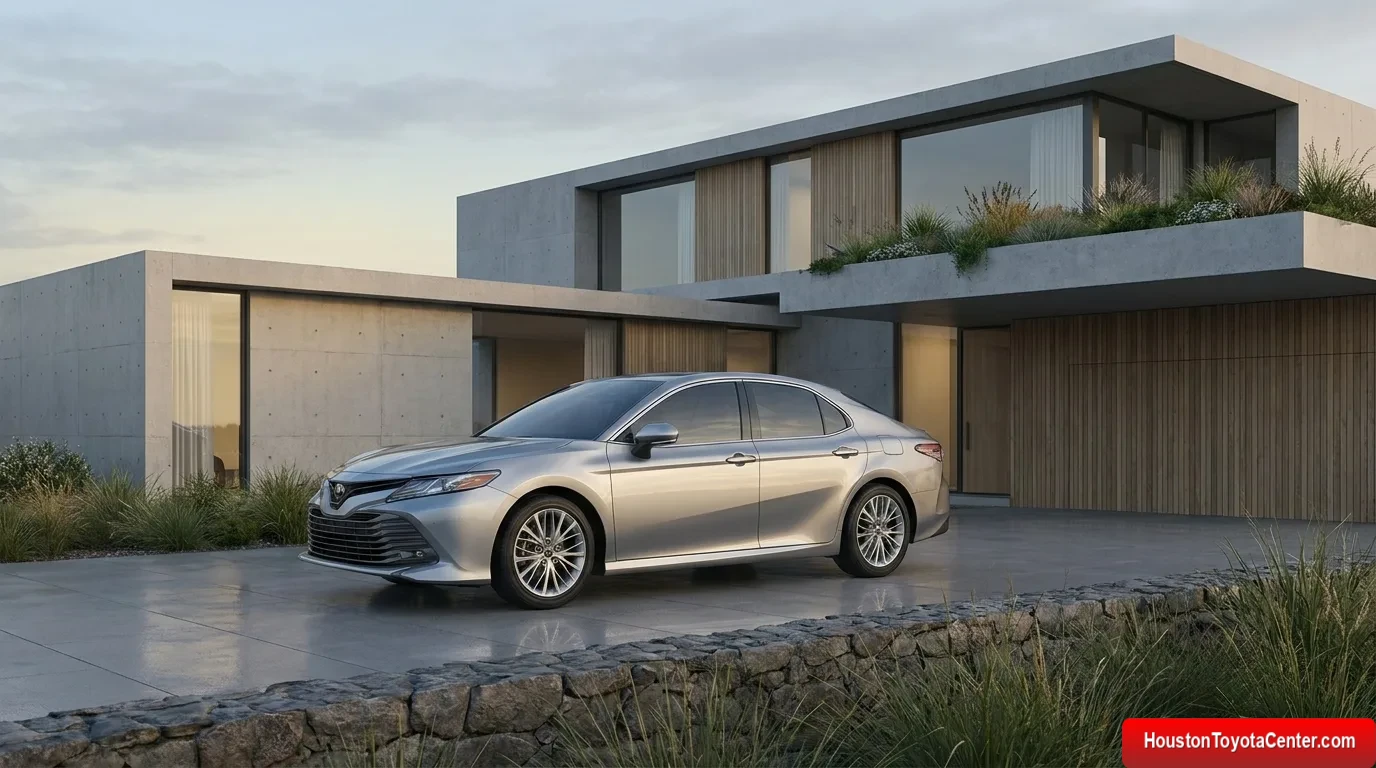
For decades, the automotive world has been divided into two broad categories. On one side are vehicles that prioritize prestige, performance, and exclusivity. On the other are vehicles designed around practicality, reliability, and affordability. Few cars have managed to bridge these two worlds successfully. Yet the Toyota Camry accomplished exactly that.
The Camry’s story is not merely the story of a successful sedan. It is the story of changing consumer values, shifting economic realities, evolving definitions of luxury, and the growing recognition that true comfort often comes not from excess, but from dependability. Over time, the Camry transformed from a sensible family car into a cultural symbol—a vehicle that represents what many people increasingly view as the ideal balance between comfort, quality, efficiency, and financial intelligence.
Today, when people describe the Camry as a form of “practical luxury,” they are referring to something deeper than leather seats or premium sound systems. They are describing a philosophy. The Camry has become the embodiment of a modern aspiration: enjoying high levels of comfort and refinement without accepting the burdens traditionally associated with luxury ownership.
Understanding how this transformation happened requires looking at the vehicle’s history, its evolution, and the broader societal forces that elevated it from a reliable commuter car into an icon of attainable success.
FREE: Quickly identify and understand problems with your vehicle 🚘
CLICK HEREThe Origins of the Camry
The Camry was introduced in the early 1980s during a period when consumer expectations for automobiles were rapidly changing. Rising fuel prices, economic uncertainty, and increasing competition forced automakers to rethink what buyers wanted.
Many consumers were growing dissatisfied with vehicles that required frequent repairs, suffered from poor fuel economy, or depreciated rapidly. At the same time, luxury vehicles remained expensive to purchase and maintain.
Toyota recognized an opportunity.
Rather than building a car that focused on flashy styling or aggressive performance, Toyota designed the Camry around a set of practical priorities:
- Reliability
- Comfort
- Efficiency
- Quality manufacturing
- Long-term ownership value
These priorities would eventually become the foundation of the Camry’s reputation.
From its earliest generations, the Camry was engineered to deliver a quiet and comfortable driving experience. It wasn’t intended to be exciting in the traditional automotive sense. Instead, it aimed to remove friction from daily life.
This philosophy resonated strongly with consumers.
Reliability as the Foundation of Luxury
Traditional luxury vehicles often emphasize craftsmanship, exclusivity, and advanced technology. However, there is another form of luxury that is less visible but arguably more valuable: peace of mind.
The Camry excelled in this area.
Owners discovered that the vehicle could routinely travel hundreds of thousands of miles with proper maintenance. Stories of Camrys reaching extraordinary mileage became common across North America, Asia, Australia, and other markets.
This reliability created a unique ownership experience.
Consider two drivers:
| Traditional Luxury Sedan | Toyota Camry |
|---|---|
| Higher purchase cost | Lower purchase cost |
| Potentially expensive repairs | Generally lower repair costs |
| Complex maintenance schedules | Predictable maintenance |
| Higher depreciation risk | Strong resale value |
| Prestige-oriented ownership | Practical confidence-oriented ownership |
For many consumers, avoiding unexpected repairs became more valuable than owning a prestigious badge.
Over time, reliability itself became a luxury feature.
A vehicle that starts every morning, performs consistently, and avoids major mechanical issues delivers a form of comfort that cannot easily be replicated by premium materials alone.
The Camry mastered this concept.
The Rise of the Middle-Class Success Story
The Camry’s growth coincided with major changes in the global middle class.
Throughout the late twentieth century and early twenty-first century, many households sought products that reflected financial stability rather than extravagance. Consumers increasingly wanted purchases that demonstrated responsibility instead of excess.
The Camry fit perfectly into this environment.
Owning a Camry communicated several messages simultaneously:
- The owner valued quality.
- The owner made rational financial decisions.
- The owner prioritized long-term value.
- The owner appreciated comfort.
- The owner avoided unnecessary risks.
In many communities, a Camry became a symbol of having “made it” without feeling the need to prove it.
This subtle status signal differed dramatically from traditional luxury brands.
Rather than announcing wealth, the Camry suggested competence.
Rather than signaling extravagance, it signaled wisdom.
That distinction proved remarkably powerful.
Redefining Luxury for a New Generation
Luxury itself has changed significantly over the past few decades.
Historically, luxury often meant:
- Large engines
- Expensive materials
- Exclusive brands
- Visible displays of wealth
Modern consumers increasingly define luxury differently.
Today, luxury often includes:
- Convenience
- Reliability
- Time savings
- Low stress
- Financial flexibility
- Technological integration
Under this newer definition, the Camry became surprisingly competitive.
The vehicle offered:
Quiet Cabins
As generations evolved, Toyota invested heavily in sound insulation and ride quality. Many drivers found the Camry surprisingly serene during highway travel.
Comfortable Interiors
Seats became more supportive, cabin materials improved, and interior ergonomics were refined.
Advanced Technology
Features that once belonged exclusively to luxury vehicles gradually appeared in Camry models:
- Adaptive cruise control
- Lane-keeping assistance
- Smartphone integration
- Premium audio systems
- Heated and ventilated seats
- Large infotainment displays
Exceptional Ownership Experience
Perhaps most importantly, owners could enjoy these features without the anxiety associated with high maintenance costs.
This combination helped redefine what luxury could mean.
The Psychology of Practical Luxury
The concept of practical luxury extends beyond automobiles.
Consumers increasingly seek products that provide premium experiences without unnecessary complexity.
Examples include:
| Category | Traditional Luxury | Practical Luxury |
|---|---|---|
| Watches | Rare mechanical pieces | High-quality everyday watches |
| Travel | Ultra-exclusive resorts | Comfortable premium experiences |
| Technology | Experimental premium devices | Reliable flagship products |
| Cars | Prestige-focused luxury brands | Well-equipped, dependable vehicles |
The Camry became one of the strongest automotive examples of this trend.
Its appeal is rooted in psychological satisfaction.
Owners experience:
Confidence
They trust the vehicle.
Predictability
Ownership costs are easier to anticipate.
Comfort
Daily driving becomes effortless.
Validation
The purchase feels rational rather than impulsive.
These emotional benefits create loyalty that many automakers struggle to match.
Design Evolution and Maturity
One of the most interesting aspects of the Camry’s journey is how its design evolved.
Earlier generations were often criticized for being conservative. Critics frequently described them as bland or uninspiring.
Toyota gradually adjusted its approach.
Modern Camry generations feature:
- More aggressive front fascia designs
- Sharper body lines
- Wider stances
- Improved proportions
- Sportier trims
This evolution reflected changing consumer expectations.
Drivers still wanted practicality, but they also wanted emotional appeal.
Toyota managed to modernize the Camry without sacrificing its core identity.
The result was a vehicle that looked more premium while maintaining the qualities that made it successful.
The Importance of Resale Value
One frequently overlooked element of luxury is financial efficiency.
Luxury vehicles often experience steep depreciation.
The Camry developed a reputation for strong resale value.
This characteristic contributed significantly to its practical luxury image.
Consider the long-term ownership equation:
| Factor | Strong Impact on Ownership Cost |
|---|---|
| Purchase Price | Yes |
| Fuel Costs | Yes |
| Maintenance | Yes |
| Insurance | Yes |
| Depreciation | Extremely Important |
Many buyers discovered that a Camry’s higher retained value effectively reduced the total cost of ownership.
This created an unusual dynamic.
The vehicle not only provided comfort during ownership but also rewarded owners financially when it was time to sell or trade.
Such outcomes reinforced the perception that the Camry represented intelligent luxury.
The Camry and Corporate America
Another major contributor to the Camry’s image was its popularity among professionals.
For years, businesspeople, managers, consultants, and executives chose Camrys as daily transportation.
This demographic adoption was significant.
The vehicle projected professionalism without appearing excessive.
It communicated stability and competence.
In many industries, driving a Camry suggested:
- Financial discipline
- Reliability
- Maturity
- Practical judgment
These associations helped elevate the vehicle’s cultural standing.
Unlike flashy luxury vehicles, the Camry blended seamlessly into professional environments.
It became the automotive equivalent of a well-tailored business suit: sophisticated, appropriate, and dependable.
Hybrid Technology and Modern Luxury
The rise of hybrid technology further strengthened the Camry’s position.
As fuel efficiency became increasingly important, Toyota’s hybrid expertise gave the Camry another competitive advantage.
The hybrid Camry offered:
- Exceptional fuel economy
- Reduced emissions
- Smooth operation
- Lower operating costs
Interestingly, hybrid systems also enhanced comfort.
Electric assistance often produces:
- Quieter acceleration
- Smoother power delivery
- Reduced engine noise
These characteristics aligned perfectly with the practical luxury concept.
Drivers enjoyed a more refined experience while simultaneously reducing fuel expenses.
This combination proved especially attractive during periods of economic uncertainty and fluctuating fuel prices.
The Camry Versus Traditional Luxury Brands
The Camry occupies a fascinating position in the automotive marketplace.
It is not technically a luxury car, yet it frequently competes for buyers who could afford entry-level luxury vehicles.
Why?
Because ownership experiences matter.
Consider a comparison:
Traditional Luxury Vehicle Benefits
- Prestigious branding
- Exclusive image
- Premium materials
- High-performance options
Camry Benefits
- Lower ownership costs
- Exceptional reliability
- Strong fuel efficiency
- Excellent resale value
- Modern technology
- Comfortable ride
For many consumers, the second list became increasingly compelling.
The question shifted from:
“Can I afford a luxury car?”
to
“Is a luxury car worth the additional cost and complexity?”
The Camry often emerged as the answer.
Cultural Reputation and Trust
Brands spend billions trying to build trust.
Toyota earned it gradually through consistency.
The Camry became one of the most trusted automotive nameplates in the world because it repeatedly delivered on its promises.
Trust compounds over time.
Parents recommended Camrys to their children.
Friends recommended Camrys to friends.
Mechanics recommended Camrys to customers.
This created a powerful cycle.
Each satisfied owner became an ambassador for the product.
As trust increased, so did the vehicle’s symbolic value.
The Camry ceased being merely a transportation tool.
It became a benchmark.
When consumers evaluated competing vehicles, the Camry often served as the reference point.
The Luxury of Time
Perhaps the most overlooked luxury associated with the Camry is time.
Vehicle ownership consumes time in numerous ways:
- Repairs
- Maintenance visits
- Breakdowns
- Research
- Troubleshooting
Reliable vehicles reduce these demands.
Camry owners frequently spend less time dealing with automotive problems than owners of less dependable alternatives.
Time is a finite resource.
A vehicle that minimizes interruptions effectively returns valuable hours to its owner.
Viewed through this lens, reliability becomes not merely a practical advantage but a luxury benefit.
The Camry excels in providing exactly this kind of value.
The Global Appeal of the Camry
The Camry’s practical luxury image extends beyond any single country.
Different markets appreciate different aspects of the vehicle.
North America
Consumers value comfort, reliability, and resale value.
Asia
Buyers appreciate efficiency, quality, and long-term durability.
Australia
Drivers often prioritize dependability and operating costs.
Middle East
Reliability in demanding conditions contributes significantly to the Camry’s reputation.
Across regions, a common theme emerges.
The vehicle consistently delivers a premium ownership experience without demanding premium ownership sacrifices.
That balance gives the Camry unusually broad appeal.
Why the Camry Survived While Others Disappeared
The automotive industry is filled with once-famous models that gradually vanished.
The Camry endured.
Several factors explain its longevity:
| Factor | Contribution to Success |
|---|---|
| Reliability | Extremely High |
| Brand Trust | Extremely High |
| Continuous Improvement | High |
| Market Adaptability | High |
| Ownership Value | Extremely High |
| Broad Demographic Appeal | High |
Toyota rarely pursued radical reinvention.
Instead, it focused on refinement.
Each generation improved upon the last while preserving core strengths.
This disciplined strategy allowed the Camry to maintain relevance across decades of changing consumer preferences.
The Shift Away From Status Consumption
Modern consumers increasingly question traditional status symbols.
Younger generations often prioritize experiences over possessions and value over conspicuous consumption.
This cultural shift benefits vehicles like the Camry.
The car represents a form of understated success.
Its appeal lies not in attracting attention but in simplifying life.
For many buyers, that proposition feels increasingly luxurious.
A product that works exceptionally well without demanding constant attention aligns perfectly with contemporary values.
The Camry embodies this principle.
The Future of Practical Luxury
The future of luxury may look very different from its past.
Emerging trends suggest consumers will increasingly value:
- Sustainability
- Reliability
- Efficiency
- Convenience
- Technological integration
- Long-term value
These priorities closely align with the strengths that made the Camry successful.
As electrification, automation, and digital technologies reshape transportation, the underlying philosophy of practical luxury may become even more important.
Consumers are likely to continue seeking products that deliver premium experiences while minimizing complexity and risk.
The Camry’s decades-long success suggests Toyota understood this shift earlier than many competitors.
Conclusion
The Toyota Camry did not become a symbol of practical luxury through aggressive marketing or extravagant design. It achieved that status through consistency.
Generation after generation, the Camry delivered what many drivers ultimately value most: reliability, comfort, efficiency, and peace of mind.
Its success reveals an important truth about modern luxury. For a growing number of people, luxury is no longer defined solely by exclusivity, prestige, or excess. Instead, it is defined by quality experiences, reduced stress, financial intelligence, and confidence in everyday life.
The Camry sits at the intersection of these values. It offers many of the comforts people associate with premium vehicles while avoiding many of the costs and complications that traditionally accompany luxury ownership.
In doing so, it created a new category of aspiration—one built not on showing wealth, but on exercising wisdom. It became a car that rewards practicality without sacrificing comfort, proving that luxury does not always need to be loud, expensive, or exclusive.
That is how the Camry evolved from a dependable family sedan into one of the most recognizable symbols of practical luxury in the modern automotive world.
Leave a Reply