
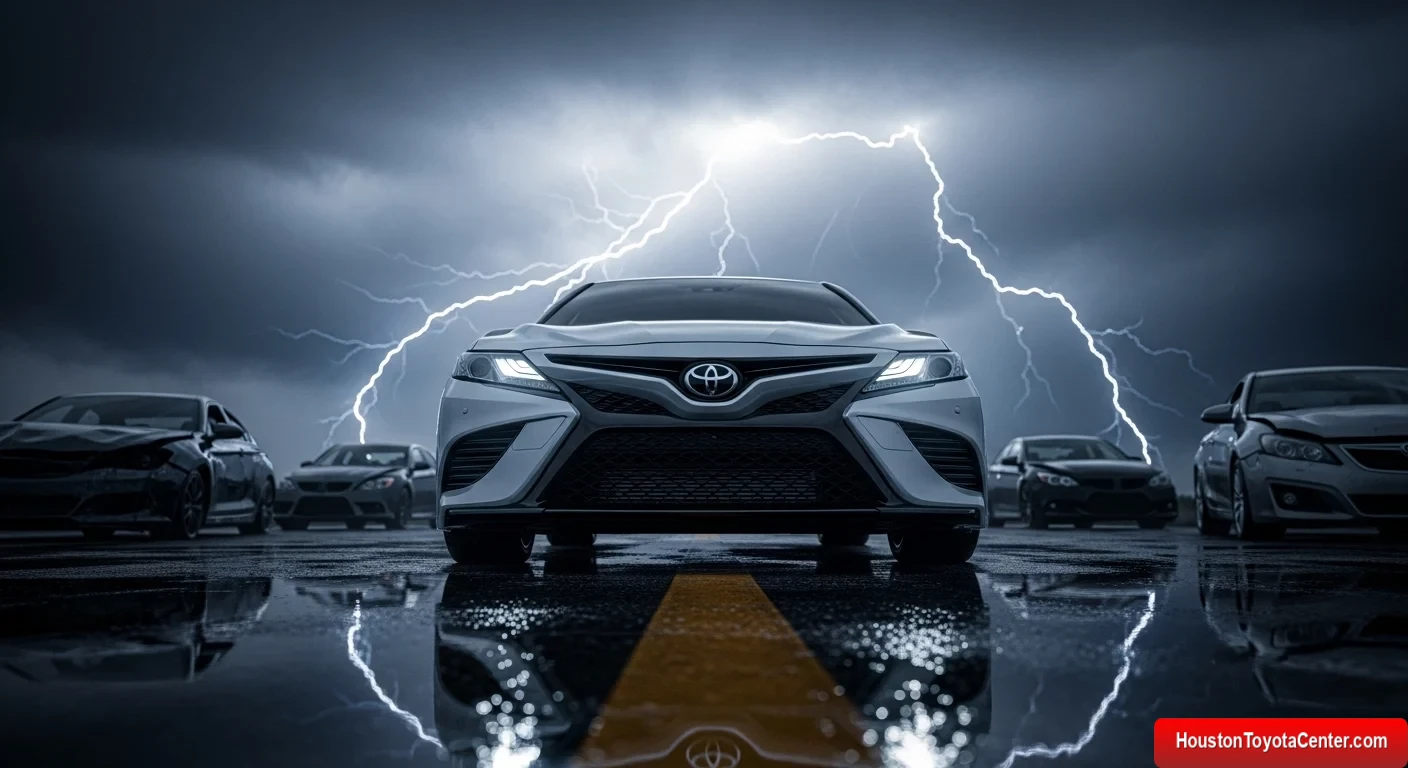
For decades, the midsize sedan segment has been one of the most fiercely competitive arenas in the automotive industry. It’s where practicality meets comfort, where affordability intersects with performance, and where brand loyalty is constantly tested. Amid shifting consumer preferences—especially the global pivot toward SUVs and crossovers—one name has consistently held its ground: the Toyota Camry.
While many competitors have struggled to maintain relevance or have exited the segment altogether, the Camry continues not just to survive, but to dominate. Its enduring success is not the result of a single standout feature, but rather a carefully balanced combination of reliability, design evolution, technological innovation, and strategic positioning.
This article explores in depth why the Camry remains a benchmark in the sedan market, examining its history, engineering philosophy, consumer appeal, and ability to adapt to changing trends.
A Legacy Built on Trust
The Camry’s dominance begins with its legacy. Introduced in the early 1980s, it quickly became synonymous with dependability. Over the years, Toyota refined the model with a clear focus: build a car that simply works—day in and day out—with minimal hassle.
FREE: Quickly identify and understand problems with your vehicle 🚘
CLICK HERETrust is a powerful currency in the automotive world. For many buyers, purchasing a car is one of the most significant financial decisions they will make. The Camry’s reputation for reliability has created a self-reinforcing cycle:
- Owners experience fewer problems
- They recommend the vehicle to others
- Repeat purchases become common
- Resale values remain high
This trust is not accidental. Toyota’s production system emphasizes quality control at every stage, from design to assembly. The result is a vehicle that consistently ranks among the most reliable in its class.
Engineering Excellence and Reliability
One of the primary reasons behind the Camry’s success is its engineering philosophy. Toyota prioritizes durability and efficiency over unnecessary complexity. While some competitors chase cutting-edge features that may compromise long-term reliability, the Camry strikes a careful balance.
Key Engineering Principles
| Principle | Impact on Consumers |
|---|---|
| Simplicity | Fewer components prone to failure |
| Proven Technology | Reduced risk of mechanical issues |
| Rigorous Testing | High durability under various conditions |
| Efficiency Focus | Lower fuel consumption and running costs |
Toyota’s engines, transmissions, and hybrid systems are designed to last. It’s not uncommon to see Camrys with hundreds of thousands of kilometers still running smoothly. This longevity significantly reduces the total cost of ownership.
The Hybrid Advantage
One of the Camry’s most strategic moves has been its early and consistent investment in hybrid technology. As environmental concerns and fuel costs have become more prominent, the Camry Hybrid has positioned itself as a practical alternative to both traditional gasoline sedans and fully electric vehicles.
Why the Hybrid Matters
- Fuel Efficiency: Exceptional mileage without sacrificing range
- Lower Emissions: Appeals to environmentally conscious buyers
- Cost Savings: Reduced fuel expenses over time
- Reliability: Toyota’s hybrid systems are among the most proven in the industry
Unlike some competitors that treat hybrid versions as niche offerings, Toyota integrates hybrid technology seamlessly into the Camry lineup. This makes it accessible and appealing to a broader audience.
Design Evolution: From Conservative to Confident
Historically, the Camry was often criticized for being too conservative in its design. While this approach appealed to a certain demographic, it limited its appeal among younger buyers.
Toyota recognized this and made a bold shift in recent generations.
Modern Design Elements
- Aggressive front grille
- Sleeker body lines
- Sportier stance
- Premium interior materials
The result is a sedan that retains its practicality while offering a more dynamic visual identity. This evolution has helped the Camry compete not just on reliability, but also on emotional appeal.
Interior Comfort and Practicality
The Camry’s interior is another area where it excels. It strikes a balance between comfort, usability, and technology.
Interior Highlights
| Feature | Benefit |
|---|---|
| Spacious Cabin | Comfortable for long journeys |
| High-Quality Materials | Premium feel without luxury pricing |
| Intuitive Controls | Easy to use while driving |
| Advanced Infotainment | Connectivity and entertainment |
Passengers benefit from ample legroom and supportive seating, making the Camry a strong choice for families and commuters alike.
Technology Without Overcomplication
Modern vehicles are increasingly defined by their technology, but more features don’t always translate to a better experience. Toyota understands this and focuses on delivering technology that enhances usability rather than complicates it.
Key Technology Features
- Smartphone integration (Apple CarPlay, Android Auto)
- Driver-assistance systems
- Adaptive cruise control
- Lane-keeping assistance
- User-friendly infotainment systems
Toyota’s approach ensures that drivers can access modern conveniences without feeling overwhelmed.
Safety as a Standard, Not an Option
Safety has become a major deciding factor for car buyers, and the Camry excels in this area. Toyota has made advanced safety features standard across most trims, rather than reserving them for higher-end models.
Toyota Safety Philosophy
| Safety Feature | Function |
|---|---|
| Pre-Collision System | Detects and helps prevent frontal collisions |
| Lane Departure Alert | Warns if the vehicle drifts out of its lane |
| Adaptive Cruise Control | Maintains safe distance from other vehicles |
| Blind Spot Monitoring | Alerts drivers to unseen vehicles |
This commitment to safety enhances the Camry’s appeal across a wide demographic, from young drivers to families.
Value Proposition: More for Less
One of the Camry’s strongest advantages is its value proposition. It offers a combination of features, reliability, and performance at a price point that undercuts many competitors.
Cost Comparison Overview
| Category | Camry Strength |
|---|---|
| Purchase Price | Competitive within segment |
| Maintenance Costs | Generally low |
| Fuel Efficiency | Excellent, especially hybrid models |
| Resale Value | Among the highest in its class |
This makes the Camry not just a good purchase, but a smart financial decision.
Global Appeal and Adaptability
The Camry is not just successful in one market—it has global appeal. Toyota has adapted the model to meet the needs of different regions, ensuring its relevance worldwide.
Factors Behind Global Success
- Reliable performance in diverse climates
- Strong dealership and service networks
- Brand reputation
- Consistent quality standards
This adaptability has allowed the Camry to maintain strong sales even as market conditions change.
Competing in the Age of SUVs
Perhaps the most impressive aspect of the Camry’s dominance is its ability to thrive despite the rise of SUVs and crossovers. Many automakers have shifted focus away from sedans, yet the Camry continues to perform strongly.
Why It Still Competes
- Better fuel efficiency than most SUVs
- Lower cost of ownership
- Easier handling and maneuverability
- Comfortable ride quality
For many consumers, especially urban drivers, these advantages outweigh the perceived benefits of larger vehicles.
Customer Loyalty and Brand Power
Toyota’s brand strength plays a significant role in the Camry’s success. The company has cultivated a reputation for reliability, and the Camry is one of its flagship models.
Loyalty Drivers
- Positive ownership experiences
- Strong resale value
- Wide availability of parts and service
- Consistent product quality
Many Camry buyers are repeat customers, which reinforces its market position.
Continuous Improvement Philosophy
Toyota follows a philosophy of continuous improvement, often referred to as “kaizen.” This approach ensures that each new generation of the Camry builds upon the strengths of its predecessor while addressing its weaknesses.
Areas of Ongoing Improvement
- Fuel efficiency
- Driving dynamics
- Interior quality
- Technology integration
Rather than making drastic, risky changes, Toyota refines the Camry incrementally, ensuring consistent quality.
Environmental Responsibility
As the automotive industry moves toward sustainability, the Camry remains relevant thanks to its hybrid offerings and efficient engines.
Environmental Contributions
- Reduced emissions through hybrid technology
- Improved fuel economy
- Commitment to sustainable manufacturing
This positions the Camry as a practical choice for environmentally conscious consumers who may not be ready to switch to fully electric vehicles.
The Psychological Factor: Peace of Mind
Beyond specifications and features, the Camry offers something less tangible but equally important: peace of mind.
When buyers choose a Camry, they are not just purchasing a car—they are investing in predictability and reliability. They know what to expect, and that consistency is a powerful selling point.
Conclusion
The continued dominance of the Toyota Camry in the sedan market is no accident. It is the result of decades of careful planning, consistent execution, and an unwavering commitment to meeting consumer needs.
While the automotive landscape continues to evolve—with electrification, autonomous driving, and shifting consumer preferences—the Camry remains a constant. It adapts without losing its core identity, offering a blend of reliability, efficiency, comfort, and value that few competitors can match.
In a world where trends come and go, the Camry’s enduring success serves as a reminder that fundamentals still matter. Build a car that people can trust, improve it continuously, and deliver real value—and dominance will follow.
Leave a Reply