
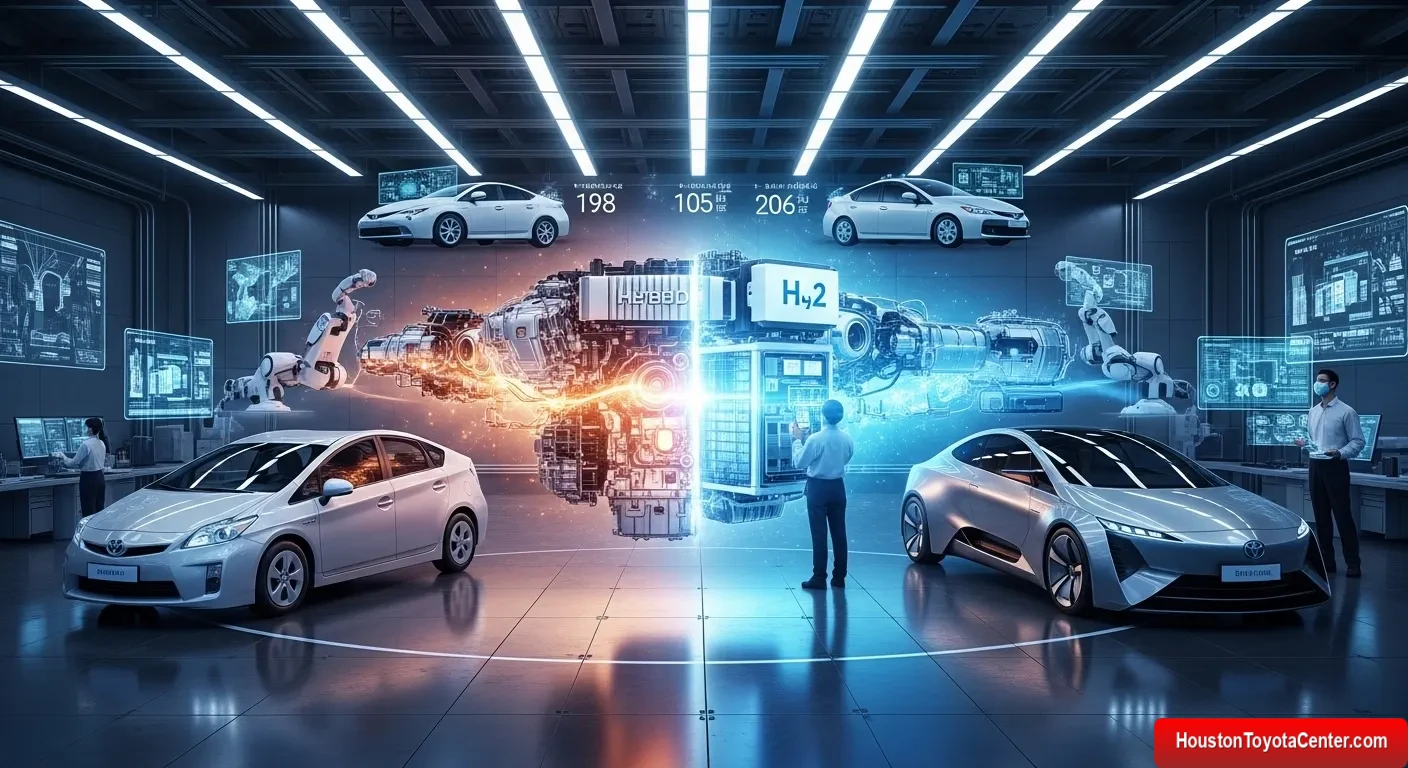
Few automotive manufacturers have shaped the global car industry as profoundly as Toyota Motor Corporation. Founded in 1937 by Kiichiro Toyoda, Toyota has grown from a small Japanese automaker into one of the largest and most influential automotive companies in the world. While Toyota is widely recognized for reliability and manufacturing excellence, the company’s true influence lies in a series of technological breakthroughs that have redefined how vehicles are designed, produced, powered, and driven.
Toyota’s innovations extend far beyond the vehicles themselves. The company revolutionized industrial manufacturing, pioneered hybrid powertrains, advanced hydrogen fuel technology, and accelerated the development of intelligent safety systems. These breakthroughs have not only shaped Toyota’s success but have also transformed the broader automotive landscape.
Many of Toyota’s most important technological achievements are rooted in philosophy as much as engineering. Concepts like continuous improvement, efficiency, and respect for people form the backbone of Toyota’s approach to innovation. This philosophy enabled the creation of systems that influenced industries worldwide—from factories to autonomous driving research.
This article explores Toyota’s most significant technological breakthroughs, examining how they emerged, how they work, and how they reshaped the automotive world. From manufacturing systems to next-generation propulsion technologies, Toyota’s innovations continue to define the future of mobility.
FREE: Quickly identify and understand problems with your vehicle 🚘
CLICK HERE1. The Toyota Production System (TPS)
One of Toyota’s most transformative innovations is not a vehicle technology at all—it is a manufacturing philosophy. The Toyota Production System (TPS) fundamentally reshaped industrial production.
Developed in the post-World War II era by engineers such as Taiichi Ohno and Eiji Toyoda, TPS introduced a radically different approach to manufacturing. Rather than producing goods in massive batches, Toyota focused on efficiency, waste reduction, and continuous improvement.
Two key concepts define TPS:
- Just-in-Time (JIT) manufacturing
- Jidoka (automation with human intelligence)
Just-in-Time ensures that parts arrive exactly when they are needed, reducing inventory costs and improving flexibility. Jidoka allows machines to stop automatically when a problem occurs, preventing defects from propagating down the production line.
Core Principles of the Toyota Production System
| Principle | Description | Impact |
|---|---|---|
| Just-in-Time | Produce only what is needed, when needed | Reduced inventory and costs |
| Jidoka | Automation that detects abnormalities | Improved quality control |
| Kaizen | Continuous improvement philosophy | Constant process optimization |
| Respect for People | Empower workers to improve systems | Higher productivity and morale |
TPS eventually inspired what is now widely known as Lean Manufacturing, a methodology adopted by companies around the world—from aerospace to healthcare.
Without TPS, Toyota likely would not have achieved the scale and quality that made its vehicles globally dominant.
2. Hybrid Synergy Drive: The Hybrid Revolution
Toyota fundamentally changed the direction of automotive propulsion with its hybrid technology.
The breakthrough arrived in 1997 with the release of the Toyota Prius, the world’s first mass-produced hybrid car.
Hybrid technology combines an internal combustion engine with electric motors and battery storage to improve efficiency and reduce emissions.
Toyota’s system—called Hybrid Synergy Drive—was unique because it used a power-split device, allowing the engine and electric motors to work together seamlessly without a traditional transmission.
Key Components of Hybrid Synergy Drive
| Component | Function |
|---|---|
| Gasoline Engine | Provides power and charges battery |
| Electric Motor | Propels the car and assists the engine |
| Battery Pack | Stores electrical energy |
| Power Split Device | Balances power between engine and motors |
| Regenerative Braking | Converts braking energy into electricity |
The benefits were dramatic:
- Fuel efficiency improvements up to 50%
- Lower emissions
- Quiet operation
- Reduced fuel consumption in city driving
Hybrid technology later spread across Toyota’s lineup, including vehicles like the Toyota Camry and the Toyota RAV4.
Today, millions of Toyota hybrids have been sold worldwide, making hybrid propulsion one of the most successful automotive technologies ever introduced.
3. Hydrogen Fuel Cell Technology
While many automakers focused solely on battery electric vehicles, Toyota invested heavily in hydrogen fuel cells.
Fuel cells generate electricity by combining hydrogen and oxygen, producing only water as a byproduct. This technology offers long driving ranges and fast refueling times similar to gasoline vehicles.
Toyota’s flagship hydrogen vehicle is the Toyota Mirai.
How Fuel Cell Technology Works
- Hydrogen stored in tanks enters the fuel cell stack.
- Oxygen from the air is introduced.
- A chemical reaction produces electricity.
- Electricity powers the electric motor.
- The only emission is water vapor.
Advantages of Hydrogen Fuel Cells
| Feature | Benefit |
|---|---|
| Fast Refueling | Similar to gasoline vehicles |
| Long Range | Often over 500 km |
| Zero Carbon Emissions | Only water is emitted |
| Quiet Operation | Electric motor propulsion |
Despite infrastructure challenges, Toyota believes hydrogen will play a critical role in future transportation, including trucks, buses, trains, and even industrial machinery.
4. Advanced Safety Systems
Toyota has been a leader in automotive safety technologies designed to prevent accidents rather than simply protect occupants during collisions.
A major milestone was the introduction of Toyota Safety Sense, a suite of driver-assistance technologies designed to reduce human error.
Features include:
- Pre-collision systems
- Lane departure alerts
- Adaptive cruise control
- Automatic emergency braking
These technologies rely on radar, cameras, and advanced algorithms to monitor the road.
Core Technologies in Toyota Safety Systems
| Technology | Function |
|---|---|
| Pre-Collision System | Detects potential crashes and applies brakes |
| Lane Departure Alert | Warns drivers if they drift out of lanes |
| Adaptive Cruise Control | Maintains safe distance from other cars |
| Automatic High Beams | Adjusts headlights automatically |
Toyota has steadily expanded these features across its vehicle lineup, helping make advanced safety technology accessible to mainstream buyers.
5. TNGA: Toyota New Global Architecture
Modern vehicles must balance performance, safety, efficiency, and cost. Toyota addressed this challenge with Toyota New Global Architecture (TNGA).
TNGA is a modular vehicle platform strategy that standardizes components across multiple models.
Benefits include:
- Lower center of gravity
- Improved driving dynamics
- Increased structural rigidity
- Reduced manufacturing complexity
Vehicles like the Toyota Corolla and Toyota Camry were redesigned using TNGA.
Advantages of TNGA
| Advantage | Result |
|---|---|
| Shared Components | Reduced production cost |
| Improved Chassis Design | Better handling |
| Stronger Structures | Enhanced crash safety |
| Flexible Design | Faster model development |
TNGA represents a major shift in Toyota’s engineering philosophy, emphasizing performance alongside reliability.
6. Solid-State Battery Research
One of the most promising breakthroughs Toyota is working on involves solid-state batteries.
Traditional lithium-ion batteries use liquid electrolytes. Solid-state batteries replace these liquids with solid materials.
Benefits may include:
- Higher energy density
- Faster charging
- Improved safety
- Longer battery life
Toyota has invested billions in developing this technology and holds many patents in the field.
If commercialized at scale, solid-state batteries could dramatically improve electric vehicle performance and accelerate global EV adoption.
7. Autonomous Driving and AI Mobility
Toyota is also investing heavily in autonomous vehicle technology.
The company established the Toyota Research Institute to accelerate development of artificial intelligence and robotics.
Research areas include:
- Automated driving
- Machine learning
- robotics
- mobility services
Toyota is exploring two approaches:
Guardian Mode
AI assists the human driver and intervenes only when necessary.
Chauffeur Mode
Full autonomous driving with no driver involvement.
Toyota believes human-AI collaboration will be key to safer mobility.
8. The Lexus Luxury Technology Revolution
Toyota’s luxury division Lexus has often served as a testing ground for advanced technologies.
One early milestone was the introduction of the Lexus LS, which stunned the luxury market with exceptional refinement, engineering precision, and reliability.
Technologies introduced through Lexus include:
- advanced noise reduction
- adaptive suspension
- hybrid luxury powertrains
- advanced infotainment systems
Lexus also played a key role in introducing hybrid technology to the luxury segment.
9. Connected Vehicles and Smart Mobility
Modern vehicles are becoming connected digital platforms.
Toyota has invested heavily in connected car ecosystems that allow vehicles to communicate with infrastructure, cloud systems, and other vehicles.
Key developments include:
- Over-the-air software updates
- predictive maintenance systems
- vehicle-to-vehicle communication
- mobility service platforms
These technologies allow vehicles to evolve after purchase, similar to smartphones.
10. Woven City: A Living Laboratory
One of Toyota’s most ambitious technological projects is Woven City.
Located near Mount Fuji in Susono, Woven City is designed as a fully connected smart city where researchers can test emerging technologies.
The city will explore:
- autonomous vehicles
- robotics
- smart homes
- hydrogen energy systems
- artificial intelligence
Toyota envisions it as a real-world testing ground for future mobility ecosystems.
11. Robotics and Mobility for All
Toyota is also developing robotic technologies to help elderly and disabled individuals.
These include:
- robotic assistants
- mobility exoskeletons
- autonomous wheelchairs
The goal is to extend mobility and independence for aging populations.
12. Environmental Innovation and Sustainability
Toyota has set ambitious environmental goals through its Toyota Environmental Challenge 2050 initiative.
Targets include:
- carbon neutrality
- reduced water usage
- zero landfill waste
- sustainable materials
The company is investing in multiple energy pathways including hybrids, plug-in hybrids, hydrogen, and electric vehicles.
Conclusion: A Century of Engineering Breakthroughs
Toyota’s technological breakthroughs have shaped not only the company but the entire automotive industry.
From the revolutionary Toyota Production System to the hybrid revolution launched by the Toyota Prius, Toyota has consistently pushed the boundaries of engineering and manufacturing.
The company’s willingness to explore multiple technological pathways—hybrids, hydrogen, solid-state batteries, robotics, and autonomous driving—demonstrates a long-term vision for the future of mobility.
While many automakers focus on short-term trends, Toyota’s approach is rooted in durability, scalability, and real-world practicality.
As the transportation industry undergoes its biggest transformation in over a century, Toyota’s legacy of innovation ensures it will remain a central player in shaping how the world moves in the decades to come.
Leave a Reply