
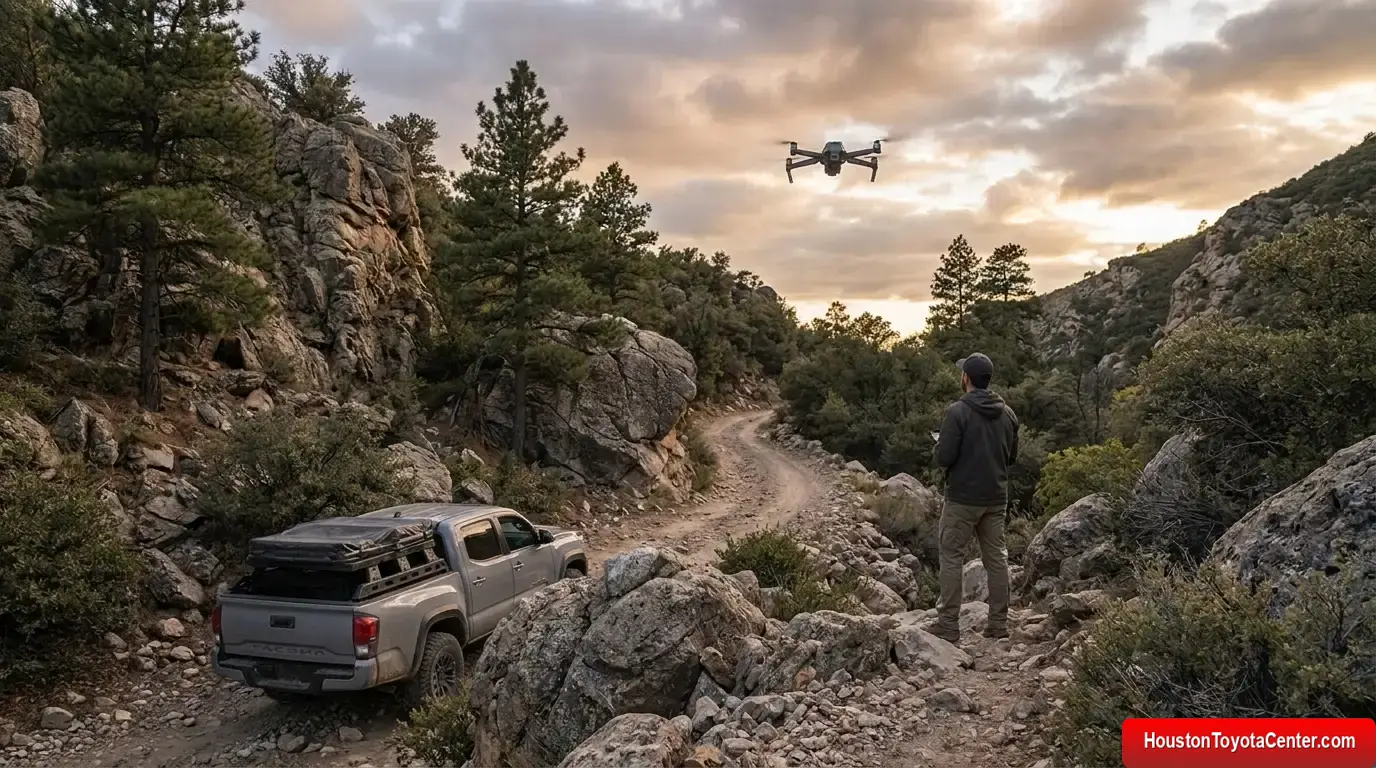
Toyota is exploring a fascinating concept that could redefine the future of off road mobility. Instead of relying solely on cameras, sensors, or satellite navigation, the company is studying a compact drone system capable of flying ahead of a vehicle, giving drivers a real time aerial view of the terrain before they reach it. According to reports, the project is still under development, but it highlights how the automotive industry continues to merge artificial intelligence, robotics, autonomous systems, and advanced mobility technologies into a single ecosystem.
For decades, off road enthusiasts have faced the same challenges: hidden obstacles, deep mud, flooded trails, fallen trees, steep inclines, and unpredictable terrain. Even experienced drivers can find themselves trapped or forced to turn around after discovering hazards that were impossible to see from behind the steering wheel.
Toyota’s proposed drone support system aims to solve exactly that problem.
Instead of driving blindly into difficult terrain, the vehicle could deploy a lightweight drone that scouts the path ahead and streams live footage back to the driver.
FREE: Quickly identify and understand problems with your vehicle 🚘
CLICK HEREIf this technology eventually reaches production, it could represent one of the biggest innovations in off road driving since electronic traction control.
🌍 Why Off Road Driving Needs Better Visibility
Driving off paved roads is fundamentally different from driving on highways.
Unlike city streets, natural environments constantly change.
Some common hazards include:
| 🌲 Challenge | 🚗 Potential Risk |
|---|---|
| Hidden rocks | Tire or suspension damage |
| Deep water | Engine failure |
| Mud pits | Vehicle becomes stuck |
| Fallen trees | Route blocked |
| Sharp inclines | Roll over risk |
| Loose gravel | Loss of traction |
| Sand dunes | Reduced control |
Drivers often leave the vehicle to inspect dangerous areas before proceeding.
A drone could perform that inspection in seconds.
Instead of walking several hundred meters through rough terrain, the driver could simply launch the drone and receive an aerial perspective.
🚁 How Toyota’s Drone System Could Work
Although Toyota has not revealed every technical detail, reports suggest the drone would integrate directly with the vehicle.
A possible workflow might include:
- Driver approaches uncertain terrain.
- Vehicle recommends launching the drone.
- Drone automatically takes off.
- AI identifies the safest route.
- Live video appears on the dashboard.
- Driver follows the suggested path.
- Drone returns automatically after the inspection.
Such a workflow would dramatically improve situational awareness.
Because the drone flies above obstacles, it can detect hazards that front facing cameras simply cannot see.
This elevated perspective could become one of the biggest safety advantages of future off road vehicles.
🛰️ Beyond Simple Video
The drone would likely become much more than a flying camera.
Future versions could incorporate multiple sensing technologies.
Potential capabilities include:
✅ High definition cameras
✅ Thermal imaging
✅ Obstacle detection
✅ Terrain mapping
✅ Artificial intelligence
✅ GPS guidance
✅ Real time route planning
✅ Autonomous flight
Combined together, these technologies could create an intelligent co pilot for adventure driving.
🤖 Artificial Intelligence at the Center
Modern vehicles already rely heavily on AI.
Toyota’s drone concept would extend those capabilities into the sky.
Instead of merely showing video, artificial intelligence could analyze:
- Safe driving lines
- Water depth estimates
- Rock locations
- Mud consistency
- Slope angles
- Tree clearance
- Alternative routes
Rather than asking the driver to interpret every image manually, AI could highlight hazards with colored overlays.
Imagine seeing:
🟢 Safe route
🟡 Proceed carefully
🔴 Do not continue
This would simplify decision making, especially for less experienced off road drivers.
🏔️ Adventure Without Guesswork
Many outdoor enthusiasts explore remote areas where help is unavailable.
In those environments, a wrong decision can become expensive.
Recovery vehicles may require hours to arrive.
Satellite phones may be the only communication available.
By reducing uncertainty, an aerial drone could significantly decrease:
- Recovery costs
- Mechanical damage
- Driver stress
- Time spent scouting
For expedition travelers, this alone could justify the technology.
🔋 Battery and Charging Possibilities
One interesting engineering challenge involves powering the drone.
Several possibilities exist.
| Charging Method | Advantages |
| Vehicle dock | Automatic charging |
| Wireless charging | No exposed connectors |
| Swappable batteries | Longer missions |
| Fast charging | Quick redeployment |
The vehicle itself could act as a charging station, allowing multiple flights during long adventures.
Because the drone would typically fly only a short distance, battery requirements may remain relatively modest.
🌦️ Weather Challenges
Nature presents many obstacles for small aircraft.
A practical automotive drone would need to handle:
🌬️ Strong winds
🌧️ Rain
❄️ Snow
🌫️ Fog
🌡️ Extreme temperatures
Flying safely under these conditions requires sophisticated stabilization software.
Toyota would likely integrate advanced flight controllers capable of maintaining stable operation even in difficult environments.
🛡️ Safety Comes First
Any autonomous drone operating around vehicles must prioritize safety.
Potential safety systems include:
- Automatic obstacle avoidance
- Return to vehicle if communication is lost
- Emergency landing
- Battery monitoring
- Collision prevention
- Restricted flight zones
These features already exist in many consumer drones, but automotive integration would require even higher reliability.
📡 Vehicle to Drone Communication
The drone would need a robust communication link with the vehicle.
Possible technologies include:
- Wi-Fi
- Dedicated radio frequencies
- 5G connectivity
- Satellite assistance
Low latency communication would be essential for delivering smooth real time video.
Drivers must receive immediate feedback when navigating difficult terrain.
🚘 Integration With Modern Driver Assistance Systems
Today’s vehicles already include:
- Adaptive cruise control
- Lane keeping assistance
- Automatic emergency braking
- Parking assistance
- Surround view cameras
Toyota’s drone could become another component of this growing digital ecosystem.
Instead of replacing existing systems, it would extend their capabilities beyond the vehicle’s immediate surroundings.
🌄 Applications Beyond Recreation
Although off road enthusiasts may be the first audience, the technology has much broader potential.
Possible professional uses include:
🚒 Emergency Services
Rescue teams could inspect disaster zones before entering dangerous areas.
🌾 Agriculture
Farmers could evaluate muddy roads and field conditions.
🌲 Forestry
Workers could inspect logging roads.
⛏️ Mining
Mining companies could monitor rough access routes.
🏗️ Construction
Heavy equipment operators could inspect job sites.
🚑 Search and Rescue
Teams could quickly locate blocked roads or stranded people.
The versatility of the concept makes it attractive across numerous industries.
🌐 A Growing Trend in Automotive Innovation
Toyota is not alone in exploring aerial mobility.
Across the automotive sector, manufacturers are increasingly investing in:
- Robotics
- Artificial intelligence
- Autonomous driving
- Advanced sensors
- Flying mobility solutions
Some companies are even researching flying vehicles.
Toyota’s approach is different.
Instead of making the entire car fly, it gives the vehicle an aerial companion.
That may prove to be a far more practical solution.
💰 Would Drivers Pay for It?
Premium off road vehicles already command high prices.
Buyers often spend thousands of dollars on:
- Lift kits
- Roof racks
- Winches
- Off road tires
- Auxiliary lighting
- Navigation systems
An integrated drone package could become another desirable premium option.
For serious explorers, the added safety may outweigh the additional cost.
📜 Regulatory Considerations
Deploying autonomous drones from vehicles raises important legal questions.
Governments may need regulations covering:
- Maximum flight altitude
- Autonomous operation
- Privacy
- Airspace restrictions
- Operator responsibility
Toyota will likely work closely with aviation regulators before any commercial launch. Earlier filings and regulatory discussions indicate the company has already explored pathways for testing such support drone systems.
📈 The Future of Smart Exploration
The automotive industry is undergoing its largest transformation in more than a century.
Electrification, connectivity, artificial intelligence, and automation are reshaping what vehicles can do.
Toyota’s drone concept demonstrates that innovation is no longer limited to the car itself.
Instead, future vehicles may become intelligent platforms supported by robotic companions that expand their awareness beyond the driver’s line of sight.
Whether navigating mountain trails, crossing deserts, exploring forests, or responding to emergencies, aerial support systems could dramatically improve safety and efficiency.
Although the project remains in the exploration stage, it offers an exciting glimpse into how tomorrow’s vehicles may interact with their environment.
Rather than replacing human drivers, technologies like these aim to provide better information, smarter decision making, and greater confidence in challenging conditions.
If Toyota successfully develops and commercializes this compact drone support system, it could establish a new category within automotive technology, one where vehicles and autonomous aerial assistants work together as a seamless team.
For adventure seekers, professional operators, and technology enthusiasts alike, the concept represents more than an interesting gadget. It signals the beginning of a future where the boundaries between ground transportation and aerial robotics continue to blur, creating safer, smarter, and more capable vehicles for the world’s most demanding environments.
Leave a Reply