
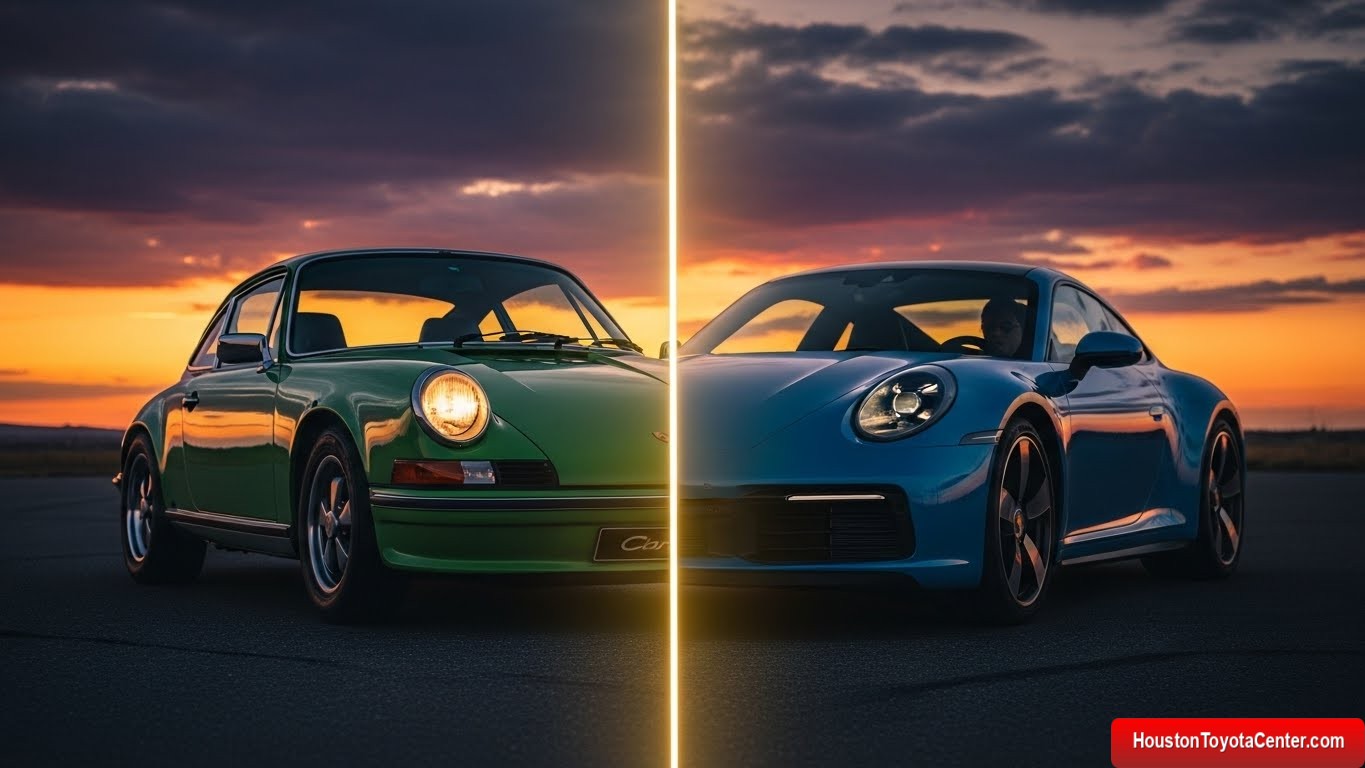
Few automobiles have achieved the cultural resonance, engineering admiration, and multi-generational passion that surround the Porsche 911. More than just a sports car, the 911 is a rolling testament to continuity—an evolving object that has stayed fundamentally true to its roots for more than six decades. Since its debut in 1964, the 911 has balanced heritage and innovation with a precision that mirrors its own handling: steady, sharp, unmistakably Porsche.
This article explores the history, design philosophy, technological leaps, cultural relevance, and motorsport triumphs that sculpted the 911 into an icon. It also examines how each major generation built upon the last—evolving while preserving what enthusiasts call the Porsche soul.
Origins: The 356 Legacy and the Birth of the 901/911
To understand the 911, one must begin with its predecessor: the Porsche 356. Introduced in 1948, the 356 was lightweight, nimble, and rear-engined—an unconventional layout that became Porsche’s signature. As the company grew, Ferry Porsche envisioned a successor that offered more power, interior space, and refinement, yet retained the 356’s spirit.
In 1963, Porsche unveiled the prototype 901 at the Frankfurt Motor Show. Peugeot objected to the “0” in the middle of the name, claiming trademark rights in France, so Porsche replaced the “0” with a “1,” and the Porsche 911 was born.
FREE: Quickly identify and understand problems with your vehicle 🚘
CLICK HEREWith its sloping roofline, rear-mounted flat-six engine, and compact proportions, the 911 looked like nothing else on the road. More than 60 years later, it still doesn’t.
Timeless Design: The Power of Evolving, Not Reinventing
Most carmakers reinvent their designs every decade. Porsche does not. The brand has refined a single shape—soft curves, raised round headlights, a rear-engine stance—until it became a recognized silhouette across the world.
How Porsche Maintains Its Design DNA
The 911’s design success lies in an approach that values evolution over revolution:
- Round headlights: A defining facial characteristic.
- Smooth, aerodynamic profile: Designed for both style and performance.
- Rear-engine layout: Rare in modern vehicles but central to the 911 experience.
- Minimalist cabin: Driver-centric, functional, with premium materials.
This philosophy maintains familiarity while allowing each new generation to introduce modern technology and styling refinements.
Generations of the 911: A Detailed Evolution
Below is a helpful reference table summarizing the major 911 generations:
| Generation | Production Years | Key Innovations | Notable Models |
|---|---|---|---|
| Original 911 (901/911) | 1964–1973 | Birth of flat-six; T, E, S models | 911 S, 911 Targa |
| G-Series | 1973–1989 | Impact bumpers; Turbo introduced | 930 Turbo, Carrera 3.2 |
| 964 | 1989–1994 | AWD, ABS, airbags | Carrera 4, RS America |
| 993 | 1994–1998 | Last air-cooled 911; multi-link suspension | Carrera S, Turbo, GT2 |
| 996 | 1998–2004 | First water-cooled 911 | GT3, Turbo S |
| 997 | 2004–2012 | Classic styling return; advanced tech | GT3 RS, Turbo, Sport Classic |
| 991 | 2012–2019 | Larger chassis; electric steering | GT2 RS, Targa, R |
| 992 | 2019–Present | Widebody standard, advanced driver aids | Turbo S, GT3 Touring |
The Air-Cooled Era: 1964–1998
For many enthusiasts, the term “air-cooled 911” evokes a sense of purity. These engines produced raw sound, mechanical feedback, and lightweight dynamics that shaped early Porsche identity.
The 901/911 (1964–1973)
The first generation established the blueprint. The early models produced 130 horsepower, but Porsche quickly expanded the lineup, offering the more powerful 911S and fuel-injected 911E. The Targa body style, introduced in 1967, featured a removable roof panel and stainless-steel roll bar.
G-Series (1973–1989)
This long-running generation introduced safety bumpers, improved reliability, and the first extraordinary leap in performance: the 911 Turbo (930). With its wide fenders and whale-tail spoiler, the 930 became an instant icon, famous for thrilling (and sometimes terrifying) boost delivery.
964 (1989–1994)
The 964 blended classic looks with modern engineering:
- All-wheel drive in the Carrera 4
- Power steering
- ABS brakes
- Improved aerodynamics
It preserved the air-cooled experience while making the 911 accessible to a wider audience.
993 (1994–1998): The Final Air-Cooled Legend
The 993 is celebrated as the pinnacle of the air-cooled era. Porsche redesigned the suspension with a multi-link setup that dramatically improved handling. The styling was sleek and modern, yet unmistakably 911. Today, the 993 remains highly collectible, often considered one of the most beautiful 911s ever built.
The Water-Cooled Revolution: 1998–Present
As emissions and performance standards tightened, Porsche faced an engineering crossroads. To stay competitive, the 911 needed to evolve.
996 (1998–2004): A Controversial Turning Point
The 996 was the most radical redesign in 911 history:
- First water-cooled flat-six
- All-new chassis
- “Fried egg” headlights
Critics argued it lacked charm, but it drastically improved everyday livability and performance. The 996 GT3 revived the motorsport connection, cementing the 996’s importance.
997 (2004–2012): A Return to Form
The 997 blended tradition with innovation. Round headlights returned, cabin quality improved, and performance variants flourished. The 997 GT3 RS, Turbo, and limited-edition Sport Classic have become modern classics.
991 (2012–2019): Bigger, Faster, More Refined
The 991 introduced an aluminum-intensive architecture that enhanced rigidity and reduced weight. Engines became more efficient, and the Turbo and GT models pushed boundaries of performance.
992 (2019–Present): The Digital 911
The latest generation embraces technology:
- Wider stance for all models
- Advanced driver assistance systems
- Improved aerodynamics
- Exceptional Turbo and GT variants
Yet its soul remains intact—rear-engine balance, flat-six sound, timeless silhouette.
Motorsport: Where the 911 Became a Legend
Porsche’s racing heritage is inseparable from the 911’s identity. It is one of the most successful racing cars in history, with thousands of victories worldwide.
Iconic Racing Achievements
- 24 Hours of Le Mans GT wins
- Monte Carlo Rally victories
- Daytona and Sebring triumphs
- Endurance championships across decades
The 911’s reliability and balance made it especially suited to endurance racing. Porsche’s racing program continuously fed innovations back into road cars—particularly in the GT3, GT2, and Turbo models.
Engineering Mastery: What Makes the 911 Unique
Beyond its shape and history, the 911’s identity stems from a few core engineering principles.
1. The Rear-Engine Layout
Placing the engine behind the rear axle gives unique advantages:
- Exceptional traction
- Compact packaging
- Distinctive driving experience
While early 911s had a reputation for snap oversteer, decades of refinement have turned this into a precise and thrilling characteristic.
2. Flat-Six Engine Architecture
The horizontally opposed layout:
- Lowers the center of gravity
- Produces a smooth, distinctive sound
- Enhances weight distribution
Few engines are as recognizable as a Porsche flat-six at full song.
3. Lightweight Construction
Porsche’s obsession with weight reduction—through aluminum, high-strength steel, and clever engineering—keeps the 911 remarkably agile for its class.
4. Everyday Usability
Unlike many sports cars, the 911 is practical:
- 2+2 seating
- Usable front trunk
- Comfortable ride
- Excellent build quality
This dual personality helped the 911 reach a broader audience.
Cultural Impact: The 911 Beyond the Road
The Porsche 911 is more than a machine; it’s a symbol of aspiration and excellence. It has been featured in films, art, and music. It commands respect among enthusiasts and casual observers alike. Ownership clubs, restoration communities, and fan events worldwide celebrate this shared passion.
Celebrities, CEOs, athletes, and car lovers of all backgrounds gravitate toward the 911 not merely for status, but because of its authenticity.
Why the 911 Endures
The 911’s lasting appeal stems from a blend of factors:
- Consistency: It remains unmistakably itself.
- Innovation: Each generation advances without losing identity.
- Performance: It is always fast—and increasingly dominant.
- Emotion: Few cars create such a connection with drivers.
The 911 is what happens when a brand refuses to compromise its heritage while embracing the future.
The Future: Electrification and the 911’s Next Era
Porsche has hinted that full electrification for the 911 is unlikely in the immediate future due to the importance of its flat-six engine. However, hybrid technology could appear in later generations. Given Porsche’s track record, any such evolution will prioritize weight balance, performance, and emotional connection.
Conclusion: The Living Legend
The Porsche 911 is more than a car—it is a living piece of engineering philosophy. It is proof that evolution can be more powerful than revolution, and that tradition and technology can coexist harmoniously.
From the first 901 prototype to the digital precision of the 992, the 911 has stayed faithful to its origins while pushing the boundaries of performance and design. It is one of the greatest automotive icons ever created, and its story is far from over.
Leave a Reply