
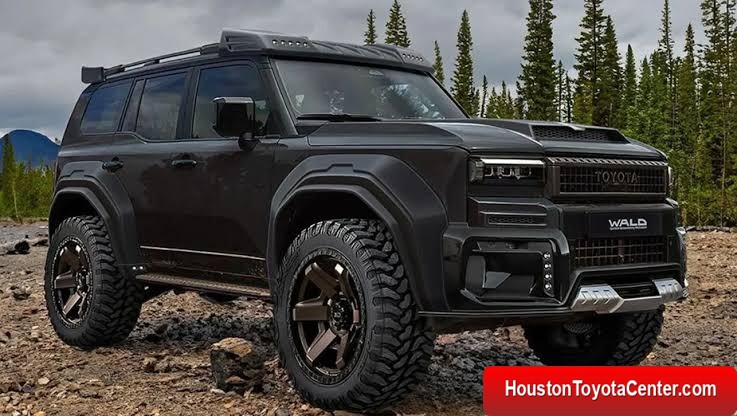
Toyota’s Land Cruiser lineage holds a legendary status in the automotive realm, celebrated for its legendary reliability and off-road prowess. Nestled directly within this storied history sits the Land Cruiser Prado, a light-duty off-road vehicle designed to bridge the gap between rugged utility and daily comfort. From its origins as a trimmed-down variant of the iconic 70 Series to its latest status as a global adventure platform, the Prado has redefined what it means to balance urban convenience with serious off-road capability.
🧭 The Origins: From Heavy Duty to Everyday Adventure
The story of the Prado begins in November 1985, when Toyota introduced the Land Cruiser 70 Series Light Duty in select international markets. This early precursor, often called the Bundera or Land Cruiser II, was designed as a response to the growing global market for recreational four-wheel-drive vehicles.
Unlike the heavy-duty 70 Series, which featured rigid leaf spring suspensions built for commercial haulage and harsh utility work, the Light Duty model introduced coil springs on both axles. This modification radically improved ride quality without severely sacrificing wheel articulation.
| Generation | Production Years | Key Architectural Highlights | Primary Engine Options |
| 70 Series Light Duty | 1985–1990 | Rigid coil spring suspension, lightweight ladder frame | 2.4L Gasoline (22R), 2.4L Turbo-Diesel (2L-T) |
| First Generation (J70 Prado) | 1990–1996 | Official “Prado” naming adopted, redesigned front fascia | 2.4L Turbo-Diesel, 3.0L Turbo-Diesel (1KZ-TE) |
| Second Generation (J90) | 1996–2002 | Independent Front Suspension (IFS), rack-and-pinion steering | 2.7L I4, 3.4L V6 (5VZ-FE), 3.0L D-4D Diesel |
| Third Generation (J120) | 2002–2009 | Torsen limited-slip center differential, optional air suspension | 4.0L V6 (1GR-FE), 3.0L D-4D Turbo-Diesel |
| Fourth Generation (J150) | 2009–2023 | Kinetic Dynamic Suspension System (KDSS), Multi-Terrain Select | 4.0L V6, 2.8L Turbo-Diesel (1GD-FTV) |
| Fifth Generation (J250) | 2024–Present | GA-F Global Truck Platform, Hybrid Powertrain, retro styling | 2.4L Turbo Hybrid (i-FORCE MAX), 2.8L Diesel |
In April 1990, Toyota officially bestowed the Prado nameplate upon the revised J70 model. Derived from the Spanish word for “meadow” or “field,” the name signaled a shift toward leisure, outdoor exploration, and family utility. The front grille, headlamps, and bonnet were completely overhauled to separate it aesthetically from its commercial siblings. Under the hood, updated turbodiesel engines provided the low-end torque required for hill climbing while maintaining manageable fuel economy for urban commutes.
FREE: Quickly identify and understand problems with your vehicle 🚘
CLICK HERE🛠️ Engineering Evolution Across Generations
           [ J70 Light Duty (1985) ]
                       │
             [ J70 Prado (1990) ]  --> First official Prado badge
                       │
              [ J90 Series (1996) ]  --> Shift to IFS & modern SUV architecture
                       │
             [ J120 Series (2002) ]  --> Luxury tech & global expansion
                       │
             [ J150 Series (2009) ]  --> Off-road electronics (KDSS/Crawl Control)
                       │
             [ J250 Series (2024) ]  --> TNGA-F Platform & Hybrid Integration
1. The J90 Series: Breaking Free from the Commercial Mold
Launched in 1996, the J90 Prado marked a total departure from the heavy-duty 70 Series architecture. Toyota developed the J90 specifically to compete against the Mitsubishi Pajero, which was dominating the recreational 4×4 market at the time.
The J90 featured an Independent Front Suspension (IFS) utilizing double wishbones, coupled with a rack-and-pinion steering setup. This transformation dramatically enhanced high-speed stability, steering precision, and highway comfort. Available in three-door short-wheelbase and five-door long-wheelbase configurations, the J90 became an immediate success in markets across Australia, Europe, and Asia.
2. The J120 Series: Refinement and Advanced Off-Road Mechanics
Unveiled in 2002, the J120 generation introduced sophisticated electronic aids while retaining a sturdy body-on-frame structure. This model served as the mechanical basis for the Lexus GX 470 in North America.
Engineers introduced a Torsen center differential in full-time four-wheel-drive models, allowing torque to split automatically between the front and rear axles based on traction needs. Higher trim levels received adaptive variable suspension and rear height-control air suspension, delivering a plush ride that rivaled luxury sedans while preserving true off-road capability.
3. The J150 Series: Longevity and Electronics Integration
The J150 generation debuted in late 2009 and enjoyed an unusually long production run spanning nearly 14 years. It integrated advanced terrain management systems:
- Multi-Terrain Select (MTS): Adjusted throttle response and brake intervention based on specific surface conditions like mud, sand, or loose rock.
- Crawl Control: Acted as low-speed off-road cruise control, managing acceleration and braking over difficult obstacles so the driver could focus entirely on steering.
- Kinetic Dynamic Suspension System (KDSS): Hydraulically adjusted the front and rear stabilizer bars, disconnecting them off-road for maximum articulation and locking them on-road to minimize body roll.
4. The J250 Series: The Modern Retro Revolution
The arrival of the J250 platform represents one of the most radical shifts in the vehicle’s history. Built on the TNGA-F global truck platform shared with the Land Cruiser 300, Lexus GX, and Toyota Tacoma, the J250 ditches soft, rounded body contours in favor of an aggressive, boxy, retro-inspired stance.
In many North American and European markets, this generation drops the “Prado” badge entirely, simply being marketed as the “Land Cruiser.” Mechanics include an electrified i-FORCE MAX 2.4L turbocharged hybrid powertrain, producing 326 horsepower and 465 lb-ft of torque, mated to an eight-speed automatic transmission.
⛰️ Off-Road Capabilities and Mechanical Blueprint
The secret behind the enduring success of the Land Cruiser Prado lies in its uncompromising chassis architecture. While many competing SUVs transitioned to unibody crossover construction for weight reduction, the Prado has consistently maintained a traditional ladder frame.
Key Off-Road Hardware
- Full-Time 4WD with Locking Center and Rear Differentials: Ensures power is delivered equally to all wheels when traction is compromised.
- Two-Speed Transfer Case: Provides low-range gearing for crawling up steep inclines or descending technical terrain.
- Disconnecting Front Anti-Roll Bar: First introduced in the J250 generation, allowing drivers to increase front axle articulation at the push of a button.
- High Ground Clearance and Favorable Approach Angles: Optimized bumper designs provide generous approach, breakover, and departure angles out of the factory.
       [ Engine ] ---> [ 8-Speed Auto Transmission ]
                                   │
                     [ 2-Speed Transfer Case ]
                                   │
                   ┌───────────────┴───────────────┐
                   ▼                               ▼
       [ Front Differential ]            [ Rear Differential ]
       (Independent Double Wishbone)      (Four-Link Solid Axle)
🌍 Global Presence and Market Positioning
The Land Cruiser Prado occupies a unique space in Toyota’s global lineup. Depending on where you live in the world, the vehicle wears different badges and serves distinct demographics.
Market Variations Around the Globe
- Australia and New Zealand: The Prado is a household name, consistently ranking among the best-selling 4×4 SUVs. It is widely used for towing caravans and long-distance desert touring across the Outback.
- Europe: Marketed primarily as the “Land Cruiser,” it serves rural landowners, rescue services, and off-road enthusiasts who require heavy towing capacity combined with strict European safety compliance.
- North America: The Prado architecture was historically sold under luxury disguise as the Lexus GX. With the launch of the J250 generation, it is sold under the main “Toyota Land Cruiser” nameplate.
- Middle East: Sold alongside the full-size Land Cruiser 300, the Prado serves as a nimble alternative for dune bashing and daily desert transportation.
🚘 Driving Dynamics: On-Road Comfort vs. Off-Road Prowess
Balancing two conflicting automotive goals is no easy feat. A vehicle stiff enough to handle highways without leaning in corners often struggles on uneven mountain trails. Conversely, an off-roader with soft, flexy suspension can feel unstable at high speeds.
                 OFF-ROAD PERFORMANCE
                          ▲
                          │    * Land Cruiser Prado (Ideal Balance)
                          │
  Pure Off-Roaders *      │
  (e.g., Land Cruiser 70) │
                          │             * Modern Crossovers
                          │               (Unibody Construction)
                          └──────────────────────────► ON-ROAD COMFORT
The Prado solves this dilemma through hybrid suspension engineering. The front independent double-wishbone suspension handles road imperfections and provides precise turn-in response. At the rear, a heavy-duty four-link solid axle with a Panhard rod ensures durability and heavy payload handling. Combined with adaptive damping systems, the Prado delivers long-distance touring comfort without compromising its trail heritage.
🔮 The Future of the Prado Legacy
As environmental regulations tighten globally, the Land Cruiser Prado is adapting without surrendering its core identity. The move toward hybrid powertrains, downsized turbocharged engines, and higher use of lightweight high-strength steel ensures that the nameplate remains viable in an era focused on carbon reduction.
For four decades, the Prado has proven that a vehicle can be tough enough to cross remote wilderness areas on Sunday and comfortable enough to drop children off at school on Monday. As the J250 generation takes the stage globally, the Land Cruiser Prado continues to set the benchmark for mid-size off-road vehicles worldwide.
Leave a Reply