
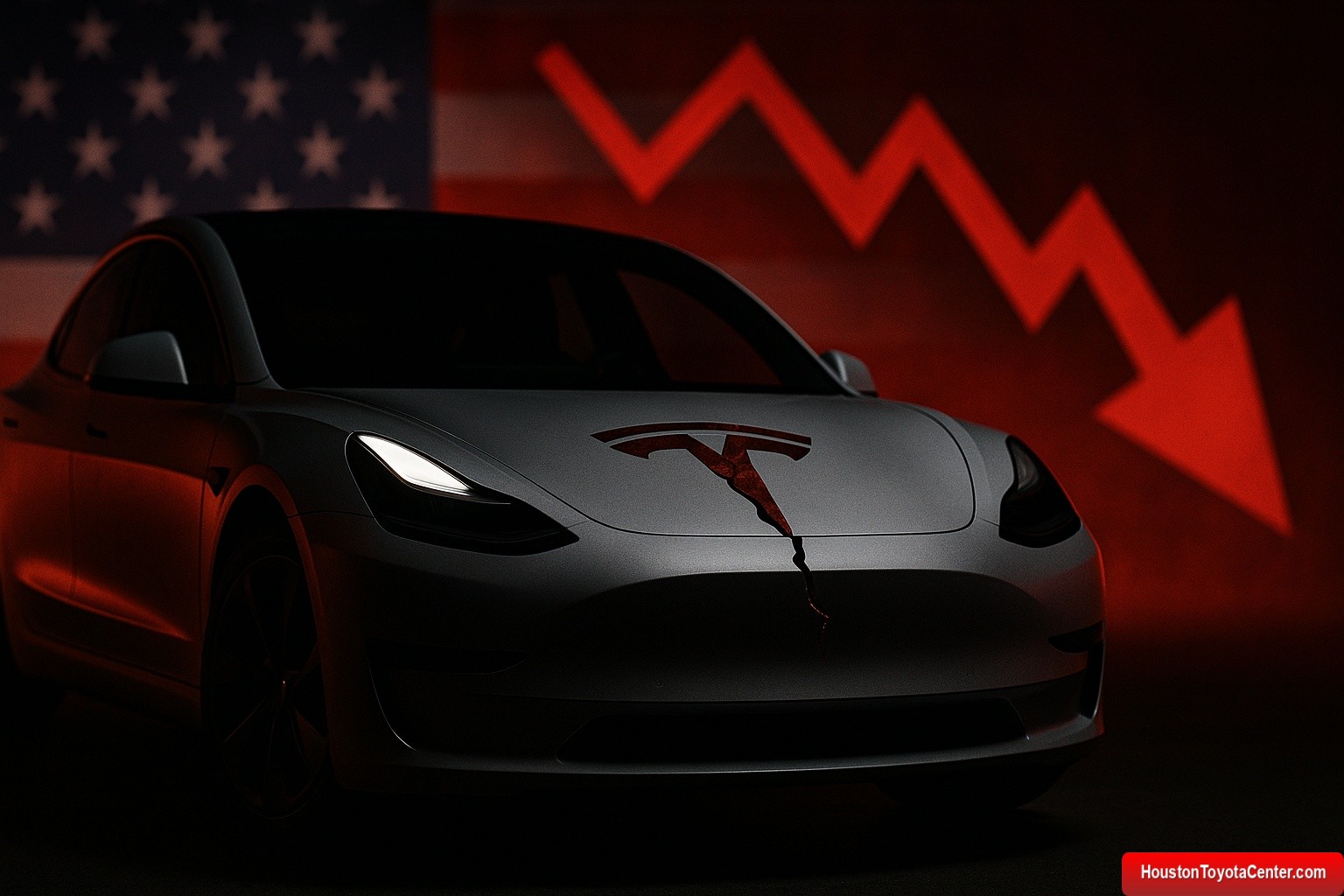
After years of unrivaled dominance in the electric vehicle (EV) industry, Tesla is facing its toughest chapter yet. Deliveries have fallen, its market share has sunk to the lowest level since 2017, and an aggressive price war is eating away at margins — threatening both the company’s future and the leadership image of Elon Musk.
📉 The Decline in Deliveries
Tesla’s once unstoppable growth has slowed dramatically. For the second consecutive year (2025), analysts forecast a drop in deliveries — a first in the company’s modern history.
- Key reasons for the decline:
- Saturation of the current lineup (mainly Model 3 and Model Y)
- Arrival of cheaper, more advanced competitors, especially from China
- Luxury EV segment increasingly dominated by Mercedes, BMW, and Audi
📊 Tesla’s Market Share in the U.S.
Tesla’s portion of the EV market has shrunk dramatically:
| Year | U.S. Market Share | Notes |
|---|---|---|
| 2020 | 60%+ | Tesla at its peak dominance |
| 2025 | Just over 40% | Lowest level since 2017 |
➡️ This 20-point drop in just five years shows how quickly rivals have gained ground.
FREE: Quickly identify and understand problems with your vehicle 🚘
CLICK HERE⚔️ The Price War
In 2023, Tesla launched an aggressive price-cutting strategy to defend its market position. Discounts of up to 20% on the Model 3 and Model Y boosted sales but devastated profitability.
- Result: Tesla’s margins, once the envy of the industry, are now at their weakest levels in years.
- Meanwhile, heavy investments in factories, battery technology, and R&D continue — creating financial pressure on all fronts.
🇨🇳 The Pressure from China
China, the world’s largest EV market, has become Tesla’s fiercest battlefield. BYD, now the world’s largest EV maker by volume, has overtaken Tesla with:
- Budget-friendly models, like the Seagull (under $10,000)
- Luxury sedans and SUVs, competing directly with Tesla’s premium offerings
This wide portfolio gives BYD unbeatable scale — leaving Tesla squeezed in the middle.
🚗 Lack of Fresh Models
Tesla’s current lineup is aging:
- Cybertruck → Delayed production, high price, niche appeal
- Semi and Roadster → Limited impact on sales numbers
- Model 3 & Model Y → Still account for 80%+ of Tesla’s sales, but lag behind rivals in tech, interiors, and pricing
Without new mass-market models, Tesla risks falling further behind competitors.
👤 Elon Musk: Strength or Weakness?
Elon Musk remains Tesla’s greatest asset — and liability. While still viewed as a visionary, his divided attention between social media ventures, AI, and space exploration has raised concerns among investors.
- Investors’ demand: Clearer strategy, realistic product timelines, and a refocus on Tesla.
- Musk’s leadership continues to inspire, but also amplifies risks if promises fail.
🔮 The Road Ahead: Tesla’s Reinvention
For Tesla to regain its crown, three urgent priorities stand out:
- Portfolio Expansion → Deliver new high-volume EVs beyond the Model 3 and Y
- Technology Leap → Accelerate battery breakthroughs and finally launch the long-promised $25,000 EV
- Profitability Balance → Stop the bleeding from the price war while sustaining growth
🏁 Conclusion
Tesla once stood as the undisputed king of EVs, but by 2025, the reality has changed. Falling deliveries, shrinking margins, and fierce competition are reshaping the market.
The company must prove it can still innovate and lead, or risk being remembered as the pioneer that lost its crown when rivals finally caught up.
What’s at stake is not just Tesla’s future — but the legacy of Elon Musk as the face of the electric revolution.
Leave a Reply