
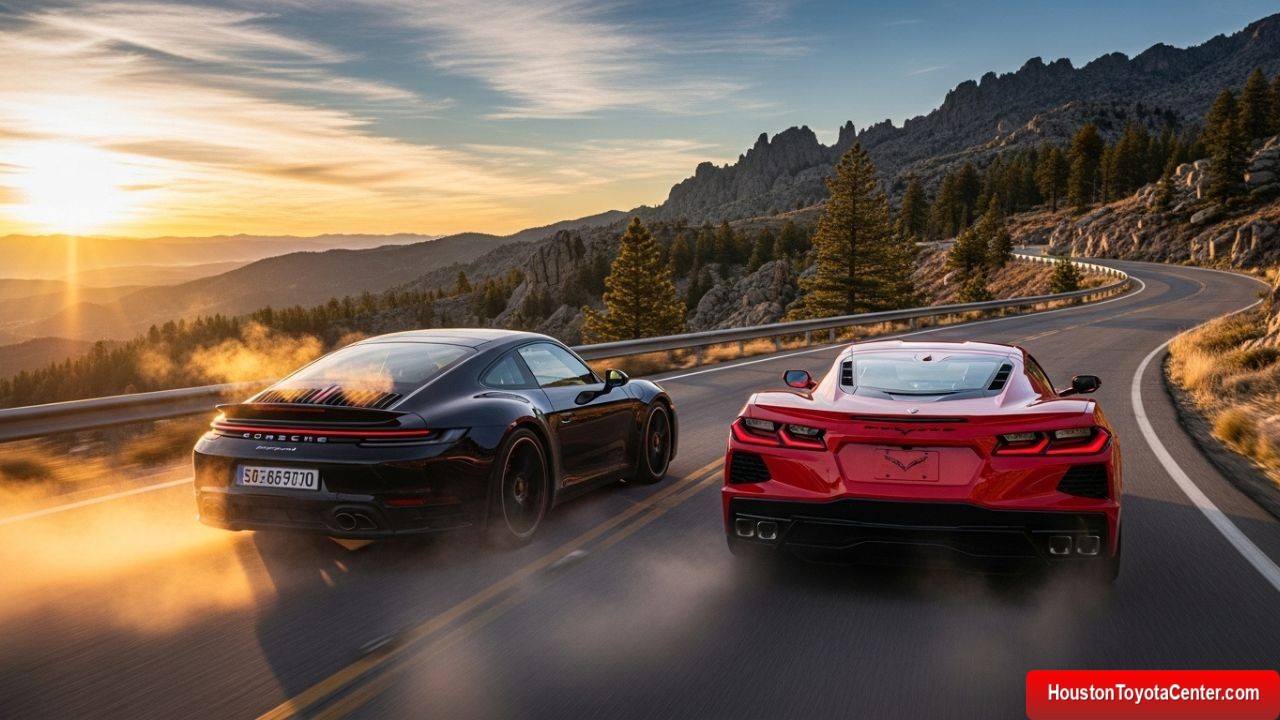
Few rivalries in the automotive world are as enduring, passionate, and polarizing as Porsche vs. Corvette. On one side stands the Porsche 911, the German icon of precision engineering, rear-engine heritage, and motorsports pedigree. On the other is the Chevrolet Corvette, America’s sports car, a symbol of V8 thunder, bold accessibility, and relentless reinvention.
Both cars represent excellence, but in profoundly different ways. And that’s exactly why the rivalry is so captivating.
This article dives deep into how these two automotive titans compare — historically, mechanically, aesthetically, emotionally, and philosophically.
1. Origins: Where the Legends Begin
Porsche 911 — Engineering Purity Since 1963
Born in Stuttgart, the 911 started with a clean mission: engineer a sports car using the principles of balance, precision, and technical discipline. Early Porsche culture favored lightness over brute force, discipline over drama. The result was a car defined by:
FREE: Quickly identify and understand problems with your vehicle 🚘
CLICK HERE- A rear-mounted flat-six engine
- Air-cooled simplicity
- Compact dimensions
- A focus on track-bred performance
Over more than 60 years, the 911 has evolved — becoming larger, faster, more technologically advanced — without abandoning its original silhouette or ethos.
Chevrolet Corvette — America’s Sports Car Since 1953
The Corvette emerged during the post-war American boom: heavy chrome, big smiles, and even bigger V8s. Created to give Americans a sports car with European flair and American power, the Corvette built its identity around:
- A long-nose, front-engine layout (until 2020)
- A rumbling, high-displacement V8
- Bold styling
- Exceptional speed per dollar
By the 2020 C8 generation, Chevrolet made the most daring change in its history: moving the engine behind the driver. This radical shift catapulted the Corvette into true exotic territory.
2. Philosophy: Precision vs. Passion
While both cars chase performance, they take dramatically different paths.
Porsche 911 — The Engineer’s Sports Car
Porsche’s approach can be understood as evolution, not revolution. Their philosophy is:
- Perfect the rear-engine concept rather than abandon it
- Focus on driver feedback
- Track development through motorsport
- Precision handling over brute force
The 911 feels like a scalpel — an instrument designed for accuracy and balance.
Chevrolet Corvette — Accessible Power and Exhilaration
Chevrolet’s philosophy is almost the opposite:
- Deliver supercar-level performance at a fraction of the cost
- Maximize horsepower-per-dollar
- Make the car dramatic, emotional, and exciting
- Prioritize straight-line thrills and bold styling
The Corvette feels like a firework — explosive, thrilling, impossible to ignore.
3. Powertrain and Performance
Below is a comparison of two modern benchmarks:
| Feature | Porsche 911 Carrera S (992) | Chevrolet Corvette Stingray (C8) |
|---|---|---|
| Engine | 3.0L twin-turbo flat-6 | 6.2L naturally aspirated V8 |
| Power | ~443 hp | ~490 hp |
| Layout | Rear-engine | Mid-engine |
| Transmission | 8-speed PDK dual-clutch | 8-speed dual-clutch |
| 0–60 mph | ~3.3 seconds | ~2.9 seconds |
| Top Speed | ~191 mph | ~194 mph |
| Starting Price (approx.) | Higher | Lower |
Some takeaways:
The 911 delivers precision-engineered power
The twin-turbo flat-six provides a smooth, progressive surge of power. Turbos give it flexibility, allowing smaller displacement while maintaining big performance.
The Corvette delivers raw, naturally aspirated punch
The C8 uses a large-displacement V8 with instant throttle response and roaring soundtrack. It’s unapologetically American.
In outright straight-line performance, the Corvette often wins — especially on price. But the 911’s power delivery is engineered for balance with its unique layout.
4. Handling Characteristics
Porsche 911 — Rear-Engine Mastery
The 911’s handling is legendary, but it’s also an engineering miracle.
Pros:
- Incredible rear traction
- Laser-sharp steering feel
- Predictable high-speed stability
- Exceptional cornering precision
Cons:
- Rear-engine weight distribution requires mastery
- At the limit, can be unforgiving for inexperienced drivers
Porsche engineers constantly refine suspension, traction control, and aerodynamics to offset the inherent challenges of a rear-engine design — and today, those efforts have produced one of the most capable sports cars ever built.
Chevrolet Corvette — Mid-Engine Transformation
The C8 Corvette marks a radical change.
Pros:
- Nearly ideal 50/50 weight distribution
- Superb stability and corner rotation
- Massive grip from its wide rear tires
- Exotic mid-engine feeling at an accessible price
Cons:
- Some drivers feel the steering lacks Porsche’s purity
- The chassis is bold and capable, but slightly less refined
The handling of the C8 is far more neutral than previous Corvettes, closing the gap with European exotics — and sometimes surpassing them.
5. Track Performance
The track is where these two legends truly shine.
Porsche 911 — Track Weapon With Road Manners
Porsche’s heritage is deeply linked to motorsport. Every 911 generation is shaped by track testing, and the result is:
- Predictable braking behavior
- Superior durability during repeated hot laps
- Exceptional tire and brake longevity
- Track-focused trims (GT3, GT3 RS, Turbo S)
Even base 911 models often outperform more powerful rivals on technical circuits thanks to their chassis engineering.
Corvette — Explosive Speed, Especially in Z06 Trim
The standard C8 Stingray is already fast, but the Z06 transforms the Corvette into a track monster:
- Flat-plane crank V8
- 8,000+ rpm redline
- Aerodynamic add-ons
- Massive brakes and grip
The Z06 is arguably the closest America has come to Ferrari-style track performance — at a fraction of the price.
6. Interior and Comfort
Porsche 911 — Luxury Meets Purpose
The interior of a 911 blends classic design cues with modern luxury.
Key characteristics:
- High-quality materials (leather, aluminum, carbon fiber)
- Functional, driver-oriented layout
- Premium infotainment
- Optional plush features (heated/ventilated seats, Burmester audio)
The cabin feels sophisticated without being overly flashy.
Chevrolet Corvette — Futuristic and Dramatic
The C8 interior makes a bold statement:
Key characteristics:
- Cockpit-style layout dividing driver and passenger
- Large central touchscreen
- Aggressive lines and angular styling
- High-tech features
- More dramatic aesthetic than the Porsche
It may not match Porsche’s refinement in material quality across all trims, but it feels exciting and modern.
7. Sound and Emotion
Porsche 911
The flat-6 sings a distinctive mechanical melody. It’s a sound that becomes more refined over time — less raw than older 911s, but still unmistakably Porsche.
Corvette
Corvette buyers love the thunderous V8 rumble. In the C8, the exhaust note is more exotic, especially in the Z06.
Emotionally, the Corvette’s sound is more dramatic, while the 911’s is more precise and refined.
8. Styling and Design
Porsche 911 — Iconic Shape
The 911 has evolved subtly since 1963. Its sloping roofline, rounded headlights, and smooth surfaces create one of the most recognizable silhouettes in automotive history.
Corvette — Bold, Angular, and Modern
The C8 looks nothing like its predecessors. Sharp lines, aggressive vents, and supercar proportions give it presence and drama.
Comparison Table: Styling Philosophies
| Category | Porsche 911 | Chevrolet Corvette |
|---|---|---|
| Design Language | Timeless, evolutionary | Bold, revolutionary |
| Aesthetic Appeal | Understated elegance | Exotic aggressiveness |
| Buyer Personality | Sophisticated, subtle | Thrill-seeker, attention-lover |
9. Reliability and Daily Usability
Porsche 911 — Surprisingly Practical
Despite being a sports car, the 911 is known for:
- Excellent long-term reliability
- Comfortable daily driving
- Small rear seats for storage/kids
- Good visibility
- Practical frunk
It’s one of the most daily-friendly sports cars ever made.
Corvette — American Durability with Some Trade-offs
The Corvette also offers strong reliability, but:
- Cargo space is reduced in C8 due to mid-engine layout
- Visibility can be more challenging
- Ride quality depends heavily on suspension package
Still, for a mid-engine sports car, it’s impressively livable.
10. Ownership Experience
Porsche — Heritage, Prestige, and Build Quality
Owning a 911 is often described as joining a legacy. Porsche’s reputation for craftsmanship and motorsport success adds to the emotional appeal. The cost of ownership is higher, but so is the brand prestige.
Corvette — Performance for the People
The Corvette remains the best performance value in the world. You get exotic looks, incredible speed, and a uniquely American identity — at a far more approachable price.
11. The Verdict: Which Is Better?
There is no universal winner — because they were built with different goals.
Choose the Porsche 911 if you value:
- Precision engineering
- Timeless styling
- Track-ready handling
- German build quality
- Subtle prestige
- A daily-friendly sports car
Choose the Chevrolet Corvette if you want:
- Maximum performance per dollar
- Exotic mid-engine styling
- A loud, emotional driving experience
- Bold design
- Supercar acceleration at a fraction of the cost
In short:
- The Porsche 911 is the engineer’s masterpiece.
- The Corvette is the people’s supercar.
Both are icons. Both are brilliant. And both deserve their place in automotive history.
Leave a Reply