
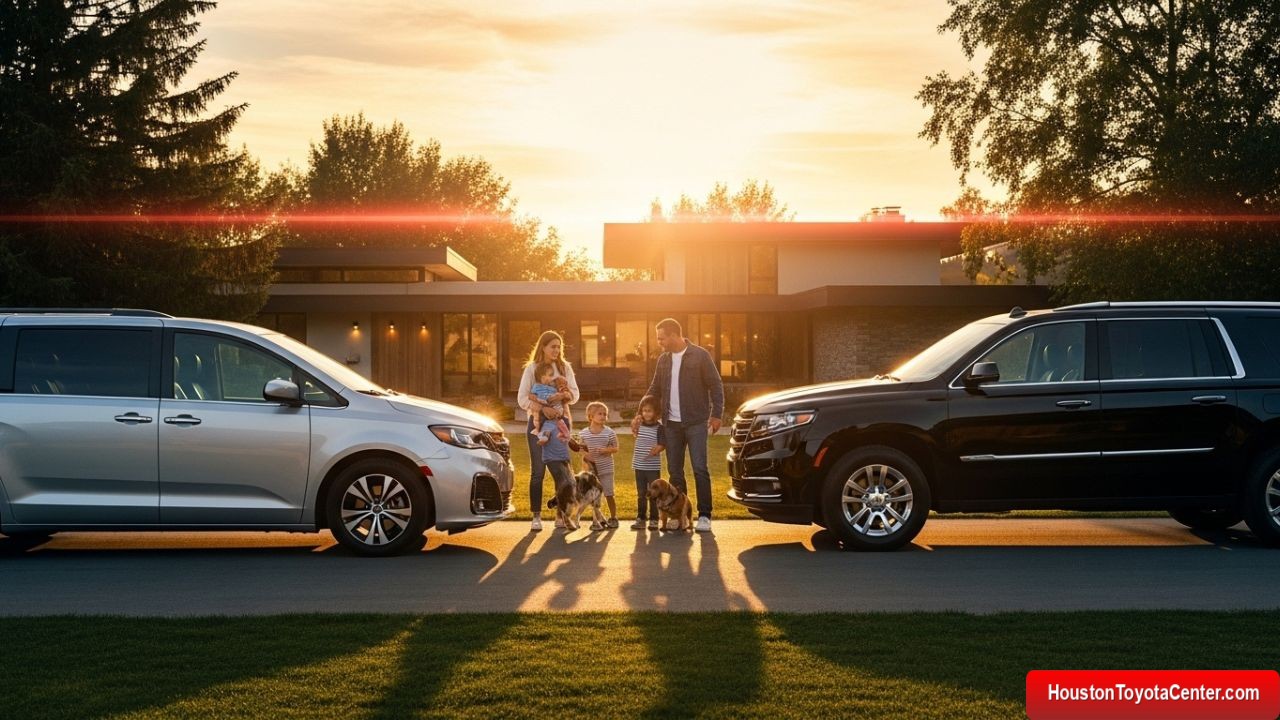
When your family starts to grow, one of the most important decisions you’ll make is choosing a vehicle that fits your needs. Whether it’s for school drop-offs, weekend road trips, or daily errands, space, comfort, and safety become top priorities. That’s where the age-old debate between minivans and 3-row SUVs comes in.
Both vehicle types promise room for passengers and cargo, but they approach the family transport problem differently. Minivans are purpose-built for families, with sliding doors, low floors, and flexible seating. 3-row SUVs, on the other hand, deliver a mix of power, style, and versatility — often appealing to those who want a family vehicle that doesn’t scream “parent-mobile.”
So, which one truly wins for large families? Let’s break it down in detail.
🧍♂️🧍♀️🧍♀️ Space and Comfort
When it comes to large families, space is king. Everyone needs a comfortable seat, and there should be enough room for backpacks, groceries, and maybe even a stroller or two.
FREE: Quickly identify and understand problems with your vehicle 🚘
CLICK HERE🚌 Minivans
Minivans typically offer the most usable interior space. Because they’re designed for passengers first, they often come with:
- Three rows of adult-sized seats
- Flat floors for easy movement between rows
- Sliding doors for easy access, especially in tight parking spots
- Deep cargo wells behind the third row
Popular models like the Toyota Sienna, Honda Odyssey, and Chrysler Pacifica are known for best-in-class space efficiency.
Minivans also provide more legroom in the third row compared to most SUVs, meaning even adults can sit comfortably for long trips.
🚙 3-Row SUVs
3-row SUVs like the Toyota Highlander, Ford Explorer, and Kia Telluride offer good space too, but often with a few trade-offs.
The third row in most SUVs is smaller and harder to access, often suitable for kids or short adults. The cargo area behind the third row is usually shallower as well, especially when all seats are in use.
However, SUVs tend to feel roomier vertically, thanks to higher ride heights and larger windows — giving passengers an airy feeling even in tighter quarters.
📏 Interior Space Comparison Table
| Feature | Minivans | 3-Row SUVs |
|---|---|---|
| Third-Row Legroom | ✅ Excellent | ⚠️ Limited in most models |
| Cargo Behind Third Row | ✅ Deep and spacious | ⚠️ Shallow in many models |
| Access to Rear Seats | ✅ Sliding doors, walk-through center | ⚠️ Fold or tilt seat entry |
| Seating Height | ⚠️ Lower | ✅ Higher and commanding |
| Cabin Flexibility | ✅ Very high (removable or stowable seats) | ⚠️ Moderate |
👉 Verdict: For pure passenger comfort and usability, minivans win easily.
⚙️ Power, Performance, and Towing
Families who live in areas with hills, snow, or off-road terrain often prioritize performance and capability.
🚙 SUVs: The Power Advantage
Most 3-row SUVs come with stronger engines, often V6 or turbocharged four-cylinders. Some, like the Toyota Highlander Hybrid, even combine power and efficiency.
SUVs usually offer all-wheel drive (AWD) or even four-wheel drive (4WD) — great for snowy climates or camping trips.
Additionally, SUVs often boast higher towing capacities, making them ideal if your family likes to tow boats, campers, or trailers.
| Example | Engine Type | Towing Capacity |
|---|---|---|
| Toyota Highlander | V6 or Hybrid | Up to 5,000 lbs |
| Ford Explorer | Turbo 4 or V6 | Up to 5,600 lbs |
| Kia Telluride | V6 | Up to 5,000 lbs |
🚌 Minivans: Smooth and Efficient
Minivans are typically front-wheel drive (though the Toyota Sienna offers AWD). They prioritize smooth, car-like handling and better fuel economy.
While towing isn’t their strong suit, most can handle up to 3,500 pounds, which is enough for small trailers or bikes.
| Example | Engine Type | Towing Capacity |
|---|---|---|
| Toyota Sienna Hybrid | 2.5L Hybrid | Up to 3,500 lbs |
| Honda Odyssey | 3.5L V6 | Up to 3,500 lbs |
👉 Verdict: If you need power and towing, go SUV. If you want smooth driving and fuel savings, go minivan.
🧳 Cargo and Storage Solutions
Large families come with a lot of stuff: sports gear, strollers, groceries, luggage, and sometimes pets.
🚌 Minivans
Minivans dominate here. The deep cargo well behind the third row means you can fit several suitcases even with all seats up. When you fold or remove seats, the cargo space becomes massive — often over 140 cubic feet.
Some models, like the Chrysler Pacifica, feature Stow ’n Go seats that fold flat into the floor, creating a perfectly flat cargo area.
🚙 3-Row SUVs
SUVs have a smaller cargo area when all three rows are in use. However, when the third row is folded, many SUVs provide ample flat space — great for bulkier items or road trips.
SUVs also allow roof rack storage, useful for camping gear or sports equipment.
| Metric | Minivan | 3-Row SUV |
|---|---|---|
| Cargo Behind 3rd Row | 30–40 cu. ft. | 12–20 cu. ft. |
| Max Cargo (Seats Down) | 140–160 cu. ft. | 80–100 cu. ft. |
| Underfloor Storage | ✅ Yes (some models) | ⚠️ Rare |
👉 Verdict: Minivans are unbeatable in cargo flexibility.
🛞 Drive Feel and Handling
How the vehicle feels to drive is another major factor — especially if you’ll be behind the wheel for hours.
🚙 SUVs
SUVs sit higher, providing a commanding view of the road. Many families love this elevated driving position for the sense of safety and visibility.
However, due to their higher center of gravity, SUVs may feel less stable in sharp turns. Parking can also be more challenging in tight spaces.
Modern SUVs like the Hyundai Palisade or Toyota Highlander handle much better than older models, offering car-like steering with a confident, planted feel.
🚌 Minivans
Minivans have lower centers of gravity and are often built on car-like platforms, resulting in smooth, predictable handling.
They’re easier to park, easier to enter and exit, and provide less body roll during turns — making them excellent for city driving or long-distance comfort.
👉 Verdict: Minivans offer easier handling, while SUVs provide a more rugged and elevated experience.
🛡️ Safety and Family Features
Safety is non-negotiable for families. Thankfully, both minivans and SUVs excel here — but they differ in how they protect and assist passengers.
🚌 Minivans
Minivans are often top-rated in safety tests, with features like:
- Automatic emergency braking
- Lane-keeping assist
- Adaptive cruise control
- Rear-seat reminder systems
- Built-in child-seat anchors (LATCH systems)
Many also include rear occupant alerts and in-cabin cameras to monitor kids in the back.
🚙 SUVs
3-row SUVs come loaded with safety tech as well — especially newer models with Toyota Safety Sense, Ford Co-Pilot360, or Hyundai SmartSense.
However, their higher center of gravity can increase rollover risk compared to lower minivans.
| Feature | Minivans | 3-Row SUVs |
|---|---|---|
| Crash Test Ratings | ✅ Excellent | ✅ Excellent |
| Rollover Risk | ⚠️ Lower | ⚠️ Higher |
| Advanced Safety Tech | ✅ Standard on most | ✅ Standard on most |
| Child Seat Accessibility | ✅ Easier | ⚠️ More difficult in 3rd row |
👉 Verdict: Both are safe, but minivans offer easier child seat access and better visibility.
🧠 Technology and Convenience
Modern families expect modern tech — from entertainment screens to voice assistants.
🚌 Minivans
Minivans shine in family-focused features. Expect options like:
- Rear-seat entertainment systems
- Built-in vacuum cleaners
- Cabin intercoms
- Hands-free sliding doors
- Multiple USB ports for every row
- In-cabin camera view on the infotainment screen
🚙 SUVs
SUVs focus more on luxury and off-road tech:
- Digital instrument clusters
- Panoramic sunroofs
- All-terrain drive modes
- Wireless Apple CarPlay and Android Auto
| Category | Minivans | 3-Row SUVs |
|---|---|---|
| Family Entertainment | ✅ Excellent | ⚠️ Optional |
| Luxury Feel | ⚠️ Moderate | ✅ High |
| Tech for Kids | ✅ Abundant | ⚠️ Limited |
| Off-Road Capability | ⚠️ Low | ✅ High (some models) |
👉 Verdict: For families, minivans win on convenience, but SUVs win on luxury.
💰 Cost of Ownership
Budget matters — not only the price tag but also long-term expenses like maintenance, fuel, and insurance.
| Cost Factor | Minivans | 3-Row SUVs |
|---|---|---|
| Purchase Price | 💲💲 | 💲💲💲 |
| Fuel Efficiency | ✅ Better | ⚠️ Lower (unless hybrid) |
| Insurance Rates | ✅ Usually lower | ⚠️ Often higher |
| Maintenance Costs | ⚖️ Similar | ⚖️ Similar |
| Resale Value | ⚠️ Slightly lower | ✅ Higher on average |
👉 Verdict: Minivans are cheaper to buy and run, but SUVs hold value better over time.
🌦️ Lifestyle Fit
Your lifestyle may dictate which vehicle suits you best.
| Family Type / Lifestyle | Best Choice | Why |
|---|---|---|
| Large families (5–8 members) | 🚌 Minivan | More seating comfort and storage |
| Outdoor adventurers | 🚙 SUV | AWD, towing, and ground clearance |
| City drivers | 🚌 Minivan | Easier parking and access |
| Style-conscious parents | 🚙 SUV | Sporty looks and prestige |
| Budget-focused buyers | 🚌 Minivan | Lower total cost of ownership |
🏁 Final Verdict: Which One Is Better?
Ultimately, there’s no one-size-fits-all answer — but here’s how the showdown plays out:
| Category | Winner |
|---|---|
| Space and Comfort | 🚌 Minivan |
| Performance & Towing | 🚙 SUV |
| Cargo Flexibility | 🚌 Minivan |
| Safety & Child Access | 🚌 Minivan |
| Tech & Convenience | 🚌 Minivan |
| Style & Status | 🚙 SUV |
| Resale Value | 🚙 SUV |
| Cost Efficiency | 🚌 Minivan |
🏆 Overall Winner: Minivan (for most large families)
Minivans offer unbeatable practicality, comfort, and value. They may not have the rugged charm of SUVs, but when it comes to real-world family life — carpooling, errands, and vacations — they simply make life easier.
However, if your family loves adventure, needs towing power, or prioritizes style, a 3-row SUV may be the better emotional (and aesthetic) fit.
💬 Final Thoughts
Think about your daily routine, family size, and weekend plans. Are you more likely to be shuttling kids to school or exploring mountain trails?
If convenience, comfort, and kid-friendly design top your list, go for a minivan.
If you crave versatility, higher ground clearance, and towing strength, a 3-row SUV might just win your heart.
No matter your choice, modern family vehicles today are safer, smarter, and more capable than ever — making it an exciting time to upgrade your ride.
Leave a Reply