
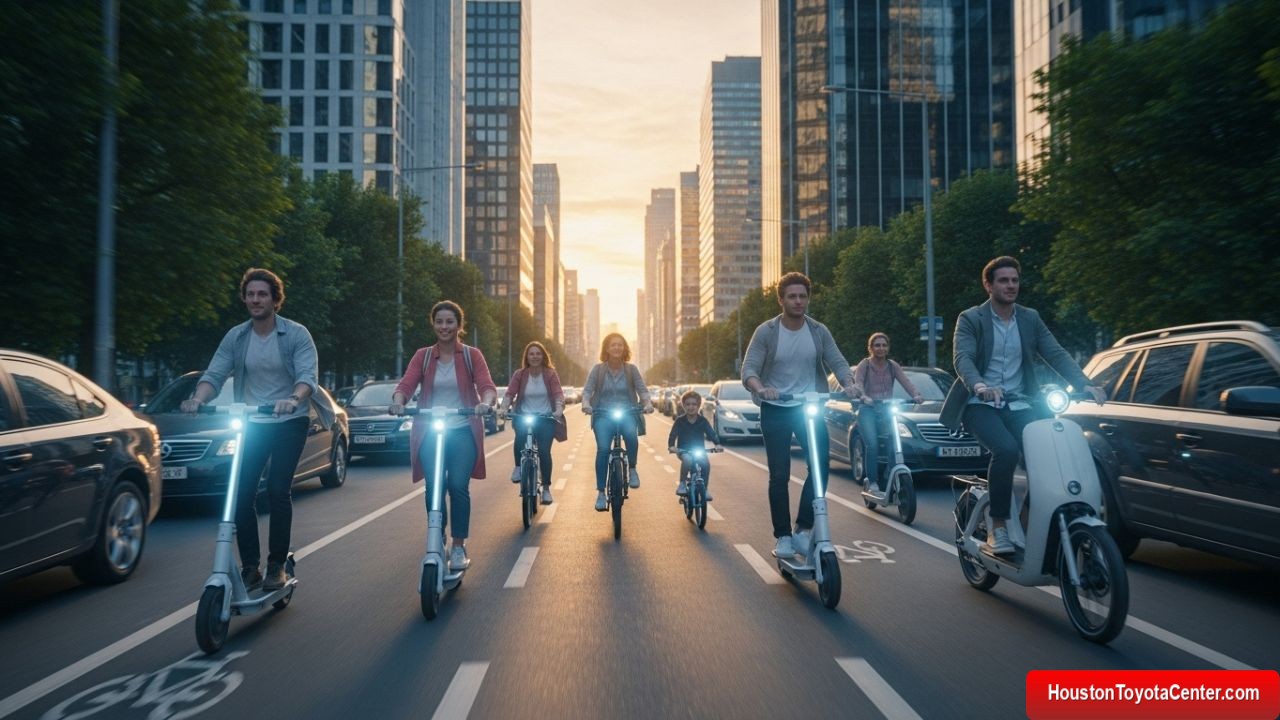
The rise of micro-mobility—shared scooters, electric bikes, and compact e-vehicles—has sparked a quiet revolution in how people move through cities. Once seen as novelties, these small and agile forms of transport are now central to urban mobility strategies, challenging the dominance of cars and reshaping traffic, infrastructure, and even car ownership itself.
In Houston, Los Angeles, Paris, and beyond, the hum of electric scooters and the steady rhythm of pedal-assist bikes are becoming as common as the roar of engines. But what does this shift really mean for how people use cars? And how does it change city life, the environment, and even our sense of freedom?
Let’s dive deep into the transformative impact of micro-mobility and uncover how scooters and bikes are not just convenient alternatives—but fundamental disruptors of car-centric culture.
🚲 From Niche to Necessity: The Rise of Micro-Mobility
Micro-mobility encompasses small, lightweight vehicles typically used for short trips—bikes (traditional and electric), e-scooters, hoverboards, and even compact seated e-scooters. What started as a startup experiment in the late 2010s has become a multi-billion-dollar global industry.
FREE: Quickly identify and understand problems with your vehicle 🚘
CLICK HEREKey Drivers of Growth:
- Urban congestion: With traffic in major cities worsening each year, people are searching for faster, cheaper, and more flexible options.
- Environmental awareness: As climate change becomes a daily concern, sustainable travel is not a luxury—it’s a necessity.
- Digital platforms: Smartphone apps make it effortless to locate, unlock, and pay for a scooter or bike within seconds.
- Economic factors: Rising fuel costs and car maintenance prices push many commuters to consider cheaper mobility options.
According to McKinsey & Company, micro-mobility could account for 15% to 20% of urban trips under five miles by 2030.
That’s not a minor adjustment—it’s a seismic shift in how we move.
🚗 The Relationship Between Micro-Mobility and Car Use
For decades, cars symbolized independence and efficiency. But as cities grow denser and parking becomes scarce, the car’s dominance is being challenged. Micro-mobility doesn’t necessarily eliminate the car—it complements or replaces it in specific contexts.
| Trip Type | Typical Distance | Common Choice Before | Micro-Mobility Alternative |
|---|---|---|---|
| Commutes under 3 miles | 1–3 miles | Car or bus | E-scooter / E-bike |
| First & last-mile to transit | 0.5–2 miles | Walking or rideshare | Shared scooter or bike |
| Quick errands | <2 miles | Car | E-bike or manual bike |
| Weekend leisure | 2–6 miles | Car | E-bike / scooter |
| Tourist travel | 1–5 miles | Taxi or rental car | Shared scooter or bike |
The Core Change:
Micro-mobility reduces short-distance car trips, especially those under three miles—the segment that makes up over 50% of all urban car journeys. This shift saves fuel, reduces emissions, and cuts congestion dramatically.
🌍 Environmental Impact: Small Wheels, Big Difference
The average car emits about 404 grams of CO₂ per mile, while an electric scooter emits roughly 30–50 grams per mile, depending on energy sources. Even when factoring in manufacturing and maintenance, scooters and bikes remain far cleaner.
Comparative Emissions (per passenger-mile):
| Mode | CO₂ Emissions (grams) | Relative to Car |
|---|---|---|
| Gasoline Car | 404 | 100% |
| Electric Car | 200 | 50% |
| E-Bike | 25 | 6% |
| E-Scooter | 35 | 9% |
| Traditional Bicycle | 0 | 0% |
That’s not just an incremental improvement—it’s a tenfold reduction in emissions for the same trip.
Cities that adopt micro-mobility infrastructure—bike lanes, charging stations, and shared-vehicle parking—see measurable improvements in air quality and noise levels.
In Paris, for instance, the expansion of protected cycling lanes has helped reduce car traffic in central districts by over 30% in five years. Similarly, in Houston, local pilot programs for e-scooters have shown promise in reducing short car rides near major transit stations.
🚶♂️ The Human Factor: Freedom, Accessibility, and Equity
Beyond emissions, micro-mobility empowers people in unique ways. It fills gaps left by public transportation and extends access to mobility for those who may not afford a car.
Accessibility Benefits:
- Low cost: Renting a scooter for a few minutes costs a fraction of what ridesharing or car ownership does.
- No license required: Most micro-mobility options are open to anyone aged 18+.
- Flexible routes: Users can reach destinations outside of standard bus or train coverage.
- Health benefits: Biking promotes cardiovascular fitness, while even short rides increase outdoor activity.
Micro-mobility is particularly transformative for lower-income users who live in areas underserved by public transit. In that sense, scooters and bikes are not luxuries—they’re mobility equalizers.
🏙️ Urban Infrastructure: A Shift in City Design
City planning is evolving fast. Streets once dominated by cars are being redesigned for mixed mobility. Protected bike lanes, shared spaces, and e-scooter parking hubs are becoming standard urban features.
Infrastructure Evolution:
| Traditional City Design | Modern Micro-Mobility Design |
|---|---|
| Wide car lanes | Narrowed lanes + bike/scooter paths |
| Curbside parking | Charging/parking docks |
| Few sidewalks | Pedestrian-priority zones |
| Car-focused intersections | Mixed-mode signals and crossings |
Example: Houston’s Downtown Bikeway Network is integrating scooter-compatible paths alongside protected bike lanes, linking office districts with transit centers and residential areas.
By doing this, cities reduce congestion, increase safety, and improve economic activity in dense urban areas.
⚡ The Technology Behind the Movement
Micro-mobility relies heavily on tech innovation. What makes these systems viable today is the integration of IoT (Internet of Things), AI-powered fleet management, and real-time GPS tracking.
Key Technological Elements:
- Smart Locks: Enable seamless app-based unlocking and anti-theft protection.
- Geofencing: Defines areas where scooters can operate or park.
- Battery Swapping Systems: Allow operators to replace depleted batteries quickly.
- Data Analytics: Helps cities plan infrastructure based on usage patterns.
- AI Predictive Maintenance: Detects wear and tear before breakdowns occur.
These technologies transform what used to be simple mechanical devices into smart mobility platforms, collecting valuable insights for future transportation planning.
💡 Behavioral Change: Redefining the Meaning of “Ownership”
One of the most profound shifts micro-mobility brings is a cultural one. The traditional concept of car ownership—having your own vehicle as a status symbol—is losing its appeal among younger generations.
According to Deloitte’s 2024 Global Automotive Consumer Study:
- Over 60% of Gen Z urban residents would rather share or rent vehicles than own one.
- 48% of respondents said they would consider giving up their car if reliable micro-mobility options existed in their city.
This mindset aligns with broader trends toward a sharing economy and environmental minimalism.
🛴 Challenges and Criticisms
Of course, not everything about micro-mobility is perfect. Cities and operators still face challenges in regulation, safety, and maintenance.
Common Issues:
- Safety Concerns – Accidents involving scooters are rising, particularly where protective lanes are lacking.
- Sidewalk Clutter – Poorly parked scooters can obstruct pedestrian access.
- Battery Waste – Disposal and recycling of lithium-ion batteries require careful management.
- Vandalism and Theft – Shared vehicles often face damage or misuse.
- Uneven Access – Some neighborhoods have abundant scooters; others have none.
However, these issues are manageable through policy and design. Smart parking systems, designated lanes, and data-driven distribution models are already improving the experience.
🌆 Economic Ripple Effects
Micro-mobility doesn’t just change transportation—it also revitalizes local economies.
- Increased local spending: Users often stop at cafes, small stores, or local attractions during rides.
- Job creation: Fleet maintenance, charging operations, and logistics support thousands of workers.
- Reduced infrastructure costs: Roads, parking lots, and gas stations require costly upkeep; lighter mobility reduces this burden.
In 2023, the global micro-mobility market was valued at around $70 billion, projected to surpass $200 billion by 2030. That means micro-mobility isn’t a trend—it’s an economic pillar in the making.
🏡 The Suburban and Rural Challenge
While micro-mobility thrives in cities, its expansion into suburban or rural areas is slower. The reasons are straightforward:
- Greater distances make scooters or bikes impractical.
- Lack of dedicated lanes makes riding unsafe.
- Fewer digital infrastructure investments outside cities.
Yet, suburban integration could emerge through multi-modal hubs, where users ride an e-bike to a train or carpool station—creating seamless transitions between mobility modes.
🧭 Policy and Regulation: The Need for Balance
Cities must balance innovation with order. Regulations determine how operators deploy fleets, where vehicles can park, and what safety measures apply.
Best Practices Emerging Worldwide:
- Speed limits: Usually 15–20 mph for e-scooters.
- Helmet incentives: Some cities require or encourage helmets.
- Parking zones: Designated “drop zones” reduce clutter.
- Data sharing: Operators share anonymized trip data with city planners.
- Fleet caps: Limit the number of active scooters per area.
Policies that are too strict risk stifling innovation. Too lenient, and cities face chaos. The most successful programs—like those in Copenhagen, Paris, and Austin—find a healthy balance between freedom and control.
🔋 Integration with Public Transit
Perhaps the most powerful transformation is how micro-mobility connects with buses, metros, and trains. Known as “first-mile/last-mile” integration, scooters and bikes bridge the gap between home and transit stops.
For example:
- A commuter in Houston may scooter two miles from home to the nearest metro line.
- After exiting downtown, they might bike the last mile to their office.
This connectivity increases public transit usage and reduces reliance on private vehicles. In fact, a study by the National Association of City Transportation Officials (NACTO) found that cities with integrated micro-mobility saw up to 12% increases in public transit ridership.
🌱 Cultural Shifts: Lifestyle and Identity
Micro-mobility isn’t just transportation—it’s lifestyle branding. Riding a bike or scooter reflects values of sustainability, urban awareness, and freedom. Many young professionals even choose apartments or jobs based on proximity to bike lanes or scooter zones.
This cultural rebranding of movement reshapes cities socially:
- Neighborhoods with micro-mobility access see higher social interaction.
- Local businesses gain from increased foot and wheel traffic.
- People feel more connected to their communities—literally and emotionally.
🏁 What the Future Holds
The future of micro-mobility will likely include:
- Smarter vehicles with AI navigation and safety sensors.
- Battery standardization across scooters and bikes.
- Integration with autonomous vehicles and smart cities.
- Subscription-based models, where users pay monthly for unlimited access to multiple vehicle types.
Imagine a single app where you can unlock any vehicle—from scooters to shared EVs—seamlessly navigating through your city. That’s the direction we’re heading.
💬 Final Thoughts: Rethinking the Role of Cars
Micro-mobility isn’t about eliminating cars; it’s about giving people choices. Cars will remain essential for long-distance travel, families, and heavy transport. But for most daily commutes, scooters and bikes are proving more efficient, sustainable, and enjoyable.
In a way, the micro-mobility revolution is a return to human-scale transportation—where movement feels personal again, not mechanical.
As cities evolve, the hum of engines will mix with the quiet whir of electric wheels—and that harmony might just redefine what freedom of movement means in the 21st century.
🧾 Summary Table: Micro-Mobility vs. Car Use
| Aspect | Cars | Micro-Mobility (Bikes/Scooters) |
|---|---|---|
| Average Trip Cost | High (fuel, insurance, parking) | Low (per minute or per ride) |
| Emissions | High | Minimal |
| Flexibility | Limited by traffic and parking | Highly flexible |
| Trip Distance | Ideal for long trips | Ideal for short trips |
| Health Benefits | None | Moderate to high |
| Accessibility | Requires license and ownership | App-based, public access |
| Urban Space Use | High (parking, roads) | Minimal |
| Environmental Impact | Negative | Positive |
🌐 Conclusion
Scooters and bikes are not replacing cars—they’re reshaping how we think about cars. In doing so, they redefine urban living, making it more sustainable, inclusive, and connected.
Whether it’s an e-scooter gliding through downtown Houston or a shared bike in Paris, micro-mobility represents a simple but profound idea:
Big change can come from small wheels.
Leave a Reply