
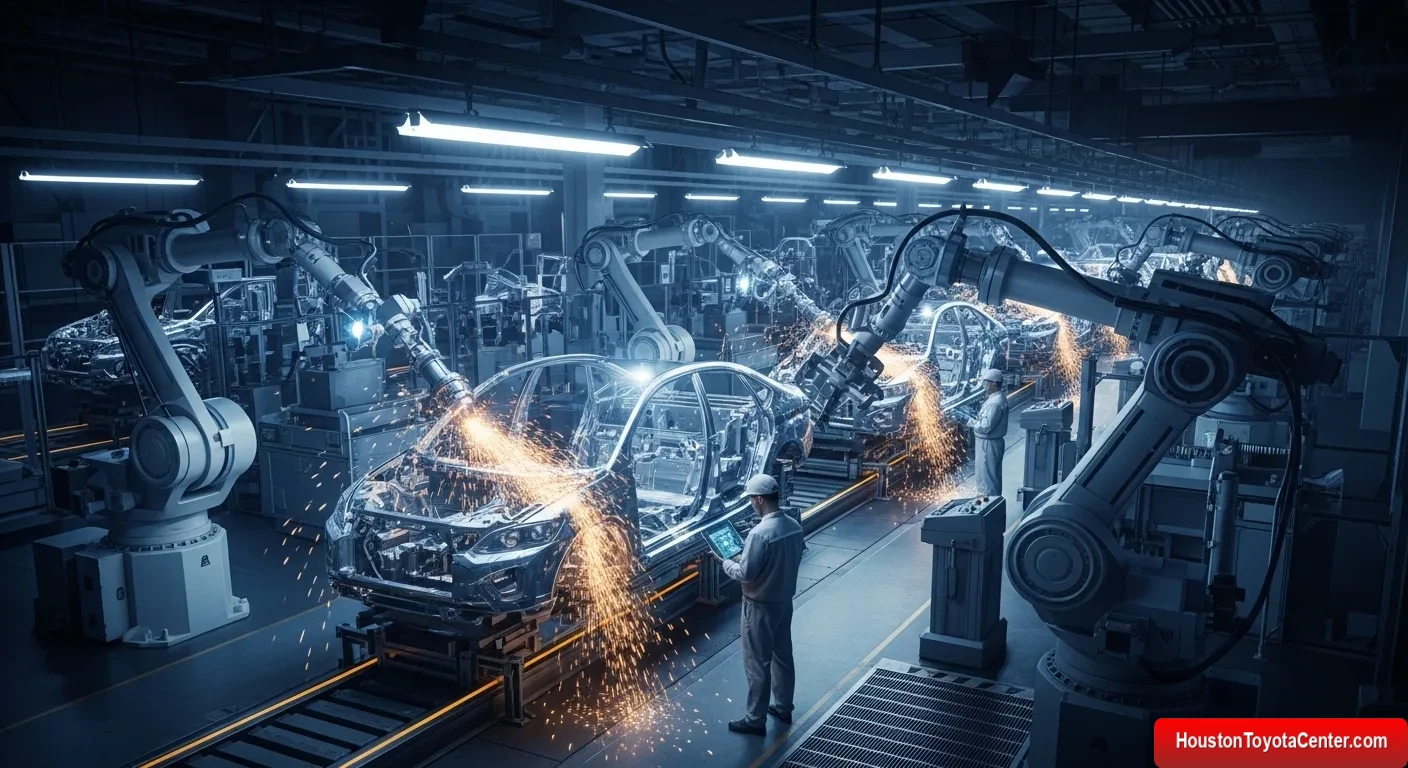
In the global automotive industry, very few names have achieved the level of trust, consistency, and reputation that Toyota Motor Corporation has built over decades. Known for reliability, durability, and high resale value, Toyota vehicles have earned the loyalty of millions of customers worldwide. Whether a car is manufactured in Japan, Brazil, the United States, or Europe, customers generally expect the same dependable quality.
Maintaining this level of consistency across dozens of manufacturing plants in different countries is an extraordinary challenge. Differences in labor skills, supply chains, cultural practices, regulatory requirements, and production environments could easily create inconsistencies. Yet Toyota has successfully maintained high standards globally through a combination of philosophy, systems, technology, training, and continuous improvement.
The secret lies not in one single strategy but in an integrated approach known worldwide as the Toyota Production System, supported by a deeply ingrained corporate culture built on long-term thinking, respect for people, and relentless improvement.
This article explores how Toyota maintains quality across the globe, examining the systems, principles, technologies, and human factors that allow the company to produce millions of vehicles each year while maintaining exceptional consistency.
FREE: Quickly identify and understand problems with your vehicle 🚘
CLICK HEREThe Philosophy Behind Toyota’s Quality
Quality at Toyota is not just a technical objective—it is a cultural value embedded throughout the company.
Toyota’s philosophy is guided by the The Toyota Way, which rests on two main pillars:
| Principle | Meaning | Impact on Quality |
|---|---|---|
| Continuous Improvement | Always look for ways to improve processes and eliminate waste | Prevents stagnation and encourages innovation |
| Respect for People | Value employees, suppliers, and partners | Builds collaboration and accountability |
This philosophy influences every decision within the organization, from factory floor operations to executive strategy. Employees are empowered to identify problems and propose solutions rather than simply follow instructions.
Toyota believes quality is not something inspected at the end of the production line. Instead, it must be built into every step of the process.
The Toyota Production System (TPS)
The Toyota Production System is widely considered one of the most influential manufacturing systems ever created. Many modern production frameworks—including Lean Manufacturing—are derived from it.
TPS focuses on eliminating waste, improving efficiency, and maintaining strict quality control.
The system revolves around two core concepts:
| Concept | Description |
|---|---|
| Just-in-Time | Producing only what is needed, when it is needed |
| Jidoka | Automation with human intelligence |
Just-in-Time Production
Just-in-Time ensures that parts arrive exactly when they are required in the assembly process. This approach reduces inventory costs but also creates strong incentives for quality.
If defective parts enter the system, production stops immediately because there is no buffer inventory. This forces problems to be addressed quickly.
Jidoka: Built-in Quality
Jidoka allows machines and workers to stop production whenever a defect is detected.
Unlike traditional manufacturing systems where workers continue production despite problems, Toyota encourages stopping the line to fix the issue immediately. This prevents defective products from moving further down the production process.
Global Standardization of Processes
One of Toyota’s most powerful tools for maintaining global quality is standardized work.
Every task in a Toyota factory is carefully documented, measured, and standardized. Workers follow precise instructions regarding:
- Work sequence
- Timing
- Tools
- Safety procedures
- Quality checkpoints
Because these standards are documented and continuously refined, Toyota factories around the world can replicate the same processes.
| Element of Standardized Work | Purpose |
|---|---|
| Work Instructions | Ensures tasks are performed consistently |
| Takt Time | Aligns production speed with customer demand |
| Standard Inventory | Maintains correct part levels |
| Quality Checks | Identifies defects early |
Standardization creates a baseline for improvement. Once a process is standardized, employees can focus on improving it.
Continuous Improvement (Kaizen)
A central concept in Toyota’s culture is Kaizen.
Kaizen encourages employees at all levels to propose small improvements regularly.
Instead of relying solely on top-down innovation, Toyota collects ideas from workers directly involved in the production process.
Example of Kaizen in Practice
Imagine a worker noticing that reaching for a tool requires unnecessary movement. By repositioning the tool, the worker may save a few seconds per cycle.
Individually, this improvement seems minor. But when multiplied across thousands of vehicles per day, the efficiency gains become enormous.
| Source of Improvement | Contribution |
|---|---|
| Line Workers | Practical operational insights |
| Engineers | Technical optimization |
| Managers | Strategic alignment |
| Suppliers | Component-level improvements |
This culture ensures that quality improvements never stop.
Supplier Quality Integration
Toyota does not treat suppliers as interchangeable vendors. Instead, it develops long-term partnerships.
Many of Toyota’s suppliers have worked with the company for decades. These suppliers are deeply integrated into Toyota’s production system.
Toyota works closely with suppliers to ensure:
- Shared quality standards
- Transparent communication
- Continuous process improvement
Suppliers are trained in the same methodologies used inside Toyota factories.
| Supplier Collaboration Strategy | Result |
|---|---|
| Long-term contracts | Stability and trust |
| Shared improvement programs | Higher component quality |
| On-site training | Process alignment |
| Joint problem-solving | Faster issue resolution |
This network approach creates a supply chain that functions almost like an extension of Toyota itself.
Global Training and Workforce Development
Toyota invests heavily in training employees to ensure consistent skills worldwide.
New workers undergo extensive onboarding programs that cover:
- Production system principles
- Quality control techniques
- Safety procedures
- Problem-solving methods
In many regions, Toyota operates dedicated training centers.
One of the most famous examples is the Toyota Institute, which helps develop leadership and technical capabilities across the company.
Training often includes:
| Training Method | Purpose |
|---|---|
| Classroom instruction | Teach theoretical concepts |
| Simulation training | Practice production scenarios |
| On-the-job training | Build real experience |
| Mentorship programs | Transfer knowledge |
Experienced employees coach new hires to ensure knowledge continuity.
The Andon System: Real-Time Problem Detection
Toyota factories use visual systems to detect problems instantly.
One of the most well-known tools is the Andon System.
Workers can pull a cord or press a button to signal an issue on the production line.
When activated, the system:
- Alerts supervisors
- Displays the problem on visual boards
- Slows or stops the production line
This system ensures that problems are addressed immediately rather than hidden.
| Andon Feature | Benefit |
|---|---|
| Visual alerts | Immediate awareness |
| Line stop capability | Prevents defect propagation |
| Team response | Faster resolution |
The Andon system reinforces Toyota’s philosophy that identifying problems is a positive action.
Quality Control Circles
Another key practice used across Toyota facilities is quality control circles.
These are small groups of employees who regularly meet to analyze problems and suggest improvements.
Quality circles empower workers to:
- Analyze defects
- Improve workflows
- Reduce waste
- Increase safety
| Benefit of Quality Circles | Outcome |
|---|---|
| Worker involvement | Higher engagement |
| Local problem-solving | Faster improvements |
| Collective learning | Knowledge sharing |
These teams play an essential role in maintaining consistent standards across different plants.
Global Quality Audits
Toyota conducts regular quality audits across its worldwide manufacturing network.
These audits assess:
- Production processes
- Component quality
- Safety standards
- Environmental compliance
Audits are performed by internal teams and sometimes external specialists.
| Audit Area | Purpose |
|---|---|
| Manufacturing processes | Ensure consistent methods |
| Supplier facilities | Maintain component quality |
| Final product testing | Verify performance |
| Documentation review | Confirm compliance |
When issues are discovered, corrective actions are implemented quickly.
Advanced Testing and Engineering Standards
Before a Toyota vehicle reaches the market, it undergoes extensive testing.
Vehicles are tested in extreme conditions including:
- Desert heat
- Arctic cold
- High-altitude environments
- Rough terrain
Testing facilities exist around the world to simulate different driving conditions.
This rigorous validation ensures vehicles can perform reliably regardless of where they are sold.
| Testing Environment | Purpose |
|---|---|
| Cold weather testing | Evaluate engine performance in freezing conditions |
| Heat testing | Ensure cooling systems work in extreme heat |
| Durability testing | Simulate long-term wear |
| Crash testing | Confirm safety compliance |
Toyota engineers aim to identify potential issues long before vehicles reach customers.
Localization Without Compromising Standards
Toyota adapts its vehicles for regional markets while maintaining global quality.
For example, vehicles sold in South America may require:
- Stronger suspension systems
- Different fuel compatibility
- Climate-specific components
However, these adaptations are carefully controlled to ensure they do not compromise reliability.
Localization allows Toyota to meet regional needs while preserving its reputation.
Technology and Digital Quality Monitoring
Modern Toyota factories increasingly use advanced technologies such as:
- Artificial intelligence
- Data analytics
- Automated inspection systems
- Smart manufacturing tools
These technologies allow real-time monitoring of production quality.
| Technology | Role in Quality |
|---|---|
| Machine vision | Detect defects automatically |
| Data analytics | Identify patterns and risks |
| IoT sensors | Monitor equipment health |
| Digital twins | Simulate production improvements |
Digital systems enhance human decision-making rather than replacing it.
Lessons from Past Challenges
Even Toyota has faced quality challenges. One notable example was the 2010 Toyota Vehicle Recalls, which involved millions of vehicles worldwide.
The incident led Toyota to strengthen its quality oversight systems.
Changes included:
- Expanded quality review teams
- Faster recall response procedures
- Increased regional decision-making authority
These reforms helped the company reinforce its commitment to safety and quality.
Corporate Culture as the Ultimate Quality Control
Ultimately, Toyota’s global quality success comes from culture.
While processes and technologies are important, they only work when supported by the right mindset.
Toyota encourages employees to:
- Speak up about problems
- Take responsibility for quality
- Focus on long-term results
- Collaborate across teams
This culture ensures that quality is not just the responsibility of inspectors or engineers—it is the responsibility of everyone.
Conclusion
Maintaining consistent quality across a global manufacturing network is one of the most difficult challenges in modern industry. Yet Toyota Motor Corporation has demonstrated that it is possible through a combination of philosophy, systems, and people.
By implementing the Toyota Production System, emphasizing Kaizen, investing heavily in employee training, collaborating closely with suppliers, and continuously improving processes, Toyota has created a manufacturing ecosystem capable of delivering reliable vehicles worldwide.
The company’s approach shows that quality is not simply a technical goal but a strategic and cultural commitment. Every employee, supplier, and engineer contributes to the final product.
As the automotive industry evolves with electrification, automation, and digital transformation, Toyota’s foundational principles remain highly relevant. Its dedication to continuous improvement ensures that the company will continue refining its systems and adapting to new challenges.
The lessons from Toyota extend far beyond the automotive sector. Organizations across industries study Toyota’s methods to learn how to build systems that prioritize quality, efficiency, and long-term success.
Leave a Reply