
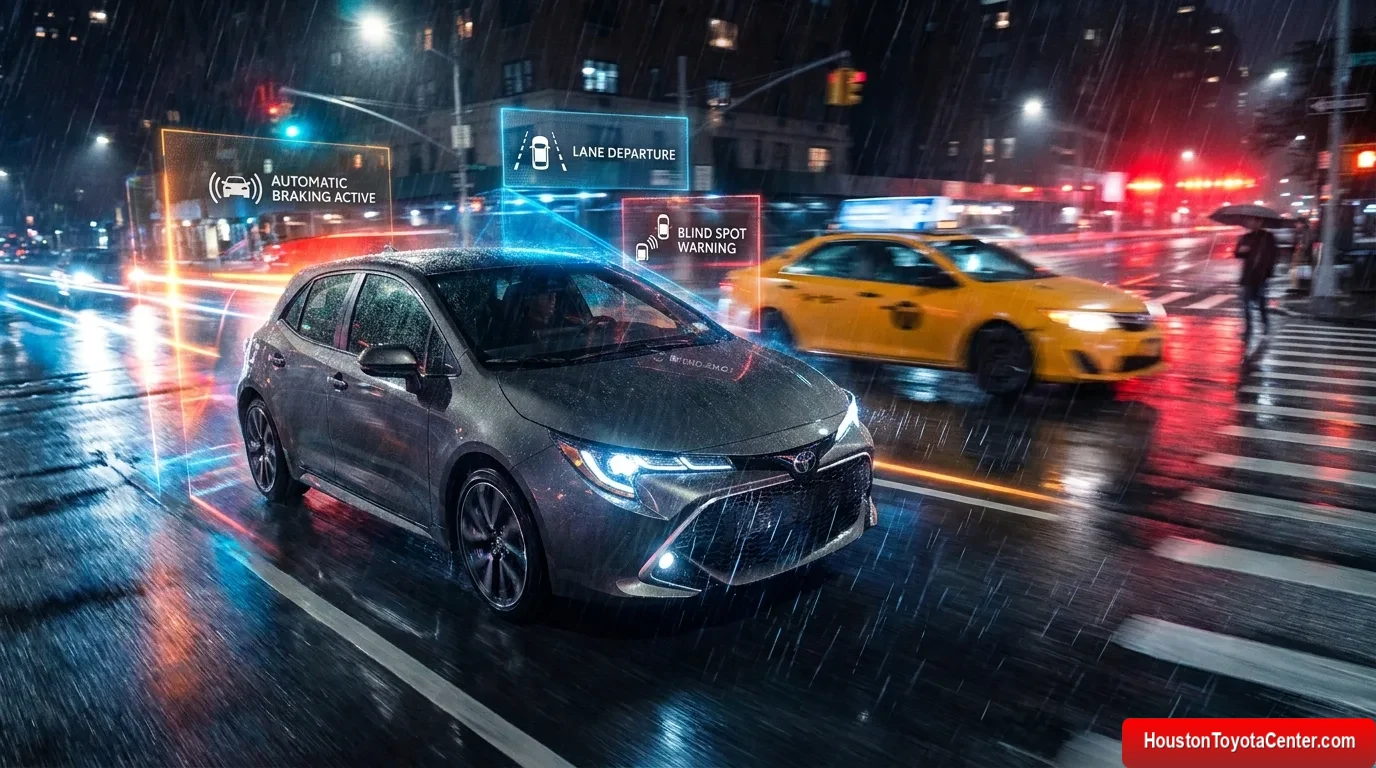
The Toyota Corolla has built a reputation over decades as one of the most dependable compact sedans in the world. While fuel economy, reliability, and resale value often dominate conversations about the Corolla, one of the vehicle’s strongest advantages is its comprehensive approach to safety. Modern Corolla models are packed with advanced driver assistance systems, intelligent crash protection technologies, visibility enhancements, and structural engineering innovations designed to help drivers avoid accidents and protect occupants when collisions occur.
For many buyers, safety is no longer a bonus feature. It is one of the primary deciding factors when choosing a vehicle. Families, commuters, students, rideshare drivers, and long-distance travelers all want confidence behind the wheel. Toyota has responded by integrating sophisticated safety systems into the Corolla lineup, making advanced protection more accessible to mainstream consumers.
This article explores the Corolla’s most important safety features in detail, how they work, why they matter, and how they improve the driving experience in real-world situations.
The Evolution of Safety in the Toyota Corolla
The Corolla has changed dramatically since its early generations. Older models focused primarily on mechanical durability and affordability. As automotive safety technology evolved, Toyota began incorporating passive and active safety systems that transformed the Corolla into a much more advanced vehicle.
FREE: Quickly identify and understand problems with your vehicle 🚘
CLICK HEREToday’s Corolla models include features that were once reserved for luxury vehicles. Technologies such as adaptive cruise control, lane tracing assistance, automatic emergency braking, and pedestrian detection are now standard or widely available.
Toyota’s philosophy centers around two major safety categories:
- Active Safety: Features designed to prevent accidents.
- Passive Safety: Features intended to reduce injury during collisions.
The Corolla combines both categories effectively, creating a layered protection strategy that helps drivers stay aware, react faster, and survive crashes with fewer injuries.
Toyota Safety Sense: The Foundation of Corolla Safety
One of the most important developments in Corolla safety is the introduction of Toyota Safety Sense, commonly abbreviated as TSS. This suite of advanced safety technologies integrates multiple driver assistance systems into one coordinated package.
Depending on the Corolla model year and trim level, drivers may encounter different versions such as:
- Toyota Safety Sense P
- Toyota Safety Sense 2.0
- Toyota Safety Sense 2.5
- Toyota Safety Sense 3.0
Each generation introduced more refined sensors, improved cameras, smarter software, and better driver assistance capabilities.
Main Components of Toyota Safety Sense
| Feature | Primary Purpose |
|---|---|
| Pre-Collision System | Helps avoid frontal crashes |
| Lane Departure Alert | Warns when leaving the lane unintentionally |
| Lane Tracing Assist | Helps keep the car centered |
| Dynamic Radar Cruise Control | Maintains following distance |
| Automatic High Beams | Improves nighttime visibility |
| Road Sign Assist | Displays traffic signs |
| Proactive Driving Assist | Provides subtle steering/braking support |
Toyota Safety Sense acts like a digital co-pilot. It cannot replace attentive driving, but it significantly reduces the chances of common human errors leading to severe accidents.
Pre-Collision System With Pedestrian Detection
The Pre-Collision System is arguably one of the Corolla’s most valuable safety features.
Using radar sensors and forward-facing cameras, the system continuously monitors the road ahead for:
- Vehicles
- Pedestrians
- Cyclists
- Potential frontal collision risks
When the system detects an obstacle and determines that a crash is possible, it follows several stages:
- Visual alerts appear.
- Audible warnings sound.
- Brake assistance increases.
- Automatic braking may activate.
Why This Matters
Distracted driving remains one of the leading causes of traffic accidents worldwide. Even a brief moment of inattention can lead to disaster.
The Corolla’s automatic emergency braking capability acts as a backup layer of protection when drivers fail to react quickly enough.
Real-World Benefits
Consider these situations:
- A pedestrian suddenly steps into a crosswalk.
- Traffic ahead stops unexpectedly.
- A cyclist swerves into your lane.
- A distracted driver fails to notice slowing traffic.
The Pre-Collision System can dramatically reduce impact severity or avoid collisions entirely.
Pedestrian and Cyclist Detection
Modern Corolla systems can identify humans and bicycles using advanced image processing algorithms.
This feature is particularly valuable in:
- Urban driving
- School zones
- Busy intersections
- Parking lots
- Residential neighborhoods
At night, visibility becomes more challenging. Enhanced detection systems help compensate for reduced human perception.
Lane Departure Alert
Lane Departure Alert helps prevent one of the most common causes of highway accidents: unintentionally drifting out of a lane.
The system uses cameras to detect lane markings and monitors whether the vehicle begins moving outside its lane without signaling.
If the Corolla detects unintended lane departure, it can:
- Issue audible warnings
- Display visual notifications
- Vibrate the steering wheel in some versions
- Apply gentle steering correction
Common Causes of Lane Drift
Drivers may unintentionally leave their lanes due to:
- Fatigue
- Distraction
- Drowsiness
- Looking at navigation systems
- Mobile phone use
- Poor visibility
Lane Departure Alert acts as an additional layer of awareness.
Highway Driving Advantages
Long highway trips can become mentally exhausting. Even experienced drivers lose concentration after hours on the road.
The Corolla’s lane monitoring systems help reduce the risk of:
- Side-swipe accidents
- Run-off-road crashes
- Head-on collisions caused by crossing center lines
This is especially valuable during nighttime driving or bad weather conditions.
Lane Tracing Assist
Lane Tracing Assist goes beyond warning the driver. It actively helps keep the vehicle centered within the lane.
When adaptive cruise control is enabled, the Corolla can make subtle steering adjustments to maintain proper positioning.
How It Works
The system combines:
- Forward camera input
- Lane marker recognition
- Steering assistance technology
The result is smoother highway driving and reduced steering fatigue.
Important Limitations
Lane Tracing Assist is not self-driving technology.
Drivers must:
- Keep their hands on the wheel
- Stay attentive
- Maintain full responsibility for vehicle control
Road conditions, faded lane markings, heavy rain, and snow may affect system performance.
Dynamic Radar Cruise Control
Traditional cruise control maintains speed. Dynamic Radar Cruise Control adds intelligence.
Using radar sensors, the Corolla can automatically adjust speed to maintain a safe following distance from vehicles ahead.
Main Benefits
Reduced Driver Fatigue
Heavy traffic and long-distance driving become less stressful because the system manages acceleration and braking automatically.
Improved Following Distance
Tailgating is a major contributor to rear-end accidents. Radar cruise control encourages safer spacing.
Smoother Driving Experience
The system creates a more relaxed driving environment, especially during highway commuting.
Stop-and-Go Functionality
Some Corolla versions include low-speed follow capability.
This allows the vehicle to:
- Slow to a complete stop
- Resume movement automatically in traffic
- Reduce repetitive driver input in congestion
For commuters dealing with urban traffic every day, this feature can significantly reduce stress.
Automatic High Beams
Night driving presents serious safety challenges.
Automatic High Beams help improve nighttime visibility by switching between high and low beams automatically.
How the System Works
The Corolla monitors:
- Oncoming traffic
- Taillights ahead
- Ambient lighting conditions
When roads are dark and clear, high beams activate.
When another vehicle approaches, the system switches back to low beams to avoid blinding other drivers.
Why It Matters
Many drivers fail to use high beams effectively.
Some leave them on too long, while others avoid using them entirely.
Automatic High Beams improve:
- Nighttime visibility
- Reaction time
- Pedestrian detection
- Animal detection on rural roads
This technology helps drivers see farther without creating unnecessary hazards.
Blind Spot Monitoring
Blind spots are dangerous because mirrors cannot always show adjacent vehicles.
Blind Spot Monitoring uses radar sensors to detect vehicles traveling in neighboring lanes.
When another vehicle enters the blind spot area:
- Warning indicators illuminate on side mirrors
- Additional alerts may appear if the driver attempts a lane change
Why Blind Spot Monitoring Is Important
Highway lane changes are among the most dangerous everyday driving maneuvers.
Blind Spot Monitoring helps reduce:
- Side collisions
- Unsafe lane merges
- Driver uncertainty
This feature is especially valuable in:
- Multi-lane highways
- Dense urban traffic
- Rainy weather
- Nighttime conditions
Rear Cross-Traffic Alert
Backing out of parking spaces can be surprisingly risky.
Large SUVs, vans, walls, and poor visibility often block a driver’s view.
Rear Cross-Traffic Alert helps detect approaching vehicles when reversing.
How It Works
Sensors monitor both sides of the vehicle while backing up.
If another vehicle approaches:
- Audible alerts activate
- Visual warnings appear
Real-World Scenarios
This feature is particularly useful in:
- Crowded shopping centers
- Parking garages
- School pickup zones
- Tight urban parking lots
Rear Cross-Traffic Alert helps compensate for limited visibility and slow driver reaction times.
Backup Camera System
Backup cameras are now standard in many markets, but the Corolla integrates them effectively into its broader safety strategy.
Benefits of Backup Cameras
The rearview camera improves visibility behind the vehicle when reversing.
This helps drivers:
- Avoid obstacles
- Detect pedestrians
- See curbs clearly
- Park more accurately
Child Safety Benefits
One of the most important advantages is reducing backover accidents involving children or pets.
Small objects behind the vehicle may remain invisible through mirrors alone.
The backup camera provides a wider field of view and significantly improves rear awareness.
Parking Assistance Features
Modern Corolla trims may include parking sensors and intelligent parking assistance technologies.
Parking Sensors
Ultrasonic sensors detect nearby obstacles during parking maneuvers.
The system typically provides:
- Beeping alerts
- Distance indicators
- Increasing warning frequency as obstacles get closer
Why Parking Assistance Matters
Parking accidents are extremely common.
Even low-speed impacts can lead to:
- Expensive repairs
- Insurance claims
- Injury risks
- Pedestrian hazards
Parking assistance technologies help drivers navigate tight spaces with greater confidence.
Airbag Protection System
While active safety technologies aim to prevent crashes, airbags protect occupants when collisions occur.
The Corolla includes multiple airbags strategically positioned throughout the cabin.
Typical Airbag Coverage
| Airbag Type | Purpose |
| Front Airbags | Protect head and chest |
| Side Airbags | Reduce side-impact injuries |
| Curtain Airbags | Protect occupants during rollover or side impact |
| Knee Airbags | Reduce lower body injuries |
Advanced Deployment Logic
Modern Corolla airbags use sophisticated sensors to determine:
- Crash severity
- Occupant positioning
- Seatbelt usage
- Collision direction
This allows more intelligent deployment timing and force.
Seatbelt Technologies
Seatbelts remain one of the most effective vehicle safety systems ever developed.
The Corolla includes advanced seatbelt technologies such as:
- Pretensioners
- Force limiters
- Seatbelt reminders
Pretensioners
Pretensioners tighten seatbelts instantly during collisions.
This helps:
- Reduce occupant movement
- Improve airbag effectiveness
- Position passengers correctly
Force Limiters
Force limiters reduce excessive pressure during crashes.
This lowers the risk of chest injuries while still maintaining restraint effectiveness.
Anti-Lock Braking System (ABS)
Anti-Lock Braking Systems prevent wheel lockup during hard braking.
Without ABS, wheels can lock completely during panic stops, causing loss of steering control.
How ABS Helps
The Corolla’s ABS rapidly pulses brake pressure to maintain wheel rotation.
This allows drivers to:
- Maintain steering ability
- Avoid obstacles while braking
- Reduce skidding risks
Emergency Situations
ABS is especially valuable on:
- Wet roads
- Snow
- Gravel
- Slippery surfaces
Drivers can maintain directional control even under heavy braking pressure.
Electronic Stability Control
Electronic Stability Control is one of the most significant automotive safety innovations of the modern era.
The system continuously monitors:
- Steering angle
- Vehicle rotation
- Wheel speed
- Lateral movement
If the vehicle begins losing traction or stability, the system intervenes automatically.
How Stability Control Prevents Crashes
The Corolla may:
- Reduce engine power
- Apply brakes selectively
- Correct understeer
- Correct oversteer
Why This Is Important
Loss-of-control crashes are often severe.
Electronic Stability Control significantly reduces:
- Spinouts
- Rollovers
- Wet-weather accidents
- High-speed instability
Studies consistently show that stability control saves lives.
Traction Control System
Traction Control works closely with stability control.
Its primary goal is preventing wheel spin during acceleration.
Common Scenarios
Traction Control becomes useful when driving on:
- Wet pavement
- Ice
- Loose gravel
- Mud
- Uneven roads
If the wheels begin spinning excessively, the Corolla adjusts power delivery and braking to restore grip.
Benefits
- Improved acceleration stability
- Better control during poor weather
- Reduced slipping risks
- Increased driver confidence
Tire Pressure Monitoring System
Underinflated tires are a major safety concern.
They can lead to:
- Blowouts
- Reduced fuel economy
- Poor handling
- Longer braking distances
- Increased tire wear
The Corolla includes a Tire Pressure Monitoring System that alerts drivers when tire pressure falls below safe levels.
Why Tire Pressure Matters
Proper tire inflation affects:
- Braking performance
- Cornering stability
- Fuel efficiency
- Tire lifespan
A simple warning light can prevent dangerous situations before they escalate.
Advanced Structural Engineering
Safety is not only about electronics.
The Corolla’s body structure is engineered to absorb and distribute crash energy efficiently.
Toyota uses advanced materials and reinforced construction techniques to improve occupant protection.
Crumple Zones
Crumple zones are designed to deform during impacts.
This absorbs energy and reduces force transferred to passengers.
Reinforced Passenger Cell
The passenger compartment is engineered to remain as intact as possible during collisions.
This helps preserve survival space for occupants.
High-Strength Steel
Modern Corolla models incorporate high-strength steel for:
- Increased rigidity
- Improved crash resistance
- Reduced overall weight
- Better fuel efficiency
The combination of structural strength and controlled deformation improves crash outcomes significantly.
Child Safety Features
Families often choose the Corolla because of its practicality and safety.
Toyota includes multiple child-focused safety systems.
LATCH System
The Lower Anchors and Tethers for Children system simplifies child seat installation.
Improperly installed child seats can become dangerous during collisions.
The LATCH system helps ensure:
- Better seat stability
- Easier installation
- Improved crash protection for children
Rear Door Child Locks
Child locks prevent rear doors from opening from inside the vehicle.
This adds an extra layer of protection for families traveling with young children.
Driver Attention and Fatigue Prevention
Modern driving environments are mentally demanding.
Some Corolla safety technologies indirectly help combat fatigue and distraction.
Reduced Cognitive Load
Features such as:
- Adaptive cruise control
- Lane tracing assist
- Traffic sign recognition
reduce the amount of repetitive decision-making required during long drives.
Fatigue Awareness
Although not all Corolla models include dedicated driver monitoring cameras, the vehicle’s assistance systems can help identify inconsistent driving behavior associated with fatigue.
Frequent lane departures, delayed reactions, and unstable steering patterns become easier to detect.
Road Sign Assist
Road Sign Assist uses cameras to identify traffic signs and display them on the instrument cluster.
The system may recognize:
- Speed limits
- Stop signs
- Yield signs
- Do-not-enter signs
Benefits
Drivers can miss signs due to:
- Weather
- Fatigue
- Traffic congestion
- Unfamiliar roads
Road Sign Assist reinforces important information and helps improve situational awareness.
Proactive Driving Assist
Newer Corolla models may include Proactive Driving Assist.
This feature provides subtle support in everyday driving situations.
What It Can Do
The system may:
- Provide gentle braking entering curves
- Support smooth steering inputs
- Help maintain distance from vehicles or pedestrians
Unlike emergency systems that activate only during imminent danger, Proactive Driving Assist works more continuously to encourage safer driving behavior.
Hybrid Corolla Safety Considerations
The Corolla Hybrid includes many of the same safety systems as gasoline models.
However, hybrid technology introduces additional engineering considerations.
Battery Protection
Toyota designs hybrid battery systems with:
- Reinforced housing
- Automatic shutdown mechanisms
- Electrical isolation systems
These protections help reduce risks during severe accidents.
Quiet Operation and Pedestrian Safety
Hybrid vehicles operate quietly at low speeds.
To improve pedestrian awareness, many hybrid Corollas use external sounds to alert nearby people.
This is especially important for:
- Pedestrians
- Cyclists
- Visually impaired individuals
Corolla Safety Ratings
The Corolla consistently performs well in crash testing conducted by major safety organizations.
These evaluations typically examine:
- Frontal crash performance
- Side-impact protection
- Roof strength
- Pedestrian safety
- Driver assistance effectiveness
Strong crash test performance increases buyer confidence and reflects Toyota’s investment in occupant protection.
Why Crash Ratings Matter
Independent testing provides valuable insight into how vehicles perform in controlled accident scenarios.
While no test can predict every real-world collision, high safety ratings generally indicate strong engineering standards.
The Human Factor in Vehicle Safety
Even the most advanced safety technology cannot eliminate human responsibility.
Drivers must still:
- Stay attentive
- Avoid distractions
- Follow traffic laws
- Maintain safe speeds
- Use seatbelts properly
The Corolla’s safety systems are best viewed as support tools rather than replacements for responsible driving.
Common Misunderstandings
Some drivers overestimate what modern driver assistance systems can do.
For example:
- Adaptive cruise control is not autonomous driving.
- Lane assist does not eliminate the need for steering.
- Automatic braking cannot prevent every crash.
Understanding system limitations is essential for safe operation.
Maintenance and Safety Performance
Safety systems require proper maintenance to function effectively.
Important Maintenance Areas
| Component | Why It Matters |
| Tires | Essential for traction and braking |
| Brakes | Critical for stopping performance |
| Sensors | Needed for driver assistance systems |
| Windshield Cameras | Must remain clean and calibrated |
| Suspension | Affects handling stability |
Sensor Calibration
Modern safety technologies rely heavily on cameras and radar systems.
After:
- Windshield replacement
- Collision repairs
- Alignment work
certain systems may require recalibration.
Ignoring calibration needs can reduce system accuracy.
Weather and Environmental Limitations
Although Corolla safety technologies are highly advanced, environmental conditions can still affect performance.
Heavy Rain and Snow
Bad weather may interfere with:
- Camera visibility
- Radar detection
- Lane recognition
Drivers should remain cautious during severe weather regardless of available assistance systems.
Dirty Sensors
Mud, snow, ice, and road debris can obstruct sensors.
Keeping cameras and radar units clean helps maintain optimal performance.
Urban Driving Safety Advantages
The Corolla’s compact size contributes positively to safety in urban environments.
Maneuverability
Smaller dimensions make it easier to:
- Avoid obstacles
- Navigate tight streets
- Park safely
- React quickly in traffic
Visibility
Modern Corolla models generally provide good outward visibility, helping drivers detect hazards more easily.
Combined with electronic safety systems, this improves confidence in crowded city driving conditions.
Highway Safety Strengths
The Corolla also performs well on highways due to its stability-focused design.
Highway Safety Technologies
Features especially valuable on highways include:
- Adaptive cruise control
- Lane tracing assist
- Blind spot monitoring
- Stability control
These systems help reduce fatigue and maintain vehicle stability during long-distance travel.
Safety Features for New Drivers
The Corolla is frequently recommended for younger or less experienced drivers.
Why Beginners Benefit
New drivers often struggle with:
- Following distance judgment
- Lane positioning
- Parking confidence
- Hazard awareness
The Corolla’s assistance systems help compensate for inexperience while encouraging safer habits.
Confidence Building
Features such as backup cameras, parking sensors, and lane alerts help reduce anxiety behind the wheel.
This can lead to more controlled and deliberate driving behavior.
Safety Features for Older Drivers
Older drivers may also benefit significantly from the Corolla’s technologies.
Helpful Features for Aging Drivers
- Automatic emergency braking
- Blind spot monitoring
- Rear cross-traffic alert
- Adaptive cruise control
- Road sign assist
These systems can help compensate for:
- Slower reaction times
- Reduced night vision
- Mobility limitations
- Decreased peripheral awareness
Toyota’s user-friendly interface also makes these technologies relatively easy to understand and operate.
Insurance Benefits of Corolla Safety Systems
Vehicles equipped with advanced safety technologies may qualify for lower insurance premiums.
Insurance companies recognize that systems such as:
- Automatic braking
- Collision avoidance
- Stability control
can reduce accident frequency and repair costs.
Although savings vary by provider and region, safety features can positively influence ownership costs over time.
Comparing Corolla Safety to Competitors
The compact sedan segment is highly competitive.
The Corolla competes with vehicles such as:
- Honda Civic
- Hyundai Elantra
- Nissan Sentra
- Mazda3
- Kia Forte
Toyota distinguishes itself through consistency, reliability, and broad availability of standard safety features.
Competitive Advantages
| Corolla Strength | Why It Matters |
| Standard Safety Systems | More protection at lower trims |
| Reliability | Long-term confidence |
| User-Friendly Technology | Easier learning curve |
| Strong Crash Ratings | Improved occupant protection |
| Hybrid Availability | Efficient and safe transportation |
Toyota’s reputation for durability further enhances the overall value proposition.
Common Driver Mistakes Despite Safety Technology
Even with advanced assistance systems, drivers still make dangerous errors.
Overconfidence
Some drivers become overly reliant on automation.
This can lead to:
- Reduced attentiveness
- Delayed reactions
- Unsafe multitasking
Ignoring Warnings
Repeated alerts may cause some drivers to ignore or disable safety systems.
However, warnings often exist for good reason.
Poor Maintenance
Neglecting tire pressure, brakes, or damaged sensors undermines vehicle safety.
Technology cannot compensate for mechanical neglect.
Future Corolla Safety Innovations
Automotive safety technology continues evolving rapidly.
Future Corolla generations may introduce:
- More advanced driver monitoring
- Enhanced semi-autonomous driving features
- Improved AI hazard prediction
- Better pedestrian detection
- Vehicle-to-vehicle communication
Toyota continues investing heavily in accident prevention technologies.
The long-term industry goal is reducing traffic fatalities dramatically through smarter vehicles and safer infrastructure.
Tips for Maximizing Corolla Safety
Drivers can improve safety further by combining technology with smart habits.
Best Practices
Keep Safety Systems Enabled
Avoid disabling assistance systems unless absolutely necessary.
Maintain Proper Tire Pressure
Check tire pressure regularly.
Clean Cameras and Sensors
Ensure radar and camera systems remain unobstructed.
Stay Updated
Install software updates and complete recommended maintenance.
Practice Defensive Driving
Technology works best when paired with attentive driving habits.
Understanding the Difference Between Assistance and Autonomy
One of the most important concepts modern drivers must understand is the distinction between driver assistance and full autonomy.
The Corolla offers advanced support systems, but it is not a fully self-driving vehicle.
Driver Assistance
The Corolla can:
- Warn drivers
- Support steering
- Assist braking
- Maintain following distance
What It Cannot Reliably Do
The Corolla cannot:
- Understand every road situation perfectly
- Replace human judgment
- Operate safely without supervision
- Predict every unpredictable hazard
Drivers remain fully responsible for vehicle operation at all times.
Why the Corolla Has Become a Trusted Safety Choice
The Corolla’s safety reputation results from a combination of factors:
- Long-term reliability
- Continuous engineering improvements
- Broad availability of advanced safety systems
- Strong crash performance
- Accessible pricing
Toyota has consistently prioritized making safety technology available to everyday drivers instead of restricting it to luxury segments.
This democratization of safety has helped millions of drivers gain access to life-saving technologies.
Final Thoughts
The Toyota Corolla has evolved far beyond its original role as a simple economy car. Today, it represents a highly sophisticated approach to everyday vehicle safety.
From automatic emergency braking and lane assistance technologies to structural crash protection and intelligent driver support systems, the Corolla delivers a comprehensive collection of features designed to help drivers avoid accidents and survive collisions more effectively.
Safety is not about a single technology. It is about layers of protection working together.
The Corolla’s integrated approach combines:
- Active collision prevention
- Driver awareness systems
- Occupant protection technologies
- Structural engineering
- Intelligent electronic assistance
Whether navigating crowded city streets, commuting on highways, driving at night, or transporting family members, these systems contribute to a safer and more confident driving experience.
For buyers seeking a dependable compact car with modern safety innovations, the Corolla remains one of the strongest options in the market.
Leave a Reply