
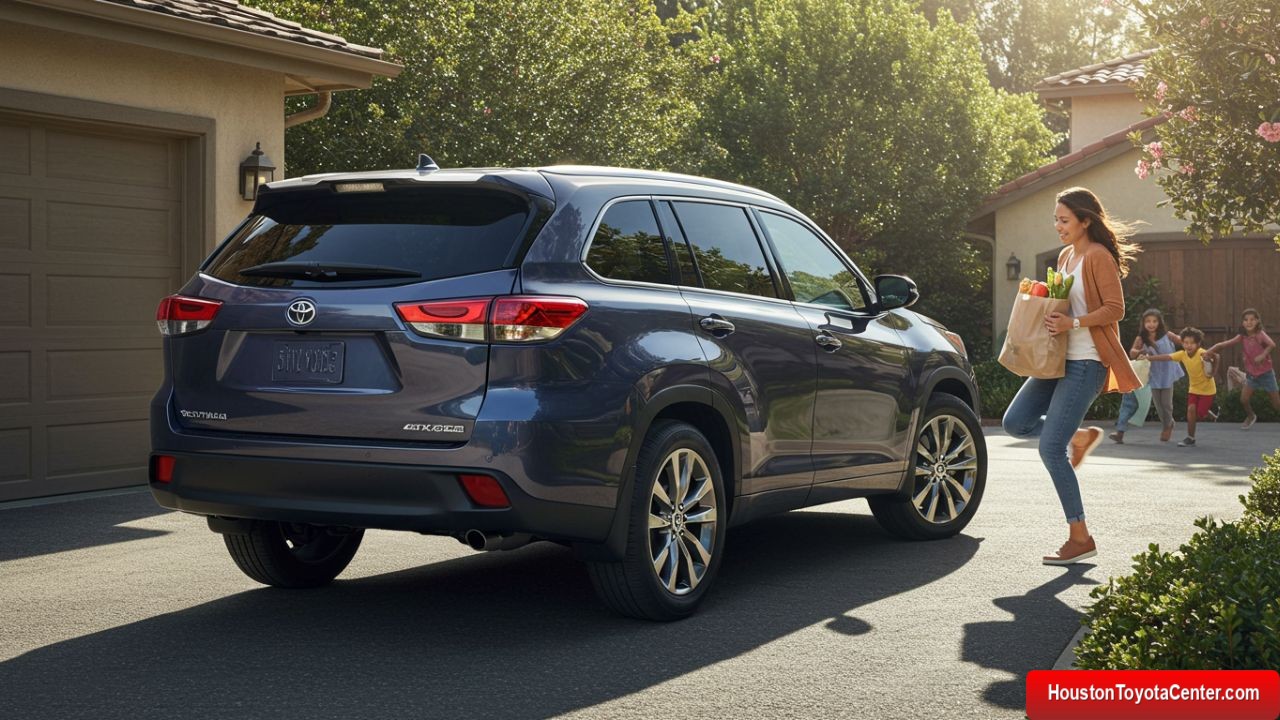
The interior of the Toyota Highlander has long been one of the defining elements of the three-row SUV. Rather than focusing exclusively on rugged styling or outright performance, the Highlander takes a more family-oriented approach, combining practical space with a polished cabin, modern technology, and a strong emphasis on passenger comfort.
That formula becomes especially important in a segment where buyers often use their vehicles for everything from weekday commuting to school runs, long road trips, airport transfers, and weekend adventures. A three-row SUV needs to do more than simply accommodate seven or eight occupants. It needs to make daily life easier.
The Highlander addresses that challenge with an interior designed around accessibility and versatility. Depending on the trim and model year, buyers can find features ranging from heated and ventilated front seats to a large touchscreen, wireless smartphone connectivity, a premium audio system, multiple USB charging points, and sophisticated driver-assistance technology.
But specifications alone do not tell the whole story. The real question is how well these features work together.
FREE: Quickly identify and understand problems with your vehicle 🚘
CLICK HEREA Cabin Designed for Family Life
The first impression inside the Highlander is one of familiarity. The dashboard layout is relatively straightforward, with controls positioned to be easy to locate while driving. The design avoids the overly complicated appearance found in some newer SUVs, where screens and touch-sensitive controls dominate the entire cabin.
That restraint can be an advantage.
For families, usability often matters more than visual drama. Physical controls for commonly used functions can make adjustments easier, particularly when the vehicle is moving. Storage compartments, cupholders, door pockets, and other small conveniences also contribute to the sense that the Highlander was designed around real-world use.
Material quality varies according to trim level, as expected. Entry-level versions typically emphasize durability and practicality, while higher trims introduce more upscale materials, additional soft-touch surfaces, premium upholstery, and decorative finishes.
The result is a cabin that can move comfortably between family transportation and a more refined road-trip environment.
Seating and Passenger Comfort
The Highlander’s three-row configuration is one of its most important selling points, but seating capacity should not be confused with equal comfort across all three rows.
The first row provides the strongest combination of space, adjustment, and available comfort features. Depending on configuration, front passengers can benefit from power-adjustable seats, heating, ventilation, memory functions, and other convenience features.
The second row is arguably the most important area for families because it is where passengers are likely to spend substantial amounts of time. Depending on the configuration, buyers can choose between a second-row bench seat or captain’s chairs. Captain’s chairs can make access to the third row easier and provide a more individual seating experience.
The third row is more challenging. As with many midsize three-row SUVs, available space is better suited to children and smaller adults than to larger passengers on extended journeys. Access is reasonably practical, but anyone expecting limousine-like room in the rearmost seats may find the Highlander’s dimensions more restrictive.
This is an important distinction when evaluating the vehicle. The Highlander offers genuine three-row capability, but its interior is optimized for flexibility rather than maximum passenger volume.
Interior Technology
Technology has become a central part of the modern SUV experience, and the Highlander incorporates a broad range of digital features.
The infotainment system provides access to navigation, media, smartphone integration, vehicle information, and other functions. Wireless connectivity can reduce the clutter associated with cables, while available wireless charging provides an additional convenience for compatible devices.
Screen size and technology features can vary considerably between trims and model years, so buyers should examine the specific configuration rather than assuming every Highlander has the same equipment.
Higher trim levels can add larger displays, premium audio, additional digital interfaces, and more sophisticated convenience features. These upgrades can make a meaningful difference for drivers who spend several hours a week behind the wheel.
The infotainment experience is also about something less measurable: how quickly drivers can understand the system. A technically impressive interface is less useful if common functions require several layers of menus. The Highlander’s approach generally favors accessibility, making it a relatively easy vehicle to live with.
Storage and Practicality
A family SUV is ultimately judged by what happens when everyday life becomes messy.
Shopping bags, backpacks, sports equipment, luggage, strollers, groceries, and electronic devices all compete for space. The Highlander’s interior therefore benefits from a variety of storage solutions throughout the cabin.
The center console provides a useful area for everyday items, while door pockets and cupholders handle smaller objects. Rear passengers also benefit from dedicated storage and charging options, depending on trim.
Cargo flexibility is another important part of the Highlander equation. Folding the rear seats creates additional room when carrying larger objects, while the three-row configuration can be adjusted according to passenger and cargo needs.
This flexibility gives the Highlander an advantage over SUVs that prioritize styling at the expense of practical interior design. Owners may not think about cargo architecture during a test drive, but they notice it quickly after a few months of ownership.
Climate and Convenience Features
Climate control is another area where the Highlander aims to accommodate multiple passengers.
Available multi-zone climate systems allow different areas of the cabin to receive different temperature settings. Rear passengers can also benefit from dedicated controls and ventilation, depending on configuration.
For families, these details are more significant than they initially appear. A long highway journey becomes considerably more comfortable when front and rear passengers can manage their own climate preferences.
Heated front seats are particularly useful in colder climates, while ventilated seats can improve comfort during hot weather. These features are generally associated with upper trims, so shoppers should check the equipment list carefully.
The same principle applies to other convenience features such as a power liftgate, keyless entry, memory settings, and automatic lighting. Individually, none of these features transforms the Highlander. Collectively, however, they can make the vehicle feel considerably more sophisticated.
Driver-Focused Interior Technology
The Highlander’s interior is not exclusively about passengers. The driver’s environment incorporates several technologies intended to reduce workload and improve awareness.
Depending on trim, the driver may have access to a digital or partially digital instrument display, a head-up display, a surround-view camera system, parking sensors, and other visibility aids.
These technologies are particularly useful in a vehicle with the Highlander’s dimensions. Parking a three-row SUV in a tight urban space can be stressful, and camera systems can provide information that is difficult to obtain from the driver’s seat alone.
Driver-assistance technologies also play an important role. Features such as adaptive cruise control, lane-related assistance, collision warning, and automatic emergency braking can provide an additional layer of support during everyday driving.
They should not replace driver attention, but they can make highway journeys less demanding.
Interior Quality Versus Luxury
One of the most interesting aspects of the Highlander interior is its position between mainstream practicality and premium aspirations.
Higher-end versions can look and feel substantially more expensive than basic family SUVs. Leather or leather-like upholstery, upgraded trim, premium audio, larger displays, panoramic roof options, and enhanced seating features can create a more upscale atmosphere.
However, the Highlander is still fundamentally designed as a practical family SUV. Buyers should therefore evaluate it against its intended competition rather than expecting it to replicate the cabin experience of a dedicated luxury vehicle.
That balance may actually be one of its strengths.
A vehicle used to transport children, pets, groceries, luggage, and sports equipment needs materials and layouts that can tolerate daily use. A cabin that is attractive but excessively delicate may not be the best solution for family life.
Noise, Comfort, and Long-Distance Driving
Interior quality is also measured by what happens after several hours on the road.
A comfortable driving position, supportive seats, effective climate control, accessible controls, and reasonable cabin refinement can dramatically change the perception of a vehicle during a long journey.
The Highlander’s overall interior philosophy supports this kind of use. Its seating position provides the elevated view many SUV buyers expect, while the cabin layout is sufficiently conventional that drivers can settle into it quickly.
Road and wind noise can vary depending on tires, trim, road conditions, and vehicle configuration, but the Highlander generally aims for a calm environment rather than an overtly sporty one.
That character makes sense. The SUV’s interior is intended to encourage relaxed travel rather than create an aggressive driving atmosphere.
The Third Row: Useful, But With Limits
The third row deserves special attention because it is one of the most frequently misunderstood aspects of midsize SUVs.
The Highlander can provide seating for larger families, but buyers should consider how often all three rows will be occupied and by whom.
For children, the third row can be highly useful. For adults on short journeys, it can also be perfectly adequate. For taller adults traveling long distances, however, the available legroom and overall space may become limiting.
Cargo capacity also changes when all seats are occupied. With the third row in use, there is less room behind it for large amounts of luggage.
This means the Highlander is particularly well suited to families who need occasional third-row flexibility rather than maximum three-row cargo and passenger capacity every day.
Overall Interior Verdict
The Toyota Highlander’s interior succeeds because it focuses on the details that matter in everyday ownership.
It offers a practical layout, comfortable first- and second-row seating, flexible cargo arrangements, modern connectivity, available premium features, and a wide range of convenience technologies. Higher trims can provide a surprisingly sophisticated atmosphere, while lower trims retain the functional qualities that make the SUV useful as a family vehicle.
Its biggest limitation is the same one found in many midsize three-row SUVs: the third row is functional, but it is not exceptionally spacious for adults, and cargo capacity becomes more restricted when all seats are occupied.
Still, the Highlander’s interior is best understood as a carefully balanced package. It does not attempt to be the largest SUV in its class or the most luxurious. Instead, it aims to be an easy vehicle to live with.
For buyers evaluating a family-oriented three-row SUV, that may be the most important feature of all. A well-designed interior does not necessarily call attention to itself. It simply makes daily driving, commuting, road trips, passenger transport, and cargo hauling easier.
That is where the Highlander makes its strongest argument.
Leave a Reply