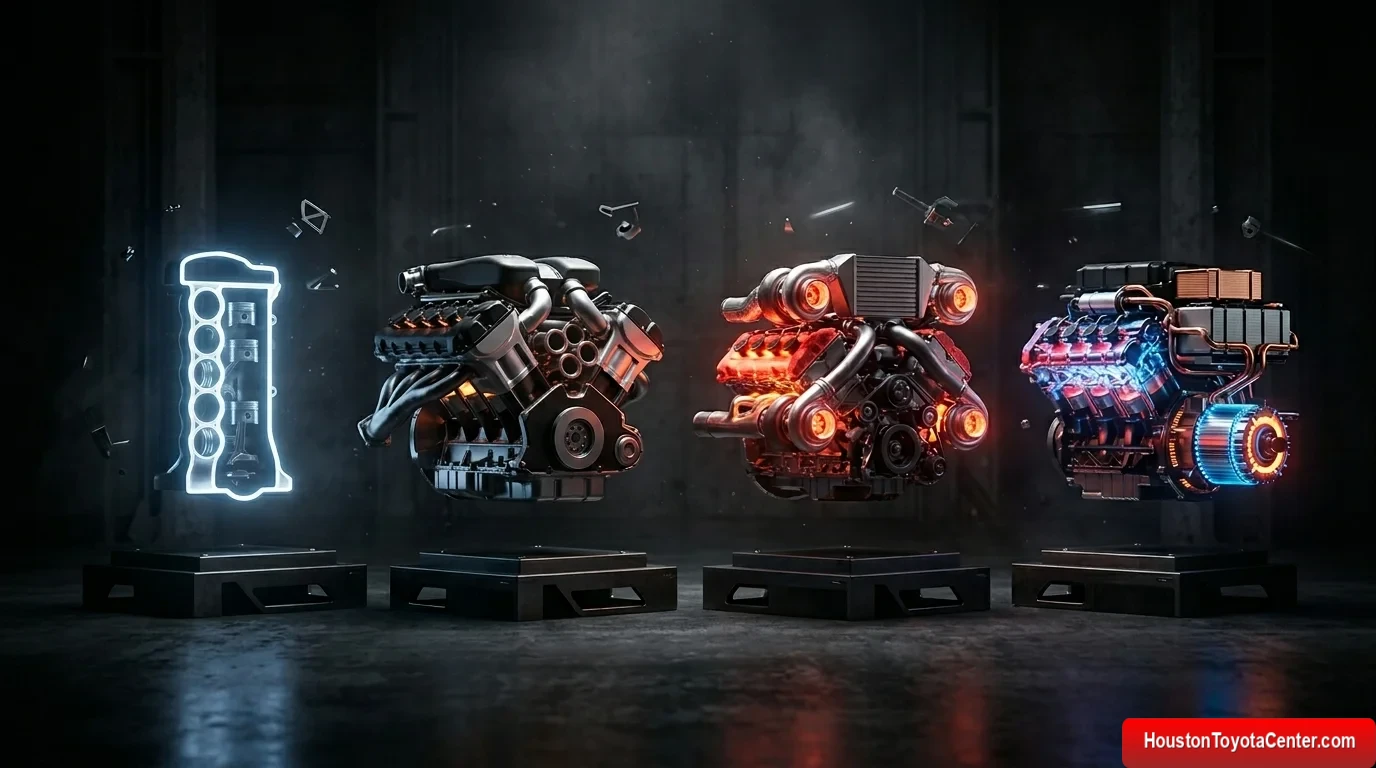
When people think of high-performance engines, names like Ferrari, Lamborghini, or Mercedes-AMG often come first. But over the decades, Toyota has quietly built some of the most durable, over-engineered, and surprisingly powerful engines in the automotive world. While Toyota is better known for reliability and efficiency than raw horsepower, its engineering divisions—especially Gazoo Racing, Yamaha collaborations, and motorsport programs—have produced engines that rival some of the best performance units ever made.
This article explores Toyota’s most powerful engines ever built, covering production engines, racing units, and extreme engineering projects that pushed the brand far beyond its “economy car” reputation.
The Philosophy Behind Toyota Performance Engineering
Toyota’s approach to high-performance engines is fundamentally different from many European manufacturers. Instead of chasing peak horsepower at all costs, Toyota engineers typically prioritize:
- Thermal efficiency and reliability under stress
- Long service life even under racing conditions
- Broad torque curves instead of narrow high-RPM peaks
- Scalability from road cars to motorsport applications
This philosophy is why many Toyota performance engines are famous not just for power, but for surviving abuse that would destroy comparable engines.
FREE: Quickly identify and understand problems with your vehicle 🚘
CLICK HEREHowever, in motorsport—especially endurance racing, rally, and Formula 1—Toyota has built engines that are brutally powerful while still maintaining its engineering discipline.
Toyota Engine Families That Changed Performance History
Before diving into individual engines, it helps to understand the key engine families that produced Toyota’s performance legends:
- JZ Series – Inline-six performance engines
- UZ Series – V8 luxury-performance engines
- GZ / V35A series – Modern twin-turbo V6 architecture
- 4A / 3S Series – Lightweight inline-four performance engines
- Toyota Racing Division engines – Le Mans, WRC, F1 hybrid systems
Each of these families contributed something unique to Toyota’s high-performance identity.
2JZ-GTE: The Legendary Inline-Six
No discussion of Toyota performance engines is complete without the 2JZ-GTE, one of the most iconic engines in automotive history.
Originally designed in the 1990s for the Toyota Supra Mk4, this 3.0-liter inline-six twin-turbo engine became legendary for one reason: it could handle extreme power increases without internal failure.
Key Specifications
| Specification | Detail |
|---|---|
| Engine type | Inline-6, twin turbo |
| Displacement | 3.0L |
| Factory output | ~280–320 hp (Japan-limited era) |
| Torque | ~427 Nm |
| Redline | ~7,000 RPM |
Why it became famous
The 2JZ-GTE’s iron block and overbuilt internals allowed tuners to push it beyond:
- 600 hp (light modifications)
- 1,000+ hp (built engines)
- Even 2,000+ hp in drag racing applications
Few production engines in history have matched this level of tuning resilience.
It remains one of the most respected performance engines ever built—not just by Toyota fans, but across the global tuning community.
1LR-GUE: The Lexus LFA V10 Masterpiece
If the 2JZ is Toyota’s durability icon, the 1LR-GUE V10 is its emotional masterpiece.
Developed for the Lexus LFA supercar, this engine was co-engineered with Yamaha and is often considered one of the greatest naturally aspirated engines ever created.
Key Specifications
| Specification | Detail |
|---|---|
| Engine type | V10, naturally aspirated |
| Displacement | 4.8L |
| Power output | 552 hp |
| Torque | 480 Nm |
| Redline | 9,000 RPM |
Why it stands out
- Revved from idle to redline in under 0.6 seconds
- Used titanium valves and ultra-light internals
- Each engine was hand-assembled by a single technician
- Sound was tuned like a musical instrument by Yamaha engineers
The LFA’s engine is often compared to Formula 1 engines in terms of responsiveness and acoustic quality.
It is not Toyota’s most powerful engine numerically—but it is one of its most refined high-performance achievements.
3S-GTE: The Rally Weapon
The 3S-GTE engine powered multiple Toyota rally cars during the Group A and WRC eras. It is a 2.0-liter turbocharged inline-four designed for durability under extreme rally conditions.
Key Specifications
| Specification | Detail |
|---|---|
| Engine type | Inline-4 turbo |
| Displacement | 2.0L |
| Power output | 200–260 hp (varies by generation) |
| Turbo system | Single turbo |
| Application | Celica GT-Four, MR2 Turbo |
Why it matters
The 3S-GTE powered Toyota’s dominance in rally racing during the 1990s. It was known for:
- Strong mid-range torque
- Resistance to heat soak
- High boost tolerance
- Excellent drivetrain compatibility with AWD systems
While not the most powerful engine, its racing success helped define Toyota’s motorsport credibility.
1UZ-FE: The Indestructible V8
The 1UZ-FE is often called one of the most reliable V8 engines ever built. Originally designed for the Lexus LS400, it was not initially intended as a performance engine—but its strength and smoothness made it a tuning favorite.
Key Specifications
| Specification | Detail |
|---|---|
| Engine type | V8, naturally aspirated |
| Displacement | 4.0L |
| Power output | 250–300 hp |
| Redline | ~6,500 RPM |
Performance potential
Despite its luxury origins, the 1UZ-FE became popular in:
- Drift cars
- Boat racing
- Turbo conversions exceeding 800+ hp
Its forged-like durability made it a sleeper performance platform.
V35A-FTS: Modern Twin-Turbo Powerhouse
The V35A-FTS is Toyota’s modern answer to high-output efficiency engines. Found in vehicles like the Toyota Tundra and Lexus LS, it represents a shift toward forced induction and hybrid-ready architecture.
Key Specifications
| Specification | Detail |
|---|---|
| Engine type | V6 twin turbo |
| Displacement | 3.5L |
| Power output | 389–437 hp |
| Torque | up to 649 Nm |
Why it matters
This engine replaces older V8s in many Toyota and Lexus vehicles. It provides:
- Higher torque at lower RPM
- Improved fuel efficiency
- Hybrid compatibility
- Reduced emissions
While not as emotionally iconic as the 2JZ or LFA V10, it represents Toyota’s future direction in performance engineering.
2UR-GSE: The High-Revving Lexus V8
The 2UR-GSE is a performance-focused V8 used in Lexus F models such as the IS F, RC F, and GS F.
Key Specifications
| Specification | Detail |
|---|---|
| Engine type | V8 naturally aspirated |
| Displacement | 5.0L |
| Power output | 467–472 hp |
| Torque | ~530 Nm |
| Redline | ~7,300 RPM |
Key features
- Yamaha-tuned cylinder heads
- Lightweight titanium components
- Track-focused tuning in F models
This engine is one of Toyota’s last great naturally aspirated V8s, offering a linear and aggressive power delivery that enthusiasts still admire.
Toyota TS050 Hybrid: Le Mans Dominance Engine System
Toyota’s dominance in endurance racing, especially at Le Mans, came from hybrid powertrains rather than traditional engines alone.
The TS050 Hybrid system combines:
- 2.4L twin-turbo V6
- Hybrid electric motors
- Energy recovery systems (ERS)
Combined output
- Over 1,000 horsepower (system output)
Why it matters
This system won multiple Le Mans championships and demonstrated Toyota’s mastery of hybrid endurance performance.
Unlike traditional engines, this powertrain focuses on:
- Energy efficiency
- Thermal management over 24-hour races
- Strategic power deployment
It is one of the most advanced racing systems Toyota has ever built.
Comparison Table of Toyota’s Most Powerful Engines
| Engine | Type | Power | Key Strength |
|---|---|---|---|
| 2JZ-GTE | I6 twin turbo | ~280–1000+ hp (tuned) | Legendary durability |
| 1LR-GUE | V10 NA | 552 hp | Exotic sound & response |
| 3S-GTE | I4 turbo | 200–260 hp | Rally reliability |
| 1UZ-FE | V8 NA | 250–800+ hp (built) | Indestructible base |
| V35A-FTS | V6 twin turbo | up to 437 hp | Modern efficiency |
| 2UR-GSE | V8 NA | 472 hp | Track performance |
| TS050 Hybrid | V6 + hybrid | 1000+ hp system | Le Mans dominance |
Motorsport: Where Toyota’s True Power Emerges
Toyota’s most powerful engines are often not found in road cars. Instead, they come from motorsport programs:
1. World Rally Championship (WRC)
Engines like the 3S-GTE and later turbocharged rally units were built for:
- Extreme terrain
- Constant vibration stress
- Rapid throttle changes
2. Le Mans / Endurance Racing
Hybrid powertrains like TS050 and GR010 represent:
- 24-hour continuous operation
- Heat endurance
- Energy efficiency under pressure
3. Formula Racing Influence
Toyota’s brief but influential Formula 1 program contributed to:
- High-revving engine development
- Lightweight material engineering
- Hybrid recovery systems
Engineering Secrets Behind Toyota’s Power
Toyota’s performance engines share several engineering principles:
Overbuilt internals
Many engines use stronger-than-necessary components, allowing them to survive tuning.
Conservative factory tuning
Engines are often detuned from their true potential for longevity.
Strong cooling systems
Toyota engines typically maintain stable temperatures under stress.
Balanced design philosophy
Instead of peak power, Toyota prioritizes usable performance across RPM ranges.
Why Toyota Engines Are Loved by Enthusiasts
Despite not always being the most powerful on paper, Toyota engines are respected because:
- They handle abuse exceptionally well
- They respond extremely well to modifications
- They last for hundreds of thousands of kilometers
- They combine reliability with surprising performance potential
This dual identity—economy car reliability + hidden performance potential—is what makes Toyota engines uniquely iconic.
The Evolution of Toyota Performance Philosophy
Toyota’s performance engine evolution can be summarized in three phases:
1. Mechanical Era (1980s–2000s)
- 2JZ-GTE
- 3S-GTE
- 1UZ-FE
Focus: durability and tunability
2. Emotional Performance Era (2000s–2010s)
- 1LR-GUE (LFA V10)
- 2UR-GSE
Focus: sound, driving emotion, refinement
3. Hybrid Performance Era (2010s–present)
- V35A-FTS
- TS050 / GR racing hybrids
Focus: efficiency + system-wide power
Conclusion
Toyota’s most powerful engines reveal a surprising truth: raw horsepower is not the company’s only definition of performance. Instead, Toyota builds engines that balance endurance, efficiency, and real-world usability with moments of extraordinary engineering brilliance.
From the indestructible 2JZ-GTE, to the screaming LFA V10, to modern hybrid endurance monsters exceeding 1,000 horsepower, Toyota has proven that it can compete at the highest level of automotive performance when it chooses to.
And perhaps more importantly, it has done so while maintaining its reputation for reliability—something few manufacturers in the world have ever managed at this level.
Leave a Reply