Car color is often treated as a matter of personal taste—something chosen to reflect personality, status, or aesthetic preference. Yet beneath the glossy surface lies a fascinating intersection of chemistry, physics, environmental science, and engineering. The color of a car is not merely paint; it is a carefully engineered system designed to withstand years of exposure to sunlight, temperature changes, moisture, pollution, and mechanical wear.
Still, not all colors age equally. Some cars seem to maintain their brilliance for decades, while others quickly dull, fade, or oxidize. Why does this happen? The answer lies in the science of pigments, ultraviolet radiation, material degradation, and even human perception.
This article explores the deep scientific principles behind automotive colors and explains why some fade faster than others.
1. Understanding Automotive Paint Systems
Modern car paint is not a single layer but a multi-layered system engineered for both aesthetics and protection. Typically, automotive paint consists of three primary layers:
FREE: Quickly identify and understand problems with your vehicle 🚘
CLICK HERE| Layer | Function | Key Materials |
|---|---|---|
| Primer | Bonds paint to metal, prevents corrosion | Epoxy or urethane-based compounds |
| Basecoat | Provides the actual color | Pigments suspended in resin |
| Clearcoat | Protects against UV radiation, scratches, and environmental damage | Transparent polyurethane or acrylic |
Each layer plays a critical role. The basecoat determines color, but the clearcoat largely dictates how long that color will last.
2. The Role of Pigments in Color Stability
At the heart of automotive color lies pigment chemistry. Pigments are substances that absorb certain wavelengths of light and reflect others, producing the colors we see.
Types of Pigments
There are two main categories:
- Organic pigments
Derived from carbon-based molecules. They often produce bright, vibrant colors like reds, yellows, and oranges. - Inorganic pigments
Made from mineral compounds such as metal oxides. These typically produce more muted but stable colors like whites, blacks, and earth tones.
Stability Differences
Organic pigments tend to be less stable under UV exposure. Their molecular structures can break down when exposed to sunlight, leading to fading. In contrast, inorganic pigments are more resistant because their chemical bonds are stronger and less reactive.
| Pigment Type | Color Range | UV Stability | Fade Resistance |
|---|---|---|---|
| Organic | Bright (red, yellow) | Low–Medium | Poor–Moderate |
| Inorganic | Neutral (white, black, gray) | High | Excellent |
3. The Physics of Light and Color Perception
Color is not inherent in objects—it is a result of how light interacts with materials and how our eyes interpret reflected wavelengths.
When sunlight hits a car:
- Some wavelengths are absorbed by the paint
- Others are reflected back to our eyes
The reflected wavelengths determine the perceived color.
Why This Matters for Fading
The same wavelengths that create color can also destroy it. Ultraviolet (UV) radiation, in particular, carries enough energy to break chemical bonds in pigments and resins.
Colors that absorb more UV radiation are more prone to degradation.
4. Ultraviolet Radiation: The Main Culprit
Sunlight contains three types of UV radiation:
- UVA (long-wave): Penetrates deeply, causes gradual degradation
- UVB (medium-wave): More energetic, causes faster damage
- UVC: Mostly absorbed by the atmosphere
Automotive paints are primarily affected by UVA and UVB.
How UV Causes Fading
UV radiation can:
- Break down pigment molecules
- Degrade the clearcoat
- Cause oxidation in the paint layer
This leads to:
- Loss of color intensity
- Chalky or dull appearance
- Surface cracking or peeling
5. Why Some Colors Fade Faster
5.1 Red: The Most Vulnerable Color
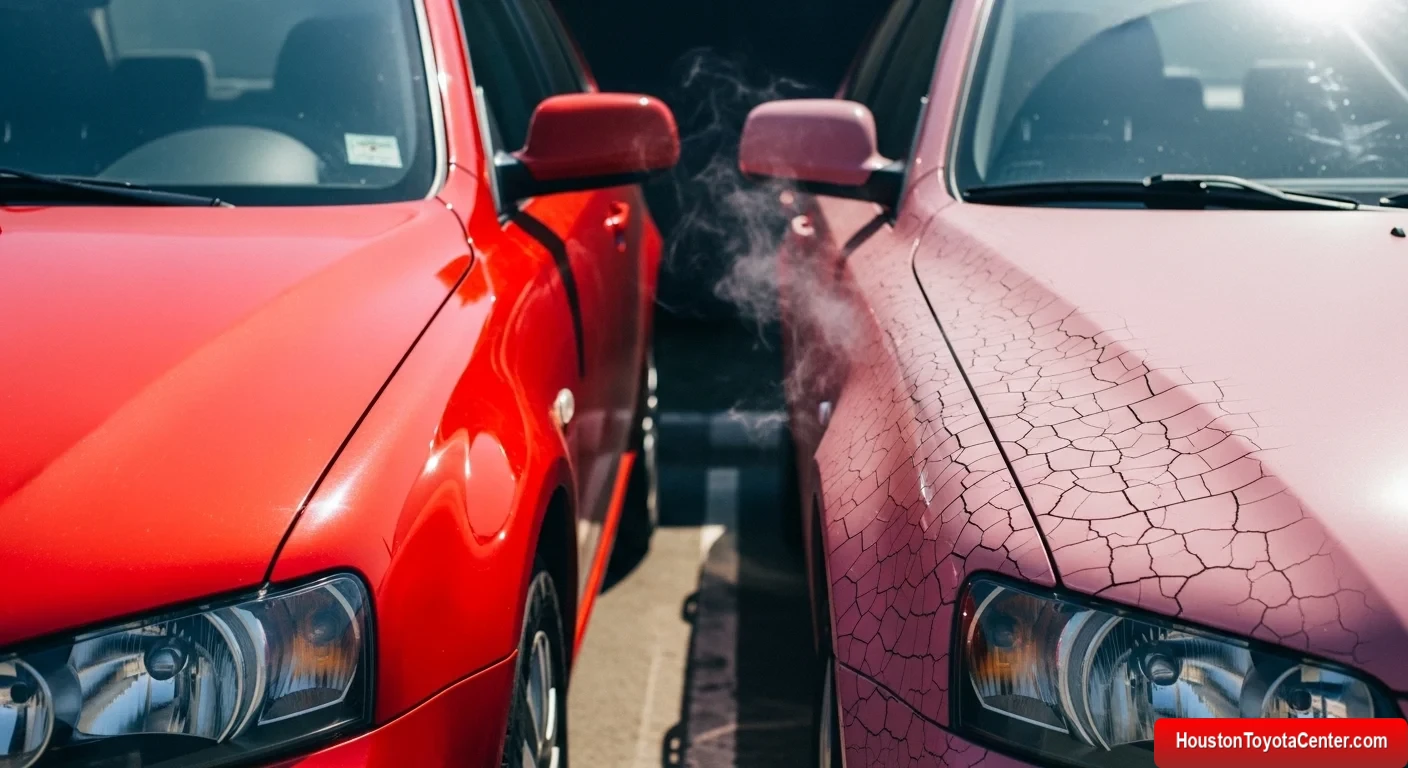
Red cars are infamous for fading quickly. This is because:
- Red pigments are often organic
- They absorb a broad spectrum of light, including UV
- Their molecular structure is less stable
Over time, red cars may turn pinkish or dull.
5.2 Blue and Green: Moderate Stability
Blues and greens vary widely depending on pigment composition.
- Some modern blues use more stable synthetic pigments
- Greens can be mixtures, making them less predictable
These colors generally fade slower than red but faster than neutral tones.
5.3 Black: Heat Absorption Issues
Black paint absorbs nearly all wavelengths of light, converting them into heat.
This leads to:
- Higher surface temperatures
- Accelerated chemical reactions
- Faster degradation of clearcoat
Interestingly, black paint may not “fade” in color as dramatically but can show:
- Swirl marks
- Oxidation
- Loss of gloss
5.4 White: The Most Durable
White cars are among the most resistant to fading.
Reasons include:
- Use of titanium dioxide (a highly stable inorganic pigment)
- Reflection of most sunlight
- Lower heat absorption
White vehicles often maintain their appearance longer than any other color.
5.5 Silver and Gray: Engineering Advantages
Silver and gray paints often include metallic flakes (usually aluminum).
These provide:
- UV reflection
- Reduced heat absorption
- Enhanced durability
This is one reason silver has been one of the most popular car colors globally—it balances aesthetics and longevity.
6. The Role of Clearcoat Technology
The clearcoat is the unsung hero of automotive paint durability.
Functions of Clearcoat
- Blocks UV radiation
- Provides a glossy finish
- Protects against scratches and chemicals
UV Absorbers and Stabilizers
Modern clearcoats include additives such as:
- UV absorbers: Convert UV radiation into heat
- Hindered amine light stabilizers (HALS): Neutralize free radicals
Without these, paint would degrade much faster.
7. Environmental Factors That Accelerate Fading
Even the best paint can degrade under harsh conditions.
7.1 Sun Exposure
Cars parked outdoors experience:
- Constant UV exposure
- Thermal cycling (heating and cooling)
7.2 Temperature Extremes
Heat accelerates chemical reactions, including:
- Oxidation
- Polymer breakdown
Cold temperatures can cause microcracks, allowing moisture to penetrate.
7.3 Pollution and Chemicals
Air pollutants such as:
- Acid rain
- Industrial fallout
- Bird droppings
can damage the clearcoat and expose the pigment layer.
7.4 Moisture and Humidity
Water can:
- Penetrate microcracks
- Promote oxidation
- Carry contaminants into the paint
8. Oxidation: The Silent Destroyer
Oxidation occurs when oxygen reacts with paint materials, especially under UV exposure.
Signs of Oxidation
- Chalky residue
- Dull appearance
- Loss of gloss
Oxidation is particularly visible on darker colors, even if the pigment itself hasn’t faded significantly.
9. Advances in Paint Technology
Automotive manufacturers continuously improve paint durability.
9.1 Nanotechnology
Nano-coatings create:
- Stronger protective barriers
- Improved scratch resistance
- Enhanced UV protection
9.2 Ceramic Coatings
These are aftermarket solutions that:
- Add a hydrophobic layer
- Reduce UV damage
- Protect against contaminants
9.3 Water-Based Paints
Modern environmental regulations have shifted toward water-based paints, which:
- Reduce emissions
- Maintain comparable durability with improved formulations
10. Maintenance and Its Impact on Color Longevity
Even the most durable paint can degrade without proper care.
Best Practices
- Regular washing to remove contaminants
- Waxing to add a protective layer
- Parking in shaded areas or garages
- Using car covers when possible
11. Human Perception and Color Fading
Interestingly, fading is not just physical—it’s perceptual.
Humans are more sensitive to changes in certain colors:
- Red fading is highly noticeable
- White fading is harder to detect
- Metallic finishes mask imperfections
This means some colors may appear to age better even if the chemical degradation is similar.
12. Comparative Overview of Color Durability
| Color | UV Resistance | Heat Absorption | Fade Visibility | Overall Durability |
|---|---|---|---|---|
| White | High | Low | Low | Excellent |
| Silver | High | Medium | Low | Excellent |
| Gray | High | Medium | Low | Very Good |
| Black | Medium | High | Medium | Good |
| Blue | Medium | Medium | Medium | Moderate |
| Green | Medium | Medium | Medium | Moderate |
| Red | Low | Medium | High | Poor |
13. Why Automakers Choose Certain Colors
Car manufacturers consider multiple factors when offering colors:
- Durability
- Market demand
- Production cost
- Environmental regulations
Neutral colors dominate the market partly because they age better and require fewer warranty claims related to paint defects.
14. Future Trends in Automotive Color Science
The future of car paint may include:
- Self-healing coatings
- Smart paints that change color with temperature
- Advanced UV-blocking nanomaterials
These innovations aim to reduce fading and extend the lifespan of automotive finishes.
Conclusion
The fading of car colors is not random—it is governed by a complex interplay of chemistry, physics, and environmental exposure. The type of pigment, the structure of the paint system, the intensity of UV radiation, and even the climate all contribute to how a car’s color evolves over time.
Bright, organic-based colors like red may offer visual impact but often sacrifice longevity. In contrast, neutral tones like white and silver benefit from stable inorganic pigments and reflective properties that protect against UV damage.
Ultimately, while manufacturers have made tremendous advances in paint technology, no color is completely immune to fading. Understanding the science behind it allows consumers to make informed choices and take better care of their vehicles—ensuring that the color they love lasts as long as possible.
Leave a Reply