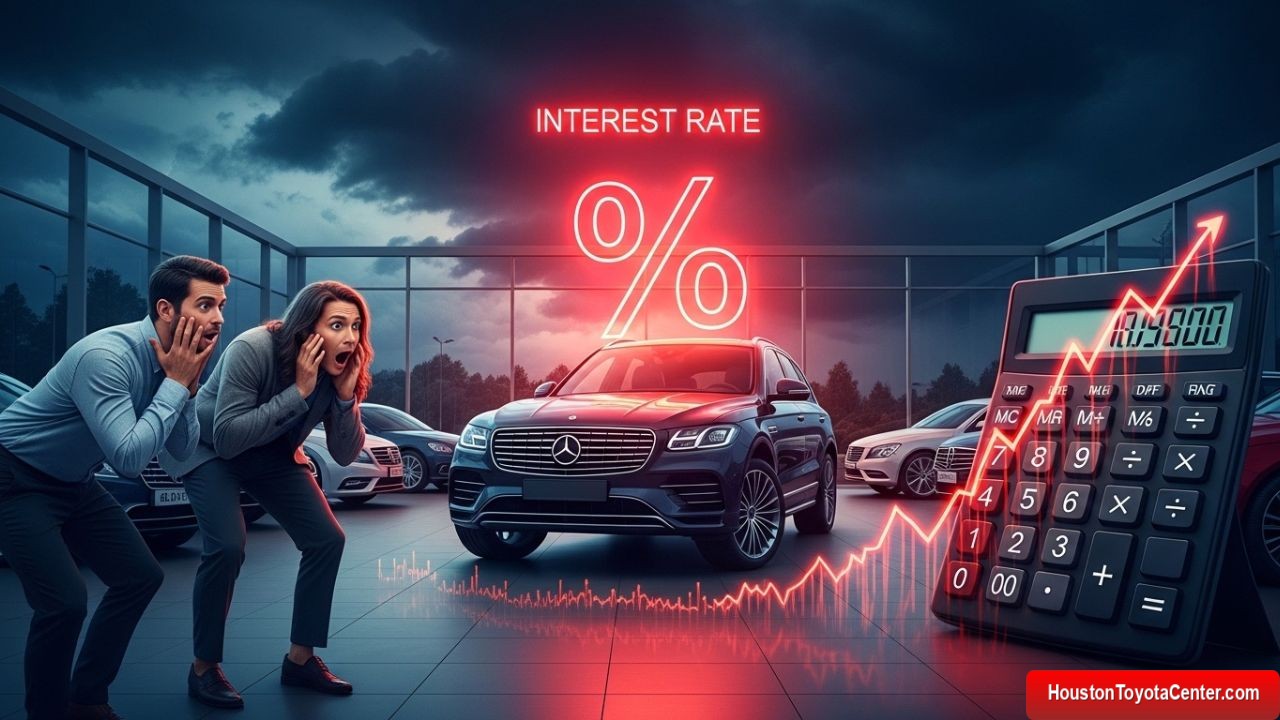
In modern economies, few financial forces influence everyday life as powerfully — and as quietly — as interest rates. They shape mortgage payments, credit card balances, business investments, and government borrowing. Yet one of the most immediate and visible impacts of rising interest rates appears in a place many people do not initially expect: the car dealership.
For millions of households, purchasing a vehicle is the second-largest financial decision after buying a home. Unlike homes, however, cars depreciate rapidly, require ongoing maintenance, and are often financed over shorter periods. When interest rates rise, the affordability equation for car buyers changes dramatically. Monthly payments increase, loan qualification becomes stricter, and total ownership costs escalate — sometimes subtly, sometimes shockingly.
Understanding how rising interest rates affect car affordability requires exploring central banking policy, consumer lending structures, dealership financing, used car markets, and broader economic psychology. This article provides a comprehensive examination of these dynamics and explains how consumers can navigate the changing landscape.
1. The Role of Interest Rates in the Economy
Interest rates are primarily influenced by central banks. In the United States, the benchmark rate is set by the Federal Reserve. When inflation rises or the economy overheats, the Federal Reserve often increases its policy rate to slow borrowing and spending. Conversely, when the economy weakens, rates may be lowered to stimulate growth.
FREE: Quickly identify and understand problems with your vehicle 🚘
CLICK HEREAlthough the Federal Reserve sets a short-term rate (the federal funds rate), its influence extends to:
- Auto loans
- Mortgages
- Credit cards
- Business loans
- Bonds
Auto loan rates are not directly set by the Federal Reserve, but they are strongly influenced by broader financial conditions shaped by its decisions.
When benchmark rates rise:
- Banks pay more to borrow money.
- Lenders pass higher borrowing costs to consumers.
- Financing becomes more expensive.
- Demand for large purchases may decline.
Cars — often financed over 48 to 84 months — become especially sensitive to these changes.
2. How Car Financing Works
To understand affordability, we must first understand how car loans function.
Most car purchases are financed rather than paid in cash. The typical auto loan includes:
- Principal: The vehicle price minus down payment.
- Interest Rate (APR): The cost of borrowing.
- Loan Term: Often 36–84 months.
- Monthly Payment: Determined by principal, rate, and term.
Even a small increase in interest rates can significantly affect monthly payments because the loan is amortized over several years.
Let’s illustrate this with a simplified example.
3. The Mathematics of Rising Interest Rates
Consider a $35,000 vehicle with a $5,000 down payment.
Loan Amount: $30,000
Term: 60 months
Below is how different interest rates affect monthly payments and total cost.
| Interest Rate (APR) | Monthly Payment | Total Interest Paid | Total Cost of Loan |
|---|---|---|---|
| 3% | $539 | $2,340 | $32,340 |
| 5% | $566 | $3,960 | $33,960 |
| 7% | $594 | $5,640 | $35,640 |
| 9% | $623 | $7,380 | $37,380 |
Key Insight:
A 6% increase in interest rate (from 3% to 9%) increases the total cost of borrowing by more than $5,000 — without changing the vehicle price at all.
Now imagine financing $45,000 instead of $30,000. The impact becomes even more dramatic.
4. The Psychological Effect on Buyers
Rising rates do more than increase payments — they change consumer behavior.
4.1 Payment Sensitivity
Most buyers focus on the monthly payment rather than the total price. When rates rise:
- Buyers stretch loan terms.
- Buyers reduce down payments.
- Buyers downgrade vehicle choice.
- Buyers delay purchases.
This psychological shift can reduce overall dealership traffic.
4.2 Affordability Thresholds
Many lenders use a debt-to-income (DTI) ratio to determine loan approval. When rates increase:
- Monthly payments rise.
- DTI ratios worsen.
- Some buyers no longer qualify.
The same person who qualified at 4% might be denied at 8%.
5. The Impact on New vs. Used Cars
5.1 New Vehicles
New cars are generally more expensive and therefore more sensitive to rate changes. However:
- Manufacturers sometimes subsidize financing.
- Promotional APR offers (e.g., 0% financing) may soften the blow.
For example, automakers like Toyota or Ford Motor Company may offer low APR deals during slow sales periods to offset rising market rates.
But when central bank rates remain high for extended periods, even manufacturer incentives shrink.
5.2 Used Vehicles
Used cars typically carry higher interest rates than new cars, even in stable environments. When benchmark rates rise:
- Used car loan rates can reach double digits.
- Buyers with lower credit scores face extreme financing costs.
- Affordability deteriorates faster than in the new car market.
6. Subprime Borrowers: The Most Affected Group
Subprime borrowers — those with lower credit scores — experience the sharpest impact.
If prime borrowers move from 4% to 7%, subprime borrowers may move from 10% to 16% or higher.
Consequences include:
- Dramatically higher monthly payments
- Increased loan defaults
- Higher repossession rates
- Greater financial strain on households
In periods of rising rates, lenders also tighten underwriting standards, meaning approval becomes more difficult.
7. Loan Term Extensions: A Temporary Solution
One strategy buyers use to offset higher rates is extending the loan term.
Instead of 60 months, they choose:
- 72 months
- 84 months
While this lowers monthly payments, it increases total interest dramatically and extends negative equity risk.
Negative equity occurs when:
Loan balance > vehicle value
Longer terms increase the likelihood of this scenario, particularly because cars depreciate quickly.
8. The Secondary Effects on Dealerships
Dealerships are deeply affected by interest rate cycles.
8.1 Inventory Adjustments
When affordability declines:
- Demand slows.
- Inventory accumulates.
- Dealers may discount prices.
- Manufacturer incentives increase.
8.2 Profit Margins
Dealership profits often rely on:
- Financing markups
- Extended warranties
- Add-ons
When lenders tighten approval standards, these revenue streams weaken.
9. Leasing vs. Financing in High-Rate Environments
Leasing can become relatively more attractive when interest rates rise, but not always.
Leasing calculations also incorporate money factors (similar to interest rates). When benchmark rates increase:
- Lease payments may rise.
- Residual value assumptions become critical.
- Leasing companies become more cautious.
However, because leases typically last 24–36 months, they expose consumers to shorter-term rate risks compared to long loans.
10. Inflation and Vehicle Pricing
Rising interest rates often occur during inflationary periods.
Inflation impacts:
- Vehicle manufacturing costs
- Shipping and logistics
- Labor
- Raw materials (steel, semiconductors)
When inflation pushes car prices up and interest rates rise simultaneously, affordability is hit from both directions:
Higher vehicle price + higher borrowing cost = double pressure
11. Electric Vehicles and Financing Sensitivity
Electric vehicles (EVs) are typically more expensive upfront than comparable gasoline vehicles.
Manufacturers such as Tesla, Inc. operate in a segment highly sensitive to financing costs.
Higher rates can:
- Reduce EV adoption
- Shift demand toward cheaper hybrids
- Increase dependence on government incentives
Because EV buyers often finance larger amounts, they are particularly exposed to rate increases.
12. Macroeconomic Ripple Effects
Rising rates impact more than individual buyers.
12.1 Auto Industry Employment
Slower vehicle sales can affect:
- Manufacturing plants
- Dealership staff
- Supply chain logistics
- Parts suppliers
The automotive industry represents a major portion of economic activity in many countries.
12.2 Used Car Market Cycles
When new car purchases decline:
- Used car demand may increase temporarily.
- But higher financing costs eventually reduce used sales too.
- Trade-in values fluctuate.
13. Real-World Example: Post-Pandemic Rate Increases
After historically low rates during 2020–2021, central banks raised rates aggressively to combat inflation.
Consequences observed:
- Average auto loan rates nearly doubled.
- Monthly payments reached record highs.
- Vehicle affordability fell to multi-decade lows.
- Loan terms lengthened significantly.
Buyers who could afford $40,000 at 2.5% suddenly struggled at 7%.
14. Strategies Consumers Can Use
Even in rising rate environments, buyers have options.
14.1 Improve Credit Score
Better credit can reduce APR significantly.
14.2 Increase Down Payment
Reducing principal lowers total interest paid.
14.3 Shop for Financing
Banks, credit unions, and dealerships offer varying rates.
14.4 Consider Certified Pre-Owned Vehicles
These may offer lower price points and manufacturer-backed warranties.
14.5 Delay Purchase
If possible, waiting for rate stabilization can preserve affordability.
15. Long-Term Implications
If rates remain elevated for extended periods:
- Consumers adjust expectations downward.
- Automakers redesign product pricing strategies.
- Used vehicles gain structural demand.
- Loan defaults may rise.
However, interest rate cycles are historically cyclical. Periods of tightening are often followed by stabilization or easing.
16. The True Cost of Ownership in High-Rate Environments
Car affordability is not just about monthly payments.
Total ownership includes:
- Insurance
- Fuel
- Maintenance
- Registration
- Depreciation
When financing costs rise, overall transportation expenses can consume a larger share of household income.
17. A Broader Financial Perspective
Rising interest rates are designed to reduce inflation and stabilize economies. While painful in the short term, they often aim to prevent deeper financial instability.
For consumers, this means adapting:
- Budget planning becomes critical.
- Debt management matters more.
- Financial literacy becomes essential.
Cars are both functional necessities and financial commitments. Understanding how rates influence affordability empowers consumers to make smarter decisions.
Conclusion
Rising interest rates fundamentally alter car affordability by increasing borrowing costs, tightening lending standards, and reshaping buyer behavior. The effect ripples across new and used markets, subprime borrowers, dealerships, manufacturers, and the broader economy.
A seemingly small rate increase can translate into thousands of dollars in additional costs over the life of a loan. In periods of inflation, the impact compounds further.
Yet informed consumers retain agency. By improving credit, increasing down payments, comparing financing options, and adjusting expectations, buyers can mitigate some of the pressure created by higher rates.
Interest rate cycles will continue as long as economies evolve. The key to navigating them is understanding how they work — and how they shape one of the most common major purchases in modern life.
Leave a Reply