
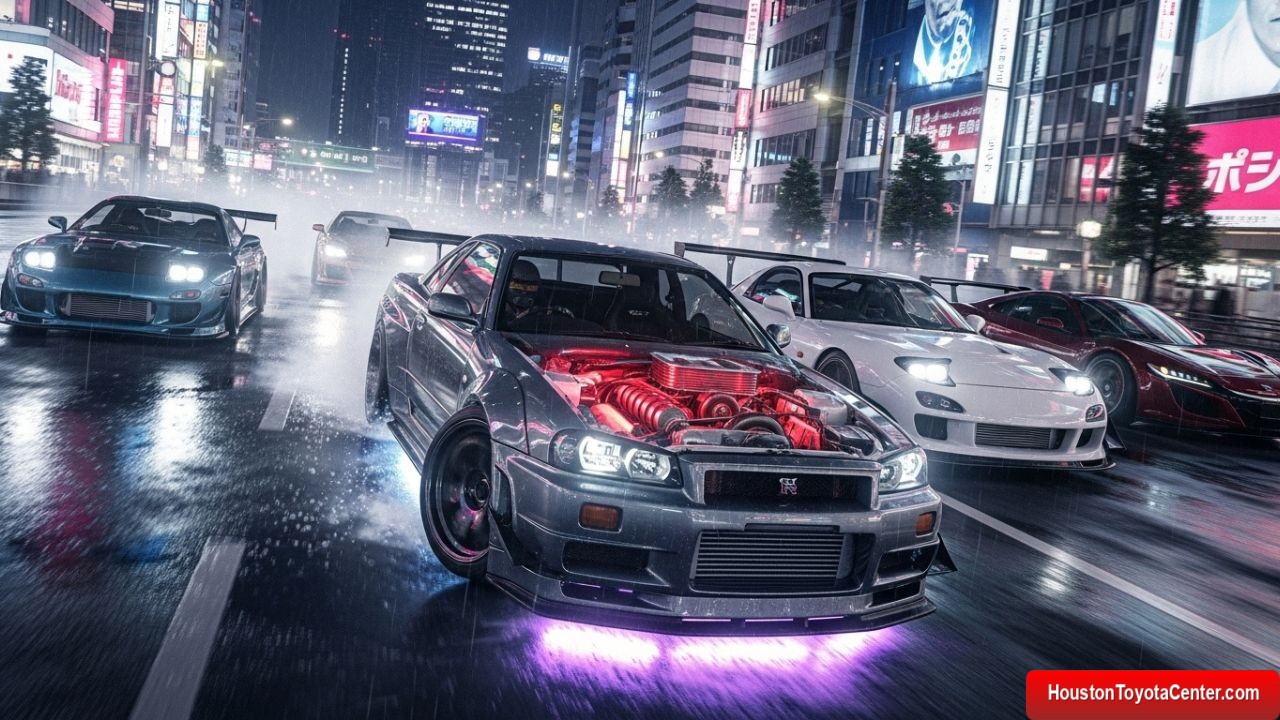
Japanese tuner culture is one of the most vibrant and influential automotive movements the world has ever seen. Born from the streets, mountain passes, and racetracks of Japan, it has grown into a global force, shaping car design, motorsport, aftermarket parts industries, and even digital entertainment. From obscure domestic-only vehicles to icons like the Nissan GT-R, Toyota Supra, and Mazda RX-7, the world’s fascination with JDM (Japanese Domestic Market) tuning shows no sign of slowing down.
This article explores the origins, philosophies, machines, and global spread of Japanese tuner culture—how it evolved, who shaped it, and why its influence is now universal.
1. Origins of Japanese Tuner Culture: When Necessity Met Passion
The roots of tuner culture in Japan can be traced back to the post-war era. Japan’s economy boomed in the 1960s and 1970s, introducing a new generation to personal mobility. Motorcycles had already taken off thanks to Honda, Yamaha, Suzuki, and Kawasaki—but by the late 1960s, cars were becoming aspirational consumer goods.
The Shift Toward Performance Cars
During the 1960s and 70s, Japanese manufacturers started engineering cars with motorsport in mind. The establishment of:
FREE: Quickly identify and understand problems with your vehicle 🚘
CLICK HERE- The Japanese Grand Prix
- Fuji Speedway
- Nihon Touring Car Championship
- Rally championships across Japan
created a natural link between consumer cars and racing.
The first true Japanese performance icon was the Nissan Skyline 2000 GT-R (Hakosuka), a sedan coupe that stunned the motorsport world. It embodied the philosophy that would drive tuner culture for decades:
Small displacement, high revs, light weight, and infinite upgrade potential.
The Birth of Street Tuning
As performance cars reached consumer hands, modifying them quickly became a hobby. The Japanese street tuning scene emerged in several parallel branches:
- Thrifty young mechanics who learned to tweak carburetors and adjust suspension on a budget.
- Midnight racers on public highways like Tokyo’s Bayshore Route.
- Mountain-pass drivers (touge racers) seeking balance, not just power.
- Drag racers experimenting with turbocharging and power upgrades.
Every group pushed the boundaries of engineering and creativity. This grassroots energy formed the cultural foundation that continues today.
2. The Rise of JDM Icons: The Machines That Started a Movement
JDM tuning culture wouldn’t exist without the cars themselves. Japan’s manufacturers created a lineup of vehicles that became legends worldwide.
The Golden Era: 1989–2002
This period is often called the Peak JDM Era, producing cars still revered today. Here’s a table summarizing some of the most iconic tuner platforms:
| Model | Engine | Drivetrain | Key Tuning Appeal |
|---|---|---|---|
| Nissan Skyline GT-R (R32/R33/R34) | RB26DETT | AWD | Overbuilt RB engine capable of 1,000+ hp |
| Toyota Supra MK4 | 2JZ-GTE | RWD | Legendary 2JZ reliability and tunability |
| Mazda RX-7 (FD3S) | 13B-REW Rotary | RWD | Lightweight, high-revving, perfect for balance tuning |
| Honda Civic/Integra (EK9, DC2) | B-series/VTEC | FWD | High-revving NA performance; dominant in time-attack |
| Nissan Silvia (S13, S14, S15) | SR20DET | RWD | Drift culture staple, perfectly balanced chassis |
| Mitsubishi Lancer Evolution I–IX | 4G63 | AWD | Rally heritage, ultimate turbocharged AWD platform |
| Subaru Impreza WRX STI | EJ20/EJ25 | AWD | Symmetrical AWD grip, iconic boxer sound |
| Toyota AE86 | 4A-GE | RWD | Lightweight legend, drift hall-of-famer |
These cars were designed for the domestic market, often never sold officially outside Japan. That exclusivity contributed heavily to their mystique abroad.
3. Philosophies of Japanese Tuning: What Makes It Unique?
Japanese tuning isn’t just about adding more horsepower. It evolved from deep cultural principles, mechanical creativity, and a unique blend of aesthetics and engineering.
1. Kaizen (Continuous Improvement)
This industrial philosophy—constantly refining and perfecting—flows into tuner culture. Enthusiasts often make dozens of small modifications:
- lighter wheels
- hotter spark plugs
- upgraded cooling
- precise suspension alignment
- incremental engine upgrades
Rather than massive overhauls, Japanese tuning values steady evolution.
2. Balance Over Brutality
Japanese tuners often prefer a car that is:
- responsive
- lightweight
- controllable
- enjoyable
…over one that is simply powerful. This is why cars like the AE86 and Miata retain cult followings—they emphasize driving feel.
3. Style as a Form of Expression
Aesthetics are just as important as performance.
From itasha cars with anime liveries to subtle OEM-plus looks, Japanese car styling always embraces creativity. Even street racers developed their own visual language—kanjozoku Civics, shakotan silhouettes, or the iconic ducktail of the RWB Porsche movement.
4. Respect for Craftsmanship
Brands such as:
- HKS
- Greddy (Trust)
- Tomei
- Cusco
- Bride
- Volk/Rays Engineering
are celebrated for engineering excellence. Their parts are not merely bolt-ons—they’re products of meticulous craftsmanship and motorsport testing.
4. The Underground: Subcultures That Defined the Movement
Japanese tuner culture isn’t monolithic. It contains numerous subcultures that evolved independently—each with its own rules, aesthetics, and identity.
1. Touge: The Mountain Racers
Made famous worldwide by Initial D, touge racing emphasizes:
- lightweight agility
- cornering balance
- driver skill
This scene heavily influenced chassis tuning and suspension engineering.
2. Wangan: Midnight Highway Speed
The legendary Wangan Midnight manga immortalized the Bayshore Route’s high-speed battles.
The Wangan scene focuses on:
- high horsepower
- aerodynamic stability
- engine durability at top speed
The Mid Night Club, an infamous but disciplined group, became mythic for its perfectionism and strict ethics.
3. Drift Culture
Japan invented modern drifting, thanks largely to:
- Kunimitsu Takahashi
- Keiichi “Drift King” Tsuchiya
Drifting transformed from a street art form into D1GP and later the global drift movement. Cars like the Nissan Silvia and Toyota AE86 became synonymous with sideways driving.
4. Bosozoku & Kaido Racers
These exaggerated customizations—long exhausts, huge overfenders, wild paint—became both controversial and iconic. Today, kaido racers are celebrated for their extreme creativity.
5. VIP Style
Originating from Osaka and the Yakuza aesthetic, VIP cars feature:
- large luxury sedans (Celsior, Cedric, Crown)
- ultra-low stance
- deep-dish wheels
- plush interiors
VIP culture influenced global stance movements.
5. Global Explosion: How the World Fell in Love with JDM
Japanese tuner culture was once a niche obsession for overseas enthusiasts—but several key events turned it into a worldwide sensation.
1. Lifting of Japan’s Export Restrictions
In the 1990s and 2000s, Japan’s used-car export market expanded massively. Enthusiasts in the U.S., Australia, New Zealand, the UK, and Canada discovered that:
- JDM cars were affordable
- extremely well-built
- easy to modify
This flood of imports created new communities around Skylines, Silvias, RX-7s, Aristo/GS300s, and more.
2. Video Games: Gran Turismo, Need for Speed, Forza
Entire generations learned car tuning through video games.
Gran Turismo in particular introduced:
- realistic tuning
- real Japanese tracks and cars
- aftermarket brands
For many, it was their first exposure to JDM performance culture.
3. The Fast & The Furious
The early 2000s film franchise didn’t just sell movie tickets—it launched a global tuner craze. The films showcased:
- drifting
- nitrous-tuned imports
- street racing
- underground car nights
The impact on car culture was seismic.
4. Social Media & YouTube
Creators like:
- Mighty Car Mods
- Hoonigan
- Adam LZ
- Donut Media
turned JDM tuning into global entertainment. Builds, drift events, dyno sessions, and road trips were suddenly accessible to millions.
6. The Industry Behind the Culture: Japan’s Tuning Giants
Behind every tuned JDM car lies a network of companies that defined the scene.
Tuning Companies Known Worldwide
- HKS – pioneering turbo kits, suspension, electronics
- Tomei – high-end engine internals, titanium exhausts
- Greddy – intercoolers, turbo kits
- APEXi – power management, intake/exhaust
- RAYS (Volk Racing) – top-tier forged wheels
- Cusco – suspension components
- TEIN – coilovers and handling upgrades
- Spoon Sports – Honda performance legend
- NISMO / TRD / Mugen / STI / Mazdaspeed – OEM tuning divisions
Performance Shops With Cultural Status
Some independent shops became legendary:
- Top Secret (Kazuhiko “Smokey” Nagata)
- Mine’s – refined, stealth performance
- Trial – time attack royalty
- RWB – Akira Nakai’s widebody Porsche movement
These shops don’t just build cars—they build myths.
7. JDM Tuning Across Continents: Local Scenes With Japanese DNA
United States
The U.S. adopted JDM culture through:
- California importers
- car meets
- street racing in Los Angeles
- SEMA builds
- drift culture (Formula Drift)
JDM cars became cultural icons in cities like LA, Seattle, Toronto, and Miami.
Europe
Squeezed by strict regulations, European JDM enthusiasts often built:
- drift cars for track use
- stance cars for shows
- hillclimb and time-attack machines
The UK, Ireland, Germany, and Scandinavia lead the European scene.
Australia & New Zealand
These regions have some of the world’s best JDM import scenes due to:
- favorable import laws
- massive motorsport communities
- strong DIY culture
They produce some of the world’s fastest time-attack and drag machines.
Southeast Asia
Countries like Malaysia, Thailand, Indonesia, and the Philippines have huge tuner communities, often mixing JDM influences with local brands and styles.
8. Resurgence of JDM: Why the Hype Is Stronger Than Ever
In the 2020s, Japanese tuner culture is undergoing a revival. Several factors fuel this resurgence:
1. The Nostalgia Boom
Millennials who grew up with:
- Gran Turismo
- Initial D
- Fast & Furious
- Top Gear
…are now adults with disposable income. They’re buying the dream cars of their childhood.
2. Rising Collector Value
JDM icons have become investment-grade vehicles. Prices of R34 GT-Rs and MK4 Supras have doubled or tripled, turning them into collectible assets.
3. Return of Japanese Sports Cars
New models like:
- Toyota GR Supra
- Nissan Z
- Honda Civic Type R
- Toyota GR86 / Subaru BRZ
- Nissan GT-R (continuing the legacy)
…prove that Japan still leads in driver-focused engineering.
4. The Aftermarket Is Thriving
Companies are now reproducing discontinued classic parts, while specialist shops restore old JDM machines.
5. Globalization of Drift and Time Attack
Events like World Time Attack Challenge (WTAC) in Australia attract tuning teams from every continent, keeping innovation alive.
9. The Future of Japanese Tuning: Where the Culture Goes Next
As electrification and autonomous driving advance, tuner culture faces new challenges. But Japan is already adapting.
Electric Tuning
Companies like Autech, Nismo, and independent shops are exploring:
- EV conversions
- hybrid performance tuning
- electric drift cars
Retro-Modding
Restomod builds of:
- Hakosuka GT-R
- AE86 Trueno
- FC/FD RX-7
- Z-cars
are becoming extremely popular.
Digital Tuning & Simulation
Virtual tuning in games and simulators is becoming as important as real tuning—mirroring the early Gran Turismo effect.
Preservation of Automotive Heritage
Japan now recognizes the cultural significance of its tuner era. Museums, archives, and preservation groups are emerging to protect the legacy.
10. Why Japanese Tuner Culture Became a Global Phenomenon
At its core, Japanese tuner culture resonates because it is:
- Creative – endless ways to personalize cars
- Inclusive – from budget Civics to six-figure GT-Rs
- Skill-driven – rewarding driving talent
- Engineering-focused – celebrating precision and craftsmanship
- Story-rich – filled with legends, rivalries, and underground mythos
JDM tuning blends performance, style, emotion, and community. It connects generations, inspires industries, and continues to innovate.
More than just modifying cars, Japanese tuner culture is a testament to human creativity, passion, and the pursuit of mechanical perfection.
Leave a Reply