
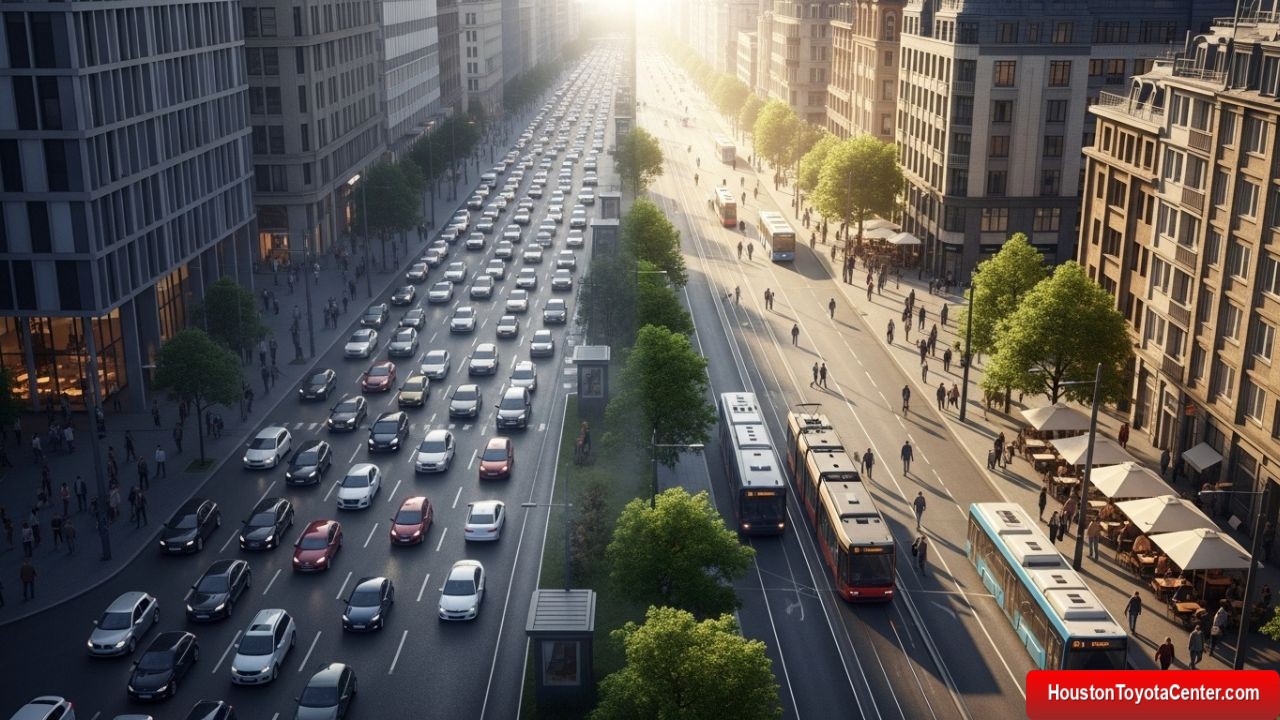
For more than a century, cities around the world have been shaped by the automobile. Roads widened, neighborhoods fragmented, public spaces sacrificed, and daily life reorganized around private car ownership. What was once hailed as freedom and progress has increasingly become a source of congestion, pollution, social inequality, and declining quality of life. As urban populations continue to grow and climate pressures intensify, the car-centric model of city planning is being fundamentally questioned.
Urban planning for fewer cars is not about eliminating vehicles entirely. Rather, it is about rebalancing priorities—placing people, communities, and the environment at the center of design decisions. This approach emphasizes public transit, walking, cycling, and mixed-use development, creating cities that are healthier, more inclusive, and more resilient.
Promoting public transit and walkability is one of the most effective ways to reduce car dependency. Cities that succeed in this transformation experience lower emissions, improved public health, stronger local economies, and more vibrant public life. Yet achieving this shift requires coordinated policy, cultural change, infrastructure investment, and long-term vision.
This article explores how urban planning can reduce reliance on cars by prioritizing public transit and walkability. It examines historical context, core principles, design strategies, policy tools, economic and social impacts, real-world examples, challenges, and future directions.
FREE: Quickly identify and understand problems with your vehicle 🚘
CLICK HEREThe Legacy of Car-Oriented Urban Development
How Cars Came to Dominate Cities
In the early 20th century, many cities were compact, walkable, and built around streetcars and rail systems. The rapid rise of the automobile, particularly after World War II, transformed urban landscapes. Governments invested heavily in highways, suburban expansion, and zoning laws that separated residential, commercial, and industrial uses.
Key factors that fueled car dominance included:
- Mass production of affordable automobiles
- Political influence of automotive and oil industries
- Federal highway funding programs
- Cultural association of cars with freedom and status
- Zoning policies that favored low-density development
Over time, cities sprawled outward. Distances between homes, workplaces, schools, and shops increased, making walking or transit impractical in many areas.
Consequences of Car-Centric Planning
The impacts of car-oriented planning are now widely recognized:
- Traffic congestion: More roads often lead to more traffic, not less.
- Environmental damage: Cars contribute significantly to greenhouse gas emissions and air pollution.
- Public health issues: Sedentary lifestyles and polluted air increase rates of obesity, cardiovascular disease, and respiratory illnesses.
- Social inequality: Car dependency disproportionately burdens low-income households and excludes those unable to drive.
- Loss of public space: Streets designed for cars reduce space for social interaction, greenery, and community life.
Recognizing these consequences has prompted a growing movement toward urban planning models that reduce car reliance.
Why Fewer Cars Matter: Benefits of Transit- and Walk-Oriented Cities
Environmental Sustainability
Transportation is one of the largest sources of carbon emissions globally. Reducing car use through effective public transit and walkable neighborhoods directly lowers emissions, improves air quality, and helps cities meet climate goals.
Benefits include:
- Reduced greenhouse gas emissions
- Lower noise pollution
- Less land devoted to roads and parking
- Improved urban biodiversity through reclaimed space
Public Health Improvements
Walkable cities encourage physical activity as part of daily routines. Public transit users typically walk more than car users, contributing to better overall health.
Health-related benefits include:
- Increased physical activity
- Lower rates of obesity and chronic disease
- Reduced traffic-related injuries and fatalities
- Improved mental well-being through social interaction and access to green spaces
Economic Efficiency and Equity
Car ownership is expensive. Fuel, insurance, maintenance, and parking consume a significant portion of household income. Transit-oriented cities reduce these costs while increasing economic accessibility.
Economic and social advantages include:
- Lower transportation expenses for households
- Increased access to jobs and education
- Higher foot traffic supporting local businesses
- Reduced public spending on road maintenance and parking infrastructure
Public Transit as the Backbone of Car-Reduced Cities
The Role of High-Quality Public Transportation
Public transit is essential for moving large numbers of people efficiently in urban environments. Buses, trams, subways, and commuter rail systems provide alternatives to private vehicles while supporting dense, mixed-use development.
Effective public transit systems share several characteristics:
- Reliability and frequency
- Affordability
- Accessibility for all users
- Integration across modes
- Safe and comfortable infrastructure
Types of Public Transit and Their Urban Impact
Bus Rapid Transit (BRT):
BRT systems offer dedicated lanes, priority signaling, and frequent service, delivering metro-like performance at lower cost.
Light Rail and Tram Systems:
These systems promote corridor-based development and often revitalize urban streets.
Heavy Rail and Subways:
High-capacity systems support dense urban cores and regional connectivity.
Commuter Rail:
Links suburbs and satellite cities to urban centers, reducing long-distance car commuting.
Transit-Oriented Development (TOD)
Transit-oriented development is a planning approach that concentrates housing, jobs, and services around transit stations. TOD reduces travel distances and encourages walking and transit use.
Key elements of TOD include:
- High-density development near stations
- Mixed land uses
- Limited parking supply
- Pedestrian-friendly street design
- Affordable housing integration
Designing Cities for Walkability
What Makes a City Walkable?
Walkability refers to how safe, comfortable, and convenient it is to walk in an area. A walkable city prioritizes human-scale design over vehicle throughput.
Core components of walkability include:
- Short block lengths
- Wide, continuous sidewalks
- Safe street crossings
- Shade, seating, and lighting
- Active ground-floor uses
The Human Experience of Walking
Walking is not just a mode of transportation; it is a social experience. Walkable environments encourage spontaneous interactions, street life, and a sense of belonging.
Well-designed walking environments:
- Increase perceived safety
- Support local commerce
- Foster social cohesion
- Enhance cultural expression
Mixed-Use Development and Proximity
One of the most important factors in walkability is proximity. When daily needs are close by, walking becomes practical and appealing.
Mixed-use development combines:
- Residential
- Commercial
- Educational
- Recreational
- Civic functions
This reduces the need for long trips and supports vibrant neighborhoods.
Reclaiming Street Space: From Cars to People
Road Diets and Lane Reductions
Many cities are redistributing street space by reducing car lanes and reallocating them to:
- Wider sidewalks
- Bus lanes
- Bike lanes
- Green infrastructure
These “road diets” often improve traffic flow while enhancing safety.
Pedestrianization and Car-Free Zones
Pedestrian-only streets and districts create spaces focused on people rather than vehicles. These areas often become cultural and economic hubs.
Benefits include:
- Increased retail activity
- Improved air quality
- Enhanced tourism appeal
- Stronger community identity
Parking Reform
Parking requirements have long shaped urban form. Reducing or eliminating minimum parking mandates allows more flexible and efficient land use.
Parking reform strategies include:
- Unbundling parking from housing costs
- Pricing street parking dynamically
- Converting parking lots into housing or parks
Policy Tools for Reducing Car Dependence
Zoning and Land-Use Reform
Traditional zoning often enforces separation of uses and low density. Reforming zoning codes is critical to supporting walkable, transit-friendly cities.
Key reforms include:
- Allowing higher densities near transit
- Legalizing mixed-use buildings
- Encouraging accessory dwelling units
- Removing parking minimums
Congestion Pricing and Traffic Management
Congestion pricing charges drivers for entering high-traffic areas during peak times. This reduces car trips and generates revenue for transit.
Cities implementing congestion pricing have seen:
- Reduced traffic volumes
- Faster transit speeds
- Improved air quality
- Increased transit funding
Investment Priorities
Redirecting public investment from highways to transit and pedestrian infrastructure signals long-term commitment to car reduction.
Technology and Innovation in Transit and Walkability
Smart Transit Systems
Technology enhances transit efficiency and user experience through:
- Real-time arrival information
- Integrated payment systems
- Demand-responsive services
- Data-driven route optimization
Micromobility Integration
While this article focuses on transit and walking, micromobility (such as shared bikes and scooters) complements both by solving “last-mile” challenges.
Digital Tools for Urban Planning
Planners now use advanced modeling and data analytics to:
- Simulate travel behavior
- Evaluate policy impacts
- Engage communities through visualization
Case Studies: Cities Leading the Shift Away from Cars
Below is a comparative table highlighting how different cities have successfully promoted public transit and walkability.
| City | Key Strategies | Results |
|---|---|---|
| Copenhagen | Pedestrian streets, cycling integration, transit priority | High walk and bike mode share, low car dependency |
| Vienna | Affordable transit passes, dense mixed-use development | High public transit usage, strong social equity |
| Bogotá | Bus Rapid Transit, car-free days, pedestrian investments | Reduced emissions, improved mobility access |
| Paris | Street pedestrianization, reduced parking, transit expansion | Increased walking, decreased car traffic |
| Tokyo | Rail-focused development, minimal parking, compact neighborhoods | Low car ownership, efficient urban mobility |
These cities demonstrate that reducing car dependence is achievable across diverse cultural and economic contexts.
Social and Cultural Dimensions of Car-Reduced Cities
Changing Mobility Culture
Infrastructure alone is not enough. Shifting attitudes toward mobility requires cultural change.
Successful strategies include:
- Public awareness campaigns
- Community engagement in street redesign
- Education on health and environmental benefits
Equity and Inclusion
Urban planning must ensure that transit and walkability improvements benefit all residents, especially marginalized communities.
Equity-focused approaches include:
- Affordable transit fares
- Universal design for accessibility
- Preventing displacement through housing protections
Challenges and Criticisms
Political Resistance
Reducing car space can face opposition from drivers, businesses, and political groups. Transparent communication and pilot projects help build support.
Funding Constraints
Transit and pedestrian projects require sustained investment. Creative financing and public-private partnerships can help bridge gaps.
Climate and Geography
Extreme weather and low-density regions pose unique challenges. Design solutions must be context-sensitive rather than one-size-fits-all.
The Future of Urban Planning for Fewer Cars
Long-Term Vision
Cities that commit to reducing car dependence adopt long-term strategies aligned with climate, health, and equity goals.
Future trends include:
- Expansion of 15-minute city concepts
- Greater integration of land use and mobility planning
- Increased citizen participation in urban design
Measuring Success
Success should be measured not only by traffic flow, but by:
- Quality of life
- Access to opportunity
- Environmental resilience
- Social connection
Conclusion: Building Cities for People, Not Cars
Urban planning for fewer cars represents a fundamental shift in how cities define progress. By prioritizing public transit and walkability, cities can become more sustainable, equitable, and enjoyable places to live. This transformation requires vision, courage, and collaboration, but the rewards are profound.
Cities designed for people rather than vehicles foster healthier residents, stronger communities, and a more resilient future. As the challenges of the 21st century intensify, the choice becomes increasingly clear: cities that move beyond car dependency will be the ones that thrive.
Leave a Reply