
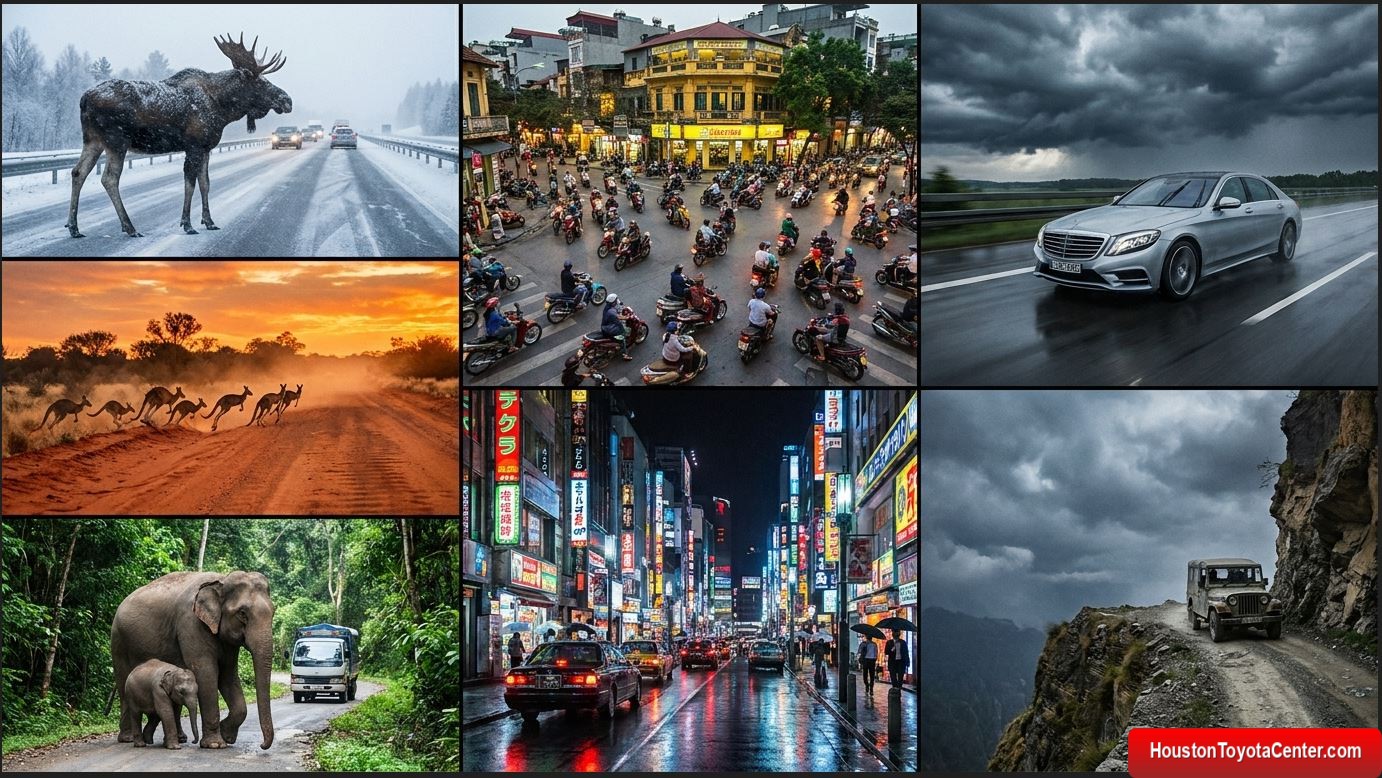
Traveling by road is one of the most revealing ways to understand a country. Roads expose how people behave under pressure, how governments prioritize safety, how communities adapt to geography, and even how humor and tradition shape everyday life. While many drivers assume road signs and traffic laws are relatively universal, the reality is far more fascinating. Across the world, drivers encounter signs warning about wandering camels, polar bears, kangaroos, avalanches, elephants, and even drunken pedestrians. Customs behind the wheel can be equally surprising, ranging from strict silent driving etiquette in some regions to aggressively expressive horn communication in others.
Road systems are cultural documents painted onto asphalt. They reflect climate, wildlife, urban density, economic development, religion, social norms, and local history. A driver crossing borders quickly learns that traffic behavior is not simply about law enforcement. It is about collective understanding. In one country, flashing headlights means “go ahead.” In another, it means “move out of my way.” In one region, pedestrians dominate the streets. Elsewhere, vehicles never slow down unless absolutely necessary.
This article explores some of the world’s most unusual road signs and driving customs, examining how they emerged and what they reveal about the places where they exist.
Why Road Signs Differ Around the World
Most modern road signage evolved from international standards introduced during the twentieth century. Agreements such as the Vienna Convention on Road Signs and Signals attempted to create consistency for international travel. However, not every nation adopted the same system, and many countries preserved distinctive local designs.
FREE: Quickly identify and understand problems with your vehicle 🚘
CLICK HERERoad signs are heavily influenced by:
- Geography and climate
- Wildlife migration patterns
- Historical transportation systems
- Urban planning philosophy
- Cultural communication styles
- Legal traditions
- Tourism and international traffic
- Local humor and public campaigns
As a result, drivers often encounter signs that make perfect sense locally but seem bizarre to visitors.
For example, in Scandinavian countries, signs warning about moose crossings are treated with extreme seriousness because collisions with large animals can be deadly. In parts of the Middle East, camel crossing signs serve the same purpose. Meanwhile, in Australia, kangaroo warning signs are so common that they have become internationally recognizable symbols of the country.
Even color schemes vary. Many European warning signs use red-bordered triangles, while the United States commonly uses yellow diamond-shaped signs. Typography, icon simplicity, and reflective materials also differ according to local regulations and road conditions.
Animal Crossing Signs: When Wildlife Owns the Road
Some of the most memorable road signs around the world involve animals. These signs are not decorative. They often exist because collisions are frequent, expensive, and dangerous.
Moose Crossings in Scandinavia
In Sweden, Norway, and Finland, moose crossing signs are among the most important warnings drivers can encounter. Moose are enormous animals capable of causing catastrophic accidents. Because of their height, a collision often sends the animal directly through the windshield.
Drivers in northern Europe are trained to reduce speed immediately after seeing these signs, especially at dawn and dusk. Reflective roadside posts are commonly installed to discourage animals from crossing highways at night.
The cultural respect for wildlife in Scandinavia influences driver behavior significantly. Many locals consider slowing down near forested roads a basic responsibility rather than an inconvenience.
Kangaroo Signs in Australia
Australia’s kangaroo crossing signs are famous worldwide. In rural areas, drivers often avoid nighttime travel because kangaroos become highly active after sunset.
Some highways include extremely long stretches with repeated wildlife warnings for:
- Kangaroos
- Wombats
- Emus
- Koalas
- Crocodiles
In remote regions, roadkill can become a major hazard because emergency services may be hours away.
Australian driving culture also includes practical survival awareness. Drivers frequently carry water, emergency supplies, and satellite communication devices when traveling through isolated areas.
Elephant Crossings in Thailand and India
In parts of Thailand and India, elephant crossing signs warn motorists near wildlife corridors and national parks.
Unlike deer or smaller animals, elephants can completely destroy vehicles during collisions. In some areas, elephants are known to block roads intentionally while moving in groups.
Drivers are often instructed never to honk aggressively at elephants because sudden noise may provoke unpredictable behavior.
Polar Bear Warnings in the Arctic
Some Arctic communities in Norway and Canada use polar bear warning signs near remote settlements.
These signs reflect genuine danger. In places such as Svalbard, residents are advised to carry protection outside populated areas because polar bear encounters can become life-threatening.
Few traffic signs communicate environmental reality more dramatically than warnings about one of the world’s largest predators.
Strange and Funny Warning Signs
Not all unusual road signs involve danger. Some are intentionally humorous, while others reflect highly specific local conditions.
“Beware of Drunken People” Signs
In parts of Eastern Europe and near entertainment districts in several countries, drivers may encounter signs warning about intoxicated pedestrians.
These signs are especially common near:
- Festival zones
- University districts
- Ski resorts
- Rural tavern regions
Though amusing to tourists, the signs often address serious accident patterns.
UFO Crossing Signs
Certain towns associated with UFO tourism have installed novelty road signs featuring flying saucers.
These signs are popular in:
- Roswell, New Mexico
- Areas near extraterrestrial-themed attractions
- Tourism-focused desert highways
Although mostly promotional, they have become iconic roadside attractions.
Falling Rocks and Avalanches
Mountainous countries frequently use dramatic warning signs for landslides, avalanches, or falling rocks.
In Switzerland, Austria, Chile, and parts of Japan, drivers may encounter signs depicting giant rocks crashing onto roads.
These warnings are often accompanied by:
- Avalanche shelters
- Emergency escape lanes
- Snow chain requirements
- Tunnel systems
In alpine regions, winter driving can become an advanced skill requiring specialized training.
Frog Crossing Signs
Some European countries install seasonal frog or toad crossing signs during migration periods.
Volunteers sometimes help amphibians cross roads safely during breeding season.
These signs reflect a broader environmental philosophy that values biodiversity protection, even for tiny animals.
The Cultural Meaning of Horn Usage
One of the most misunderstood aspects of international driving is horn etiquette.
In some countries, using the horn is considered rude and aggressive. In others, it functions as an essential communication tool.
Silent Roads in Northern Europe
Countries such as Germany, Sweden, and Switzerland generally discourage unnecessary horn use.
Drivers may use horns only for:
- Immediate danger warnings
- Preventing collisions
- Emergency situations
Using a horn out of frustration can lead to social disapproval or even fines.
This restraint reflects broader cultural values emphasizing order, predictability, and respect for public space.
Expressive Driving in India
India offers one of the world’s most dynamic horn cultures.
Trucks commonly display phrases such as:
- “Horn OK Please”
- “Use Dipper at Night”
- “Blow Horn”
In dense traffic conditions involving motorcycles, bicycles, pedestrians, buses, animals, and cars sharing limited road space, horns become constant communication devices.
Rather than signaling anger, horn usage often means:
- “I am here.”
- “I am passing.”
- “Be aware of my position.”
To outsiders, the noise may feel chaotic. To experienced local drivers, it creates a complex communication system.
Mediterranean Communication Styles
In countries such as Italy, Greece, and parts of southern Europe, driving tends to be more emotionally expressive.
Drivers may:
- Gesture frequently
- Use headlights actively
- Communicate through assertive lane positioning
- Use horns conversationally
Visitors from quieter traffic cultures may initially interpret this behavior as aggressive when it is often simply energetic.
Driving on the Left Versus the Right
One of the most obvious international differences involves which side of the road people use.
Approximately two-thirds of countries drive on the right, while many former British territories continue driving on the left.
Countries That Drive on the Left
Some notable left-driving nations include:
| Region | Countries |
|---|---|
| Europe | United Kingdom, Ireland, Malta |
| Asia | Japan, India, Thailand, Indonesia |
| Oceania | Australia, New Zealand |
| Africa | South Africa, Kenya, Botswana |
| Caribbean | Barbados, Jamaica |
Switching driving sides can be psychologically challenging because instincts developed over years suddenly become dangerous.
Visitors commonly struggle with:
- Roundabouts
- Lane positioning
- Mirror awareness
- Turning at intersections
- Automatic gear shifting with the opposite hand
Why Left-Side Driving Survived
Historically, left-side travel dates back centuries. Some historians believe horseback riders preferred keeping swords on the right side while passing opponents.
The British Empire later spread left-driving systems globally.
Many countries eventually switched to right-side driving for economic integration with neighbors, but others retained left-driving traditions.
Japan independently developed left-side rail and road systems due partly to British engineering influence during modernization.
Roundabouts: A Global Driving Personality Test
Roundabouts reveal remarkable differences in national driving psychology.
The French Roundabout Experience
France has thousands of roundabouts, more than almost any country in the world.
French traffic planners embraced them because they:
- Reduce severe collisions
- Improve traffic flow
- Lower fuel consumption
- Minimize traffic lights
However, tourists often find French roundabouts stressful due to:
- High traffic density
- Aggressive merging behavior
- Multiple lane exits
- Fast-moving scooters
The famous Arc de Triomphe roundabout in Paris is considered one of the most intimidating urban driving environments globally.
British Roundabouts
The United Kingdom transformed roundabouts into a national institution.
British drivers are trained extensively on:
- Yielding etiquette
- Lane discipline
- Signaling timing
- Spiral lane systems
Some British roundabouts are so complex they have become tourist attractions.
The “Magic Roundabout” in Swindon consists of multiple mini-roundabouts connected together, confusing even experienced drivers.
American Resistance to Roundabouts
For decades, many American drivers resisted roundabouts because they were less familiar with them.
However, modern traffic engineering studies showed roundabouts significantly reduce deadly crashes compared to traditional intersections.
As a result, more U.S. cities now install them despite initial public skepticism.
Unwritten Rules of the Road
Official laws only tell part of the story. Every country develops unwritten customs that locals understand instinctively.
Flashing Headlights
Headlight flashing means completely different things depending on the country.
| Country or Region | Common Meaning |
| United States | “You go ahead.” |
| Germany | “Move over.” |
| Parts of Latin America | “Danger or police ahead.” |
| India | “I am overtaking.” |
| Rural areas worldwide | General warning or courtesy signal |
Misunderstanding these signals can create confusion quickly.
Tailgating Norms
Following distance varies dramatically worldwide.
In Germany, despite high Autobahn speeds, drivers generally maintain disciplined lane behavior.
In some densely populated cities elsewhere, extremely close spacing becomes normal due to congestion.
Visitors often feel uncomfortable until they adapt to local traffic rhythm.
Merging Philosophy
Some countries prioritize zipper merging and orderly lane integration.
Others rely on assertiveness.
In highly competitive traffic systems, hesitation can prevent drivers from moving at all.
Local drivers learn subtle negotiation techniques involving:
- Eye contact
- Vehicle positioning
- Speed modulation
- Gesture interpretation
Japan’s Remarkably Polite Driving Culture
Japan is frequently praised for courteous road behavior.
Several customs stand out.
Thank-You Hazard Lights
Japanese drivers often flash hazard lights briefly to thank another driver for allowing them to merge.
This tiny gesture reinforces cooperative traffic behavior.
Pedestrian Respect
Drivers in Japan typically stop carefully for pedestrians, even in situations where people from more aggressive traffic environments might continue driving.
Quiet Urban Roads
Excessive horn use is discouraged socially.
The result is a calmer acoustic environment despite high urban density.
Precision Parking
Japanese cities often contain extremely small parking spaces.
As a result, drivers become highly skilled at precise maneuvering.
Automated parking garages and vertical car storage systems are also common due to limited urban land.
Germany and the Mythology of the Autobahn
Germany’s Autobahn system has become legendary because certain sections have no mandatory speed limit.
However, foreign perceptions often misunderstand Autobahn culture.
Lane Discipline Is Sacred
German drivers expect strict lane behavior.
The left lane is primarily for overtaking.
Remaining unnecessarily in the left lane is considered irresponsible and dangerous.
Vehicle Maintenance Expectations
At extremely high speeds, mechanical reliability becomes critical.
Drivers are expected to maintain:
- Tires
- Brakes
- Suspension systems
- Lighting
Poor vehicle maintenance on unrestricted roads can become catastrophic.
Speed with Structure
Contrary to stereotypes, Autobahn driving is not lawless.
It depends heavily on:
- Predictability
- Signaling discipline
- Awareness
- Precision
German driving education is relatively demanding compared to many countries.
Obtaining a license can be expensive and time-consuming.
Mountain Roads and Survival Customs
Mountain driving produces unique customs shaped by geography.
Honking Before Blind Corners
In mountainous regions of India, Nepal, and parts of South America, drivers often honk before blind curves.
This is not considered rude.
It serves as a warning signal on narrow roads where visibility may be nearly zero.
Priority Rules on Narrow Roads
In some mountain areas, uphill traffic receives priority because restarting heavy vehicles on steep slopes is difficult.
Elsewhere, larger vehicles dominate due to momentum constraints.
Local customs vary significantly.
Chain Requirements
Countries with severe winters often require snow chains during storms.
Drivers may encounter checkpoints verifying:
- Winter tires
- Chains
- Emergency kits
- Fuel levels
Ignoring these requirements can result in heavy fines or dangerous isolation.
Roadside Shrines and Spiritual Driving Traditions
In many cultures, spirituality appears directly beside highways.
Thailand’s Spirit Houses
Small spirit houses are common near roads and businesses in Thailand.
Drivers may leave offerings seeking protection during travel.
Latin American Roadside Memorials
Throughout Latin America, roadside shrines often commemorate accident victims.
These memorials can influence driver behavior emotionally, serving as visible reminders of mortality.
Blessing Vehicles in South Asia
In India and Nepal, vehicle blessing ceremonies are common.
New cars, trucks, buses, and motorcycles may receive:
- Flowers
- Colored powder
- Religious symbols
- Coconut-breaking rituals
These traditions combine spirituality with transportation culture.
Ice Roads and Extreme Winter Driving
In some parts of the world, roads themselves become temporary seasonal phenomena.
Canada’s Ice Roads
Northern Canada builds temporary ice roads over frozen lakes during winter.
These roads allow remote communities and mining operations to receive supplies.
Drivers must follow strict rules regarding:
- Vehicle spacing
- Speed
- Weight limits
Driving too fast can create pressure waves beneath the ice, increasing collapse risk.
Nordic Winter Techniques
Drivers in Finland and Sweden often learn winter control skills from an early age.
Advanced winter driving may involve:
- Controlled skidding
- Countersteering
- Snow braking
- Ice traction management
Studded tires are common in many northern regions.
Iceland’s Wind Warnings
Icelandic roads frequently include warnings about extreme wind.
Tourists unfamiliar with these conditions sometimes damage car doors when gusts violently catch them.
Certain roads may close suddenly due to:
- Volcanic activity
- Snowstorms
- Flooding
- Sandstorms
Driving there requires constant weather monitoring.
The Informal Logic of Urban Traffic Chaos
Some cities appear completely chaotic to outsiders, yet locals navigate them effectively.
Cairo’s Negotiated Traffic
Traffic in Cairo often relies less on strict lane discipline and more on continuous negotiation.
Drivers communicate through:
- Tiny speed adjustments
- Horns
- Eye contact
- Assertive positioning
Visitors may initially perceive disorder, but experienced local drivers understand the flow intuitively.
Ho Chi Minh City’s Motorcycle Rivers
In Vietnam, enormous streams of motorcycles move almost like schools of fish.
Pedestrians crossing roads often learn an unusual strategy:
- Walk slowly
- Maintain predictable movement
- Avoid sudden stops
Motorcyclists continuously adapt around them.
Sudden hesitation can actually increase danger.
Mexico City’s “Hoy No Circula” Program
Mexico City introduced vehicle restrictions limiting driving days based on license plate numbers to combat pollution.
Such programs demonstrate how traffic management can intersect with environmental policy.
Driving Etiquette and Social Hierarchy
Road behavior often reflects deeper social structures.
VIP Convoys
In some countries, government or elite convoys receive aggressive traffic priority.
Roads may temporarily close for:
- Political leaders
- Royal families
- Diplomats
- Religious figures
Public reactions vary from acceptance to frustration.
Truck Dominance Cultures
In heavily freight-dependent economies, trucks dominate highway culture.
Truckers may develop their own:
- Communication signals
- Rest stop traditions
- Radio etiquette
- Decorative vehicle styles
In South Asia and Latin America, truck art has become an important cultural expression.
Motorcycle Societies
In cities with high motorcycle usage, road dynamics shift dramatically.
Motorcycles occupy spaces impossible for larger vehicles.
Traffic becomes more fluid but also more unpredictable.
Countries with massive motorcycle cultures include:
- Vietnam
- Indonesia
- India
- Thailand
Road Signs Designed for Tourists
Tourism-heavy countries often create signs specifically aimed at foreign drivers.
New Zealand’s Tourist Safety Campaigns
New Zealand frequently warns visitors unfamiliar with local roads.
Signs encourage:
- Slower speeds
- Rest breaks
- Left-side awareness
- Caution on winding roads
Because many tourists arrive after long flights and immediately rent cars, fatigue-related accidents became a major concern.
Iceland’s Nature Warnings
Icelandic tourism signs warn visitors about:
- Dangerous waves
- Fragile moss ecosystems
- Glacier hazards
- Sudden weather shifts
These signs often combine safety messaging with environmental preservation.
Desert Highway Warnings
Countries with vast deserts may post signs warning drivers about:
- Heat exhaustion
- Fuel scarcity
- Water shortages
- Long distances without services
In Australia and parts of the American Southwest, ignoring such warnings can become life-threatening.
The Psychology Behind Road Sign Design
Road sign design is deeply connected to human psychology.
Effective signs must communicate instantly across language barriers.
Why Symbols Matter
Pictograms allow rapid recognition even for foreign drivers.
For example:
- Deer silhouettes indicate wildlife danger universally
- Snowflakes signal icy conditions
- Curved arrows warn about sharp bends
Visual simplicity improves reaction speed.
Color Psychology
Different colors communicate urgency and function.
| Color | Common Meaning |
| Red | Danger, prohibition, stop |
| Yellow | Warning, caution |
| Blue | Information, services |
| Green | Directions, routes |
| Orange | Temporary hazards or construction |
These associations are broadly international but not entirely universal.
Humor in Safety Campaigns
Some countries experiment with humorous signs to increase attention.
Examples include:
- Sarcastic speeding warnings
- Creative anti-drunk-driving slogans
- Cartoon-style caution signs
Studies suggest humor can improve memory retention when used carefully.
Unusual Traffic Laws Around the World
Many countries have highly specific driving laws that surprise visitors.
Splashing Pedestrians
In some places, drivers can receive fines for splashing pedestrians with puddle water.
Dirty Cars
Certain regions discourage excessively dirty vehicles because obscured visibility and unreadable license plates create safety issues.
Mandatory Breathalyzers
France once required drivers to carry unused breathalyzer kits in vehicles.
Although enforcement evolved over time, the rule gained global attention.
Daytime Headlights
Several Nordic countries require headlights during daytime due to reduced winter visibility.
No Fuel on Sundays
In parts of the world during historical crises or shortages, governments restricted fuel purchases on specific days.
Traffic culture can change rapidly during economic or political pressure.
How Technology Is Changing Road Culture
Modern technology is reshaping driving customs everywhere.
GPS Dependency
Navigation apps reduce reliance on local knowledge.
However, they also create problems when tourists follow routes unsuitable for actual road conditions.
Remote villages worldwide have reported confused travelers arriving on dangerous or inaccessible roads.
Dashcams
Dashcams are extremely common in countries where accident disputes or insurance fraud are concerns.
Russia became especially associated with dashcam footage due to:
- Insurance disputes
- Harsh weather events
- Meteor incidents
- Viral online videos
Electric Vehicles
Electric vehicles are influencing road infrastructure through:
- Charging stations
- Quiet vehicle warnings
- Dedicated parking
- Urban low-emission zones
Driving habits may evolve further as autonomous systems develop.
Border Crossings and Driving Adaptation
Crossing international borders by car can produce immediate cultural shock.
Drivers must adapt quickly to:
- Different road signs
- Speed units
- Enforcement styles
- Fuel systems
- Toll procedures
- Lane discipline
Metric Versus Imperial Systems
Most countries use kilometers per hour.
However, the United States and United Kingdom commonly use miles per hour.
Tourists occasionally underestimate speed differences, creating dangerous situations.
Corruption and Informal Enforcement
In some regions, traffic stops may involve informal payment expectations.
Experienced travelers often research local enforcement culture carefully before road trips.
Insurance and Documentation
International driving frequently requires:
- International driving permits
- Border insurance
- Temporary import permits
- Emissions compliance
Road travel becomes not just physical movement but administrative navigation.
The Future of Road Signs
Traditional road signs may eventually change dramatically.
Smart Highways
Some countries are experimenting with:
- Dynamic digital signs
- Weather-responsive speed limits
- Real-time traffic communication
- Connected vehicle systems
Autonomous Vehicles
Self-driving technology could eventually reduce reliance on human-readable signage.
Cars may communicate directly with infrastructure.
However, during long transition periods, roads must remain understandable to both humans and machines.
Environmental Design
Future road systems may prioritize:
- Bicycle infrastructure
- Pedestrian-first planning
- Wildlife crossings
- Noise reduction
- Reduced urban emissions
Road signs will likely evolve alongside changing transportation philosophy.
What Road Culture Reveals About Humanity
Roads are social ecosystems.
The way people drive reveals how societies balance:
- Individual freedom and collective order
- Speed and safety
- Competition and cooperation
- Efficiency and courtesy
- Human convenience and environmental responsibility
A driver traveling internationally quickly learns that there is no single “normal” traffic culture.
What feels polite in one country may seem passive elsewhere. What feels aggressive in one region may simply represent efficient communication.
Road signs, meanwhile, tell stories about landscapes, fears, priorities, and identity. A camel crossing sign speaks about desert trade history. Moose warnings reveal coexistence with wilderness. Avalanche barriers demonstrate engineering against nature itself.
Even the smallest roadside symbols contain layers of cultural meaning.
Conclusion
Unique road signs and driving customs around the world are far more than amusing travel curiosities. They are reflections of geography, history, psychology, economics, and culture.
A simple road trip across borders can expose travelers to entirely different philosophies of movement and behavior. In some places, roads operate through strict order and silence. In others, they function through negotiation, instinct, and constant communication.
Animal crossing signs remind drivers that humans share territory with wildlife. Mountain road customs reveal adaptation to dangerous terrain. Polite hazard-light thank-yous in Japan demonstrate social harmony, while expressive horn systems in India showcase a different but equally functional traffic language.
As technology transforms transportation, some traditional customs may fade. Yet roads will probably always remain deeply human spaces where culture becomes visible in motion.
Every sign beside a highway tells a story.
Every driving custom reflects a society.
And every traveler who gets behind the wheel abroad discovers that understanding traffic is really about understanding people.
Leave a Reply