The badge “GR” stands for Gazoo Racing, but in reality, it represents far more than just a name—it’s a movement. A testament to Toyota’s relentless pursuit of performance, precision, and passion, GR-branded vehicles are rooted in motorsport excellence and engineered for real-world excitement. But how did we get here? How did Toyota evolve from reliable family sedans to building some of the most enthusiast-loved performance machines on the road?
To understand the legacy of GR, we must journey through Toyota’s rich motorsport history, particularly in rally racing, and examine how those racing technologies now echo through today’s road cars like the GR86, GR Corolla, and GR Supra.
The Birth of Gazoo Racing: A Racing Skunkworks
In the early 2000s, Toyota’s top executives were concerned. The company had a reputation for quality and reliability, but it lacked the emotional connection that brands like Ferrari or even Subaru had cultivated through motorsport. Enter Akio Toyoda, grandson of Toyota’s founder and a motorsport fanatic himself.
Akio Toyoda believed that “no more boring cars” should be Toyota’s mission. To do that, he created a secret division called Gazoo Racing, named after “Gazo,” the Japanese word for “image.” Initially involved in digital motorsport simulations and amateur racing, Gazoo Racing soon became a real-world racing lab, entering grueling endurance races like the 24 Hours of Nürburgring.
FREE: Quickly identify and understand problems with your vehicle 🚘
CLICK HERE“You can’t make exciting cars without experiencing the harshness of racing.” – Akio Toyoda
Toyota’s Rally Racing Roots: The WRC Era
Before GR became mainstream, Toyota was already a dominant force in rally racing.
🏁 Toyota Team Europe and the WRC Era
In the 1970s and 1980s, Toyota Team Europe (TTE) began competing in the World Rally Championship (WRC), setting the stage for decades of rally dominance.
Iconic Rally Cars:
| Model | Years Active | Highlights |
|---|---|---|
| Toyota Celica GT-Four (ST165, ST185, ST205) | 1988–1995 | 4 WRC Manufacturer Titles |
| Toyota Corolla WRC | 1997–1999 | Final rally car before Toyota left WRC in 1999 |
- 1990–1994: Toyota won three drivers’ titles with Carlos Sainz, Juha Kankkunen, and Didier Auriol.
- 1993: Toyota becomes the first Japanese manufacturer to win the WRC manufacturer’s title.
The technology developed for these rally cars—such as turbocharged engines, all-wheel drive systems, and lightweight construction—influenced Toyota’s engineering for decades to come.
The Resurrection: GR’s Modern Motorsport Dominance
Toyota returned to the World Rally Championship in 2017 with the Yaris WRC, developed under the GR umbrella. The result? Instant success.
🏆 Modern WRC Achievements:
- 2018: Toyota wins the Manufacturer’s Championship
- 2019–2023: Multiple driver’s championships with stars like Ott Tänak, Sébastien Ogier, and Kalle Rovanperä
GR’s racing efforts also extend to:
- WEC (World Endurance Championship) with the GR010 Hybrid Hypercar
- Dakar Rally with the Hilux GR DKR T1+
These platforms serve as testbeds for advanced technologies, from hybrid propulsion to aerodynamics—feeding directly into the DNA of today’s GR road cars.
From Dirt Roads to Showrooms: The GR Lineup
🚗 GR Supra: The Grand Comeback
In 2019, Toyota brought back a legendary nameplate: the Toyota Supra, this time under the GR branding as the GR Supra (A90).
Highlights:
- Co-developed with BMW (shares platform with Z4)
- 3.0L turbocharged inline-6 with up to 382 hp
- 50:50 weight distribution
- Now offered with a 6-speed manual transmission for purists
The GR Supra proved that Toyota could deliver sports cars that rival German and Japanese legends alike.
🏎 GR Yaris: A Homologation Masterpiece
Perhaps the purest expression of rally DNA, the GR Yaris was born to homologate Toyota’s WRC program.
Specifications:
- 1.6L turbocharged 3-cylinder (world’s most powerful)
- AWD system with active differentials
- 0–100 km/h in 5.2 seconds
The GR Yaris stunned the automotive world. Journalists called it “a rally car for the road”, and its raw, mechanical driving feel made it an instant classic.
🔥 GR Corolla: America’s Turn
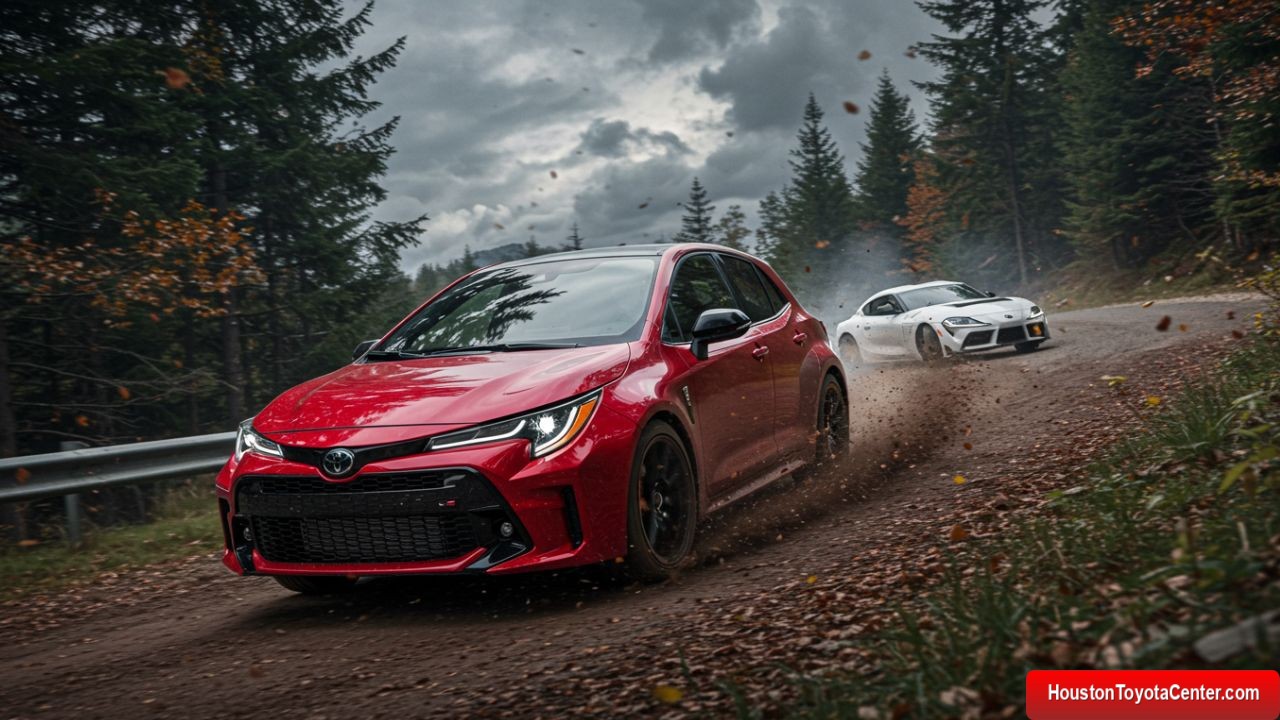
With the Yaris not sold in the U.S., Toyota created something just for the American enthusiast: the GR Corolla.
Key Features:
| Engine | 1.6L Turbocharged I-3 |
|---|---|
| Drivetrain | GR-FOUR AWD |
| Power Output | 300 hp |
| Transmission | 6-speed manual only |
It even features a “Circuit Edition” with a forged carbon fiber roof and limited-slip differentials.
🌀 GR86: The Lightweight Purist’s Dream
A successor to the beloved GT86, the GR86 continues the tradition of affordable rear-wheel-drive performance.
Notable Specs:
- 2.4L flat-four boxer engine
- 228 hp and 184 lb-ft
- 0–60 mph in 6.1 seconds
- Curb weight under 2,900 lbs
It offers a pure analog driving experience in an age of turbocharged complexity.
Racing DNA in Every GR Car
What makes a GR car special? It’s more than performance figures—it’s about feeling connected to the machine. That connection stems from racing development, and GR implements these principles:
🛠 GR Engineering Principles:
- Track-tuned suspensions
- Reinforced chassis for rigidity
- Driver-first cockpit layouts
- True manual gearboxes
- Functional aerodynamics
Each GR car undergoes development at Toyota’s Shimoyama Test Track, modeled after the Nürburgring. Akio Toyoda himself often test-drives prototypes under his racing pseudonym “Morizo.”
The Cultural Shift: Enthusiasts Embrace Toyota
Just a decade ago, Toyota was seen as a safe, conservative automaker. Now, it’s a name enthusiasts proudly tattoo on their bodies and shout in racing paddocks.
🔄 What Changed?
- GR flipped Toyota’s identity from “appliance-like” to aspirational
- New online communities, track days, and GR owner clubs flourished
- Toyota launched GR Garage Stores in Japan for custom tuning and community events
Comparison Table: GR Models At a Glance
| Model | Engine | Power (hp) | Drivetrain | 0–60 mph | Notable Feature |
|---|---|---|---|---|---|
| GR86 | 2.4L Boxer-4 | 228 | RWD | 6.1 sec | Lightweight, RWD purist |
| GR Corolla | 1.6L Turbo I-3 | 300 | AWD | 4.9 sec | Rally-bred AWD, 3 exhaust tips |
| GR Yaris | 1.6L Turbo I-3 | 268 | AWD | 5.2 sec | Homologation special |
| GR Supra | 3.0L Turbo I-6 | 382 | RWD | 3.9 sec | Inline-6 + optional manual |
Limited Editions and Future Models
Toyota GR isn’t done yet.
- GRMN (Gazoo Racing Masters of Nürburgring) editions of the Yaris and Supra push performance even further with reduced weight and track upgrades.
- Rumors of a GR Camry or GR C-HR are gaining momentum.
- Toyota is also developing hydrogen-powered racing engines, hinting at a sustainable yet thrilling GR future.
The GR Experience: More Than Just Cars
Toyota understands that the GR brand is a lifestyle.
- Toyota Gazoo Racing Cup: a grassroots racing series
- GR Track Days: drive your car with professional instruction
- Merchandise & Simulators: build fan engagement beyond ownership
Akio Toyoda once said, “Cars should be fun.” The GR brand makes that belief a tangible reality.
Conclusion: GR is Just Getting Started
From dusty rally trails to Nürburgring asphalt, Toyota GR represents decades of motorsport evolution channeled into road cars. It’s a rare blend of passion, performance, and pedigree—where everyday drivers get a slice of the racetrack in every gear shift and tire squeal.
Whether it’s the agile GR86, the explosive GR Corolla, the classic-modern GR Supra, or the rally-bred GR Yaris, these machines honor the past while carving out an exciting future.
Toyota GR isn’t just a badge—it’s a promise. A promise to never be boring again.
✅ Bonus: Key GR Moments Timeline
| Year | Event |
|---|---|
| 1990 | Toyota wins first WRC Driver’s title with Carlos Sainz |
| 1993 | Wins WRC Manufacturer’s title |
| 2007 | Akio Toyoda races Nürburgring as “Morizo” |
| 2017 | Returns to WRC with Yaris |
| 2019 | Launch of GR Supra |
| 2020 | GR Yaris debuts |
| 2022 | GR Corolla enters the U.S. market |
| 2025 | Rumors of GR Prius, GR Camry emerge |
Leave a Reply