
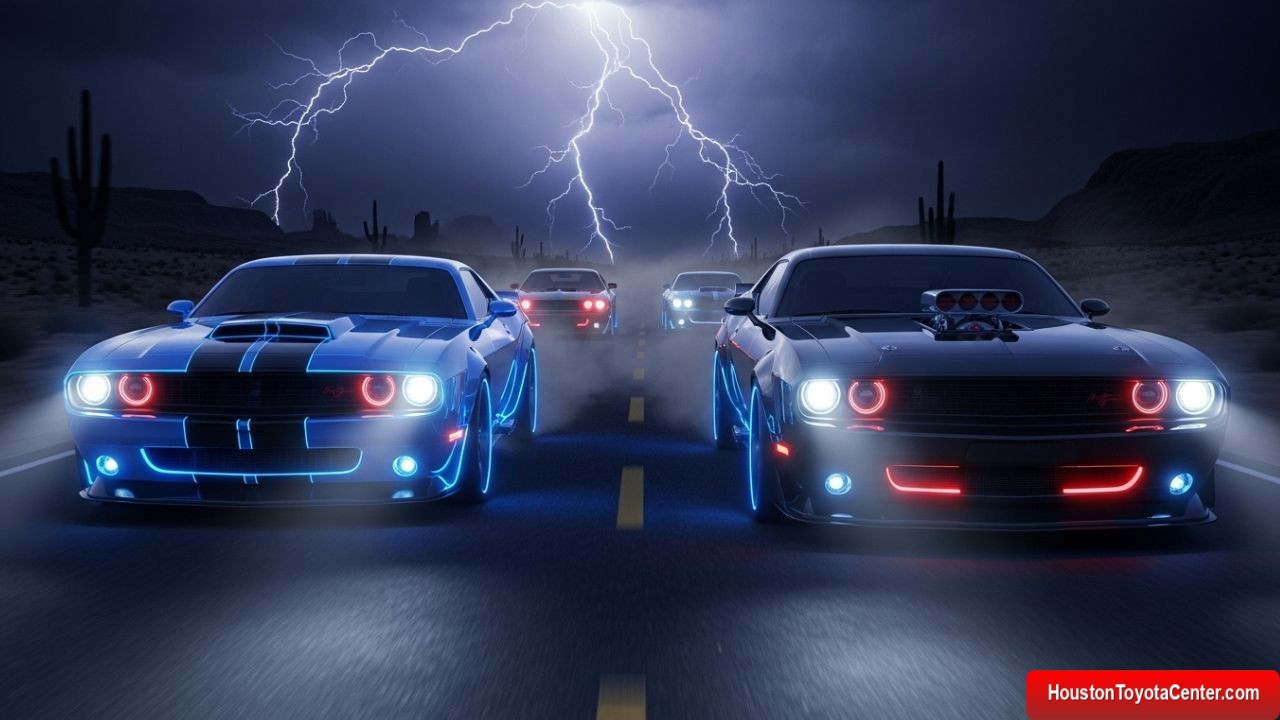
For decades, American muscle cars have been the roaring heart of automotive culture — icons of rebellion, raw power, and the freedom of the open road. Names like Mustang, Charger, Camaro, and Corvette became legends, capturing the imagination of car lovers around the world. Their thunderous V8 engines, sleek lines, and visceral energy symbolized an era when horsepower reigned supreme.
But the automotive world is changing. The 21st century has brought new challenges — climate change, rising fuel costs, and an urgent demand for cleaner energy. Once dismissed as relics of the past, American muscle cars are now being reimagined for a new generation. The question is: can a muscle car still be a muscle car without gasoline?
Welcome to the Electric Edition of American muscle — where silent power meets modern performance, and nostalgia collides with innovation.
⚡ A Shift in Power: The Electric Revolution
The electric revolution in the auto industry has accelerated faster than many expected. What began as a niche for eco-friendly commuters — with small EVs like the Nissan Leaf and Toyota Prius leading the way — has evolved into a high-performance frontier.
FREE: Quickly identify and understand problems with your vehicle 🚘
CLICK HERETesla broke barriers, proving electric cars could be thrilling, luxurious, and incredibly fast. But now, Detroit’s titans — Ford, Dodge, and Chevrolet — have entered the arena, determined to redefine what “muscle” means in the EV era.
This transformation isn’t just about compliance with emissions standards; it’s about reclaiming identity. The new electric muscle cars promise instant torque, breathtaking acceleration, and designs that honor their legendary predecessors.
🏁 A Brief Look Back: When Muscle Cars Ruled the Streets
Before diving into the EV wave, it’s worth remembering what made American muscle cars so beloved in the first place.
| Era | Key Models | Defining Traits | Cultural Impact |
|---|---|---|---|
| 1960s | Ford Mustang, Chevy Camaro, Dodge Charger | Affordable V8 power, bold styling | Symbol of youth rebellion and freedom |
| 1970s | Pontiac Firebird, Plymouth Barracuda | Raw performance, drag strip dominance | Cemented muscle in pop culture |
| 1980s | Chevy Monte Carlo SS, Ford Mustang GT | Emissions restrictions softened power | Rise of tuning culture |
| 1990s–2000s | Dodge Challenger, Corvette C6 | Muscle revival with modern tech | Performance meets nostalgia |
| 2020s | Mustang Mach-E GT, Dodge Charger Daytona SRT EV | Electrification meets tradition | The rebirth of muscle in a new form |
For over 60 years, muscle cars represented American engineering at its boldest — uncompromising, emotional, and unapologetically powerful. Now, as the world turns electric, that same spirit must evolve.
⚙️ Meet the New Breed: Electric Muscle Cars Redefining the Game
1. Ford Mustang Mach-E GT
The Mustang name has long been synonymous with freedom and adrenaline. When Ford announced the all-electric Mach-E, purists were skeptical — could an SUV truly carry the Mustang badge?
But the Mach-E GT silenced critics. With up to 480 horsepower and 634 lb-ft of torque, it sprints from 0–60 mph in just 3.5 seconds. It delivers muscle in a futuristic form, combining instant torque with advanced driving tech. The Mach-E GT Performance Edition proves that silence can still be savage.
Key Specs:
- Horsepower: 480 hp
- Torque: 634 lb-ft
- Range: ~270 miles
- 0–60 mph: 3.5 seconds
2. Dodge Charger Daytona SRT EV
When Dodge unveiled the Charger Daytona SRT Concept, jaws dropped. This wasn’t just another electric car — it was a statement. Dodge promised that the “Brotherhood of Muscle” would survive the electric transition.
It features a “Fratzonic Chambered Exhaust”, an artificial sound system that mimics the roar of a combustion engine, because Dodge understands: muscle is as much about emotion as motion.
Its sleek body, illuminated front grille, and all-wheel-drive layout hint at performance figures rivaling Hellcat models — but without the gas bill.
Expected Highlights:
- Estimated 800V Banshee powertrain
- Simulated exhaust producing up to 126 dB
- Retro-futuristic design inspired by classic Chargers
- AWD torque distribution for precision launches
3. Chevrolet Corvette E-Ray
While the Corvette isn’t fully electric yet, the E-Ray represents a crucial hybrid step. It combines the classic V8 with an electric motor, offering 655 combined horsepower and electrified all-wheel drive.
It’s a glimpse of what’s to come — a bridge between the raw muscle of the past and the electrified precision of the future. And when the day arrives that a fully electric Corvette hits the streets, it will likely redefine supercar performance all over again.
Key Specs:
- 6.2L V8 + front electric motor
- Total Power: 655 hp
- 0–60 mph: 2.5 seconds
- AWD capability for improved traction
4. Tesla Model S Plaid: The Unexpected Challenger
Tesla’s Model S Plaid might not wear a muscle car badge, but its specs are undeniably muscular. It’s America’s silent assassin — producing over 1,020 horsepower, rocketing from 0–60 mph in just 1.99 seconds, and outrunning nearly every gasoline car ever made.
It embodies what the next generation of American performance can be: high-tech, electric, and brutally fast. Traditional muscle makers have taken note — Tesla raised the bar.
⚡ Electric Muscle: Performance Without the Noise
What defines muscle has always been torque, acceleration, and attitude — not necessarily noise or fuel. Electric vehicles deliver torque instantly, meaning they can achieve breathtaking acceleration from a standstill.
For example:
- The Dodge Charger Daytona EV is expected to rival the gas-powered Hellcat’s 0–60 time (3.6 seconds).
- The Ford Mustang Mach-E GT already matches the acceleration of a 5.0L V8 Mustang GT.
- The Tesla Model S Plaid simply obliterates everything on the drag strip.
And yet, it’s not just about straight-line speed. These electric beasts introduce precision handling, lower centers of gravity, and software-based control systems that enhance traction and responsiveness.
🔋 The Technology Behind the Power
Electric muscle cars are not only faster off the line — they’re smarter. Here’s a breakdown of key technologies driving this evolution:
| Technology | Purpose | Impact on Performance |
|---|---|---|
| Instant Torque Delivery | Power available immediately from standstill | Explosive acceleration |
| Regenerative Braking | Recovers energy during deceleration | Improves efficiency, extends range |
| Battery Thermal Management | Keeps batteries at optimal temperature | Prevents power loss during high-performance driving |
| Software-Defined Driving Modes | Adjusts suspension, torque, and sound | Customizable performance feel |
| Active Aerodynamics | Automatically adjusts drag and downforce | Enhances stability and range |
Electric muscle isn’t about replacing tradition — it’s about amplifying it through innovation.
🧠 Emotional Power: The Soul of Muscle
Skeptics often argue that electric cars lack soul — that without the rumble of a V8, the experience feels sterile. But that’s changing fast. Automakers are finding creative ways to preserve emotion in an EV world.
- Dodge’s “Fratzonic Exhaust” uses sound waves to simulate combustion vibrations.
- Ford’s Mach-E GT integrates driver feedback systems that mimic gear shifts.
- Chevrolet is experimenting with simulated clutch feel and sound modulation.
The essence of muscle — that emotional punch — is being reborn through technology rather than fuel.
🌎 The Environmental Factor: Green is the New Mean
In a world where sustainability matters more than ever, the transition to electric muscle represents responsibility with rebellion. Reducing emissions doesn’t mean giving up excitement.
- EVs produce zero tailpipe emissions.
- They can be powered by renewable energy sources.
- They reduce maintenance needs (no oil changes, no complex transmissions).
In short, the future of muscle can be clean and fast. Imagine drag strips powered by solar energy, or car meets where the air smells like ozone instead of gasoline. It’s a new vision — one where power and responsibility coexist.
💲 Price and Accessibility: Can Everyone Afford Electric Muscle?
One challenge facing electric muscle cars today is cost. While traditional muscle cars like the Dodge Challenger or Ford Mustang started under $35,000, most EV counterparts are pricier.
| Model | Starting Price (USD) | Type | Range |
|---|---|---|---|
| Ford Mustang Mach-E GT | $59,995 | Electric SUV | ~270 miles |
| Dodge Charger Daytona EV (est.) | ~$65,000 | Electric coupe | TBD |
| Chevy Corvette E-Ray | $104,900 | Hybrid sports car | 260 miles (est.) |
| Tesla Model S Plaid | $89,990 | Electric sedan | 396 miles |
However, as battery technology improves and economies of scale take hold, prices will fall — just as they did with the early days of gasoline cars.
🚀 The Cultural Shift: From Roar to Whirr
Car culture is deeply emotional — it’s about sound, smell, and sensation. For older enthusiasts, the idea of a silent muscle car might feel wrong. But younger generations, raised on instant gratification and cutting-edge tech, see things differently.
Electric muscle cars appeal to this new mindset:
- Instant acceleration instead of engine tuning.
- Over-the-air software updates instead of carburetor tweaks.
- Digital dashboards instead of analog gauges.
The passion remains — it’s just expressed through different tools. The same adrenaline rush that once came from a V8 burnout now comes from pressing the accelerator on a 1,000-hp EV.
🔮 What’s Next? The Road Ahead for Electric Muscle
The resurgence of American muscle cars is only beginning. Expect the next decade to bring even more electrified legends:
- Chevrolet Camaro EV rumored for 2026.
- Dodge Challenger EV variants expanding.
- Ford’s performance division developing lighter, track-oriented Mach-E models.
- New startups like Drako and Lucid pushing American electric performance beyond imagination.
In the future, “muscle car” won’t just describe gasoline-powered beasts — it will represent a mindset: bold design, thrilling power, and unapologetic individuality.
❤️ A Legacy Recharged
American muscle cars once defined rebellion against conformity. Now, in an era demanding sustainability and innovation, they’re rebelling again — this time against the notion that eco-friendly has to mean boring.
The electric muscle movement isn’t just a trend — it’s a resurgence.
It’s proof that heritage can evolve, that emotion can coexist with innovation, and that the American dream still has horsepower — even if it’s measured in kilowatts.
Final Thoughts
The Electric Edition of American muscle isn’t an end; it’s a new beginning. It challenges our definitions of speed, sound, and soul. Whether you’re loyal to the rumble of a V8 or curious about the silent rush of an electric motor, one thing’s certain:
the spirit of American muscle is alive — and more powerful than ever.
Leave a Reply