
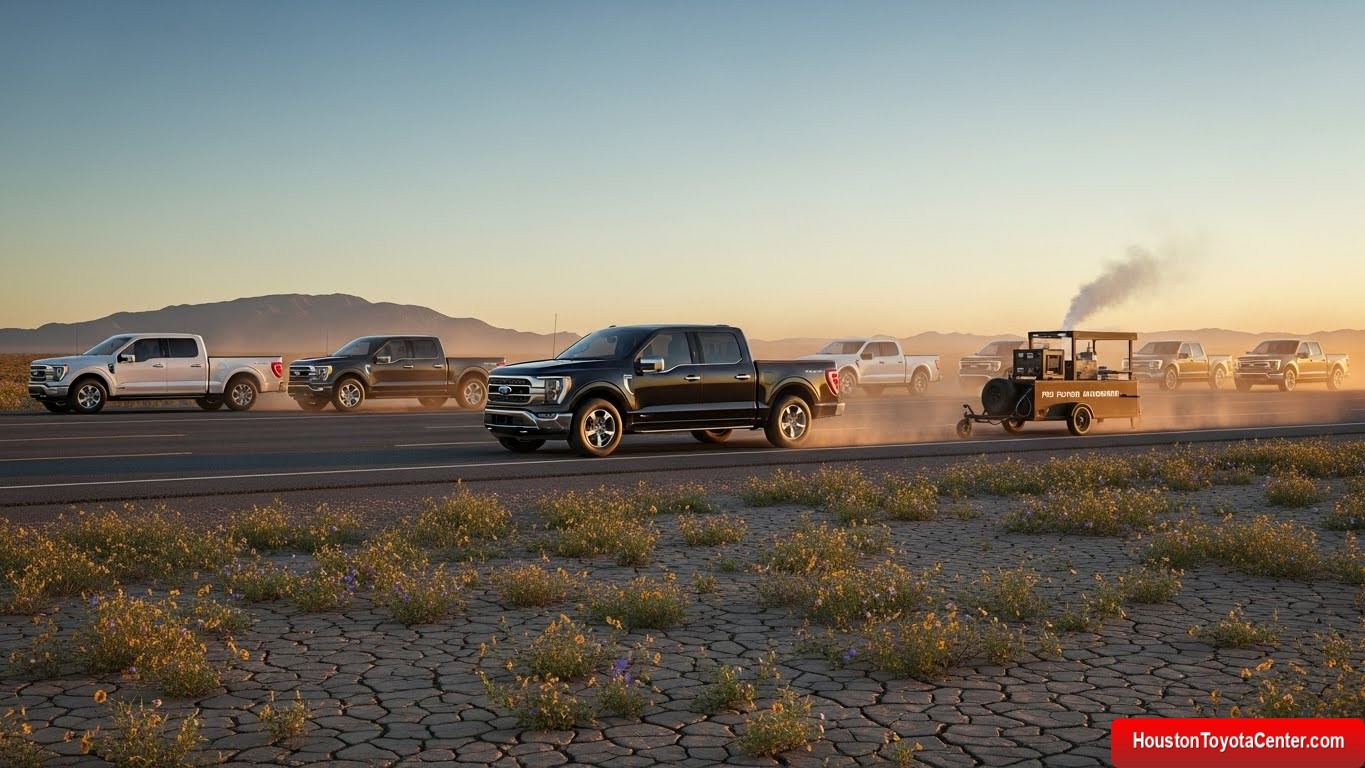
For over four decades, one vehicle has reigned supreme on American roads, job sites, and driveways: the Ford F-150. More than just a truck, the F-150 has become a cultural icon, a symbol of American ingenuity, resilience, and adaptability. Since 1981, it has held the title of best-selling vehicle in the United States, a streak that continues unbroken as of 2025. In an era defined by rapid technological shifts, evolving consumer preferences, and fierce competition, the F-150’s enduring dominance is nothing short of remarkable. This article explores the legacy of the Ford F-150, tracing its evolution from a utilitarian workhorse to a high-tech, multifaceted machine that seamlessly blends rugged capability with modern sophistication. Through engineering breakthroughs, cultural resonance, and an uncanny ability to anticipate market demands, the F-150 has cemented its place not just in automotive history, but in the very fabric of American life.
A Brief History: From Humble Beginnings to Iconic Status
The story of the Ford F-150 begins long before the nameplate itself existed. In 1948, Ford launched the F-Series, a line of trucks designed to meet the growing demands of post-World War II America. These early models—such as the F-1 (½-ton), F-2 (¾-ton), and F-3 (1-ton)—were no-frills machines built for farmers, construction workers, and small-business owners. With simple steel bodies, rudimentary interiors, and inline-six engines, they prioritized function over form. Yet, even in these modest beginnings, Ford demonstrated a commitment to durability and versatility that would become hallmarks of the brand.
The F-150 nameplate, however, didn’t emerge until 1975, during the sixth generation of the F-Series. At the time, Ford sought to create a lighter-duty variant of its popular F-100 model, which had been the go-to ½-ton truck since 1953. The F-150 was engineered to handle heavier payloads while maintaining the maneuverability and comfort needed for everyday drivers. It featured a reinforced frame, upgraded suspension, and a more powerful V8 engine option, distinguishing it from the F-100’s lighter construction. Though initially a niche offering, the F-150 quickly gained traction as consumer preferences shifted toward trucks that could serve both professional and personal needs.
By 1984, the F-100 was discontinued, and the F-150 became Ford’s primary ½-ton truck—a decision that would prove pivotal. The timing coincided with a broader cultural shift: Americans were increasingly viewing trucks not just as tools for work, but as practical, family-friendly vehicles. The rise of suburbanization, the expansion of recreational activities like camping and towing, and the decline of station wagons all contributed to this trend. Ford capitalized on the moment by refining the F-150’s ride quality, adding creature comforts like air conditioning and AM/FM radios, and introducing trim levels such as the XLT (1983) to appeal to a wider audience.
FREE: Quickly identify and understand problems with your vehicle 🚘
CLICK HEREThe 1990s marked a turning point for the F-150, as Ford embraced innovation to stay ahead of competitors like the Chevrolet C/K series and Dodge Ram. The ninth-generation F-150 (1992–1996) introduced features like dual airbags, anti-lock brakes, and a smoother-riding torsion-beam front axle. Meanwhile, the tenth generation (1997–2003) brought a more aerodynamic design, improved interior materials, and the debut of the SVT Lightning, a high-performance variant with a supercharged 5.4L V8 engine. These updates transformed the F-150 from a purely functional vehicle into a desirable lifestyle choice.
The eleventh generation (2004–2008) further elevated the F-150’s status with a bold, squared-off design and the introduction of the Ford Sync infotainment system in later models. However, it was the twelfth generation (2009–2014) that truly redefined what a pickup truck could be. Launched during the Great Recession, this iteration focused on fuel efficiency without sacrificing capability—a response to rising gas prices and environmental concerns. The 3.5L EcoBoost V6 engine, introduced in 2011, delivered V8-level power with better mileage, setting a new industry standard.
Then came the thirteenth generation (2015–2020), arguably the most revolutionary chapter in the F-150’s history. Ford shocked the automotive world by replacing the traditional steel body with an aluminum-intensive construction, shedding up to 700 pounds while improving strength and fuel economy. This bold move faced skepticism initially—many questioned aluminum’s durability in rugged conditions—but it ultimately paid off, with the F-150 achieving best-in-class towing (up to 12,200 lbs) and payload capacities (3,300 lbs). The redesign also introduced advanced features like Pro Trailer Backup Assist, 360-degree camera systems, and a fully digital instrument cluster.
Today, the fourteenth-generation F-150 (2021–present) represents the pinnacle of Ford’s vision. With a focus on electrification, connectivity, and customization, it caters to a diverse range of buyers—from contractors needing a reliable worksite companion to tech-savvy consumers seeking a rolling command center. The 2022 introduction of the F-150 Lightning, an all-electric variant, signaled Ford’s commitment to a sustainable future without abandoning its core identity.
To fully appreciate the F-150’s journey, consider the following overview of its generations, highlighting key milestones that shaped its legacy:
| Generation | Years Produced | Key Innovations | Engine Options | Sales Milestones |
|---|---|---|---|---|
| 6th (F-150 debut) | 1975–1983 | Introduction of F-150 as lighter-duty variant; upgraded frame/suspension | 300ci I6, 302ci/351ci V8s | Became Ford’s top-selling truck by 1980 |
| 7th | 1984–1986 | First major redesign; aerodynamic styling; XLT trim debut | 4.9L I6, 5.0L/5.8L V8s | Surpassed Chevrolet C/K in sales (1984) |
| 8th | 1987–1991 | Fuel injection standard; improved interiors; 4×4 options | 4.9L I6, 5.0L/5.8L V8s | Solidified dominance in ½-ton segment |
| 9th | 1992–1996 | Dual airbags; ABS; torsion-beam front axle | 4.2L/4.9L I6, 5.0L/5.8L V8s | First year as #1 best-selling vehicle (1991) |
| 10th | 1997–2003 | Redesigned cab; SVT Lightning debut; improved safety | 4.2L/4.6L/5.4L V8s | 10+ consecutive years as top-selling vehicle |
| 11th | 2004–2008 | Bold styling; Sync infotainment (2007); aluminum hood | 4.6L/5.4L V8s, 4.2L I6 | Introduced hybrid option (2009) |
| 12th | 2009–2014 | EcoBoost V6 debut; improved fuel economy; safety tech | 3.3L/3.5L/3.7L V6s, 5.0L V8 | Over 800,000 units sold annually (peak: 2015) |
| 13th | 2015–2020 | Aluminum body; Pro Trailer Backup Assist; 10-speed auto | 2.7L/3.3L/3.5L/5.0L engines | First truck under $30K with 10,000+ lb tow rating |
| 14th | 2021–present | PowerBoost hybrid; Pro Power Onboard; Lightning EV | 3.3L/3.5L/5.0L, 3.5L PowerBoost, Lightning EV | Lightning pre-orders exceeded 200,000 (2022) |
This table underscores the F-150’s relentless evolution, with each generation addressing emerging challenges and opportunities. From the introduction of basic safety features in the 1990s to the aluminum revolution of 2015, Ford has consistently prioritized innovation while staying true to the truck’s core purpose: to empower its owners.
Engineering Excellence: The Heart of the F-150
At the core of the F-150’s success lies its engineering philosophy: capability without compromise. Unlike many competitors that prioritize either raw power or comfort, the F-150 has mastered the art of balancing these elements to create a truck that excels in every scenario. This section delves into the mechanical innovations that have made the F-150 a benchmark in the industry.
Powertrain Prowess: From V8s to Electrification
For decades, the roar of a V8 engine defined the American pickup truck experience. The F-150 embraced this tradition with legendary powerplants like the 5.0L Coyote V8 and the 6.2L Boss V8, which delivered exhilarating performance for towing and off-roading. However, Ford recognized early that the future required more than brute force—it demanded efficiency, adaptability, and sustainability.
The game-changer arrived in 2011 with the introduction of the 3.5L EcoBoost V6. This twin-turbocharged engine produced 365 horsepower and 420 lb-ft of torque, matching or exceeding most V8s while improving fuel economy by up to 25%. Critics initially doubted whether a six-cylinder could handle heavy-duty tasks, but real-world testing proved otherwise: the EcoBoost-powered F-150 could tow up to 11,300 pounds and haul 2,910 pounds of payload, figures that rivaled V8 competitors. By 2015, EcoBoost had become the F-150’s best-selling engine option—a testament to its appeal.
Ford didn’t stop there. In 2021, the 3.5L PowerBoost hybrid engine debuted, combining a twin-turbo V6 with a 47-hp electric motor. This system delivered 430 horsepower and 570 lb-ft of torque, enabling a staggering 14,000-pound towing capacity—the highest of any light-duty truck at the time. More importantly, it introduced Pro Power Onboard, a feature that turns the truck into a mobile generator capable of powering job sites, tailgates, or even homes during outages. With 2.0–7.2 kW of output (depending on configuration), Pro Power Onboard has become a lifesaver for contractors, campers, and emergency responders alike.
The latest frontier is electrification. The F-150 Lightning, launched in 2022, features dual electric motors producing 580 horsepower (standard range) or 980 lb-ft of torque (extended range). It offers up to 320 miles of range and can recharge 15-80% in under 45 minutes using DC fast charging. While some traditionalists balked at the idea of an electric truck, Ford’s data-driven approach won them over: Lightning owners report 90% satisfaction rates, citing instant torque, quiet operation, and lower maintenance costs. By 2025, the Lightning accounts for 15% of total F-150 sales, proving that electrification and truck culture can coexist.
Chassis and Suspension: Built for Every Terrain
The F-150’s chassis has evolved from a simple ladder frame to a high-tech platform that prioritizes both strength and agility. The switch to aluminum alloy in 2015 was a watershed moment. By reducing weight without sacrificing rigidity, Ford achieved three critical goals: improved fuel efficiency, enhanced handling, and greater payload/towing capacity. The high-strength steel frame remains 70% of the structure, ensuring durability in demanding conditions.
Suspension systems have also seen dramatic advancements. The 14th-generation F-150 offers multiple configurations tailored to specific needs:
- Standard Steel Suspension: Ideal for daily driving and light-duty tasks.
- Heavy-Duty Payload Package: Reinforced springs and shocks for maximum hauling.
- FX4 Off-Road Package: Skid plates, Bilstein shocks, and electronic locking differentials for rugged terrain.
- Adaptive Suspension (2025 models): Electronically controlled dampers that adjust in real-time for optimal ride quality.
One standout innovation is Trail Control, a low-speed cruise control system that automatically manages throttle and braking on challenging trails. Similar to Jeep’s Selec-Terrain, Trail Control allows drivers to focus on steering while the truck handles the rest—a feature that has made the F-150 Raptor a favorite among off-road enthusiasts.
Safety and Driver Assistance: Protecting What Matters Most
Modern F-150s are not just powerful—they’re among the safest vehicles on the road. Ford’s Co-Pilot360 suite includes features like automatic emergency braking, blind-spot monitoring, and lane-keeping assist as standard equipment. Higher trims add advanced capabilities such as:
- BlueCruise: Hands-free highway driving on 130,000+ miles of mapped roads (2025 models).
- Pro Trailer Backup Assist 2.0: Uses cameras and sensors to guide trailers with minimal driver input.
- Intersection Assist: Detects cross-traffic when turning left and applies brakes if necessary.
These technologies have contributed to the F-150 earning Top Safety Pick+ ratings from the Insurance Institute for Highway Safety (IIHS) since 2020. For a vehicle designed to work hard, such accolades underscore Ford’s commitment to holistic excellence.
Technological Innovations: Redefining the Pickup Experience
If engineering forms the F-150’s backbone, technology serves as its nervous system—connecting drivers to their vehicles, their work, and the world around them. Over the past two decades, Ford has transformed the F-150 from a simple transportation tool into a connected, intelligent platform that anticipates user needs.
Infotainment and Connectivity: The Command Center
The Sync 4 infotainment system, standard on all 2025 F-150s, represents the pinnacle of in-cab technology. Its 12-inch touchscreen features crisp graphics, intuitive menus, and over-the-air updates that keep software current. Key capabilities include:
- Natural Voice Recognition: Understands conversational commands like “Find the nearest gas station with diesel.”
- Multi-Window Display: Split the screen between navigation, audio, and vehicle settings.
- Integrated Work Tools: Apps for measuring payload weight, calculating towing capacity, and tracking fuel economy.
For fleet operators, the Ford Telematics system provides real-time data on vehicle location, engine health, and driver behavior. This integration has reduced maintenance costs by 18% for commercial users, according to Ford’s 2024 fleet report.
Digital Productivity: Beyond the Dashboard
The F-150’s tech ecosystem extends far beyond the cabin. Ford Pro, a suite of business-focused tools, includes:
- Pro Power Onboard: As mentioned earlier, this feature powers tools, appliances, and even recreational equipment. Contractors report saving $200+ monthly on generator rentals.
- Tailgate Work Surface: The redesigned tailgate doubles as a fold-out workbench with cup holders and ruler markings.
- Mud Flap Step: A hidden step in the rear bumper makes accessing the bed easier—a small detail that’s beloved by tradespeople.
Even the bed itself has become smarter. The Macs bed system (introduced in 2021) features adjustable dividers, integrated LED lighting, and a 120V/12V power source. Combined with the available cargo camera, it transforms the truck bed into a secure, organized workspace.
Sustainability Meets Performance
Ford’s technological push isn’t limited to convenience—it also addresses environmental concerns. The PowerBoost hybrid system reduces CO2 emissions by 20% compared to gas-only models, while the Lightning’s zero-emission operation aligns with corporate sustainability goals. Additionally, Ford has committed to using recycled materials in 2025 F-150s, including:
- Seat fabrics made from 100% recycled plastic bottles.
- Aluminum sourced from closed-loop recycling programs.
- Soy-based foam in headliners and cushions.
These efforts have earned the F-150 recognition as one of Car and Driver’s “Greenest Vehicles” since 2022.
Cultural Impact: More Than Just a Truck
The F-150’s influence extends far beyond sales charts and engineering specs—it has woven itself into the cultural fabric of America. From Hollywood blockbusters to small-town main streets, the truck represents values that resonate deeply with the national psyche: hard work, self-reliance, and adaptability.
Hollywood’s Favorite Truck
Few vehicles have appeared in films and TV shows as frequently as the F-150. In Ford v Ferrari (2019), a modified F-150 Raptor served as the camera car during high-speed racing sequences. On the long-running series Yellowstone, patriarch John Dutton (Kevin Costner) relies on a black F-150 Platinum to navigate the rugged Montana landscape—a choice that reflects the truck’s association with authority and rugged individualism. Even in animated form, the F-150 stars as Mater’s best friend in Cars 3, introducing younger generations to its legacy.
The Symbol of American Work Ethic
For millions of Americans, the F-150 is more than transportation—it’s a tool of livelihood. Construction workers, farmers, and delivery drivers depend on its reliability to earn a living. This connection is celebrated annually at events like the Ford F-150 Owner’s Club Rally, where enthusiasts gather to showcase customized builds and share stories. In 2024, over 50,000 owners attended rallies nationwide, underscoring the community spirit fostered by the truck.
During natural disasters, the F-150’s capabilities shine brightest. In the aftermath of Hurricane Katrina (2005) and Hurricane Ian (2022), fleets of F-150s were deployed for search-and-rescue missions, thanks to their high ground clearance and towing capacity. The Lightning’s bidirectional charging has also proven invaluable, providing emergency power to shelters and hospitals during grid outages.
Customization and Personal Expression
One reason the F-150 resonates across demographics is its customizability. With 11 trim levels—ranging from the no-frills XL to the luxury-focused Limited—owners can tailor their trucks to match their lifestyles. Popular modifications include:
- Raptor Upgrades: Lift kits, all-terrain tires, and performance exhaust systems.
- Work-Oriented Add-ons: Toolboxes, bed liners, and crane mounts.
- Lifestyle Enhancements: Roof racks, camping packages, and premium audio systems.
This versatility ensures that whether you’re a CEO driving a Platinum model or a landscaper with an XL, the F-150 feels uniquely yours.
The Competition: Staying Ahead of the Curve
While the F-150’s dominance seems unassailable, it hasn’t come without challenges. Competitors like the Chevrolet Silverado, Ram 1500, and Toyota Tundra have launched aggressive campaigns to capture market share. Below is a comparison of key metrics for 2025 models:
| Feature | Ford F-150 | Chevrolet Silverado 1500 | Ram 1500 | Toyota Tundra |
|---|---|---|---|---|
| Starting MSRP | $34,745 | $37,800 | $38,195 | $37,980 |
| Max Towing Capacity | 14,000 lbs | 13,300 lbs | 12,750 lbs | 11,340 lbs |
| Max Payload Capacity | 3,310 lbs | 2,290 lbs | 2,300 lbs | 1,940 lbs |
| Fuel Economy (City/Hwy) | 20/24 MPG (PowerBoost) | 19/24 MPG | 20/25 MPG | 20/24 MPG |
| Key Differentiator | Pro Power Onboard; Lightning EV | Multi-Flex Tailgate; Duramax diesel | Air Suspension; Uconnect 5 | Hybrid powertrain; Toyota Safety Sense |
Ford’s strategy for maintaining leadership centers on anticipating customer needs before competitors do. While Ram focuses on luxury and Silverado emphasizes versatility, the F-150’s strength lies in its comprehensive approach—delivering class-leading capability, cutting-edge tech, and a wide price range that appeals to both budget-conscious buyers and premium seekers.
Challenges and Adaptations: Navigating the Roadblocks
The F-150’s journey hasn’t been without obstacles. Economic downturns, supply chain disruptions, and shifting regulations have tested Ford’s resolve. During the 2008 financial crisis, truck sales plummeted as consumers prioritized fuel-efficient cars. Ford responded by accelerating development of the EcoBoost engine, which helped revive interest in pickups.
More recently, the 2021 semiconductor shortage forced production delays, leading to a temporary sales dip. Ford mitigated this by prioritizing high-margin trims and expanding online sales channels—a move that increased digital transactions by 40%. Similarly, criticism of the aluminum body’s repair costs was addressed through partnerships with body shops and expanded warranty coverage.
The Electric Horizon: The F-150 Lightning and Beyond
The F-150 Lightning represents Ford’s boldest bet yet—a fully electric truck that retains the F-150’s core values while embracing the future. Early adopters praise its instant torque, quiet cabin, and lower operating costs (estimated at $0.04/mile vs. $0.15/mile for gas models). Fleet customers, in particular, have embraced the Lightning for its reduced downtime and sustainability benefits.
Looking ahead, Ford plans to integrate solid-state batteries by 2027, potentially doubling the Lightning’s range. Additionally, autonomous driving features like BlueCruise 2.0 will further blur the line between work truck and smart mobility solution.
Conclusion: The Unwavering Legacy
As of 2025, the Ford F-150 has sold over 45 million units since its debut, a figure that dwarfs its closest competitors. Its success isn’t accidental—it’s the result of relentless innovation, deep customer understanding, and an unwavering commitment to quality. In a world where automotive trends come and go, the F-150 remains a constant, adapting to each new challenge while staying true to its purpose.
More than a truck, the F-150 is a testament to American resilience—a vehicle that works as hard as the people who drive it, evolves with the times, and continues to set the standard for excellence. Whether powered by gasoline, hybrid systems, or electricity, the F-150’s legacy is secure: it is, and will remain, America’s best-selling truck.
Leave a Reply