
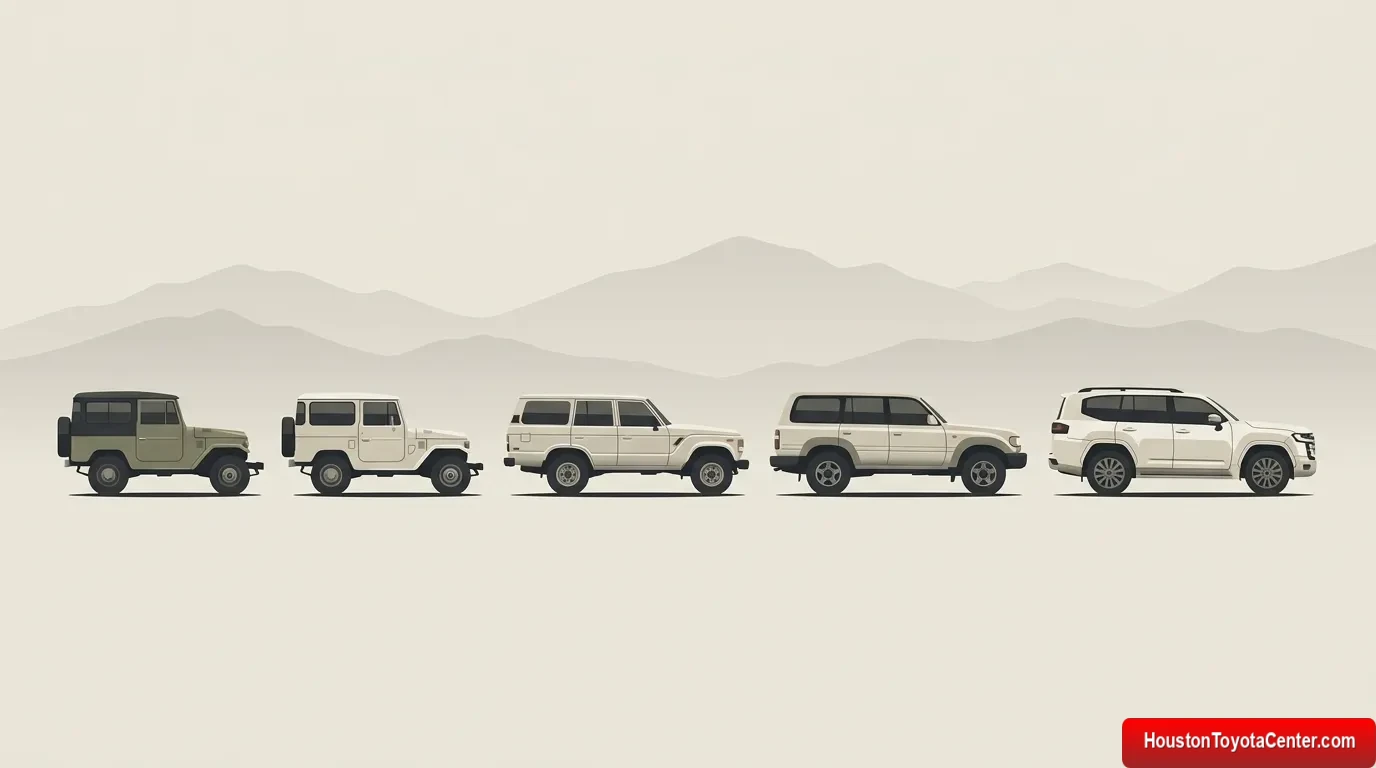
Few vehicles have earned a reputation as enduring and respected as the Toyota Land Cruiser. For more than seven decades, it has traveled across deserts, mountains, forests, and remote regions where reliability is often the difference between success and failure. Whether serving humanitarian organizations, exploring untouched landscapes, or providing luxury transportation in major cities, the Land Cruiser has consistently demonstrated an extraordinary balance of durability, capability, and refinement.
Unlike many vehicles that constantly reinvent themselves to follow trends, the Land Cruiser has evolved through careful engineering improvements while preserving its original philosophy. Toyota has always prioritized reliability, mechanical simplicity, and long-term durability over short-lived innovations. This commitment has allowed the Land Cruiser to become more than just an SUV. It has become a global symbol of trust.
Its journey reflects changing customer expectations, technological progress, and the growing demand for comfort without sacrificing rugged performance. From its humble beginnings in the early 1950s to today’s technologically advanced models, the Land Cruiser remains one of the automotive industry’s greatest success stories.
The Origins of a Legend
The story of the Toyota Land Cruiser began shortly after World War II. During the early 1950s, Japan needed a robust four-wheel-drive vehicle capable of supporting military and government operations. Inspired by the American Jeep, Toyota developed a prototype known as the Toyota BJ.
FREE: Quickly identify and understand problems with your vehicle 🚘
CLICK HEREThe BJ featured a powerful six-cylinder engine and a rugged ladder-frame chassis designed to conquer extremely difficult terrain. One of the vehicle’s earliest demonstrations became legendary after it successfully climbed to the sixth station of Mount Fuji, proving its exceptional off-road capability.
This achievement attracted significant attention from Japanese authorities and established Toyota as a serious competitor in the growing four-wheel-drive market.
In 1954, the vehicle officially received the name “Land Cruiser,” chosen to compete with the British Land Rover while emphasizing strength and exploration.
Building a Global Reputation
The first production Land Cruiser, known as the 20 Series, marked Toyota’s transition from military utility to civilian transportation.
Although still highly functional, the new model offered improved comfort, better styling, and increased practicality. It quickly found customers beyond Japan, especially in countries with challenging road conditions.
Throughout Africa, Australia, the Middle East, and South America, the Land Cruiser earned praise for surviving environments that destroyed less capable vehicles.
Mining companies, farmers, aid organizations, scientists, and government agencies relied on the Land Cruiser because it could continue operating where repair facilities were limited or completely unavailable.
Its growing international reputation laid the foundation for decades of worldwide success.
The Iconic 40 Series
Introduced in 1960, the 40 Series became one of the most recognizable Land Cruiser generations ever produced.
Its simple design featured boxy proportions, removable doors, durable steel construction, and exceptionally reliable mechanical components.
Owners appreciated the ease of maintenance. Many repairs could be performed using basic hand tools, making the vehicle especially valuable in remote locations.
The 40 Series remained in production for more than two decades in certain markets, demonstrating remarkable longevity.
Even today, restored examples continue to attract collectors, enthusiasts, and adventurers who appreciate classic engineering and timeless styling.
The 40 Series established the Land Cruiser’s reputation as virtually indestructible.
Expanding Comfort Without Losing Capability
By the late 1960s, Toyota recognized that customers increasingly wanted off-road performance combined with everyday comfort.
The introduction of the 55 Series reflected this shift.
Featuring four doors and a larger interior, the vehicle appealed to families, businesses, and travelers seeking greater practicality.
Later generations continued expanding this concept.
The 60 Series introduced in 1980 improved ride quality, interior refinement, and passenger comfort while maintaining excellent off-road ability.
Features such as power steering, improved air conditioning, and more comfortable seating transformed the Land Cruiser into a practical long-distance touring vehicle.
This evolution significantly broadened its global appeal.
Technology Meets Tradition
The arrival of the 80 Series in the early 1990s represented one of the most significant milestones in Land Cruiser history.
Toyota introduced advanced suspension systems, permanent four-wheel drive, electronic differential locks, and improved safety technologies.
Despite becoming more sophisticated, the Land Cruiser retained its legendary reliability.
Engineers carefully integrated new technology without compromising durability.
Owners appreciated that the vehicle remained highly capable off-road while becoming considerably more comfortable on paved roads.
The 80 Series remains highly regarded among enthusiasts and overlanding communities.
Many consider it one of the greatest off-road vehicles ever built.
Entering the Luxury SUV Market
The 100 Series, launched in the late 1990s, demonstrated Toyota’s confidence in expanding into the premium SUV segment.
The vehicle featured luxurious interiors, advanced electronics, powerful V8 engines in many markets, and improved highway refinement.
Leather seating, premium audio systems, advanced climate control, and sophisticated suspension technologies allowed the Land Cruiser to compete with high-end European SUVs.
However, unlike many luxury competitors, the Land Cruiser never abandoned its off-road heritage.
Owners could comfortably drive across cities during the week and confidently explore remote wilderness during weekends.
This dual personality became one of its strongest selling points.
Modern Engineering and Global Success
The 200 Series further enhanced performance, safety, and comfort.
Advanced traction management systems, crawl control, terrain selection modes, and improved structural rigidity made the vehicle more capable than ever.
Toyota also invested heavily in crash safety, driver assistance technologies, and interior quality.
Global demand remained strong despite increasing competition.
Many governments, humanitarian organizations, and expedition companies continued selecting the Land Cruiser because of its proven dependability.
Its reputation had evolved beyond marketing.
It became supported by decades of real-world performance.
The Return to Simplicity
The newest generation represents an interesting balance between modern technology and traditional engineering values.
Toyota introduced more efficient turbocharged engines, lightweight construction, advanced infotainment systems, and improved driver assistance features.
At the same time, engineers focused on preserving the qualities that made the Land Cruiser famous.
Body-on-frame construction, exceptional suspension articulation, sophisticated four-wheel-drive systems, and remarkable durability remain central to its design.
This combination allows the Land Cruiser to satisfy both longtime enthusiasts and new buyers seeking premium adventure vehicles.
A Favorite Among Explorers
One reason the Land Cruiser enjoys such enduring popularity is its unmatched versatility.
Professional explorers trust it during international expeditions.
Wildlife researchers use it in remote conservation areas.
Medical organizations depend on it in difficult humanitarian missions.
Families appreciate its comfort during long-distance travel.
Outdoor enthusiasts rely on it for camping, overlanding, and off-road adventures.
Very few vehicles have successfully served such diverse purposes across multiple generations.
Its adaptability remains one of its greatest strengths.
An Unmatched Reliability Record
The Land Cruiser’s legendary reliability results from Toyota’s engineering philosophy rather than chance.
Components undergo extensive durability testing under extreme temperatures, rough terrain, heavy loads, and prolonged operation.
Toyota traditionally avoids introducing unproven technologies until they demonstrate long-term reliability.
This conservative engineering approach has occasionally made the Land Cruiser appear less technologically aggressive than competitors.
However, it has also allowed owners to accumulate hundreds of thousands of miles with relatively few major mechanical problems.
This reputation continues to attract loyal customers worldwide.
The Land Cruiser in Popular Culture
Beyond its engineering achievements, the Land Cruiser has become an icon in global culture.
It frequently appears in documentaries, adventure films, travel photography, and international news coverage.
Its presence in humanitarian missions has reinforced its image as a dependable workhorse capable of reaching places inaccessible to ordinary vehicles.
Collectors increasingly seek vintage models, while modern versions remain highly desirable among luxury SUV buyers.
This broad cultural appeal reflects decades of consistent performance rather than temporary popularity.
Looking Toward the Future
The automotive industry is rapidly embracing electrification, autonomous driving, and connected technologies.
Toyota faces the challenge of modernizing the Land Cruiser while preserving the characteristics that built its reputation.
Future generations may incorporate hybrid systems, alternative fuels, and increasingly advanced driver assistance.
Yet industry experts generally agree that durability, mechanical strength, and off-road capability will remain central to the Land Cruiser’s identity.
As environmental regulations evolve and consumer expectations change, Toyota’s ability to balance innovation with tradition will determine the next chapter in the Land Cruiser’s remarkable history.
Conclusion
The Toyota Land Cruiser is far more than a successful SUV.
It represents decades of engineering discipline, practical innovation, and unwavering commitment to reliability.
Its evolution demonstrates that continuous improvement does not require abandoning core principles.
Instead, Toyota has carefully refined the Land Cruiser generation after generation, allowing it to remain relevant in a rapidly changing automotive world.
From its military-inspired origins to its status as a premium global icon, the Land Cruiser has earned the trust of explorers, professionals, governments, and families alike.
Very few vehicles can claim such an impressive legacy.
As new technologies reshape the future of mobility, the Land Cruiser stands as proof that true automotive excellence is built not only through innovation, but also through consistency, resilience, and an enduring commitment to quality.
Leave a Reply