
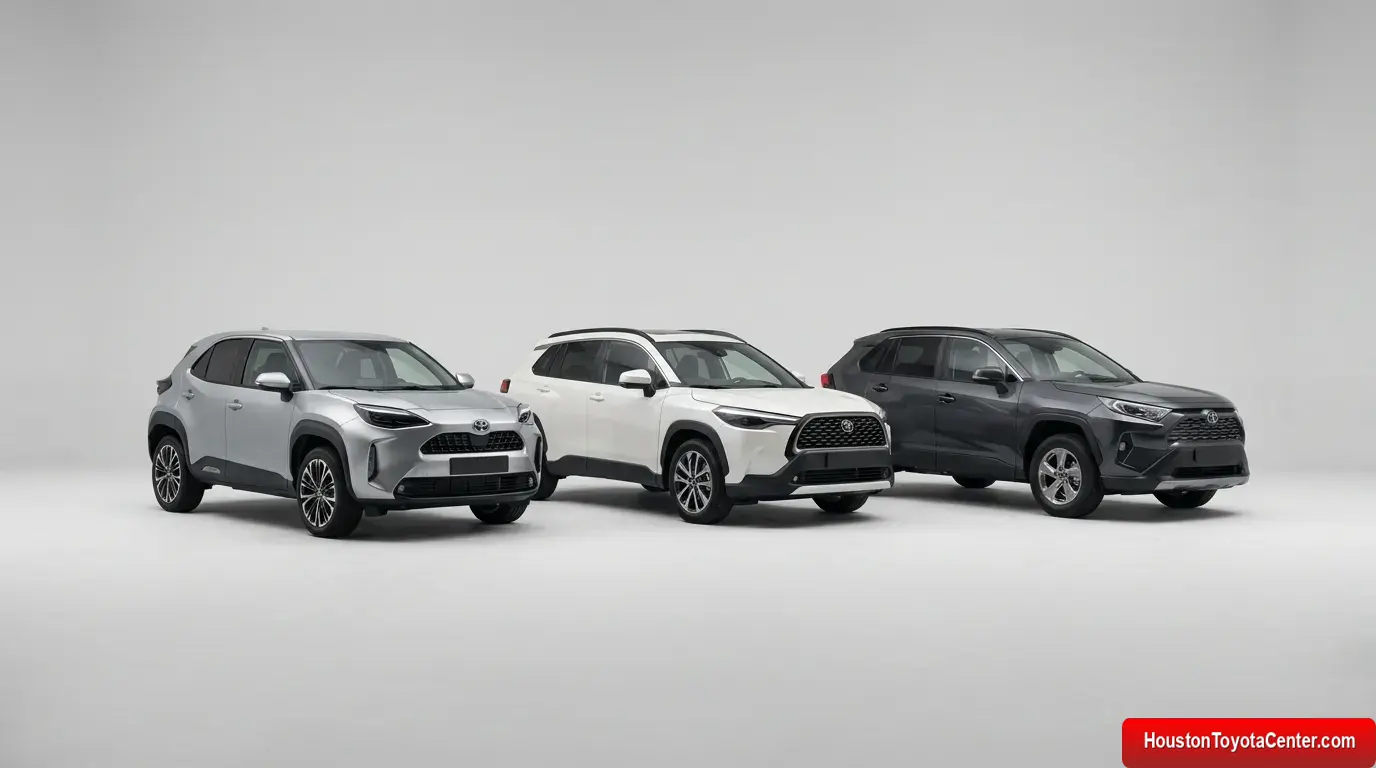
Buying a first SUV can be an exciting milestone, but choosing the right vehicle involves more than appearance or brand reputation. For new drivers, the ideal SUV should be easy to handle, offer strong safety features, deliver reasonable fuel economy, and remain affordable to maintain. Toyota’s lineup includes several compelling options, from the compact Corolla Cross to the popular RAV4, giving first-time buyers a range of vehicles suited to different budgets and lifestyles.
For someone who has recently obtained a driver’s license, getting behind the wheel of an SUV can feel very different from learning in a small hatchback or sedan. SUVs generally offer a higher seating position, a commanding view of the road, and flexible cargo space. However, their larger dimensions, higher centers of gravity, and potentially greater purchase prices mean that not every model is equally suitable for an inexperienced driver.
Toyota has developed a strong reputation for practical vehicles, broad model availability, and long-term ownership value. Its SUVs appeal to drivers who want everyday versatility without necessarily moving into the largest or most expensive vehicle classes.
Still, choosing the right model requires careful consideration. A compact SUV may be easier to park and more economical to operate, while a larger model could provide additional passenger space but introduce higher costs and more challenging maneuverability.
FREE: Quickly identify and understand problems with your vehicle 🚘
CLICK HEREHere are the Toyota SUVs worth considering for new drivers, along with the features that matter most when selecting a first vehicle.
1. Toyota Corolla Cross: A Sensible Starting Point
The Toyota Corolla Cross is one of the most logical choices for drivers entering the SUV market. It combines the practicality of a crossover with the familiar engineering philosophy associated with the Corolla name.
Its relatively compact footprint makes it easier to maneuver than larger SUVs, particularly in crowded urban environments. For drivers who are still developing their spatial awareness, this can be a meaningful advantage when changing lanes, navigating narrow streets, or parking in tight spaces.
The elevated driving position provides a useful view of surrounding traffic, while the cabin offers the flexibility needed for groceries, luggage, sports equipment, and everyday errands. Depending on the market and model year, buyers may find gasoline and hybrid versions, as well as different equipment packages.
Why it works for beginners: The Corolla Cross strikes a practical balance between size, visibility, comfort, and utility. It gives new drivers the advantages of an SUV without the bulk of a three-row family vehicle.
Fuel economy is another consideration. The hybrid version can be particularly attractive for people who spend considerable time in city traffic, although the purchase price, local fuel costs, and availability of specific versions should be compared before making a decision.
Safety equipment varies by model year, trim, and market. Buyers should check which driver-assistance systems are included rather than assuming every Corolla Cross has identical equipment. Features such as automatic emergency braking, lane-departure alerts, and a rearview camera can be valuable, but they do not replace attentive driving.
For first-time buyers, a used Corolla Cross may also be worth considering if it comes with a documented maintenance history, no unresolved recalls, and a clean inspection.
2. Toyota RAV4: A Versatile All-Rounder
The Toyota RAV4 is one of the automaker’s best-known SUVs and a strong candidate for new drivers who expect their needs to change over time.
Compared with smaller crossovers, the RAV4 offers more room for passengers and cargo. That additional capacity can be useful for college students, young professionals, couples, and drivers who frequently travel with friends or family.
The RAV4 is also versatile enough for city commuting, highway driving, weekend getaways, and light outdoor activities. Depending on the configuration, buyers can choose front-wheel drive or all-wheel drive, as well as conventional gasoline or hybrid powertrains in markets where these options are available.
However, its larger dimensions can make parking and maneuvering slightly more demanding than in a smaller crossover. New drivers should test the vehicle in realistic conditions, including tight parking spaces and busy roads, before deciding that the additional space is worth the trade-off.
Why it works for beginners: The RAV4 offers room to grow into a vehicle that can serve a driver for many years, rather than becoming impractical as their lifestyle changes.
The RAV4’s widespread popularity can also make it easier to compare used examples, find replacement parts, and locate mechanics familiar with the model. Actual costs will vary according to location, vehicle condition, insurance profile, and the specific model year.
Safety deserves particular attention. Buyers should review crash-test results for the exact model year and confirm the availability of features such as blind-spot monitoring, rear cross-traffic alert, and automatic emergency braking.
For a new driver who wants one vehicle for commuting, travel, and everyday responsibilities, the RAV4 is a compelling option. The main question is whether its size and price fit the buyer’s circumstances.
3. Toyota RAV4 Hybrid: A Smart Option for Frequent Commuters
The Toyota RAV4 Hybrid combines the space and versatility of the conventional RAV4 with a gasoline-electric powertrain designed to improve fuel efficiency.
For a new driver who expects to commute regularly, lower fuel consumption can help reduce ongoing ownership expenses. Hybrid systems can be especially effective in stop-and-go traffic, where electric assistance and regenerative braking can improve efficiency.
Unlike a plug-in hybrid, a conventional RAV4 Hybrid does not require external charging. This makes it convenient for drivers who live in apartments or lack access to a private charging point.
The hybrid powertrain also offers smooth acceleration in many everyday driving situations. Nevertheless, new drivers should understand how the vehicle responds under acceleration and braking, particularly when transitioning from a smaller training vehicle.
Why it works for beginners: It combines practical passenger space with the potential for lower fuel expenses, especially for people who drive frequently.
There are trade-offs. Hybrid versions may cost more to purchase than comparable gasoline models, so buyers should compare the initial price difference against expected fuel savings. Insurance, financing, maintenance, and local fuel prices all influence the final calculation.
A used hybrid should receive an appropriate inspection, including checks of the hybrid system and its battery when necessary. Buyers should also review the maintenance schedule and any applicable warranty coverage.
The RAV4 Hybrid is best suited to drivers who want a versatile vehicle and plan to keep it for several years. It may be less attractive to someone who drives very little and would take a long time to recover the additional purchase cost through fuel savings.
4. Toyota Yaris Cross: Compact Dimensions for Urban Driving
In markets where it is sold, the Toyota Yaris Cross deserves attention from first-time drivers who prioritize manageable dimensions and city-friendly operation.
Its compact design can make it easier to navigate narrow streets, negotiate congested traffic, and fit into parking spaces. These advantages can be particularly valuable in dense urban areas, where a larger SUV may feel unnecessarily cumbersome.
Depending on the market, the Yaris Cross is available with different powertrain and equipment combinations, including hybrid versions in many regions. Buyers should verify local specifications because model names, engines, and standard features can vary between countries.
The smaller footprint can also help new drivers feel more comfortable judging the vehicle’s position relative to curbs, parked cars, and other traffic. Nevertheless, a test drive remains essential, as seating position, rear visibility, steering response, and turning radius all affect the driving experience.
Why it works for beginners: Its compact size and practical crossover design make it an appealing choice for urban commuters who want an SUV without excessive dimensions.
Cargo capacity and rear-seat space are more limited than in larger models. Buyers who frequently carry adult passengers or substantial luggage should assess those limitations carefully.
The Yaris Cross may be especially attractive to drivers who spend most of their time in cities and occasionally travel outside them. It offers a practical compromise between the footprint of a small car and the flexibility of an SUV.
5. Toyota C-HR: A Stylish Choice With Practical Considerations
The Toyota C-HR is another model worth examining in markets where it is available. Its distinctive styling and compact proportions appeal to buyers who want something visually different from a conventional crossover.
For new drivers, the main attraction is its manageable size. A compact vehicle can be easier to position on the road than a large SUV, and the C-HR’s interior is designed around everyday passenger transportation rather than heavy-duty utility.
However, the model’s styling creates some practical compromises. Depending on the generation, the rear windows and sloping roofline can limit outward visibility and make the back seat feel less spacious than in boxier alternatives.
Those limitations matter for inexperienced drivers, who benefit from a clear view of surrounding traffic and predictable maneuvering. A test drive should include reversing, parking, and checking the view through the rear and side windows.
Why it works for some beginners: It offers compact dimensions and distinctive design, making it appealing to drivers who value appearance alongside everyday usability.
The C-HR is not automatically the best option for every first-time buyer. Someone who regularly carries passengers or prioritizes maximum visibility may prefer the Corolla Cross or another model with a more conventional body shape.
As with any used vehicle, the condition, maintenance record, safety equipment, and price of the specific example should take priority over styling alone.
6. Toyota Highlander: Better for Drivers Who Need More Space
The Toyota Highlander is a midsize SUV designed for families and drivers who need additional passenger capacity. Many versions feature three rows of seating, making the model suitable for larger households and frequent group travel.
For a new driver, however, the Highlander represents a different proposition from the compact options in this list.
Its larger body can make parallel parking, reversing, and navigating narrow streets more challenging. It also generally requires more space in garages and parking lots. Fuel, tire, and insurance costs may be higher than those of smaller Toyota crossovers, depending on the specific version and local conditions.
Why it may work for beginners: It can make sense for someone who genuinely needs three rows, has access to suitable parking, and is comfortable learning to manage a larger vehicle.
Drivers who select a Highlander should take time to practice parking and reversing in a safe environment. A rearview camera and parking sensors can be helpful, while additional driver-assistance systems may provide support in certain situations.
The third row should also be tested in person. Its usefulness depends on the passengers’ size, the duration of typical journeys, and how much cargo space is needed when all seats are occupied.
For most people buying their first vehicle alone, a Highlander may be more SUV than necessary. For a young parent or a driver responsible for transporting several passengers, the additional capacity may justify the larger dimensions.
What New Drivers Should Look for in a Toyota SUV
Selecting a suitable SUV requires looking beyond the model name. Several factors can make a substantial difference to the safety, affordability, and comfort of a first vehicle.
Safety Features That Support Better Driving
Safety should be a priority, particularly for inexperienced drivers. Depending on the vehicle and model year, useful features may include automatic emergency braking, forward collision warning, lane-departure alerts, blind-spot monitoring, rear cross-traffic alert, and a rearview camera.
These systems can provide additional information or intervene in specific situations, but they have limitations. Drivers must remain attentive, check their mirrors and blind spots, maintain safe following distances, and understand the vehicle’s controls.
Buyers should also examine independent crash-test ratings for the exact model year and configuration. A vehicle’s overall safety performance cannot be determined solely by counting the number of electronic features it offers.
Manageable Size and Good Visibility
A smaller SUV can be easier to control and park, particularly in cities. Clear outward visibility, predictable steering, and a comfortable driving position are equally important.
During a test drive, new drivers should assess whether they can judge the vehicle’s corners, see approaching traffic clearly, and maneuver without excessive effort.
Affordable Ownership Costs
The purchase price is only one part of the budget. Insurance premiums, fuel, routine servicing, tires, registration, taxes, and unexpected repairs should all be considered.
New drivers may face higher insurance premiums, depending on their age, experience, location, and insurance history. Obtaining quotes before purchasing can prevent unpleasant surprises.
Reliability and Maintenance Records
Toyota’s reputation for reliability can be useful when comparing vehicles, but individual condition remains critical. A poorly maintained SUV can become expensive regardless of its brand.
For used vehicles, buyers should request maintenance records, check the vehicle identification number for outstanding recalls, and arrange an independent pre-purchase inspection. Warning lights, uneven tire wear, unusual noises, fluid leaks, and signs of accident damage deserve attention.
New Versus Used
A new SUV offers a known ownership history and may include a manufacturer’s warranty. However, depreciation and financing costs can make it substantially more expensive.
A used Toyota SUV may provide better value, particularly when the buyer can find a well-maintained example from a generation with a strong reliability record. The most attractive choice is not necessarily the newest vehicle, but the one that offers the best combination of condition, safety, price, and suitability.
Final Verdict: Which Toyota SUV Is Best for a New Driver?
For most first-time SUV buyers, the Toyota Corolla Cross is an excellent starting point. Its compact dimensions, practical cabin, and everyday versatility make it well suited to drivers who are still developing confidence behind the wheel.
The Toyota RAV4 is a stronger choice for those who want additional space and expect to use the vehicle for years to come. The RAV4 Hybrid is particularly appealing to frequent commuters who want to reduce fuel consumption without relying on external charging.
In markets where it is available, the Yaris Cross is worth considering for urban drivers who want a smaller footprint. The C-HR may appeal to buyers who prioritize distinctive styling, although rear visibility and passenger space should be assessed carefully. The Highlander is best reserved for drivers who genuinely need three-row seating.
Ultimately, the best Toyota SUV for a new driver is one that feels manageable, fits the budget, provides appropriate safety protection, and meets the owner’s real transportation needs.
Choosing a smaller, well-maintained vehicle with clear visibility and useful safety features can make the learning process less stressful. Combined with regular maintenance, responsible driving habits, and continued practice, the right SUV can provide a confident and practical start to years of driving.
Leave a Reply