
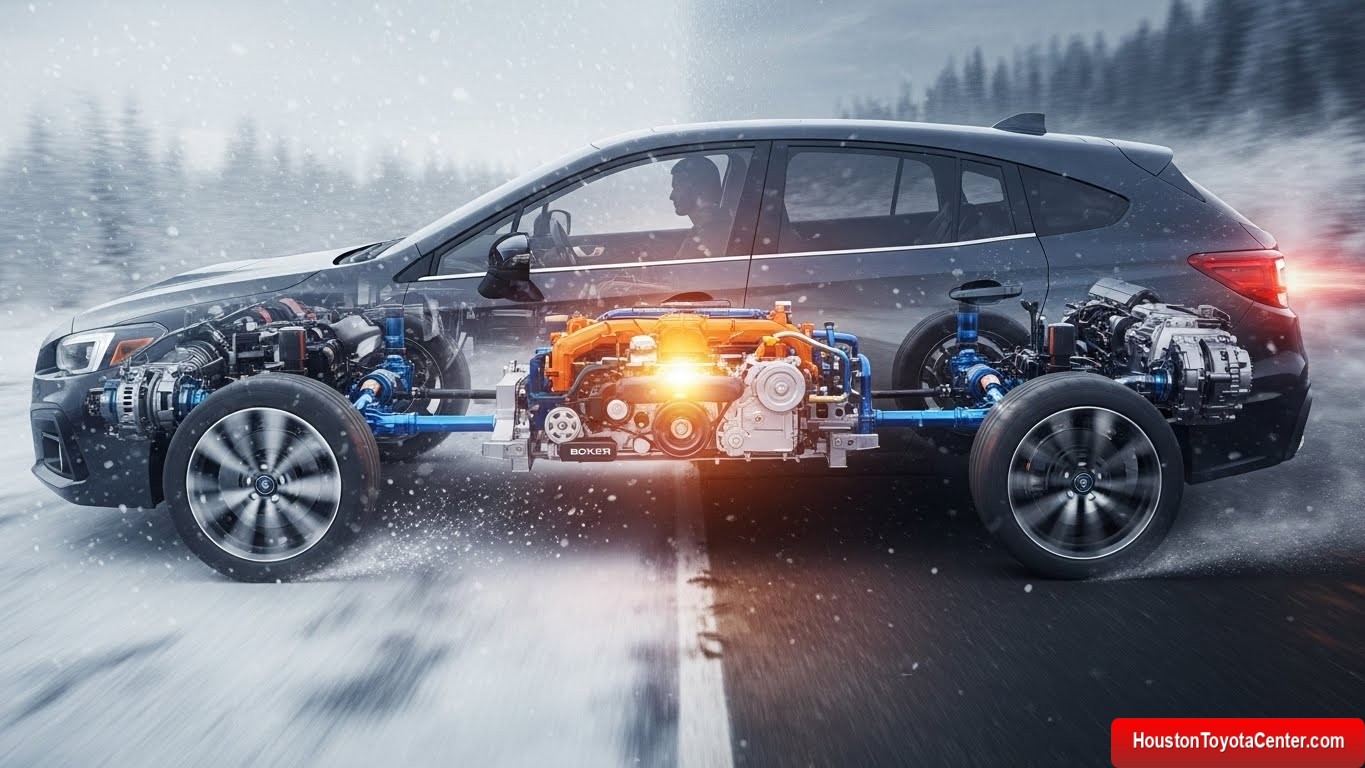
Few automotive brands have built their identity around engineering principles as consistently as Subaru. While many manufacturers chase trends—downsized turbo engines one decade, electrification the next—Subaru has spent decades refining two core technologies that define nearly every vehicle in its lineup: Symmetrical All-Wheel Drive (AWD) and the horizontally opposed Boxer engine. These systems are not marketing afterthoughts or optional add-ons. They are foundational design philosophies that influence everything from chassis layout and handling behavior to safety performance and long-term durability.
To casual observers, Subaru’s commitment to AWD and Boxer engines might seem like stubborn tradition. After all, front-wheel drive is cheaper and more efficient, while inline or V-shaped engines dominate the global market. Yet Subaru’s approach is neither nostalgic nor accidental. It is the result of decades of real-world testing, motorsport involvement, harsh-weather usage, and a deep understanding of mechanical balance.
This article explores in depth what makes Subaru’s Symmetrical AWD and Boxer engine unique, how they work together as an integrated system, and why they continue to attract loyal drivers around the world. We will look at the engineering principles behind each technology, their advantages and trade-offs, comparisons with conventional alternatives, and how they shape the Subaru driving experience.
The Philosophy Behind Subaru Engineering
Before diving into technical details, it is important to understand Subaru’s mindset. Subaru is the automotive division of Subaru Corporation (formerly Fuji Heavy Industries), a company with roots in aerospace engineering. This background heavily influences Subaru’s focus on balance, stability, and predictability rather than outright performance numbers.
FREE: Quickly identify and understand problems with your vehicle 🚘
CLICK HEREInstead of designing a car around an engine or drivetrain that is already common in the industry, Subaru builds the entire vehicle as a cohesive system. The Boxer engine and Symmetrical AWD are designed together, not separately. The engine’s flat layout allows it to sit low and centered in the chassis, while the symmetrical drivetrain distributes weight evenly from left to right. This philosophy prioritizes:
- Vehicle stability in all conditions
- Predictable handling characteristics
- Mechanical simplicity and durability
- Driver confidence rather than raw speed
This approach explains why Subaru vehicles often excel in poor weather, uneven terrain, and real-world driving scenarios, even when they are not the most powerful or luxurious in their class.
Understanding the Boxer Engine
What Is a Boxer Engine?
A Boxer engine, also known as a horizontally opposed engine, is an internal combustion engine in which the cylinders are arranged in two banks that lie flat on opposite sides of the crankshaft. The pistons move horizontally, punching outward and inward like boxers throwing punches—hence the name.
Unlike inline engines, where cylinders are stacked vertically, or V-engines, where they are angled, the Boxer engine spreads its mass horizontally. Subaru has used this layout in passenger vehicles since the 1960s, making it one of the few manufacturers to remain committed to the design.
Mechanical Layout and Operation
In a Boxer engine:
- Each piston has a directly opposing counterpart.
- When one piston moves outward, the opposite piston moves outward at the same time.
- This opposing motion naturally cancels out many vibrations.
The result is an engine that is inherently balanced without requiring heavy balance shafts or complex counterweights. This mechanical harmony is one of the Boxer engine’s defining traits.
Advantages of the Boxer Engine
1. Low Center of Gravity
Because the engine sits flat and low in the engine bay, it significantly lowers the vehicle’s center of gravity. This has several benefits:
- Reduced body roll during cornering
- Improved stability at highway speeds
- Better balance during sudden maneuvers
A lower center of gravity is especially valuable in taller vehicles like crossovers and SUVs, where body roll can compromise handling.
2. Natural Mechanical Balance
The opposing piston motion reduces vibration, resulting in smoother operation. This balance improves:
- Long-term component durability
- Driver comfort
- Engine efficiency under load
While modern inline engines often rely on balance shafts to control vibration, the Boxer engine achieves this balance through geometry alone.
3. Compact Longitudinal Packaging
Subaru mounts its Boxer engines longitudinally (front to back) rather than transversely. This orientation aligns perfectly with the drivetrain in AWD vehicles, creating a straight power flow from the engine to the transmission and differentials.
Limitations and Trade-Offs of the Boxer Engine
No engine design is without compromises, and the Boxer engine is no exception.
Width and Packaging Challenges
The horizontal layout makes the engine wider than inline designs. This can complicate:
- Engine bay access for maintenance
- Exhaust and intake routing
- Crash structure design
Manufacturing Complexity
Boxer engines often require:
- Two cylinder heads
- More complex lubrication systems
- Precise machining tolerances
These factors can increase manufacturing costs compared to simpler inline engines.
Maintenance Considerations
Some maintenance tasks, such as spark plug replacement, can be more labor-intensive due to the engine’s width. While not a deal-breaker, it is a practical consideration for owners.
Despite these drawbacks, Subaru continues to refine its Boxer engines, balancing reliability, efficiency, and emissions compliance.
The Evolution of Subaru Boxer Engines
Over the decades, Subaru has continuously improved its Boxer engine lineup. Key developments include:
- Transition from carburetors to fuel injection
- Introduction of turbocharging in performance models
- Adoption of variable valve timing
- Improved materials and cooling systems
Modern Subaru Boxer engines, such as the FA and FB series, emphasize fuel efficiency and reduced emissions while maintaining the core benefits of the flat layout.
What Is Subaru’s Symmetrical AWD?
Defining Symmetry in Drivetrains
Subaru’s Symmetrical AWD is not just a marketing term. It describes a drivetrain layout that is physically symmetrical along the vehicle’s centerline. This means:
- The engine is mounted longitudinally and centered
- The transmission sits directly behind the engine
- Front and rear driveshafts are aligned in a straight line
- Axles are equal in length on both sides
This symmetry results in balanced weight distribution and predictable power delivery.
Continuous AWD vs. On-Demand Systems
Unlike many competitors that use on-demand AWD systems (which primarily drive one axle and engage the other when slip is detected), Subaru’s Symmetrical AWD is typically full-time. Power is always sent to all four wheels, improving traction before wheel slip occurs.
Types of Subaru Symmetrical AWD Systems
Subaru uses several variations of Symmetrical AWD depending on the transmission and vehicle purpose.
Manual Transmission AWD
- Uses a viscous center differential
- Typically features a 50:50 front-to-rear torque split
- Favored by driving enthusiasts for its mechanical simplicity
Automatic and CVT AWD
- Uses electronically controlled multi-plate clutches
- Torque split can vary dynamically
- Optimized for fuel efficiency and everyday driving
Performance-Oriented AWD (WRX STI heritage)
- Includes driver-controlled center differentials
- Allows torque bias adjustment
- Designed for aggressive driving and motorsport
Advantages of Symmetrical AWD
1. Superior Traction in All Conditions
By constantly driving all four wheels, Subaru’s AWD provides excellent grip on:
- Snow and ice
- Wet pavement
- Gravel and dirt roads
This makes Subaru vehicles particularly popular in regions with harsh winters or rural terrain.
2. Balanced Handling
The symmetrical layout ensures that weight and torque are evenly distributed. This leads to:
- Neutral handling characteristics
- Reduced torque steer
- Predictable responses during emergency maneuvers
3. Seamless Power Delivery
Because the system does not rely solely on wheel-slip detection, power transitions feel smooth and immediate. Drivers often describe Subaru AWD as “invisible” because it works without drawing attention to itself.
Comparing Symmetrical AWD to Other AWD Systems
| Feature | Subaru Symmetrical AWD | Front-Based AWD | Rear-Based AWD |
|---|---|---|---|
| Default Power Distribution | All wheels | Front wheels | Rear wheels |
| Response to Slippage | Proactive | Reactive | Reactive |
| Weight Balance | Highly balanced | Front-heavy | Rear-biased |
| Complexity | Moderate | Lower | Higher |
This comparison highlights why Subaru’s system feels different in real-world driving, particularly in low-traction environments.
The Integration of Boxer Engine and Symmetrical AWD
The true magic of Subaru’s design lies in how the Boxer engine and Symmetrical AWD work together as a unified system.
Straight-Line Power Flow
With the engine mounted longitudinally and centered, power flows directly through the transmission and into the front and rear differentials. This reduces:
- Mechanical losses
- Unwanted vibrations
- Uneven torque distribution
Weight Distribution Benefits
The flat engine lowers the center of gravity, while the symmetrical drivetrain balances weight left-to-right. Combined, these features enhance:
- Cornering stability
- Braking performance
- Overall driver confidence
Safety Implications
Subaru’s layout also supports its strong safety reputation. In frontal collisions, the engine is more likely to slide beneath the cabin rather than intrude into it, reducing injury risk.
Real-World Driving Experience
Everyday Commuting
In daily driving, Subaru’s engineering translates to:
- Confident acceleration on slippery roads
- Stable highway cruising
- Reduced driver fatigue
Drivers often note that the vehicle feels planted and secure, even in poor weather.
Enthusiast and Performance Driving
While not traditionally associated with luxury or extreme performance, Subaru vehicles—especially models like the WRX—benefit from:
- Predictable corner exits
- Excellent traction under hard acceleration
- Consistent handling behavior
The system rewards smooth driving inputs rather than aggressive corrections.
Off-Road and Adventure Use
Subaru’s AWD is particularly effective for light off-road use. While not a replacement for body-on-frame 4×4 systems, it excels in:
- Forest roads
- Snow-covered trails
- Uneven terrain
This capability has made Subaru a favorite among outdoor enthusiasts.
Reliability and Longevity
Subaru’s mechanical choices prioritize durability. The balanced nature of the Boxer engine reduces internal stress, while the AWD system distributes load across multiple components. When properly maintained:
- Engines often exceed high mileage benchmarks
- AWD components show consistent wear patterns
- Vehicles maintain predictable handling over time
Regular maintenance remains essential, but the underlying design supports long-term ownership.
Environmental and Efficiency Considerations
Historically, AWD systems and Boxer engines were criticized for fuel consumption. Subaru has addressed these concerns through:
- Lightweight materials
- Improved CVT tuning
- Reduced internal friction
- Hybrid-assisted powertrains in select models
While still not class-leading in efficiency, modern Subaru vehicles strike a better balance between capability and consumption.
Why Subaru Stays the Course
Many manufacturers have abandoned unique engine layouts in favor of modular platforms. Subaru’s continued commitment reflects confidence in its philosophy. By refining rather than replacing its core technologies, Subaru delivers a consistent driving experience that resonates with its audience.
This consistency builds trust. Subaru owners know what to expect when they step into a new model: stability, traction, and mechanical honesty.
The Emotional Connection
Beyond engineering, there is an emotional component to Subaru’s design. Drivers often describe a sense of reassurance, especially in challenging conditions. This confidence fosters loyalty and turns owners into advocates.
The Boxer engine’s distinctive sound and the AWD system’s quiet competence become part of the vehicle’s character rather than mere specifications.
The Future of Subaru’s Core Technologies
As the automotive industry shifts toward electrification, Subaru faces new challenges. However, the principles behind Symmetrical AWD and low center of gravity remain relevant. Electric drivetrains can also benefit from:
- Balanced weight distribution
- Low-mounted components
- All-wheel power delivery
Subaru’s future models are likely to reinterpret these concepts rather than abandon them.
Conclusion
Subaru’s Symmetrical AWD and Boxer engine are more than technical curiosities—they are the backbone of the brand’s identity. Individually, each system offers tangible benefits in balance, stability, and reliability. Together, they create a cohesive driving experience that emphasizes control, predictability, and confidence.
In a market crowded with interchangeable designs, Subaru’s commitment to these technologies sets it apart. While they may not appeal to every driver, for those who value sure-footed handling, mechanical balance, and real-world capability, Subaru’s approach remains uniquely compelling.
Leave a Reply