
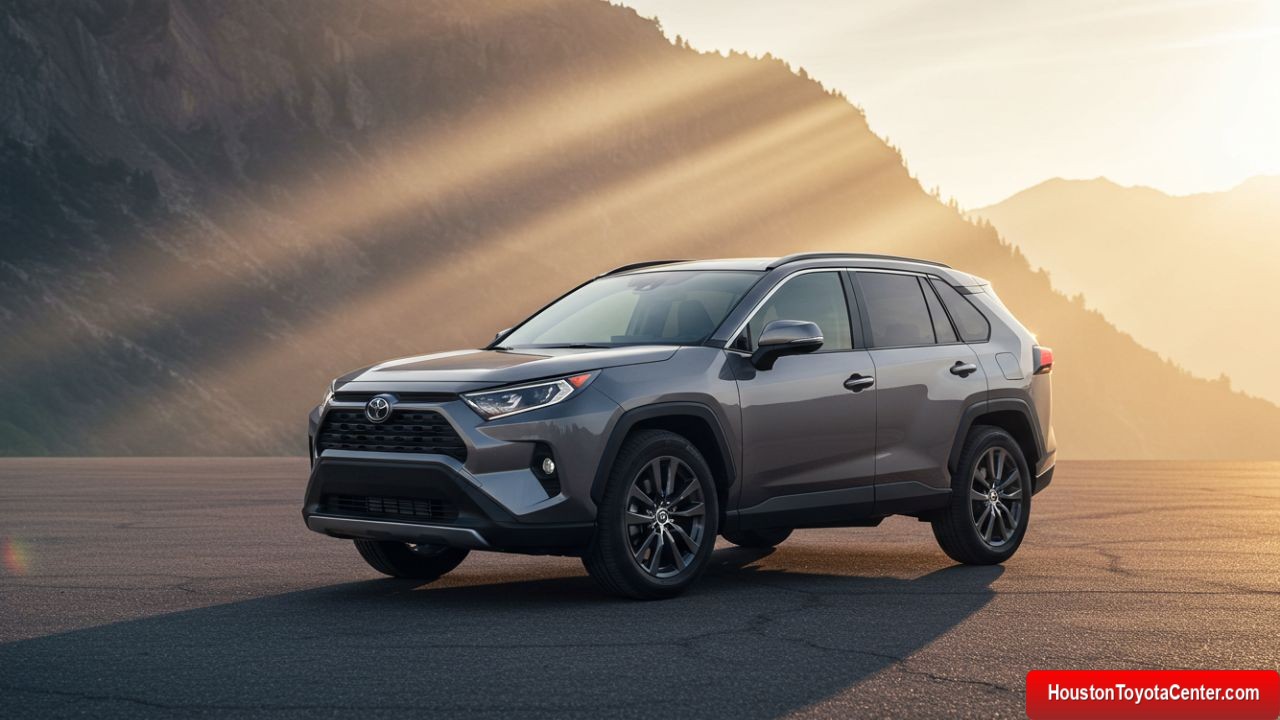
Safety has become one of the defining features of modern SUVs, and the Toyota RAV4 is no exception. For the 2026 model year, Toyota has introduced a new generation of its driver-assistance technology, Toyota Safety Sense 4.0, while continuing to offer a broad range of active and passive safety equipment across the RAV4 lineup.
The result is a vehicle designed not only to help protect occupants in a collision, but also to assist the driver in identifying potential hazards and maintaining control during everyday driving. However, understanding what these systems actually do is more useful than simply reading a long list of feature names.
Here is a closer look at the major safety technologies available in the 2026 RAV4, how they work, and what drivers should know about their limitations.
Toyota Safety Sense 4.0: The Core of the RAV4’s Safety Technology
The most important development for the 2026 RAV4 is Toyota Safety Sense 4.0, commonly abbreviated as TSS 4.0. Toyota describes it as a suite of active driver-assistance and convenience technologies designed to support safer driving.
FREE: Quickly identify and understand problems with your vehicle 🚘
CLICK HEREThe system brings together several technologies that work through cameras, radar and vehicle software. According to Toyota, the fourth generation includes improvements to sensors, processing, networking and software compared with the previous system.
For RAV4 buyers, that means several different safety functions are integrated into one broader system rather than being isolated technologies.
The core features include Pre-Collision System with Pedestrian Detection, Dynamic Radar Cruise Control, Lane Departure Alert with Steering Assist, Automatic High Beams, Road Sign Assist, Proactive Driving Assist and Lane Tracing Assist.
Importantly, these technologies are designed to assist the driver. They do not turn the RAV4 into an autonomous vehicle, and drivers remain responsible for controlling the vehicle and paying attention to the road.
Pre-Collision System With Pedestrian Detection
One of the most significant technologies is the Pre-Collision System with Pedestrian Detection, or PCS with PD.
The system is designed to detect certain vehicles, pedestrians, bicyclists and motorcyclists in front of the vehicle. When operating conditions are met, it can provide visual and audible warnings if a potential forward collision is detected. If the driver does not respond, the system is designed to apply automatic emergency braking.
This technology addresses one of the most important situations in everyday driving: a driver failing to react quickly enough to an obstacle or road user ahead.
The system should not, however, be interpreted as a guarantee that a collision will be avoided. Detection can depend on factors such as speed, road conditions, visibility, the position and movement of another road user, and other operating conditions.
That distinction is important. Driver assistance can provide an additional layer of protection, but it does not eliminate the need for attentive driving.
Dynamic Radar Cruise Control
The RAV4 also uses Dynamic Radar Cruise Control, or DRCC, to assist with maintaining a selected speed and following distance.
Unlike traditional cruise control, which generally maintains a preset speed regardless of traffic ahead, adaptive cruise control can adjust the vehicle’s speed based on the vehicle in front.
Toyota says the RAV4’s Full-Speed Range DRCC can operate from a complete stop up to 110 mph under the appropriate conditions. The system uses vehicle-to-vehicle distance control to help maintain a driver-selected distance from traffic ahead.
This can be particularly useful on highways, where traffic speed can change frequently.
DRCC is best understood as a convenience and driver-support feature rather than an automated driving system. The driver still needs to monitor traffic, road conditions and the system’s operation.
Lane Departure Alert With Steering Assist
Unintended lane departure is another situation addressed by Toyota’s safety technology.
Lane Departure Alert with Steering Assist monitors lane markings and certain road-edge boundaries. When operating conditions are met, the system can warn the driver if it detects what appears to be an unintended departure from the lane. It can also provide gentle steering assistance if the driver does not take corrective action.
The purpose is not to take over steering. Instead, it is intended to provide an additional intervention when the vehicle begins to move away from its lane.
Toyota specifies operating conditions for the system. For example, the company says lane markings or certain road-edge boundaries must be detected, and the system’s operation can depend on vehicle speed and other circumstances.
That makes the technology particularly useful on clearly marked roads, while also illustrating why drivers should not assume the system will work in every situation.
Lane Tracing Assist
Lane Tracing Assist, or LTA, works in conjunction with Dynamic Radar Cruise Control or Full-Speed Range DRCC when the necessary conditions are met.
The system uses detected lane markings and, in some circumstances, vehicles ahead to provide steering assistance intended to help keep the RAV4 centered in its lane.
For long highway drives, this can reduce some of the small steering corrections that drivers make continuously.
The 2026 RAV4 can also be equipped with an Emergency Driving Stop System associated with the lane-tracing technology. Toyota says the system can monitor driver inputs, and under certain conditions, if it determines that the driver is not responding to prompts, it can bring the vehicle to a stop.
Again, the technology is designed as a driver-assistance feature rather than a replacement for an attentive driver.
Automatic High Beams
Driving at night presents a different set of challenges, particularly when visibility is limited and there is traffic approaching from the opposite direction.
Automatic High Beams are designed to help manage the transition between high and low beams. Toyota says the system can detect headlights from oncoming vehicles and taillights from vehicles ahead, then automatically switch between high and low beams under specified conditions.
The feature can reduce the need for the driver to manually change the headlights repeatedly on dark roads.
It is a relatively simple feature compared with collision avoidance or lane assistance, but it addresses an important part of nighttime driving: providing useful illumination without unnecessarily keeping high beams activated around other road users.
Road Sign Assist
Road Sign Assist, or RSA, uses the RAV4’s camera system to identify certain road signs and display corresponding information to the driver.
Toyota says the technology can recognize signs including speed limits, stop signs, Do Not Enter signs, yield signs and certain warning signs. The detected information can then appear on the vehicle’s Multi-Information Display.
The benefit is primarily informational. Instead of relying entirely on memory after passing a speed-limit sign, for example, the driver can receive an additional visual reminder.
As with the other driver-assistance technologies, recognition is dependent on conditions and should not replace the driver’s responsibility to observe signs directly.
Blind Spot Monitoring and Rear Cross-Traffic Alert
Some of the RAV4’s safety equipment addresses areas that are difficult for drivers to see directly.
Blind Spot Monitor, or BSM, is designed to help identify vehicles in areas alongside the RAV4 that may not be immediately visible in the driver’s mirrors.
Rear Cross-Traffic Alert, or RCTA, adds assistance when the vehicle is reversing. It can help alert the driver to approaching traffic behind the vehicle, an especially useful function in parking lots and other situations where visibility can be restricted.
Toyota lists Blind Spot Monitor with Rear Cross-Traffic Alert among the RAV4’s safety and convenience equipment.
For 2026, Toyota also lists Safe Exit Alert in the RAV4’s safety equipment. The feature is intended to help warn occupants when a vehicle or other hazard is approaching from behind before a door is opened.
Cameras and Parking Assistance
The RAV4’s safety technology extends beyond highway driving.
Depending on the version, the vehicle can be equipped with parking assistance features such as Front and Rear Parking Assist with Automatic Braking. Toyota also lists advanced camera-based systems, including a Panoramic View Monitor with a 3D 360-degree overhead view on applicable versions.
These technologies are particularly useful at low speeds. A 360-degree camera perspective can make it easier to understand the vehicle’s position relative to nearby objects, while parking sensors and automatic braking can provide another layer of assistance when maneuvering.
The important distinction is that these systems help with visibility and maneuvering. They do not remove the need for the driver to check the surroundings directly.
Front Cross-Traffic Alert and Lane Change Assist
Higher levels of driver assistance are also available on certain RAV4 versions.
Toyota lists Front Cross-Traffic Alert and Lane Change Assist among the advanced driver-assistance features available on the 2026 RAV4, depending on grade. Traffic Jam Assist is also available under specified conditions and requires the appropriate connected-service subscription.
Front Cross-Traffic Alert is intended to help when vehicles or other road users approach from the sides in situations where forward visibility may be limited.
Lane Change Assist can provide additional support during lane changes when the system’s operating conditions are satisfied.
These technologies illustrate how modern vehicle safety is moving beyond a simple focus on what happens directly in front of the vehicle. Sensors and cameras can provide information about areas around the vehicle that may otherwise be difficult for the driver to monitor continuously.
Passive Safety Still Matters
Electronic driver assistance receives much of the attention, but physical occupant protection remains a fundamental part of vehicle safety.
The 2026 RAV4 includes three-point seatbelts for all seating positions, front and outboard second-row seatbelt pretensioners with force limiters, and a LATCH child-seat anchoring system. Toyota’s specifications also list multiple airbags and other occupant-protection equipment.
These systems perform a different role from active driver assistance.
Active systems are generally designed to help prevent or reduce the severity of certain incidents. Seatbelts, airbags and the vehicle’s structural protection are intended to help protect occupants when a crash occurs.
Both categories are important because no electronic system can prevent every accident.
What Drivers Should Remember
The growing number of safety features in the RAV4 can make the technology sound almost self-sufficient. In practice, these systems are designed to support the driver, not replace the driver.
Weather, road markings, traffic, lighting, sensor visibility and other conditions can affect how driver-assistance features operate. Toyota itself notes that feature availability can vary by vehicle and trim, and the systems have specific operating conditions.
Drivers should therefore understand what each feature is designed to do, know how to adjust its settings, and remain prepared to intervene.
That is particularly important with technologies such as adaptive cruise control and lane-centering assistance. Their ability to control speed or provide steering assistance can make highway driving more convenient, but they are not substitutes for active supervision.
The Bigger Picture
The 2026 Toyota RAV4 represents a broader shift in automotive safety. Instead of relying on a single technology, modern vehicles combine multiple layers of assistance.
Forward-facing systems can monitor potential collisions. Radar-based systems can track traffic ahead. Cameras can identify lane markings and road signs. Blind-spot technology can provide information about adjacent traffic. Parking cameras can improve visibility around the vehicle at low speeds. Passive safety equipment remains available when prevention is no longer possible.
Toyota Safety Sense 4.0 brings many of these functions together in the RAV4, making safety technology an integrated part of the vehicle rather than a collection of isolated options.
For buyers evaluating the RAV4, the most useful question is therefore not simply how many safety features it has. A better question is how each feature works, under what conditions it operates, and which versions of the vehicle include it.
Ultimately, the technology is designed to provide another layer between a potentially dangerous situation and a serious collision. The driver remains the most important part of that safety system, while the RAV4’s sensors, cameras, warnings and automated assistance are designed to provide additional support when it is needed.
Leave a Reply