
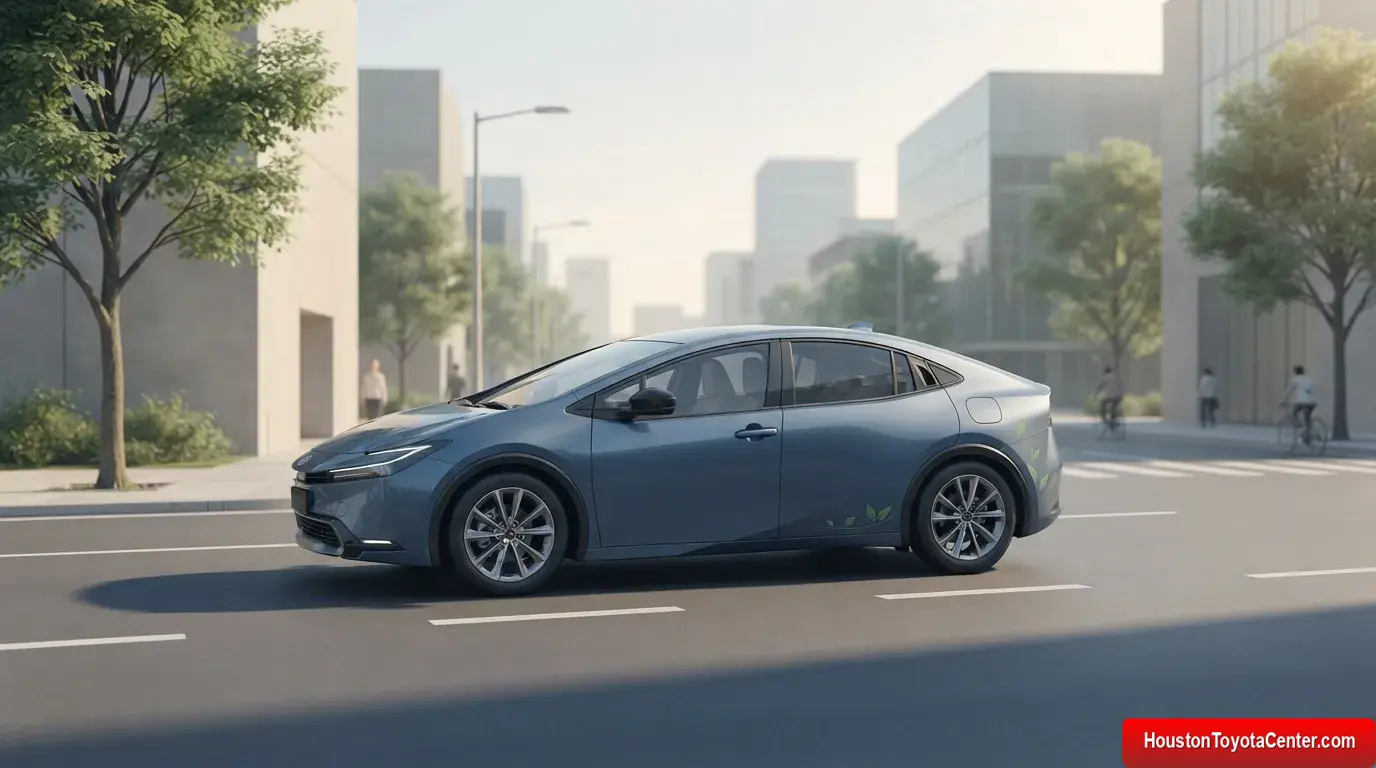
For more than two decades, the Toyota Prius has stood as one of the most recognizable symbols of fuel-efficient motoring. What began as a relatively unconventional hybrid has evolved into a mainstream choice for drivers who want practical transportation without completely ignoring the environmental cost of getting from one place to another.
The Prius has never been simply another compact car. Its identity is closely connected to the idea that everyday transportation can be redesigned around efficiency. While electric vehicles have transformed the automotive industry and captured much of the attention surrounding clean transportation, the Prius continues to occupy an important middle ground. It offers drivers the convenience of a conventional gasoline-powered vehicle while using hybrid technology to reduce fuel consumption and emissions.
For commuters, that combination can be particularly appealing.
A Car Designed Around Efficiency
The Prius became famous because it approached the automobile from a different perspective. Rather than focusing primarily on acceleration, aggressive styling, or towing capability, Toyota made efficiency one of the vehicle’s defining characteristics.
FREE: Quickly identify and understand problems with your vehicle 🚘
CLICK HEREAt the heart of the Prius is its hybrid powertrain, which combines a gasoline engine with electric motors and a battery system. Instead of relying exclusively on the gasoline engine, the vehicle can use electric power in certain driving conditions and recover energy during braking. This approach allows the car to make better use of energy that would otherwise be lost.
The result is particularly relevant in urban and suburban environments, where frequent stops, low-speed driving, and traffic can make conventional gasoline vehicles relatively inefficient.
For commuters who spend significant amounts of time navigating crowded streets, the Prius offers a compelling proposition: use less fuel while maintaining the flexibility associated with a gasoline-powered vehicle.
The Commuter’s Advantage
The daily commute is where the Prius concept makes perhaps the most sense.
A commuter’s vehicle does not necessarily need enormous horsepower or specialized off-road equipment. What it needs to do is start reliably, consume relatively little fuel, provide a comfortable cabin, and handle repetitive trips without making transportation unnecessarily expensive.
The Prius was effectively built around this reality.
Its hybrid system can take advantage of conditions that are common during everyday driving. When the vehicle slows down, regenerative braking can capture some of the energy normally dissipated as heat through the brakes. That energy can then be stored in the battery and used later.
In stop-and-go traffic, this strategy can be especially useful. Instead of treating every braking event as pure energy loss, the hybrid system turns part of that process into an opportunity for energy recovery.
For someone driving to work five days a week, small efficiency improvements can accumulate over thousands of kilometers. Over months and years, fuel consumption becomes more than a specification on a brochure. It becomes a meaningful part of the ownership experience.
More Than Just Saving Fuel
Fuel efficiency is one of the Prius’s biggest attractions, but the vehicle’s broader significance goes beyond the amount of gasoline it uses.
The Prius helped make hybrid technology understandable to a mass audience. Before hybrids became common, the idea of combining an internal combustion engine with electric propulsion seemed highly specialized. Toyota demonstrated that the technology could be packaged into a practical passenger car and used every day.
That normalization mattered.
Today, hybrid systems are available across a wide range of vehicles and manufacturers. Consumers can find hybrid versions of sedans, SUVs, crossovers, and other popular vehicle categories. The Prius was not solely responsible for this transformation, but it became one of the most visible examples of what hybrid technology could accomplish.
Its influence can be seen in the broader automotive industry’s gradual movement toward electrification.
The Environmental Argument
The Prius has long been marketed as an environmentally conscious alternative to conventional cars, and its reputation is closely associated with lower fuel consumption and reduced tailpipe emissions.
However, describing any automobile as completely “green” oversimplifies the environmental equation.
Cars require raw materials, manufacturing facilities, transportation, roads, maintenance, and eventually recycling or disposal. Hybrid vehicles are no exception. Their batteries and electrical components also require materials and energy to produce.
The more accurate argument is that a highly efficient vehicle can reduce the amount of fuel required during its operational life compared with a less efficient alternative. For drivers who still depend on liquid fuels and do not have practical access to charging infrastructure, a hybrid can represent a significant step toward reducing fuel consumption without requiring a complete transition to an electric vehicle.
This is one reason the Prius remains relevant even as battery-electric vehicles become increasingly common.
Hybrid Versus Electric
The rise of electric vehicles has inevitably raised a question: does the Prius still make sense in an increasingly electrified automotive market?
The answer depends heavily on the driver.
Battery-electric vehicles eliminate tailpipe emissions and can offer extremely low energy costs under favorable conditions. They also provide a driving experience that is fundamentally different from traditional gasoline vehicles.
A Prius, by comparison, retains a gasoline engine. That means it does not eliminate dependence on liquid fuel.
Yet the hybrid format has a practical advantage. Refueling is familiar and fast, and drivers do not need to plan their lives around access to charging infrastructure in the same way that some electric vehicle owners do.
For apartment residents, people who frequently travel long distances, or drivers living in areas where charging networks remain limited, a hybrid can be a convenient compromise.
The Prius therefore occupies an interesting position in the transition toward cleaner transportation. It is not the final destination for every driver, but it can be a practical bridge between conventional vehicles and fully electric mobility.
Technology That Works Quietly
One of the most interesting aspects of the Prius is how little attention its technology demands from the driver.
A modern hybrid system can automatically determine when to use the gasoline engine, when to use electric propulsion, and when to recover energy through regenerative braking. The driver generally does not need to manage these decisions manually.
That simplicity is important.
Technological innovation is most successful when consumers do not have to think about it constantly. A driver can simply get into the Prius, select drive, and begin the journey. The sophisticated interaction between the engine, electric motors, battery, and braking system happens largely in the background.
This creates a different kind of automotive experience. The Prius does not necessarily ask the driver to become an expert in electrification. Instead, it incorporates the technology into the normal routine of driving.
Built for Everyday Life
Efficiency alone does not make a successful commuter car. Practicality matters just as much.
The Prius has traditionally emphasized useful passenger space, cargo flexibility, and a relatively compact footprint. These characteristics make it suitable for urban environments where parking, maneuverability, and operating costs can be more important than sheer size.
For many owners, the ideal commuter vehicle is not the most exciting car in the parking lot. It is the one that makes Monday morning slightly easier.
That means predictable fuel consumption, comfortable seating, useful storage, manageable dimensions, and dependable operation can all matter more than performance figures.
The Prius has built much of its reputation on exactly these qualities.
A Cultural Icon of Efficient Driving
Few economy-focused cars have achieved the cultural recognition of the Prius.
The vehicle became associated with environmental awareness, fuel-conscious driving, and a changing attitude toward transportation. Its distinctive shape and unusual technology made it immediately recognizable, while its growing presence on city streets demonstrated that hybrid vehicles could become part of everyday life.
Over time, the Prius became more than a product. It became a symbol.
For some drivers, owning one represented a deliberate decision to prioritize efficiency. For others, it was simply a practical financial choice. Either way, the Prius helped change the conversation around what a modern car could be.
Its importance is therefore not limited to sales figures or fuel economy ratings. The Prius helped introduce the concept of electrified propulsion to millions of ordinary drivers.
The Road Ahead
The automotive industry is changing rapidly. Battery technology continues to improve, charging infrastructure is expanding, and manufacturers are investing heavily in electric vehicles.
That transformation could eventually reduce the role of conventional hybrids.
But the Prius has already secured an important place in automotive history.
It demonstrated that environmental considerations could become central to vehicle design without making the automobile impractical for everyday use. It showed consumers that efficiency could be a primary reason to choose one vehicle over another. Most importantly, it helped make electrified powertrains familiar to the general public.
The Prius may no longer represent the cutting edge of every aspect of automotive technology, but its core idea remains relevant: transportation does not have to consume more energy simply because it is convenient.
The Champion of the Daily Drive
Calling the Prius an “eco-friendly commuter champion” does not mean that it is a perfect environmental solution. No mass-produced automobile is.
Its significance lies elsewhere.
The Prius represents a practical approach to reducing fuel consumption within the realities of everyday transportation. It combines gasoline and electric propulsion, recovers energy during braking, and turns efficiency into a central part of the driving experience.
For millions of commuters, that philosophy can make a meaningful difference.
The future of transportation will likely include a mixture of battery-electric vehicles, hybrids, plug-in hybrids, public transportation, cycling, walking, and other forms of mobility. There will not be a single solution for every driver or every city.
Within that diverse future, the Prius remains an important chapter in the story of automotive efficiency.
It is the car that helped make the hybrid mainstream, the commuter vehicle that turned fuel economy into a defining feature, and a reminder that technological progress does not always arrive as a dramatic revolution.
Sometimes, it arrives quietly, one efficient commute at a time.
Leave a Reply