
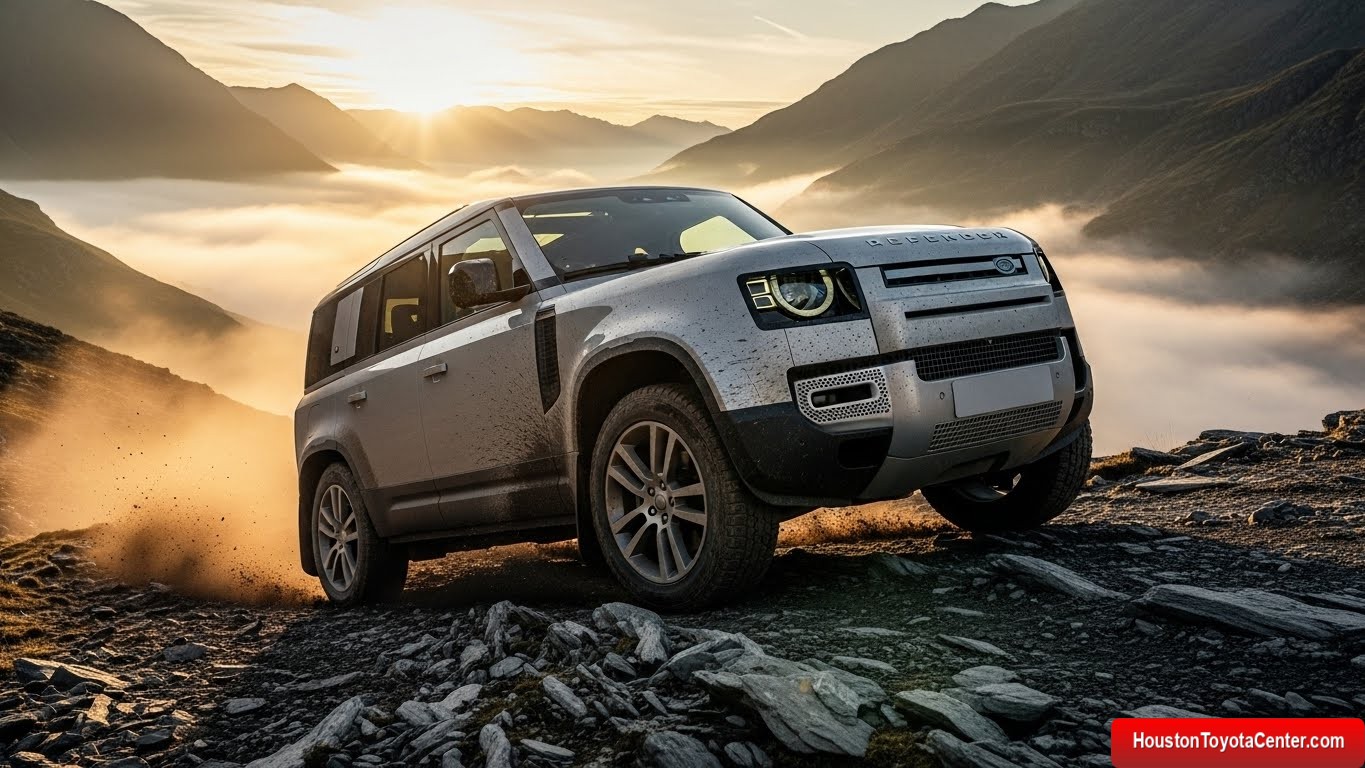
Few vehicles in automotive history carry the weight of legend quite like the Land Rover Defender. It is more than a car; it is a cultural artifact, a symbol of endurance, exploration, and purpose-built engineering. From muddy farms in rural England to deserts in Africa, mountain trails in South America, and urban streets in the world’s most fashionable cities, the Defender has traveled further—and meant more to more people—than almost any other four-wheel-drive vehicle ever produced.
The modern Land Rover Defender stands at a fascinating crossroads. It must honor a past defined by simplicity, durability, and mechanical honesty, while also meeting the expectations of contemporary drivers who demand comfort, technology, safety, and refinement. This dual identity—rugged heritage meeting modern luxury—is not merely a marketing slogan. It is the central challenge and greatest achievement of the Defender’s reinvention.
This article explores the Defender’s journey from utilitarian workhorse to luxury off-road icon. We will examine its origins, design philosophy, engineering evolution, off-road capabilities, interior transformation, technological advancements, market positioning, and cultural significance. By the end, it becomes clear why the Defender is not just surviving in the modern automotive landscape—but thriving.
Origins of a Legend: The Birth of the Land Rover Defender
The story of the Defender begins not with luxury, but with necessity. In the aftermath of World War II, Britain faced material shortages, economic hardship, and a pressing need for practical vehicles that could support agriculture and industry. Maurice Wilks, Rover’s chief designer, envisioned a simple, durable, all-terrain vehicle inspired by the American Willys Jeep.
FREE: Quickly identify and understand problems with your vehicle 🚘
CLICK HEREIn 1948, the first Land Rover Series I made its debut at the Amsterdam Motor Show. Constructed with aluminum alloy panels—chosen due to steel shortages—the vehicle was lightweight, corrosion-resistant, and extraordinarily tough. Its ladder-frame chassis and permanent four-wheel drive laid the foundation for what would become one of the most capable off-road platforms in history.
At this stage, comfort was irrelevant. The early Land Rovers were designed to work:
- Farmers used them as tractors
- Militaries adopted them as transport and reconnaissance vehicles
- Explorers relied on them in remote regions
- Aid organizations trusted them in harsh environments
This was transportation reduced to its purest form: function over form, reliability over refinement.
From Series I to Defender: Evolution Without Compromise
Over the decades, the Land Rover evolved incrementally rather than radically. The Series II and III models introduced modest improvements in power, drivability, and ergonomics, but the core philosophy remained unchanged.
In the 1980s, Land Rover introduced the 90 and 110 models (named after their wheelbase lengths). These vehicles brought coil-spring suspension—borrowed from the Range Rover—significantly improving ride quality without sacrificing off-road prowess. Permanent four-wheel drive, locking center differentials, and robust axles made them formidable in extreme conditions.
In 1990, the name “Defender” was officially adopted, distinguishing the utilitarian model from the increasingly luxurious Range Rover lineup. The Defender was still unapologetically basic, but it was also becoming iconic.
Key Characteristics of the Classic Defender
- Body-on-frame construction
- Solid axles
- Minimal electronics
- Flat glass and upright panels
- Spartan interiors
- Exceptional approach, departure, and breakover angles
The Defender became a global symbol of toughness. It was used by the British Army, humanitarian organizations, wildlife conservationists, and adventurers alike. Ownership often meant accepting discomfort in exchange for unstoppable capability.
Cultural Impact: More Than a Vehicle
The Defender’s reputation extended far beyond the automotive world. It became embedded in popular culture, representing resilience, exploration, and authenticity.
- Appeared in films, documentaries, and television shows
- Associated with African safaris and Australian outback expeditions
- Became a status symbol among explorers and collectors
- Represented British engineering at its most honest
Ironically, what once made the Defender a necessity eventually made it obsolete. Stricter emissions regulations, safety standards, and consumer expectations rendered the old design unsustainable. In 2016, production of the classic Defender officially ended.
For many, this marked the end of an era.
The Challenge of Reinvention
Reviving the Defender was never going to be easy. Land Rover faced a difficult question:
How do you modernize a vehicle built on simplicity without losing its soul?
The automotive world had changed dramatically. Customers now expected:
- Advanced safety systems
- Connectivity and infotainment
- Quiet cabins
- Efficient engines
- Premium materials
At the same time, loyal Defender enthusiasts feared a betrayal of the original ethos. The new Defender could not simply be another luxury SUV. It had to earn its name.
Land Rover chose a bold path: complete reinvention.
A New Platform: Engineering for the 21st Century
The modern Defender is built on Land Rover’s D7x aluminum monocoque architecture, a radical departure from the traditional ladder-frame design. This platform is three times stiffer than traditional body-on-frame construction, providing exceptional torsional rigidity.
At first glance, purists were skeptical. Monocoque construction was associated with crossovers, not hardcore off-roaders. However, Land Rover engineered the D7x platform specifically for extreme durability.
Engineering Highlights
- Ultra-high-strength aluminum structure
- Integrated subframes for suspension loads
- Exceptional rigidity for off-road articulation
- Reduced weight compared to steel frames
The result is a vehicle that is both stronger and more refined, capable of withstanding severe off-road punishment while offering superior on-road comfort.
Modern Design: A Respectful Reinterpretation
Visually, the modern Defender strikes a careful balance between past and present. It does not attempt to replicate the old Defender—but it unmistakably references it.
Design Elements Inspired by Heritage
- Upright stance and short overhangs
- Alpine roof windows
- Side-hinged rear door
- Exposed fasteners and structural elements
- Squared-off wheel arches
Modern Touches
- LED lighting
- Flush surfaces for improved aerodynamics
- Panoramic glass roof
- Customization options
The design communicates strength and honesty. Panels look structural because they are. Nothing feels ornamental. Even luxury is presented with a sense of purpose.
Interior Transformation: From Utility to Luxury
Perhaps the most dramatic evolution of the Defender is found inside the cabin.
Where once there were bare metal surfaces and hose-out interiors, the modern Defender offers a refined, thoughtfully designed environment that still respects its utilitarian roots.
Interior Philosophy
- Durable materials meet premium finishes
- Exposed magnesium cross-car beam
- Washable rubberized flooring options
- High-quality leather and sustainable textiles
Luxury in the Defender is not about excess—it is about confidence and functionality.
Comfort Features
- Heated and ventilated seats
- Multi-zone climate control
- Advanced sound insulation
- Panoramic roof for enhanced visibility
The Defender can now comfortably serve as a daily driver, long-distance tourer, or executive vehicle—without losing its rugged identity.
Technology: Intelligence in Service of Capability
The modern Defender is one of the most technologically advanced off-road vehicles ever produced.
Terrain Response System
Land Rover’s Terrain Response 2 system allows drivers to select modes optimized for different conditions:
| Terrain Mode | Optimized For |
|---|---|
| Grass/Gravel/Snow | Low traction surfaces |
| Mud and Ruts | Deep, uneven terrain |
| Sand | Soft, shifting ground |
| Rock Crawl | Extreme off-road obstacles |
| Wade Mode | Deep water crossings |
The system automatically adjusts throttle response, transmission behavior, suspension height, and differential locking.
Off-Road Visibility
- 360-degree camera system
- Transparent hood view for obstacle detection
- Digital rearview mirror
These features reduce driver stress and improve confidence in challenging environments.
Powertrains: Strength Meets Efficiency
The Defender offers a wide range of engines, balancing performance, efficiency, and environmental responsibility.
Engine Options
- Turbocharged four-cylinder engines
- Inline-six mild-hybrid engines
- Plug-in hybrid (PHEV) options
- High-performance V8 variants
Despite its size and capability, the Defender demonstrates impressive efficiency, especially in hybrid configurations.
Off-Road Capability: Still the Benchmark
No discussion of the Defender is complete without addressing its off-road performance.
Key Capability Metrics
| Feature | Specification |
|---|---|
| Ground Clearance | Up to ~291 mm |
| Wading Depth | Up to 900 mm |
| Approach Angle | ~38 degrees |
| Departure Angle | ~40 degrees |
Electronic air suspension allows the Defender to adapt its ride height dynamically, while locking differentials and advanced traction systems ensure power reaches the ground.
Despite its luxury, the Defender remains one of the most capable production off-road vehicles in the world.
On-Road Refinement: A New Dimension
Unlike its predecessors, the modern Defender excels on paved roads.
- Stable highway cruising
- Precise steering for its size
- Reduced body roll
- Quiet cabin
This duality—off-road dominance paired with on-road comfort—is perhaps the Defender’s greatest triumph.
Sustainability and Responsibility
Land Rover has made clear efforts to align the Defender with modern sustainability goals.
- Use of recycled and sustainable materials
- Hybrid powertrain options
- Improved emissions compliance
- Longer service intervals
The Defender now reflects a more responsible approach to adventure.
Market Positioning: A Class of Its Own
The Defender occupies a unique space in the market.
It is more capable than most luxury SUVs, more refined than traditional off-roaders, and more authentic than lifestyle crossovers.
Competitors include:
- Mercedes-Benz G-Class
- Toyota Land Cruiser
- Jeep Wrangler (at the extreme end)
Yet none combine heritage, luxury, and versatility quite like the Defender.
The Defender Lifestyle
Ownership today extends beyond the vehicle itself.
- Factory accessories for overlanding
- Roof tents and expedition gear
- Community events and Defender experiences
The Defender has become a platform for personal expression and adventure.
Criticism and Controversy
Not all feedback has been positive.
Common criticisms include:
- Higher price compared to the old Defender
- Increased complexity and electronics
- Loss of mechanical simplicity
Yet these criticisms underscore an unavoidable truth: the old Defender could not exist unchanged in the modern world.
Conclusion: A Worthy Heir to a Legendary Name
The Land Rover Defender has achieved something rare.
It honors its past without being trapped by it. It embraces luxury without abandoning purpose. It evolves without forgetting why it exists.
The modern Defender is not a replacement for the old—it is its successor. A vehicle shaped by decades of experience, reimagined for a new generation of explorers.
In an era where many SUVs chase trends, the Defender remains grounded in identity. It is still a tool, still a companion, still a promise of adventure—now wrapped in comfort, intelligence, and refinement.
Rugged heritage meets modern luxury, not as a compromise, but as a triumph.
Leave a Reply