
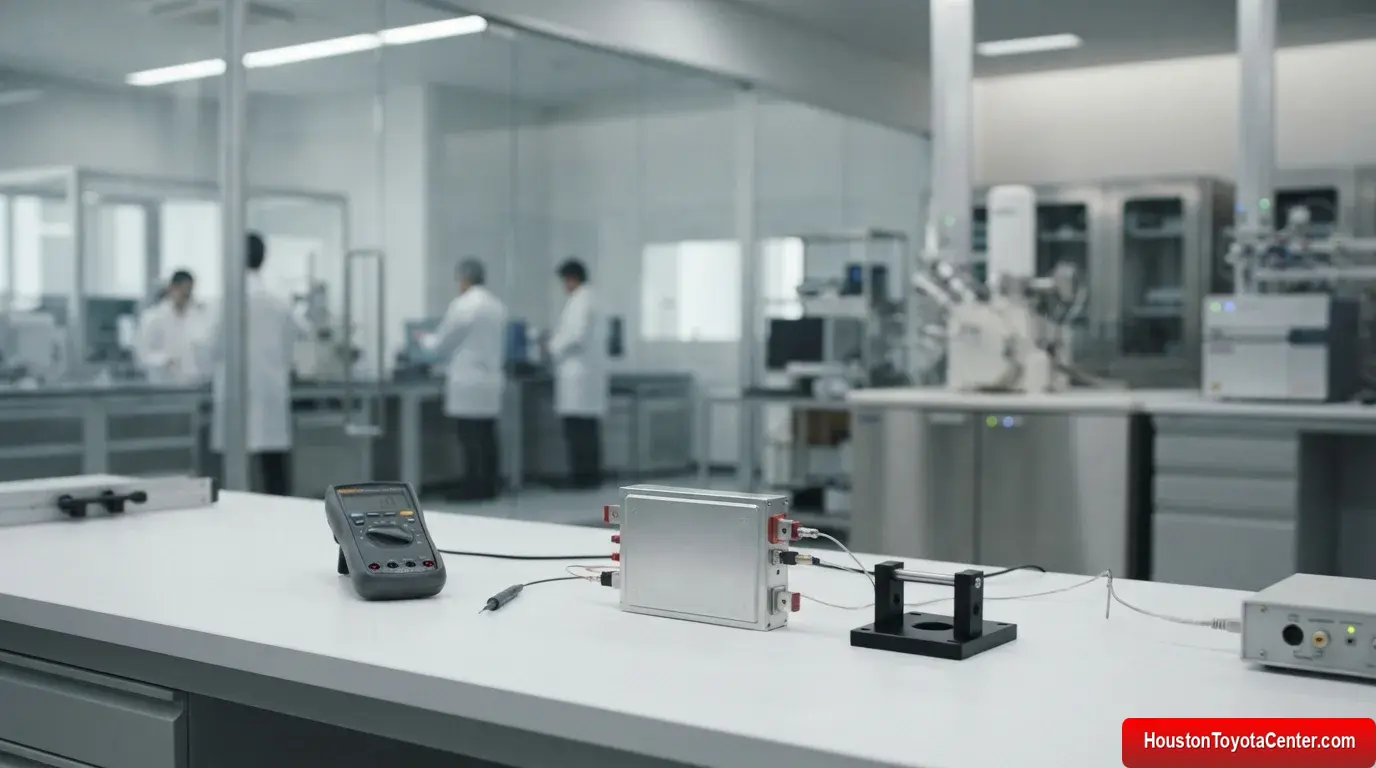
By 2026, the automotive industry’s most important competition is no longer taking place only on the factory floor. It is happening inside battery laboratories, where engineers are working to make electric vehicles travel farther, charge faster, cost less, and become easier to manufacture. At Toyota, that effort has become a central part of the company’s strategy for the next generation of vehicles.
A battery may look like a relatively simple component from the outside. Inside, however, it is a complex system of materials, chemistry, manufacturing processes, electronics, thermal management and mechanical structures. Small changes in any of those areas can affect an electric vehicle’s range, charging time, weight, durability and price.
Toyota has spent decades developing battery technology through its hybrid vehicles. Today, that accumulated knowledge is being redirected toward a broader portfolio that includes lithium-ion batteries, lithium iron phosphate batteries and all-solid-state batteries. The company is also working with partners on materials, production technology and supply chains.
The objective is not simply to build a larger battery. Toyota is attempting to develop different battery technologies for different types of vehicles and customers.
FREE: Quickly identify and understand problems with your vehicle 🚘
CLICK HEREA Laboratory Built Around Different Battery Technologies
Toyota’s approach differs from the idea that one battery chemistry will eventually dominate every vehicle. The company describes its strategy as a range of battery options designed for different requirements.
Its current development roadmap includes next-generation lithium-ion batteries, bipolar batteries using lithium iron phosphate, high-performance batteries using high-nickel cathodes, and all-solid-state batteries.
That distinction matters because an electric vehicle designed for affordability has different requirements from a premium model designed for maximum range and performance.
For a mass-market vehicle, reducing the cost of the battery can be more important than achieving the highest possible energy density. For a long-range vehicle, engineers may prioritize energy density and charging performance. The challenge is to improve several characteristics without creating new problems elsewhere.
Toyota’s next-generation battery program illustrates this balancing act.
The company’s performance-oriented battery is based on a prismatic design and is intended to combine greater energy density with vehicle efficiency improvements. Toyota has said that vehicles using this technology are being developed with a target range of around 1,000 kilometers, including improvements from aerodynamics and weight reduction. The company has also stated targets for lower costs and charging from 10% to 80% in 20 minutes or less.
These figures are development targets, rather than guarantees for every future Toyota vehicle. The distinction is important because battery performance depends on vehicle design, driving conditions, temperature, software and other factors.
Why Battery Architecture Matters
One of the most interesting areas of Toyota’s battery research involves the bipolar structure.
In a conventional battery cell, current collectors and electrode materials are arranged in a relatively complex configuration. A bipolar design can simplify the structure by allowing one current collector to carry an anode on one side and a cathode on the other.
Toyota says its bipolar configuration can use approximately one-third as many components as a conventional structure. The company is applying technology developed through its hybrid vehicle experience to battery electric vehicles.
The significance goes beyond engineering elegance.
Fewer components can potentially mean fewer manufacturing steps, lower material use and a simpler production process. If those advantages can be achieved at scale, they could help reduce the cost of electric vehicles.
Toyota is also developing a bipolar lithium iron phosphate battery aimed at the popularization segment. The company has described targets including a 20% increase in driving range and a 40% reduction in cost compared with an earlier bZ4X reference point, along with a charging time of 30 minutes or less from 10% to 80%.
Again, these are development targets. Their eventual real-world impact will depend on how the technology performs when integrated into production vehicles.
The Solid-State Challenge
If lithium-ion batteries represent the evolution of today’s technology, all-solid-state batteries represent a more fundamental change.
A conventional lithium-ion battery uses a liquid electrolyte to transport ions between the electrodes. An all-solid-state battery replaces that liquid electrolyte with a solid material.
The concept has attracted enormous interest because solid electrolytes may enable advantages in energy density, power output, charging speed and packaging. But turning a laboratory concept into a reliable automotive product is a much more difficult problem.
Toyota has acknowledged that durability has been one of the challenges in the development of solid-state batteries. The company has also described work on solid electrolyte materials and manufacturing processes as critical steps toward commercialization.
Inside a development facility, therefore, the work is not simply about producing a cell that works once. Engineers must determine whether it can operate repeatedly, safely and consistently over many years.
That requires testing materials, electrode structures, pressure conditions, temperatures, charging cycles and manufacturing tolerances.
Toyota’s planned production approach also illustrates the complexity of the challenge. The company has been developing manufacturing methods for all-solid-state batteries and has targeted practical use in vehicles around 2027 to 2028.
In October 2025, Toyota and Sumitomo Metal Mining announced a joint development agreement focused on mass production of cathode materials for all-solid-state batteries. The partnership demonstrates how battery development extends beyond the laboratory itself. New battery technology requires an industrial ecosystem capable of producing its materials at automotive scale.
From Laboratory Prototype to Mass Production
This is perhaps the least visible part of battery development.
A prototype can demonstrate that a particular chemistry or cell architecture works. Automotive manufacturing requires something much more demanding: millions of components produced with consistent quality, at an economically viable cost.
Toyota has therefore been working simultaneously on battery research, manufacturing technology and production capacity.
In Japan, the company has received government certification for plans covering next-generation battery development and production, including all-solid-state battery research and production. One of the certified plans for next-generation performance batteries calls for production to begin from 2026 and eventually reach 9 GWh per year.
The company is also expanding production outside Japan.
In November 2025, Toyota announced the start of battery production at its new facility in Liberty, North Carolina. The nearly $14 billion plant is Toyota’s first battery manufacturing facility outside Japan and is planned to eventually operate 14 production lines supporting hybrid, plug-in hybrid and battery electric vehicles.
That factory is not a research laboratory, but it is closely connected to the same technological transition. Research only becomes commercially meaningful when manufacturing can reproduce the desired characteristics reliably.
The Quiet Work Behind the Battery
The image of battery innovation often focuses on futuristic materials and spectacular prototypes. The reality is usually much quieter.
Engineers spend significant amounts of time measuring degradation, examining microscopic structures, controlling manufacturing tolerances and testing how cells behave under different conditions.
They are also looking at how batteries interact with the rest of the vehicle.
A battery with extremely high energy density is not automatically the best solution if it increases weight, creates thermal challenges or becomes too expensive to manufacture. Similarly, a battery that charges extremely quickly may require changes to cooling systems, electrical infrastructure and vehicle architecture.
This is why Toyota’s battery strategy is closely connected to vehicle design.
The company has described its goal as developing batteries in line with the characteristics of the vehicles it wants to create. Its internal development efforts cover different battery types, including ternary lithium, lithium iron phosphate and all-solid-state technologies.
The laboratory, in that sense, is not an isolated room filled with experimental cells. It is part of a much larger engineering system.
A Different Kind of Automotive Competition
The battery race is changing the definition of automotive innovation.
For much of the automobile’s history, competition revolved around engines, transmissions, suspension systems and manufacturing efficiency. Electric vehicles shift a large part of that technological competition toward electrochemistry and energy storage.
That makes the battery laboratory one of the strategic centers of the modern automotive industry.
Toyota enters this competition with an unusual background. Its long experience with hybrid vehicles gave the company decades of experience with battery systems, power electronics and energy management. At the same time, its relatively cautious approach to battery electric vehicles has placed greater attention on how quickly and effectively it can expand its BEV technology.
The company is now pursuing several battery pathways simultaneously rather than relying on a single technological bet.
Its next-generation lithium-ion batteries are intended to improve range, cost and charging performance. Bipolar LFP batteries are being developed with affordability and wider adoption in mind. Higher-performance batteries target greater range and performance. All-solid-state batteries represent the longer-term effort to fundamentally change the underlying battery architecture.
What Happens Next
The most important question is no longer whether Toyota can demonstrate advanced battery technology in a laboratory. It is whether those technologies can survive the transition from prototype to mass production.
That transition requires reliable materials, scalable manufacturing, competitive costs, long-term durability and consistent performance.
Toyota’s recent partnerships suggest that the company understands the scale of that challenge. Its collaboration with Idemitsu focuses on solid electrolytes and manufacturing technology, while its work with Sumitomo Metal Mining addresses cathode materials.
Meanwhile, production facilities such as the North Carolina battery plant represent the industrial infrastructure needed to bring electrified vehicles to larger markets.
Inside Toyota’s battery laboratories, then, the future of the automobile is being shaped through a combination of chemistry, engineering and manufacturing discipline.
The breakthrough may ultimately come from a new material. It may come from a simpler cell structure. It may come from a manufacturing process that makes an existing technology significantly cheaper.
Or it may come from combining several incremental improvements into a battery that is not revolutionary in one single dimension, but is better balanced across range, cost, charging, durability and production.
That is the central challenge facing Toyota and the wider automotive industry.
The battery of the future will not be judged only by what it can do inside a laboratory. It will be judged by what it can do millions of times, in millions of vehicles, under real-world conditions.
And that is where the quiet work inside the battery lab becomes an industrial race.
Leave a Reply