
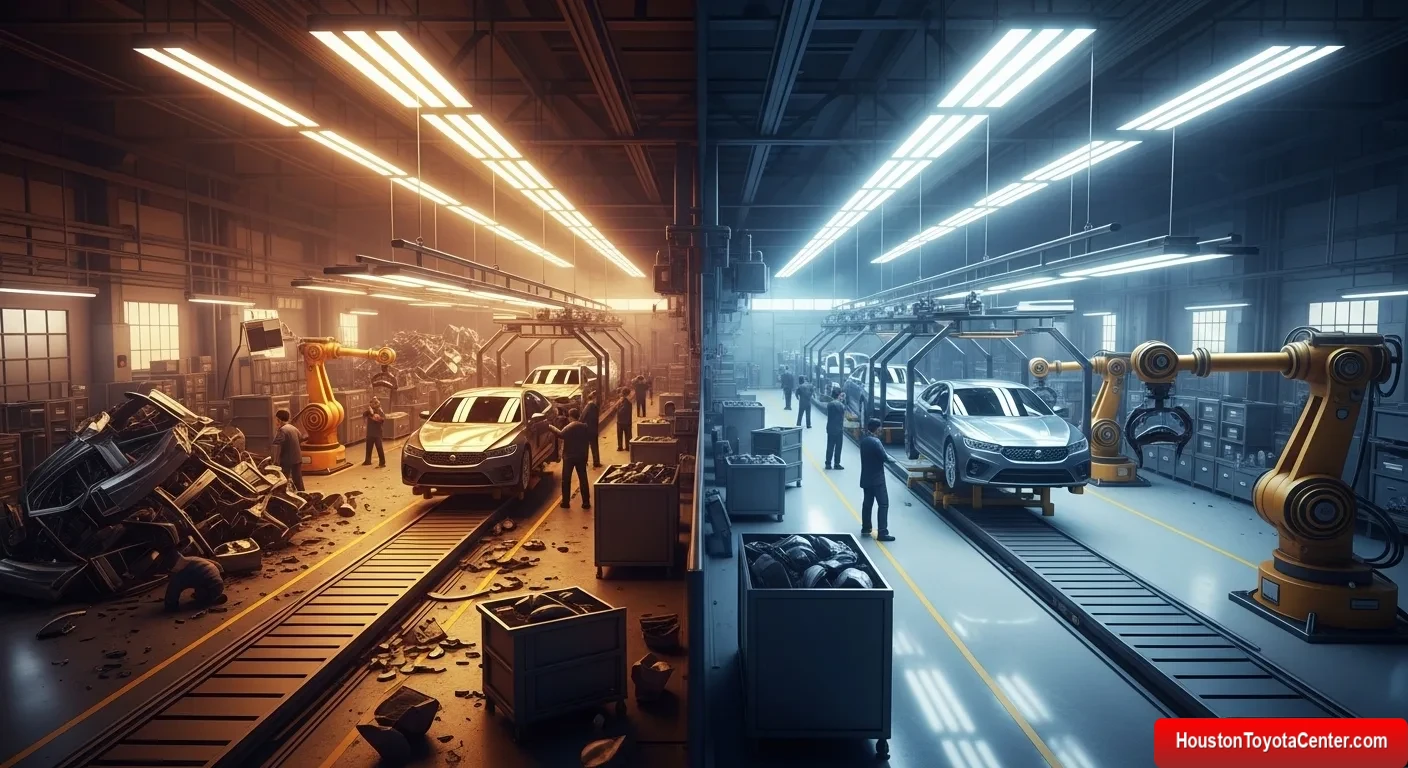
The global automotive industry has experienced numerous revolutions over the past century, from Henry Ford’s assembly line to the rise of electric vehicles. Yet one transformation stands out for fundamentally changing how companies manufacture products across industries: the Lean Production system developed by Toyota. Often called the Toyota Production System (TPS), this approach reshaped manufacturing efficiency, reduced waste, improved product quality, and transformed management philosophies worldwide.
Today, Lean principles extend far beyond automobile manufacturing, influencing sectors such as healthcare, software development, logistics, and aerospace. But the roots of this transformation lie in post-World War II Japan, when Toyota faced enormous constraints and needed a new way to compete with larger American automakers like Ford Motor Company and General Motors.
This article explores how Toyota’s Lean Production system emerged, how it works, and how it revolutionized the automotive industry and modern manufacturing.
The Origins of Lean Production
Post-War Constraints in Japan
In the late 1940s and early 1950s, Japan’s industrial base was severely damaged by World War II. Toyota, like many Japanese manufacturers, struggled with:
FREE: Quickly identify and understand problems with your vehicle 🚘
CLICK HERE- Limited financial resources
- Scarce raw materials
- Small domestic demand
- Limited factory space
- Workforce instability
Unlike American manufacturers, Toyota could not afford massive production runs or large inventories. In the United States, companies such as Ford produced huge batches of identical vehicles, relying on economies of scale to drive down costs.
Toyota had to find a different solution.
The Visionaries Behind the System
The architects of the Toyota Production System were:
- Taiichi Ohno – Toyota engineer and industrial pioneer
- Kiichiro Toyoda – founder of Toyota Motor Corporation
- Eiji Toyoda – executive who studied American production methods
After visiting Ford’s Rouge plant in the United States, Eiji Toyoda recognized that simply copying the American mass production model would not work in Japan. Toyota needed a system designed for flexibility rather than scale.
The result was the Toyota Production System, later popularized globally as Lean Manufacturing.
What Is Lean Production?
Lean Production is a manufacturing philosophy focused on maximizing value while minimizing waste. The goal is to deliver exactly what the customer wants, when they want it, with minimal resources.
Lean thinking revolves around several key principles:
- Eliminating waste
- Continuous improvement
- Respect for workers
- Efficient workflow
- Just-in-time production
- Built-in quality control
Unlike traditional mass production, Lean production emphasizes flexibility, responsiveness, and constant learning.
The Seven Types of Waste
One of the foundational concepts in Lean Production is the elimination of waste—called muda in Japanese.
Taiichi Ohno identified seven types of waste that reduce efficiency.
| Type of Waste | Description | Example in Auto Manufacturing |
|---|---|---|
| Overproduction | Producing more than needed | Building vehicles before orders exist |
| Waiting | Idle time during production | Workers waiting for parts |
| Transport | Unnecessary movement of materials | Parts moved between distant facilities |
| Overprocessing | Doing more work than necessary | Excess inspection steps |
| Inventory | Excess raw materials or parts | Warehouses full of unused components |
| Motion | Inefficient worker movement | Tools stored far from the assembly station |
| Defects | Products needing rework | Faulty parts requiring replacement |
By systematically eliminating these wastes, Toyota dramatically improved efficiency and cost control.
Just-in-Time Manufacturing
One of the most famous components of Lean Production is Just-in-Time (JIT) manufacturing.
Instead of storing large inventories, parts arrive exactly when they are needed.
How JIT Works
- Suppliers deliver components in small batches
- Assembly lines produce vehicles based on real demand
- Inventory levels remain extremely low
- Problems become visible quickly
This approach forces organizations to solve problems immediately instead of hiding them behind excess stock.
Advantages
Just-in-Time manufacturing offers several benefits:
- Lower storage costs
- Faster problem detection
- Increased flexibility
- Reduced capital tied up in inventory
However, it also requires extremely reliable logistics and strong supplier relationships.
The Kanban System
To make Just-in-Time production work, Toyota developed a visual signaling method known as Kanban.
Kanban uses cards, bins, or digital signals to indicate when new parts should be produced or delivered.
Basic Kanban Workflow
- A worker consumes parts in production.
- The empty container triggers a Kanban signal.
- The signal tells the previous process to produce more parts.
- The cycle continues across the production chain.
This system ensures production is driven by actual demand, not forecasts.
Kanban systems are now widely used in software development, logistics, and project management.
Built-In Quality: Jidoka
Another key concept in Toyota’s system is Jidoka, often translated as automation with a human touch.
Jidoka means that machines and workers automatically stop production when a problem occurs.
Instead of allowing defective parts to continue through the system, the line stops so the issue can be fixed immediately.
Benefits of Jidoka
- Prevents defects from spreading
- Improves long-term quality
- Encourages root-cause analysis
- Empowers workers to take responsibility
This approach contrasts with traditional factories where defective products might only be discovered at the end of production.
Continuous Improvement (Kaizen)
Lean Production emphasizes Kaizen, the philosophy of continuous improvement.
Instead of large, infrequent changes, Toyota encourages small daily improvements made by workers at every level.
Employees are expected to:
- Identify inefficiencies
- Suggest improvements
- Experiment with better workflows
- Share knowledge across teams
This culture of constant refinement makes the production system evolve over time.
Respect for People
One of the most misunderstood aspects of Lean Production is its focus on respect for people.
Toyota believes that workers closest to the process are best positioned to improve it.
Employees are encouraged to:
- Stop production if something is wrong
- Suggest operational improvements
- Participate in problem-solving teams
- Develop new skills
This participatory culture increases engagement and innovation within the workforce.
Lean vs Traditional Mass Production
The differences between Lean Production and traditional mass production are significant.
| Feature | Traditional Mass Production | Lean Production |
|---|---|---|
| Production style | Large batches | Small batches |
| Inventory levels | High | Low |
| Problem detection | Late | Immediate |
| Worker role | Repetitive tasks | Problem-solving contributors |
| Flexibility | Low | High |
| Quality control | End-of-line inspection | Built into the process |
Lean production shifts the focus from maximizing output to maximizing efficiency and quality.
The Global Spread of Lean Manufacturing
For decades, Toyota’s production system remained relatively unknown outside Japan.
That changed in the 1980s.
The MIT Study
A major research project at Massachusetts Institute of Technology analyzed global automobile manufacturing and revealed Toyota’s extraordinary efficiency advantage.
The findings were later published in the influential book The Machine That Changed the World.
The study showed that Toyota factories required:
- Fewer workers
- Less space
- Less inventory
- Less time to produce a vehicle
- Fewer defects
Yet they produced higher-quality cars.
This discovery shocked the global auto industry.
How Lean Forced the Industry to Adapt
Once Toyota’s methods became widely known, competitors had no choice but to adapt.
Automakers around the world began implementing Lean practices.
These included:
- Just-in-time supply chains
- Continuous improvement programs
- Worker suggestion systems
- Flexible manufacturing cells
Companies like BMW, Volkswagen, and Honda integrated Lean principles into their production processes.
Even American automakers gradually adopted elements of Lean manufacturing.
Supply Chain Transformation
Lean Production also revolutionized automotive supply chains.
Instead of maintaining thousands of parts in inventory, manufacturers developed close partnerships with suppliers.
Key changes included:
- Long-term supplier contracts
- Shared quality standards
- Coordinated logistics systems
- Frequent small deliveries
Suppliers became integrated partners rather than distant vendors.
This collaborative ecosystem increased efficiency across the entire production network.
Lean’s Impact on Quality
One of the most visible outcomes of Toyota’s Lean Production system was a dramatic improvement in vehicle reliability.
In the 1970s and 1980s, Japanese cars became known for exceptional durability.
Consumers began choosing Japanese vehicles over American competitors due to:
- Lower maintenance costs
- Higher reliability
- Better fuel efficiency
- Consistent quality
This shift forced the global auto industry to prioritize quality improvements.
Lean and Product Development
Toyota didn’t just apply Lean principles to manufacturing—it also transformed product development.
Lean development emphasizes:
- Cross-functional teams
- Rapid feedback loops
- Knowledge sharing
- Simultaneous engineering
This approach reduces development time while improving product design.
Many modern engineering organizations have adopted similar practices.
Lean’s Influence Beyond Automobiles
Lean thinking has expanded far beyond the auto industry.
Today, Lean principles are used in sectors including:
- Healthcare
- Software development
- Construction
- Logistics
- Aerospace
- Retail
For example, Lean-inspired project management frameworks such as Kanban boards and agile workflows are widely used in software teams.
Companies across industries study Toyota’s approach to improve efficiency and eliminate waste.
Lean Production in the Digital Age
Modern technologies are transforming Lean manufacturing.
Automation, artificial intelligence, and data analytics allow manufacturers to optimize processes even further.
Examples include:
- Predictive maintenance using sensors
- Automated quality inspection
- AI-driven supply chain optimization
- Smart factory systems
However, the core philosophy of Lean remains unchanged: continuous improvement and waste elimination.
Challenges and Criticisms of Lean
While Lean Production has many advantages, it also faces criticism.
Some concerns include:
Supply Chain Vulnerability
Just-in-Time systems can be disrupted by unexpected events such as:
- Natural disasters
- Supply shortages
- Global pandemics
Low inventory levels reduce buffers against disruptions.
Worker Pressure
Some critics argue Lean systems can increase stress if poorly implemented.
When companies focus only on efficiency without respecting workers, Lean principles can become distorted.
Toyota’s original philosophy emphasized worker empowerment, not just productivity.
Lean and the Future of Automotive Manufacturing
As the automotive industry shifts toward electric vehicles and autonomous technology, Lean principles remain relevant.
Electric vehicle production requires:
- Efficient battery supply chains
- Flexible manufacturing lines
- Rapid innovation cycles
Lean production’s adaptability makes it well suited for this evolving landscape.
Companies entering the EV market often study Toyota’s methods when designing new factories.
Why Toyota’s Lean Production Still Matters
Toyota’s Lean Production system represents one of the most influential innovations in industrial history.
It transformed manufacturing by demonstrating that:
- Efficiency comes from eliminating waste
- Quality should be built into processes
- Workers are essential contributors to improvement
- Flexibility can outperform scale
Today, Lean thinking influences organizations worldwide.
From hospitals reducing patient wait times to software teams optimizing development workflows, the legacy of Toyota’s production philosophy continues to shape modern operations.
More than a manufacturing method, Lean Production is a mindset—one that values learning, efficiency, and continuous improvement.
And that mindset changed the global auto industry forever.
Leave a Reply