
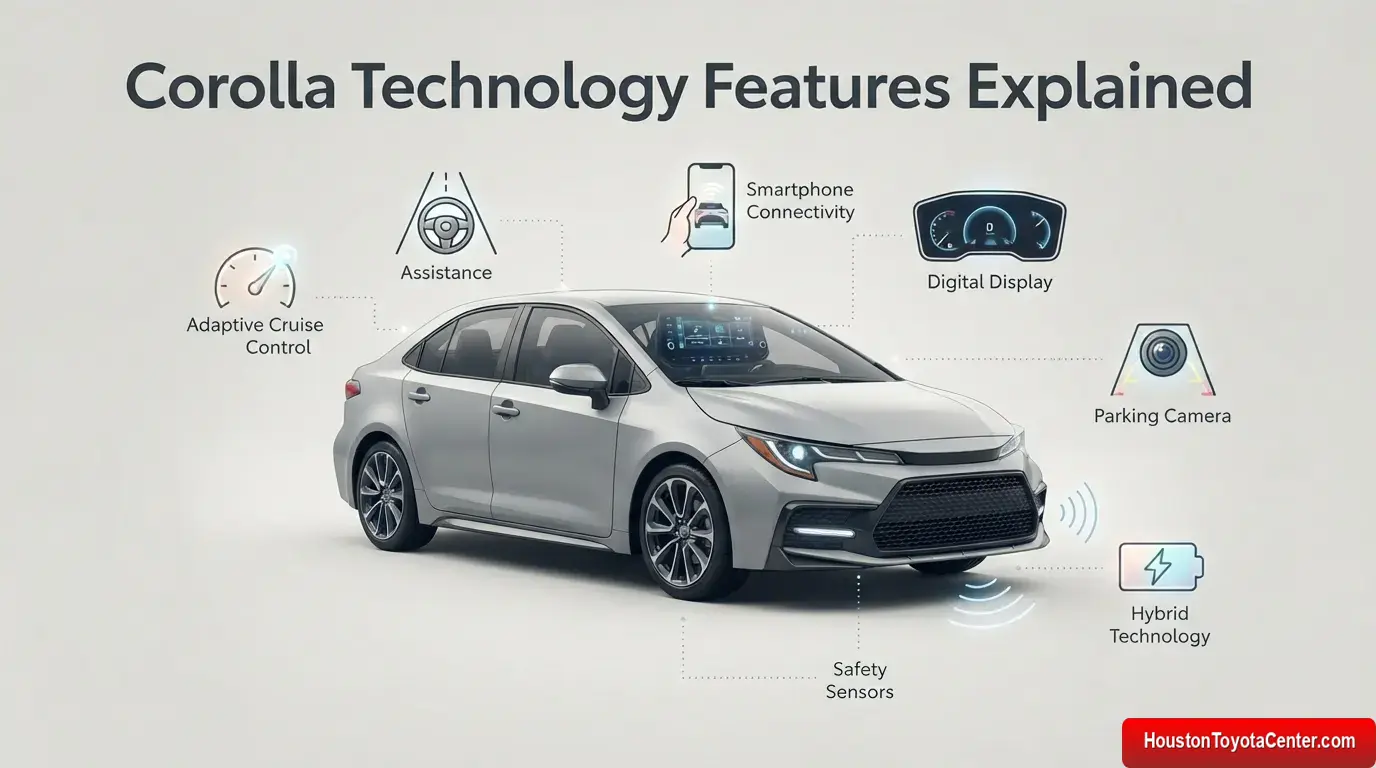
The Toyota Corolla has long been associated with practicality, efficiency, and everyday usability. In recent generations, however, the compact sedan and hatchback have also become increasingly defined by technology. From driver assistance systems and digital displays to smartphone connectivity and hybrid powertrain technology, the Corolla now offers a collection of features designed to make daily driving safer, easier, and more connected.
Understanding the technology inside the Corolla requires looking beyond a simple list of features. Some systems are designed to reduce the workload on the driver, while others focus on connectivity, convenience, efficiency, or entertainment. Availability can also vary by model year, market, body style, trim level, and powertrain, so buyers should verify the specifications for the particular Corolla they are considering.
Driver Assistance Technology
One of the most significant areas of technological development in the Corolla is driver assistance. Toyota has incorporated a range of active safety technologies into its vehicles, with many Corolla versions benefiting from the Toyota Safety Sense suite.
Toyota Safety Sense is a collection of systems intended to help drivers identify potential hazards and respond to certain situations. Rather than replacing the driver, these technologies are designed to provide additional information, warnings, and, in some circumstances, automated assistance.
FREE: Quickly identify and understand problems with your vehicle 🚘
CLICK HEREDepending on the version and model year, the system can include features such as a Pre-Collision System with pedestrian detection, Lane Departure Alert, Lane Tracing Assist, Automatic High Beams, and Dynamic Radar Cruise Control.
The Pre-Collision System uses sensors and other vehicle information to detect certain potential collisions. If the system determines that a frontal collision may be imminent, it can provide warnings and, depending on the circumstances and vehicle configuration, apply braking assistance.
Pedestrian detection adds another layer to the system by helping identify certain pedestrians in the vehicle’s path. Its performance can vary according to factors such as lighting, road conditions, speed, and the behavior of surrounding road users.
Lane Departure Alert is designed to monitor lane markings and alert the driver when the vehicle appears to be leaving its lane under certain conditions. Lane Tracing Assist can provide steering assistance when the relevant conditions are met, helping the vehicle remain centered within a detected lane.
These systems are particularly relevant during long highway journeys, where maintaining lane position and monitoring traffic can demand continuous attention. They are also examples of how modern vehicle technology is increasingly focused on assistance rather than simply adding entertainment features.
Adaptive Cruise Control
Cruise control has been available in passenger vehicles for decades, but modern systems can do considerably more than maintain a fixed speed.
The Corolla can be equipped, depending on market and configuration, with Dynamic Radar Cruise Control. The technology is designed to help maintain a selected cruising speed while also adjusting the vehicle’s speed in response to traffic ahead.
This changes the experience of highway driving. Instead of repeatedly turning cruise control on and off as traffic conditions change, the system can automatically adjust the vehicle’s speed within its operating parameters.
The exact capabilities of the system vary by vehicle and version. Drivers still need to remain attentive and responsible for controlling the vehicle. Adaptive cruise control is an assistance feature, not an autonomous driving system.
That distinction is important because modern driver assistance technologies can sometimes create unrealistic expectations. Sensors and software have limitations, and road conditions can change faster than a vehicle’s systems can respond.
Digital Displays and Instrumentation
The Corolla’s technology is also visible inside the cabin. Depending on the version, drivers may have access to a digital or partially digital instrument cluster that presents information such as vehicle speed, fuel economy, driving assistance status, and other operating data.
Digital displays provide flexibility in how information is presented. Instead of relying exclusively on traditional analog gauges, manufacturers can use screens to combine driving information with warnings and system notifications.
For drivers, the value of a digital instrument display is largely connected to clarity. Important information can be grouped into a central viewing area, reducing the need to look away from the road for extended periods.
Higher trim levels in some markets can offer larger or more advanced displays, while entry-level versions may use simpler instrumentation. Because Toyota’s equipment strategy varies between countries, prospective buyers should check local specifications rather than assuming that every Corolla has identical technology.
Infotainment and Smartphone Connectivity
Connectivity has become an expected part of modern car ownership, and the Corolla reflects that shift.
Depending on the market and model year, Corolla infotainment systems can support smartphone integration through Apple CarPlay and Android Auto. These systems allow compatible smartphones to connect with the vehicle’s display and provide access to selected navigation, communication, music, and other applications.
The practical advantage is that drivers can use a familiar smartphone interface while keeping key functions accessible through the vehicle’s screen or voice controls.
A modern infotainment system can also provide Bluetooth connectivity, hands-free calling, audio streaming, and access to vehicle information. Some configurations include larger touchscreens and additional connected services.
The availability of wireless connectivity can vary by version, so it is worth checking whether a particular Corolla supports wireless or wired smartphone integration.
Voice and Connected Services
Connected vehicle technology has also changed the relationship between the driver and the car. In supported Corolla configurations, connected services can provide features that extend beyond the physical controls inside the vehicle.
Depending on the market and subscription structure, these services may include remote vehicle functions, vehicle status information, safety-related services, navigation assistance, or other digital features.
Voice interaction can make some functions easier to access without requiring the driver to navigate multiple menus. This is particularly useful for tasks such as selecting navigation destinations or interacting with compatible media and communication functions.
However, connected services depend on factors such as network availability, compatible devices, account registration, and the specific services offered in a particular market.
Hybrid Technology
For Corolla buyers interested in efficiency, hybrid technology represents one of the most important technical developments associated with the nameplate.
The Corolla Hybrid combines an internal combustion engine with electric motor technology and a battery system. Instead of relying solely on gasoline or operating exclusively as an electric vehicle, the hybrid system manages power from multiple sources according to driving conditions.
One of the advantages of this approach is the ability to recover energy during deceleration. Regenerative braking can convert some of the vehicle’s kinetic energy into electrical energy, which can then be stored in the hybrid battery.
The system can also allow the vehicle to operate using electric power under certain conditions. The transition between electric and gasoline propulsion is managed automatically, meaning drivers generally do not need to manually decide which power source to use.
Hybrid technology therefore represents a different approach to vehicle efficiency. Rather than requiring drivers to change their driving habits dramatically, the system is designed to manage energy automatically.
The precise hybrid configuration, battery technology, output, and fuel economy figures vary depending on the Corolla version and market.
Parking and Camera Technology
Parking assistance has become another important area of automotive technology. Depending on the Corolla configuration, drivers can have access to a rearview camera and other parking-related assistance features.
A rearview camera provides a view behind the vehicle when reversing. Guidelines displayed on the screen can help the driver estimate the vehicle’s path, although the camera does not eliminate the need to check mirrors and surroundings directly.
Some higher-specification versions may provide additional sensors or parking assistance technologies. These can help detect nearby obstacles and provide audible or visual warnings.
Such systems are particularly useful in crowded urban environments, where parking spaces can be narrow and visibility around the vehicle may be limited.
Automatic High Beams
Lighting technology is another area where the Corolla can use sensors and software to assist the driver.
Automatic High Beams can detect certain conditions involving surrounding traffic and switch between high and low beams when the system determines that a change is appropriate.
The objective is relatively simple: provide greater forward illumination when conditions allow while reducing the risk of dazzling other road users.
Like other automated systems, however, automatic high beams are not infallible. Drivers should continue to monitor road conditions and lighting manually when necessary.
The Role of Software in Modern Corolla Technology
Perhaps the most important change in automotive technology is not a single feature but the increasing role of software.
Modern vehicles depend on software to interpret information from cameras, radar systems, sensors, electronic control units, and other components. Software determines how information is displayed and how certain assistance functions respond to changing conditions.
This means that a modern Corolla is not simply a mechanical machine with electronic accessories. It is increasingly a network of interconnected systems.
That approach makes it possible to combine safety, connectivity, and efficiency technologies within a single vehicle. At the same time, it makes the ownership experience more dependent on software updates, compatibility, connectivity, and electronic systems.
Technology Designed for Everyday Driving
The technology in the Corolla is generally focused on practical applications rather than extreme experimentation. The objective is to make routine driving easier, safer, and more convenient.
Driver assistance systems can help monitor the road. Adaptive cruise control can reduce some of the repetitive work associated with highway driving. Smartphone integration can bring familiar digital services into the cabin. Hybrid technology can manage energy more efficiently. Cameras and sensors can make parking and low-speed maneuvering easier.
The significance of these features becomes clearer when they are considered together. Each individual technology performs a specific function, but the broader experience comes from the way multiple systems operate within the same vehicle.
For buyers, the most important consideration is not simply how many technological features a Corolla has. It is how those features fit their actual driving needs.
Someone who spends most of their time in urban traffic may value parking assistance, smartphone connectivity, and hybrid efficiency. A driver who regularly travels long distances may place greater importance on adaptive cruise control, lane assistance, and a clear digital instrument display.
What Buyers Should Check
Because Corolla specifications differ between countries and model years, buyers should carefully verify the equipment included with a specific vehicle.
Important questions include whether the car has the latest version of Toyota Safety Sense available for that market, which driver assistance systems are included, what size infotainment screen is installed, whether Apple CarPlay and Android Auto are supported, and whether connectivity features require a subscription.
Buyers should also check whether the vehicle is equipped with a hybrid powertrain and understand the differences between available trims.
Technology packages can change during a model’s production cycle, so information from an older review may not accurately describe a newer Corolla. Official specifications and local dealer information are therefore useful references when comparing versions.
A More Connected Corolla
The modern Toyota Corolla demonstrates how technology has become an integral part of the compact car segment. Its evolution is not defined by one revolutionary feature, but by the gradual integration of safety systems, connectivity, digital displays, electronic controls, sensors, and hybrid powertrain technology.
For drivers, the result is a vehicle that can provide assistance in several parts of the driving experience, from navigating traffic and maintaining speed to connecting a smartphone and managing energy consumption.
The most important point is that these technologies are intended to support the driver rather than replace the driver’s responsibility. Understanding what each system does, when it operates, and what its limitations are is essential to using the technology effectively.
As automotive technology continues to develop, features that once seemed exclusive to expensive vehicles are increasingly appearing in mainstream models. The Corolla is part of that broader transformation, combining familiar practicality with a growing collection of digital and electronic systems.
For anyone considering a Corolla, understanding the technology can be just as important as comparing engine specifications, interior space, fuel economy, and pricing. The technology package can significantly influence the everyday experience, making it an important part of the overall vehicle equation.
Leave a Reply