
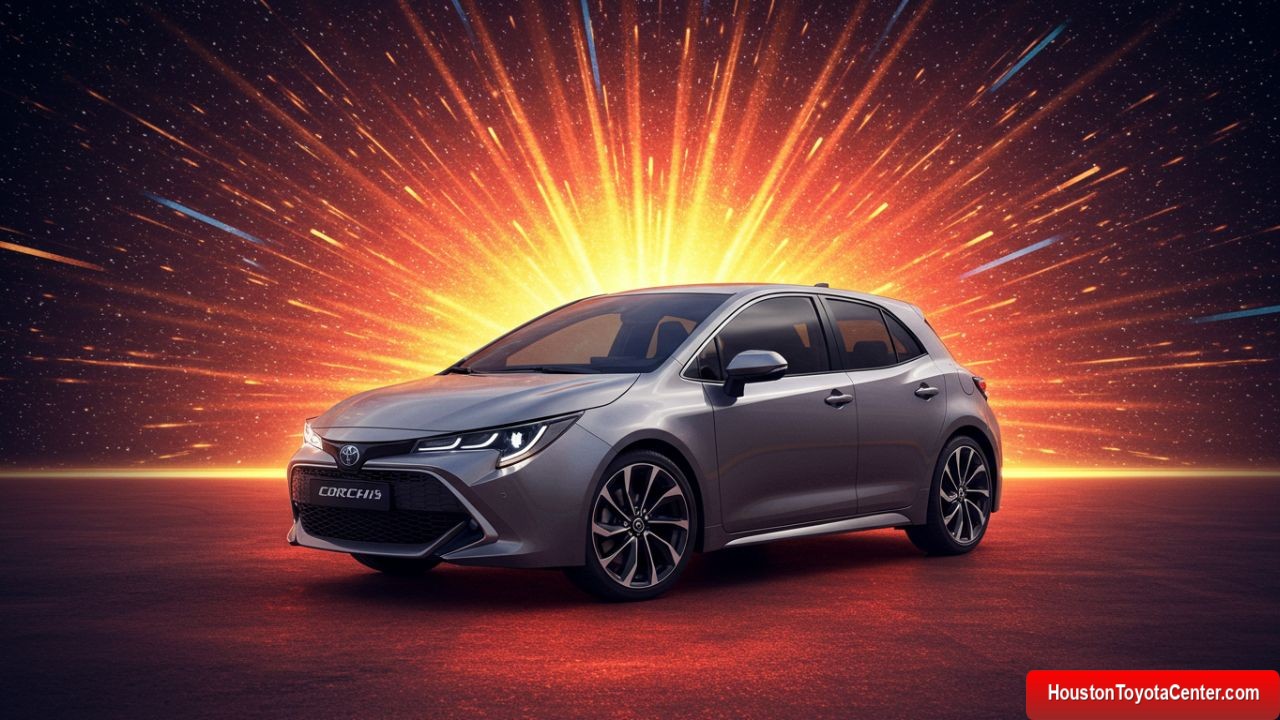
In the ever-evolving world of compact cars, few names carry as much weight and legacy as Toyota Corolla. Since its debut in 1966, the Corolla has grown into one of the most iconic and best-selling vehicles in automotive history—surpassing over 50 million units sold globally by the mid-2020s. While traditionally known for reliability, fuel efficiency, and practicality, the Corolla has undergone a dramatic transformation in recent years, particularly with the introduction of the Corolla Hatchback—a model that dares to challenge perceptions by blending Toyota’s hallmark dependability with a sportier, more dynamic character.
The Corolla Hatchback is not just another body style variant; it represents a bold reimagining of what a Corolla can be. With sharper styling, improved handling, a turbocharged engine option, and a driver-focused interior, this hatchback version appeals to younger buyers, urban commuters, and driving enthusiasts who want something more engaging than the typical economy car. It’s a vehicle that respects its roots while confidently stepping into a new era—one where fun-to-drive dynamics are no longer sacrificed at the altar of affordability and longevity.
This article dives deep into the Corolla Hatchback, exploring its design philosophy, engineering innovations, performance characteristics, safety features, technology integration, market positioning, and cultural significance. We’ll examine how it stands out from both its sedan sibling and competitors in the hot hatch segment, and why it might just be the most exciting Corolla Toyota has ever produced.
A New Chapter for an Automotive Legend
To understand the significance of the Corolla Hatchback, we must first appreciate the context in which it emerged. For decades, the Corolla was synonymous with sensible transportation—a reliable daily driver that prioritized comfort, fuel economy, and low maintenance costs. It wasn’t flashy or fast, but it got the job done, year after year. This reputation made it a favorite among fleet managers, first-time car buyers, and families seeking dependable wheels.
FREE: Quickly identify and understand problems with your vehicle 🚘
CLICK HEREHowever, by the early 2010s, the automotive landscape began shifting. Consumers—especially millennials and Gen Z drivers—started demanding more from their vehicles. They wanted style, connectivity, agility, and emotional appeal. Compact hatchbacks like the Volkswagen Golf GTI, Honda Civic Hatchback, and Ford Focus ST had already carved out niches by offering spirited driving experiences without breaking the bank. Meanwhile, Toyota’s offerings in the U.S. market were seen as increasingly conservative, even dull.
Recognizing this gap, Toyota embarked on a comprehensive overhaul of the Corolla lineup with the launch of the twelfth-generation Corolla (E210 series) in 2018–2019. Unlike previous updates, this wasn’t just a facelift—it was a complete reinvention built on the Toyota New Global Architecture (TNGA) platform, specifically the GA-C variant designed for compact and midsize vehicles.
The TNGA platform brought several critical improvements:
- Lower center of gravity for better stability
- Increased structural rigidity enhancing ride quality and crash safety
- Improved suspension geometry for sharper handling
- Enhanced noise, vibration, and harshness (NVH) control
- Greater flexibility for integrating advanced tech and hybrid systems
While the Corolla Sedan benefited from these upgrades, it was the Corolla Hatchback, introduced in North America for the 2019 model year, that truly embodied the spirit of change. Available initially as the SE and XSE trims, the hatchback featured aggressive exterior styling, a rear torsion beam suspension tuned for responsiveness (later upgraded), and a standard 2.0-liter Dynamic Force four-cylinder engine producing 169 horsepower—a significant jump over the outgoing 1.8L engine.
But Toyota didn’t stop there. In 2020, they introduced a high-performance variant that sent shockwaves through the automotive press: the Corolla GR (Gazoo Racing) Hatchback. Co-developed with Toyota’s motorsport division, Gazoo Racing, this version transformed the Corolla from a humble commuter car into a legitimate contender in the hot hatch arena.
Suddenly, the Corolla was no longer just about reliability—it was about passion, precision, and performance.
Design Language: From Practical to Passionate
One of the most immediate differences between the Corolla Hatchback and its predecessors is its bold and expressive design. Departing from the safe, rounded shapes of earlier models, the E210 Corolla Hatchback embraces sharp lines, angular surfaces, and a confident stance that communicates athleticism.
Exterior Design Highlights
| Feature | Description |
|---|---|
| Front Fascia | Aggressive honeycomb grille, narrow LED headlights, pronounced lower air intake |
| Profile | Fastback roofline, flared wheel arches, short overhangs, muscular shoulders |
| Rear End | Sweeping LED taillights, integrated spoiler, dual exhaust tips (on XSE and GR models), diffuser-style lower bumper |
| Wheels | Standard 17-inch alloys (SE/XSE); GR models feature unique 18-inch forged wheels |
The front end is dominated by a wide, hexagonal grille flanked by slim, boomerang-shaped LED headlights. The overall effect is predatory—almost coupe-like in its intensity. From the side, the fast-sloping roofline gives the hatchback a sleek silhouette, while the short rear overhang enhances its agile appearance. The rear design is equally striking, with full-width LED lighting elements and subtle aerodynamic touches like underbody panels and active grille shutters (for improved efficiency).
Color options have also evolved to reflect the car’s bolder personality. While classic hues like Super White and Silver Metallic remain popular, Toyota now offers vibrant choices such as Supersonic Red, Celestial Blue, and Nitrous Metal—colors that emphasize the car’s youthful energy.
Inside, the cabin marks a dramatic departure from past Corollas. Gone are the cheap plastics and utilitarian layouts. Instead, the dashboard adopts a driver-centric design with a slightly angled center stack aimed toward the cockpit. Materials are significantly upgraded, featuring soft-touch surfaces, contrast stitching, and available synthetic leather upholstery.
Key interior features include:
- Digital gauge cluster (standard on higher trims)
- 8-inch touchscreen infotainment system with Apple CarPlay, Android Auto, and Amazon Alexa compatibility
- Wireless charging pad (on XSE and GR)
- Dual-zone automatic climate control
- Piano black trim and metallic accents
Notably, the GR model adds unique touches like red-accented instrumentation, Alcantara-wrapped steering wheel and shift knob, bolstered front seats with fabric inserts, and GR-branded floor mats. These details reinforce the sense that this isn’t just another Corolla—it’s a machine built for driving enthusiasts.
Engineering Excellence: The TNGA-GA C Platform
At the heart of the Corolla Hatchback’s transformation lies the TNGA-GA C platform, a modular architecture that enables greater design freedom, improved dynamics, and enhanced safety. Let’s break down how this foundation contributes to the car’s capabilities.
Structural Advantages
| Benefit | Impact |
|---|---|
| High-strength steel usage (~40%) | Increased torsional rigidity (+60% vs. prior gen), reducing flex during cornering |
| Lower hood line and center of gravity | Improved visibility and reduced body roll |
| MacPherson strut front / torsion beam rear suspension (SE/XSE) | Balanced ride comfort and handling response |
| Double wishbone rear suspension (GR model) | Superior wheel control, better traction, and sharper turn-in |
| Adaptive Variable Suspension (AVS) (GR only) | Real-time damping adjustments based on road conditions and driving mode |
The increased use of high-strength steel allows Toyota engineers to create a lighter yet stiffer chassis. This translates directly into better handling precision, improved crash protection, and reduced noise transmission into the cabin. According to Toyota, the GA-C platform achieves a torsional rigidity of approximately 35,000 Nm/deg, placing it among the stiffest in its class.
Suspension tuning varies across trims. The SE and XSE models utilize a conventional setup: MacPherson struts up front and a torsion beam axle at the rear. While cost-effective and space-efficient, this configuration typically sacrifices some refinement compared to independent rear suspensions. However, Toyota tuned the dampers and bushings carefully to minimize drawbacks, resulting in a ride that feels taut but not overly harsh—even on rough pavement.
The real engineering marvel comes with the GR Corolla Hatchback, which replaces the torsion beam with a double wishbone rear suspension. This setup allows each wheel to move independently, improving contact with the road surface during hard cornering or over uneven terrain. Combined with wider front and rear tracks, larger anti-roll bars, and stiffer springs, the GR delivers sports-car-like composure.
Additionally, the GR model features Adaptive Variable Suspension (AVS), a system that adjusts shock absorber firmness in real time using sensors that monitor vehicle speed, steering input, throttle position, and road surface. Drivers can select modes like Normal, Sport, and Track, each altering not only suspension behavior but also steering weight, throttle mapping, and transmission response (in manual-equipped models).
Another crucial element is weight distribution. Thanks to the longitudinal placement of key components and careful packaging, the Corolla Hatchback achieves a near 60:40 front-to-rear weight balance—favorable for balanced handling. The GR model further optimizes this with lightweight materials such as aluminum hood, fenders, and doors, bringing curb weight down to around 3,200 lbs (1,450 kg) depending on configuration.
Powertrain Evolution: Efficiency Meets Excitement
For many years, the Corolla was powered exclusively by naturally aspirated four-cylinder engines paired with either a CVT or six-speed manual. While efficient, these powertrains lacked excitement. The twelfth-generation Corolla changed that narrative—with two distinct paths: the mainstream 2.0L engine and the fire-breathing turbocharged unit in the GR model.
Standard Powertrain: 2.0-Liter M20A-FKS “Dynamic Force” Engine
Introduced in 2018, the M20A-FKS is part of Toyota’s new generation of highly efficient engines. Key specifications:
- Displacement: 1,987 cc
- Configuration: Inline-4, DOHC, 16-valve
- Fuel System: Port + Direct Injection (D-4S)
- Compression Ratio: 13.0:1
- Max Power: 169 hp @ 6,600 rpm
- Max Torque: 151 lb-ft @ 4,800 rpm
- Thermal Efficiency: Up to 40% — among the highest in production gasoline engines
This engine uses Toyota’s D-4S dual injection system, combining port and direct fuel injection to optimize combustion across all RPM ranges. At low speeds, port injection helps prevent carbon buildup on intake valves; at high loads, direct injection cools the combustion chamber and increases power output.
Paired with either a CVT (K120) or an optional six-speed intelligent manual transmission (iMT), the 2.0L engine offers responsive acceleration and excellent fuel economy. EPA ratings vary slightly by trim:
| Trim | Transmission | City MPG | Highway MPG | Combined MPG |
|---|---|---|---|---|
| SE | iMT | 30 | 38 | 33 |
| SE | CVT | 31 | 38 | 34 |
| XSE | CVT | 30 | 37 | 32 |
The iMT is particularly noteworthy. Unlike a traditional manual, it includes software that automatically rev-matches during downshifts, making heel-toe techniques easier and reducing clutch wear. It also integrates with the vehicle’s stability control and traction systems for smoother launches.
High-Performance Option: GR Corolla’s G16E-GTS Turbocharged Three-Cylinder
When Toyota unveiled the GR Corolla, skeptics questioned whether a three-cylinder engine could deliver true hot hatch performance. Those doubts were quickly silenced.
Under the hood sits the G16E-GTS—a 1.6-liter, inline-three, turbocharged powerhouse derived from the same engine family used in the GR Yaris. But don’t let the cylinder count fool you. This little giant produces:
- Max Power: 300 horsepower @ 6,500 rpm
- Max Torque: 273 lb-ft @ 3,000–5,500 rpm
- Redline: 6,700 rpm
- Turbocharger: Mitsubishi ML4–7Y single-scroll unit with anti-lag system
- Oil System: Dry-sump lubrication for sustained high-G cornering
Yes, you read that right—300 horsepower from a 1.6L three-cylinder. That’s more power than many V6 sedans from just a decade ago. And thanks to its compact size and lightweight construction, the engine fits neatly within the Corolla’s engine bay while allowing optimal weight distribution.
Power is sent exclusively to all four wheels via a six-speed intelligent manual transmission (iMT) and Toyota’s proprietary GR-FOUR all-wheel-drive system. This AWD setup is fully mechanical, with driver-selectable torque split ratios:
| Drive Mode | Front:Rear Torque Split |
|---|---|
| Normal | 60:40 |
| Sport | 30:70 |
| Track | 50:50 |
In Track mode, the system behaves almost like a rear-biased performance AWD setup, enabling controlled drifts and maximum traction out of corners. The inclusion of a Torsen limited-slip differential (front) further enhances grip and corner exit speed.
Acceleration figures are impressive:
- 0–60 mph: ~4.9 seconds (with launch control)
- ¼-mile time: ~13.4 seconds @ 104 mph
These numbers put the GR Corolla firmly in the company of legends like the Honda Civic Type R, Volkswagen Golf R, and Subaru WRX STI (before its discontinuation). Yet, unlike some rivals, the GR maintains everyday usability—with folding rear seats, a usable cargo area, and reasonable fuel economy for a performance car (~23 mpg combined).
Driving Dynamics: Where Fun Meets Functionality
Perhaps the most compelling argument for the Corolla Hatchback—especially the GR variant—is how enjoyable it is to drive. Whether navigating city streets, cruising highways, or carving mountain roads, the car rewards attentive driving with feedback, balance, and confidence.
Handling & Steering
Steering feel has long been a weak point in mainstream Toyotas, often criticized for being overly light and disconnected. The Corolla Hatchback makes significant strides here. The electric power steering system is tuned to provide progressive weighting and decent road feel, especially in Sport mode. While not quite matching the hydraulic feedback of older hot hatches, it’s a vast improvement over previous Corollas.
On winding roads, the car exhibits minimal body roll, thanks to stiff springs and well-calibrated dampers. Turn-in is sharp, aided by precise steering ratio and wide tires (225/40R18 on GR models). Mid-corner, the chassis remains neutral, resisting understeer unless provoked aggressively. When pushed to the limit, the GR Corolla will happily rotate with throttle modulation—aided by its rear-biased AWD settings.
Braking performance is equally commendable. The GR model features large ventilated discs (12.6 inches front, 11.7 inches rear) clamped by dual-piston calipers. Stopping distances are short (~110 feet from 60 mph), and fade resistance is strong, even during repeated hard stops.
Ride Comfort & NVH
Despite its sporty nature, the Corolla Hatchback remains livable as a daily driver. The standard SE and XSE models offer a compliant ride over potholes and expansion joints, thanks to well-tuned suspension travel and adequate sound insulation.
The GR model, while firmer, doesn’t sacrifice too much comfort. AVS ensures that bumps are absorbed effectively in Normal mode, making it suitable for long-distance touring. Wind and road noise are well-contained, though tire roar becomes noticeable on coarse asphalt due to the sticky Michelin Pilot Sport 4 tires.
Cargo space is respectable for a compact hatchback:
| Model | Cargo Volume (Behind Rear Seats) | Max Cargo Volume (Seats Folded) |
|---|---|---|
| SE/XSE | 18.0 cu ft | 47.0 cu ft |
| GR | 17.4 cu ft | 46.5 cu ft |
The slight reduction in the GR is due to the spare tire well housing the AWD drivetrain components.
Safety & Driver Assistance: Toyota Safety Sense 2.0+
No discussion of modern Toyotas would be complete without addressing safety. The Corolla Hatchback comes standard with Toyota Safety Sense 3.0 (TSS 3.0)—an advanced suite of driver assistance technologies designed to prevent accidents and reduce severity when they occur.
Key Features of TSS 3.0
| System | Function |
|---|---|
| Pre-Collision System with Pedestrian Detection | Uses radar and camera to detect vehicles, cyclists, and pedestrians; can apply brakes automatically |
| Full-Speed Range Dynamic Radar Cruise Control | Maintains set speed and distance from vehicle ahead, including full stop-and-go capability |
| Lane Departure Alert with Steering Assist | Warns if drifting out of lane; gently corrects steering to keep centered |
| Lane Tracing Assist | Works with cruise control to follow lane markings on highways |
| Automatic High Beams | Switches between high and low beams based on traffic |
| Road Sign Assist | Recognizes speed limit signs and displays them on the instrument panel |
| Proactive Driving Assist | Gently applies braking or steering in congested traffic to maintain spacing (new in TSS 3.0) |
These systems work seamlessly together to make highway driving less fatiguing and city navigation safer. In independent testing by the Insurance Institute for Highway Safety (IIHS), the Corolla Hatchback earned a Top Safety Pick+ rating—the highest possible—for multiple model years.
Additional passive safety features include ten airbags (including driver knee bag), reinforced cabin structure, and whiplash-reducing front seats.
Technology & Connectivity: Modern Without Overcomplication
While some automakers overload their cabins with touchscreens and voice commands, Toyota takes a more pragmatic approach. The Corolla Hatchback balances modern tech with usability.
Infotainment System Overview
- Standard Display: 8-inch touchscreen (SE/XSE/GR)
- Audio Systems: Six-speaker standard; JBL Premium Audio (800W, 8 speakers) available on XSE and GR
- Connectivity: Apple CarPlay, Android Auto, Amazon Alexa (all wireless)
- USB Ports: Two front USB-A ports; one rear USB-C port (GR)
- Bluetooth: Hands-free calling and audio streaming
- Wi-Fi Hotspot: Compatible with connected services
Notably absent is built-in navigation on base models—drivers are encouraged to use smartphone mirroring instead. While purists may miss physical knobs, the system responds quickly and menus are logically organized.
The GR model adds performance-specific displays, including:
- Boost pressure gauge
- G-force meter
- Lap timer
- Drive mode status (Normal/Sport/Track)
These digital readouts enhance the immersive driving experience, appealing to track-day enthusiasts.
Wireless Apple CarPlay and Android Auto were added starting in the 2023 model year, eliminating the need for cables—an important upgrade in today’s mobile-first world.
Market Positioning & Competition
The Corolla Hatchback occupies a unique space in the marketplace. It bridges the gap between affordable econoboxes and premium performance compacts. Here’s how it stacks up against key rivals:
| Vehicle | Starting Price (USD) | Horsepower | Drivetrain | Key Strengths |
|---|---|---|---|---|
| Toyota Corolla SE Hatchback | $22,950 | 169 | FWD | Value, reliability, fuel economy |
| Honda Civic Hatchback EX-L | $27,350 | 180 | FWD | Refined interior, smooth ride |
| Volkswagen Golf S Hatchback | $25,995 | 158 | FWD | Premium feel, sharp handling |
| Hyundai Elantra N Line | $25,500 | 201 | FWD | Turbo engine, sporty looks |
| Toyota Corolla GR Hatchback | $36,900 | 300 | AWD | Performance, AWD traction, exclusivity |
| Honda Civic Type R (FL5) | $44,990 | 315 | FWD | Track-ready, high-revving engine |
| Volkswagen Golf R | $45,695 | 315 | AWD | Luxury features, refined ride |
| Subaru WRX (discontinued after 2021) | N/A | N/A | AWD | Rally heritage, all-weather capability |
What sets the Corolla Hatchback apart is its combination of Toyota’s legendary reliability, strong resale value, and lower cost of ownership compared to European rivals. The GR model, in particular, offers near-European performance at a significantly lower price point—making it accessible to a broader audience.
Moreover, Toyota’s extensive dealership network ensures easy maintenance and widespread parts availability, a major advantage over niche brands.
Cultural Impact & Enthusiast Reception
Since its launch, the Corolla Hatchback—especially the GR variant—has garnered praise from critics and enthusiasts alike. Publications such as Car and Driver, Motor Trend, and Top Gear have lauded its blend of practicality and performance.
In 2023, the GR Corolla won MotorTrend’s “Car of the Year” award, marking the first time a Toyota had received the honor since 2012. The judges praised its “raw, analog charm in a digital world,” noting that it felt more like a rally-bred machine than a mass-market appliance.
Social media communities have embraced the GR Corolla as a modern cult car. Owners modify them with aftermarket exhausts, suspension kits, aerodynamic body kits, and roll cages. Clubs and meetups dedicated to GR models have sprung up across North America, Europe, and Australia.
Toyota has responded by releasing special editions:
- Morizo Edition (2023): Stripped-down, track-focused version with manual-only transmission, deleted rear seats, and enhanced chassis bracing. Named after Akio Toyoda’s racing pseudonym (“Morizo”).
- Core Plus Package: Adds convenience features like heated seats and blind-spot monitoring to the GR.
- Circuit Edition (2024): Cosmetic upgrades including matte-gray paint, bronze wheels, and exclusive badging.
These limited runs have only heightened demand, with some Morizo editions selling above MSRP in the secondary market.
Ownership Experience: Cost of Ownership & Reliability
One of Toyota’s enduring strengths is long-term reliability. The Corolla Hatchback continues this tradition. Based on data from sources like J.D. Power, Consumer Reports, and iSeeCars, the E210 Corolla shows excellent projected reliability scores.
Expected Maintenance Costs (First 10 Years)
| Expense Category | Estimated Cost |
|---|---|
| Routine Maintenance | $5,800 |
| Repairs | $450 |
| Average Annual Cost | ~$625 |
| Industry Average (Compact Cars) | ~$750/year |
Source: RepairPal.com estimates (2025)
Major service intervals are spaced generously:
- Oil changes: Every 10,000 miles or 12 months
- Brake fluid: Every 2 years
- Transmission fluid: Every 60,000 miles (CVT); lifetime fill (manual)
- Spark plugs: Every 120,000 miles
The GR Corolla requires more frequent inspections due to performance demands, but Toyota offers complimentary scheduled maintenance for the first two years or 25,000 miles.
Resale value is exceptional. According to Kelley Blue Book (KBB), the Corolla Hatchback retains over 70% of its value after five years, outperforming most competitors. The GR model exceeds 80% retention, driven by enthusiast demand and limited production.
Fuel costs remain manageable despite the GR’s thirst. At 23 mpg combined and average U.S. gas prices (~$3.50/gallon in 2026), annual fuel expense for 15,000 miles is approximately $2,280—reasonable for a 300-hp AWD hatchback.
Environmental Considerations & Future Outlook
As the auto industry shifts toward electrification, Toyota faces questions about the future of internal combustion performance cars. The Corolla Hatchback, especially the GR model, exists in a transitional period—offering peak ICE engineering before the inevitable EV takeover.
That said, Toyota emphasizes sustainability in other ways:
- Use of recycled materials in interior fabrics
- Energy-efficient manufacturing processes
- Lightweight design reducing overall emissions
- Investment in hydrogen fuel cell research (Mirai)
While no hybrid or electric Corolla Hatchback is currently offered (the Corolla Hybrid is only available as a sedan), rumors suggest a battery-electric GR model could emerge by 2030, potentially leveraging Toyota’s bZ platform.
Until then, the gasoline-powered Corolla Hatchback stands as a celebration of combustion engine craftsmanship—a final bow for raw mechanical engagement before silent electric torque takes over.
Conclusion: A Worthy Evolution of an Icon
The Corolla Hatchback is more than just a new body style. It is a statement—a declaration that practicality and passion are not mutually exclusive. By embracing bold design, cutting-edge engineering, and genuine performance, Toyota has reinvented the Corolla for a new generation.
For decades, the Corolla represented the virtues of simplicity, durability, and efficiency. Today, it also embodies excitement, engagement, and emotion. The Corolla Hatchback proves that a car can be reliable and thrilling, affordable and desirable, sensible and soulful.
Whether you’re drawn to the peppy 2.0L SE for its value and efficiency, or the fire-breathing GR for its track-ready prowess, one truth remains: this is the most compelling Corolla Toyota has ever built.
It honors the past—not by repeating it, but by evolving beyond it. In doing so, the Corolla Hatchback secures its place not just as a chapter in automotive history, but as a defining moment in the story of what a Corolla can be.
And if the roar of its turbocharged three-cylinder engine is any indication, the best may still be yet to come.
Leave a Reply