
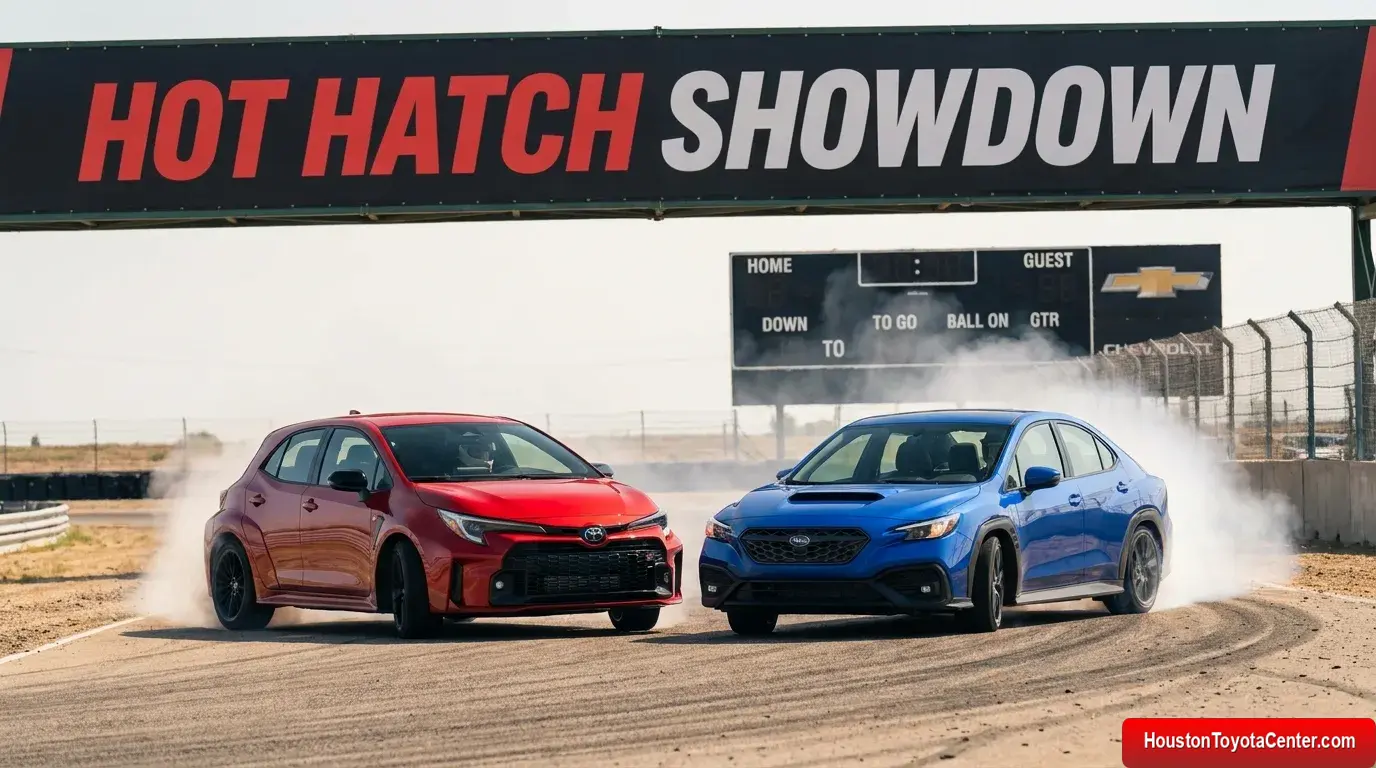
Two turbocharged, all-wheel-drive performance cars take very different approaches to the modern enthusiast formula. The Toyota GR Corolla is compact, aggressive and unapologetically hatchback-shaped. The Subaru WRX brings a longer body, a rally-bred identity and a reputation built over decades. So which one delivers the better performance experience?
A Battle Between Two Different Ideas
For years, the performance-car market has been shrinking. Stricter emissions regulations, rising production costs and the growing popularity of SUVs have made affordable enthusiast cars increasingly difficult to justify. Yet a small group of manufacturers continues to build machines designed primarily for drivers who still care about acceleration, cornering and the mechanical connection between car and road.
The Toyota GR Corolla and Subaru WRX are two of the most interesting examples.
At first glance, the comparison seems obvious. Both use turbocharged engines, both send power to all four wheels, and both are designed to deliver serious performance without requiring a supercar budget. But the similarities largely end there.
FREE: Quickly identify and understand problems with your vehicle 🚘
CLICK HEREThe GR Corolla is a compact hot hatch developed with motorsport-inspired engineering and a distinctly modern performance philosophy. The WRX, meanwhile, remains deeply connected to Subaru’s rally heritage, but it has evolved into a more practical sports sedan with a broader range of everyday capabilities.
That makes this matchup less about which car is universally faster and more about which philosophy works better for today’s enthusiast driver.
Design: Compact Aggression vs. Rally Attitude
The GR Corolla does not try to hide its intentions.
Its compact hatchback proportions are combined with wide bodywork, aggressive aerodynamic details and a stance that makes the car look considerably more serious than a conventional Corolla. Toyota took an ordinary economy-car platform and transformed it into something that looks ready for a track day.
The result is unusual in today’s market. The GR Corolla is practical enough to carry passengers and cargo, but its appearance communicates that practicality was never the main objective.
The WRX takes a different route.
Its sedan silhouette gives it a more mature appearance, while muscular fenders, a prominent grille and available performance-oriented details preserve the car’s sporting character. Subaru has gradually moved the WRX away from its traditional boy-racer image, but the connection to the company’s rally history remains obvious.
The choice between them is therefore partly a matter of personality.
The Toyota feels like a small performance weapon disguised as a hatchback. The Subaru feels like a daily sedan that happens to have serious performance hardware underneath.
Engines: Small Displacement, Big Ambitions
Under the GR Corolla’s hood is a compact turbocharged three-cylinder engine. The configuration itself is one of the car’s most distinctive engineering choices. Rather than relying on a larger four-cylinder engine, Toyota extracted substantial performance from a much smaller powerplant.
The engine’s character is a major part of the GR Corolla experience. Turbocharged power arrives with a sense of urgency, while the compact dimensions help maintain the car’s lightweight, focused personality.
The WRX follows the more conventional route of a turbocharged horizontally opposed four-cylinder engine. Subaru’s boxer layout is part of the company’s identity and contributes to the low center of gravity that has long been associated with the WRX.
Both cars demonstrate that displacement alone does not determine performance.
The Toyota represents the modern trend toward extracting impressive output from a small engine. Subaru remains committed to a larger turbocharged boxer configuration that provides strong midrange torque and a character enthusiasts have come to recognize.
Neither approach is inherently superior. They simply create different driving experiences.
All-Wheel Drive Is the Common Ground
Perhaps the most important connection between these two cars is their all-wheel-drive systems.
For performance drivers, all-wheel drive provides more than additional traction in bad weather. It can also improve acceleration and allow engineers to create a car that remains confidence-inspiring when the driver starts exploring its limits.
Toyota’s GR Corolla uses an advanced all-wheel-drive system designed specifically to enhance the car’s sporting character. One of its most celebrated features is the ability to alter the front-to-rear torque distribution depending on the selected driving mode.
That gives the driver more influence over how the car behaves.
The WRX has a long history of using all-wheel drive as a central element of its performance formula. Subaru’s system has evolved over generations, but the fundamental objective remains the same: provide traction and stability while allowing the car to remain entertaining on challenging roads.
This is where both vehicles benefit from their heritage.
The GR Corolla feels engineered around modern performance driving. The WRX feels like the latest chapter in a story that began with rally stages and evolved into a road-going performance icon.
Manual Transmissions Still Matter
One of the strongest arguments for both cars is that they preserve something increasingly rare: the manual transmission.
The GR Corolla became an important enthusiast car partly because Toyota chose to pair its high-output engine with a manual gearbox. More recently, the model has also expanded its transmission options, but the manual remains central to its identity.
For enthusiasts, this matters because shifting gears manually changes the relationship between driver and machine.
The WRX also continues to offer a manual transmission, giving buyers a direct alternative to its continuously variable transmission option.
That distinction is significant.
A performance car can be objectively quick with an automatic transmission, but the manual versions of these cars emphasize involvement rather than convenience. The driver has to select gears, manage engine speed and coordinate acceleration with the road ahead.
In a world where many new performance vehicles increasingly automate these decisions, that interaction has become a selling point in itself.
Behind the Wheel: The Toyota’s Sharp Edge
The GR Corolla’s greatest strength is arguably its sense of urgency.
Its compact dimensions make it feel immediate. The steering, throttle response and chassis all contribute to an impression that the car wants to change direction quickly.
This is where the hot-hatch formula becomes powerful.
Unlike a larger performance sedan, the GR Corolla does not need a huge amount of road to feel exciting. A sequence of corners can be enough. The car’s relatively compact footprint allows the driver to focus on positioning, braking and acceleration rather than simply chasing higher speeds.
The result is a car that can feel entertaining even when the driver is nowhere near the limits of its performance.
That is an important quality.
A performance car does not necessarily need to be faster to be more fun. Sometimes the best enthusiast vehicle is the one that communicates what it is doing before the numbers become intimidating.
The WRX Plays the Long Game
The WRX has a different personality.
Its larger body and sedan architecture give it a more substantial feel. It can be fast and agile, but it also feels designed to serve as a realistic everyday vehicle.
That broader mission has always been part of the WRX’s appeal.
A buyer can use a WRX for commuting, road trips, winter driving and weekend back-road adventures without feeling as though they are sacrificing practicality for performance. The cabin and trunk-oriented body style can also make the Subaru more attractive to buyers who do not want the visual or functional compromise of a dedicated sports car.
The WRX therefore occupies an interesting middle ground.
It is not simply a family sedan with a turbocharger. But it is also not as narrowly focused as the GR Corolla.
That distinction becomes increasingly important when these cars are evaluated as daily transportation rather than weekend toys.
Practicality: The Hatchback Advantage
Here, the Toyota has one undeniable advantage: its hatchback body.
The GR Corolla combines compact exterior dimensions with a useful rear cargo area. Folding the rear seats increases flexibility, making it possible to carry equipment that would be awkward to transport in a conventional sedan.
The WRX counters with its own practical strengths. Its sedan configuration offers a conventional trunk and a cabin that can work well for everyday use.
But the hatchback format gives the Toyota a unique advantage for enthusiasts.
It allows one vehicle to perform multiple roles. The same car can handle a grocery run in the morning, a mountain road in the afternoon and a track day on the weekend.
That versatility is one reason hot hatches have remained so appealing despite the industry’s movement toward crossovers.
Ride and Daily Comfort
The biggest question for potential buyers may not be speed. It may be how much performance they are willing to tolerate every day.
The GR Corolla’s focused nature means its sporty character can be more apparent during normal driving. Road imperfections, tire noise and the overall firmness of the chassis are part of the price paid for a vehicle designed with enthusiastic driving in mind.
The WRX is also performance-oriented, but its larger dimensions and broader mission can make it feel like a more conventional everyday vehicle.
Neither should be confused with a luxury sedan.
Both cars prioritize driving dynamics over isolation, and that is exactly what their target buyers expect. But the Subaru may appeal more strongly to drivers who want their performance car to disappear into the background during an ordinary commute.
Which One Is Faster?
This is where internet comparisons often become too simplistic.
Performance depends on the exact model, transmission, tires, conditions and driver. Acceleration numbers can also vary between testing organizations and configurations.
More importantly, outright speed does not capture the reason these cars exist.
The GR Corolla is compelling because it makes performance accessible in a small package. The WRX is compelling because it combines performance with a practical, proven all-weather formula.
On a twisty road, the Toyota’s compact dimensions and highly focused chassis can make it feel exceptionally quick and agile. On longer journeys or mixed road conditions, the Subaru’s broader personality can become an advantage.
The real winner depends on the environment.
The Emotional Factor
Numbers tell only part of the story.
The GR Corolla has an unusual emotional appeal because Toyota created something that many enthusiasts assumed manufacturers were no longer interested in building. It is a relatively compact, highly specialized machine with a powerful engine, sophisticated all-wheel drive and a manual transmission.
That combination gives it an almost rebellious character.
The WRX, on the other hand, benefits from decades of emotional history. The name carries memories of rally cars, snowy roads and generations of enthusiasts who grew up associating Subaru with performance and all-weather capability.
The Toyota feels like a new performance phenomenon.
The Subaru feels like a continuing tradition.
For some buyers, that difference may matter more than any specification sheet.
The Verdict
So, which car wins the hot-hatch showdown?
If the priority is maximum driver involvement in a compact package, the GR Corolla is the more compelling choice. Its small footprint, aggressive chassis and distinctive engine give it a character that is difficult to replicate.
If the priority is performance combined with everyday practicality, all-weather confidence and a more mature road-car personality, the WRX makes an equally strong argument.
There is also an important technical distinction: the GR Corolla is genuinely a hot hatch, while the WRX is fundamentally a performance sedan. That makes this comparison slightly unconventional, but also more interesting.
The Toyota represents what happens when an automaker takes the hot-hatch concept to an extreme.
The Subaru represents what happens when a rally-inspired performance car evolves into a versatile modern daily driver.
Neither car needs to destroy the other to succeed.
In fact, their continued existence is arguably the real victory.
At a time when enthusiast cars are becoming harder to find, the GR Corolla and WRX prove that performance does not have to mean six-figure pricing, enormous engines or exotic bodywork. They demonstrate that a relatively affordable car can still be engineered around the driver.
And ultimately, that is what makes this matchup so compelling.
The GR Corolla asks the driver to embrace its compact, aggressive personality.
The WRX asks the driver to trust a formula refined over generations.
One is the sharp new weapon. The other is the established rally-bred contender. Both keep the manual performance-car spirit alive, and that may be the most important result of all.
Leave a Reply