
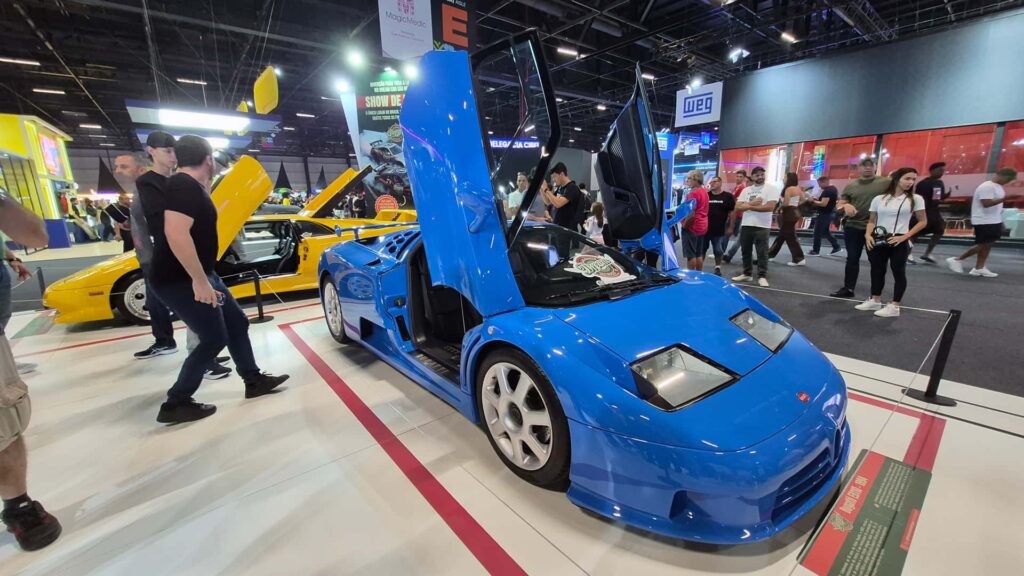
At the 2025 São Paulo Auto Show, supercar fans enjoyed a once-in-a-lifetime treat: a Ferrari F40 at the Carde Museum stand and, just a few steps away, another Italian legend from the 1990s — the Bugatti EB110, displayed by the Dream Car Museum (São Roque, SP).
Perfect timing to revisit the astonishing saga of one of the most advanced and ambitious supercars ever created.
👤 Romano Artioli: The Man Behind the Dream
Quick Profile
| Year | Milestone |
|---|---|
| 1932 | Born in Northern Italy |
| 1950s | Worked as a mechanic; opened own repair shop |
| 1960s–70s | Became a major international dealer of Ferrari & luxury cars |
| 1980s | Built wealth through Suzuki importing & investments in computer tech |
Artioli’s love for cars — and newfound fortunes — pushed him toward a daring idea: revive Bugatti, a brand that had been dormant for 30 years.
🇫🇷→🇮🇹 Reviving Bugatti: A Political and Engineering Labyrinth
Bugatti’s trademark belonged to the French government via Messier-Hispano-Bugatti, a state-owned aerospace firm.
France guarded the name like a national treasure.
To convince them he wasn’t a reckless dreamer, Artioli submitted a technical plan signed by legendary engineer Paolo Stanzani (Lamborghini Countach).
Satisfied, France approved the sale: 7.5 million francs (~€2.3 million today). A bargain for a legendary brand.
FREE: Quickly identify and understand problems with your vehicle 🚘
CLICK HERE🔵 Fabbrica Blu: A Factory as Bold as the Car
Artioli wanted Bugatti’s spiritual home to stay French — but its production home needed world-class talent.
He chose Campogalliano, Italy, near Modena, placing Bugatti beside Ferrari, Lamborghini, Maserati, and De Tomaso.
🏭 Inside the Fabbrica Blu
- Marble floors
- Glass walls with natural lighting
- A canteen decorated with artwork
- A striking engine-development building clad in French racing blue
This wasn’t a factory — it was a cathedral of engineering.
✈️ A Supercar Built Like an Airplane
While other supercars used aluminum or steel tubular chassis, Artioli demanded carbon fiber, still exotic and rare in the late 1980s.
He hired Aérospatiale, builder of the Concorde, to create a 125-kg carbon monocoque.
This decision led to clashes with engineer Stanzani, who preferred a simpler aluminum honeycomb structure. He eventually left the project.
To rescue the troubled quad-turbo V12, Artioli brought in Nicola Materazzi, chief engineer of the Ferrari F40. Materazzi solved turbo-lag issues and stabilized the power delivery.
🎨 Design Drama: Gandini, Giugiaro, and… an Architect?
Artioli wanted a body that looked futuristic but honored Bugatti’s heritage.
💥 The Designers
- Bertone → rejected early
- Giugiaro → elegant but not aggressive enough
- Gandini → sharp wedge, scissor doors, but too Lamborghini-like
When Gandini refused to soften his lines, Artioli took the extreme step of assigning redesign duties to architect Giampaolo Benedini — not a car designer.
Benedini:
- Smoothed the sharp angles
- Improved visibility with new side windows
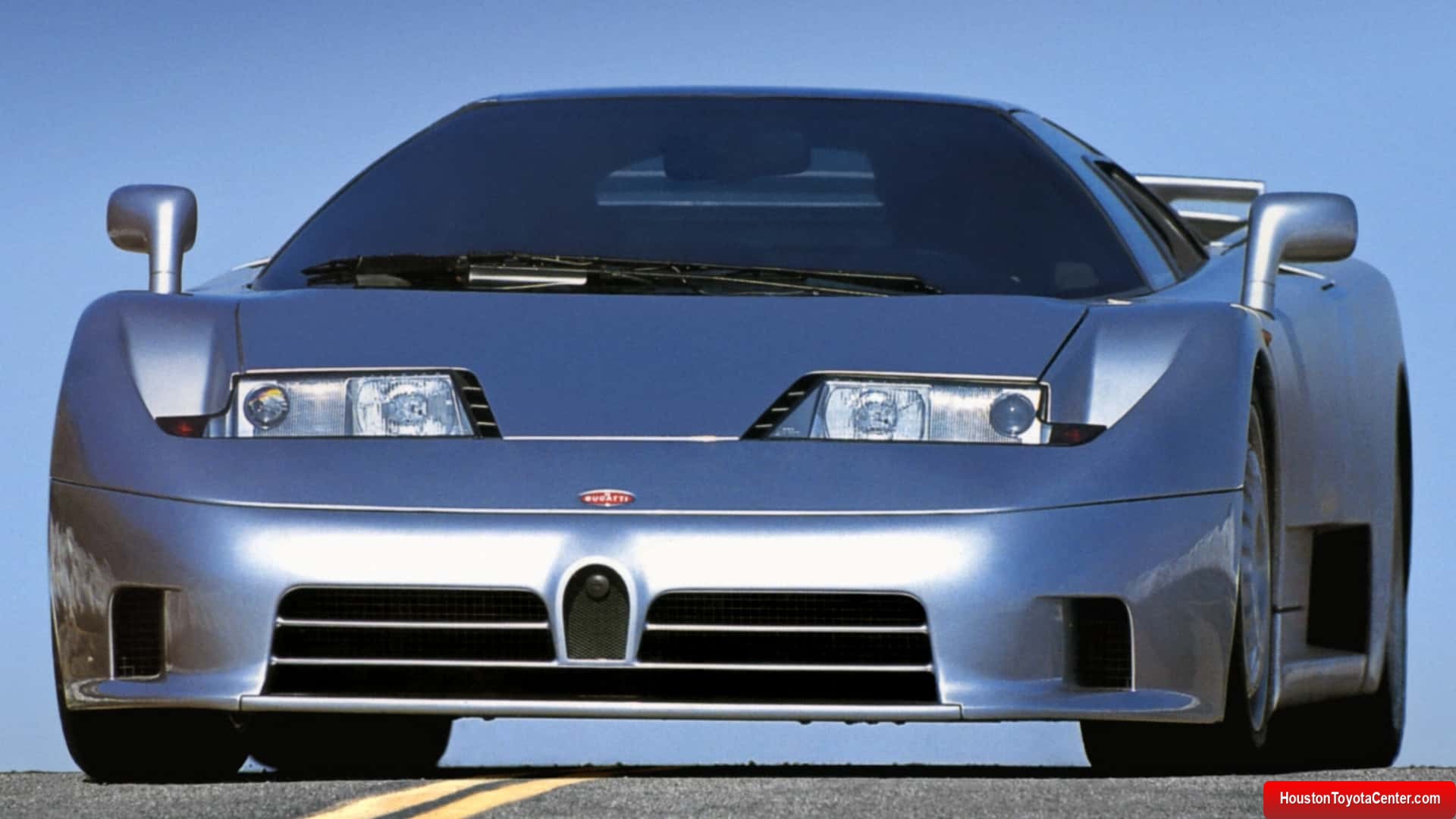
- Added the iconic horseshoe grille
- Rounded proportions for a more Bugatti-like elegance
Gandini was furious and refused to acknowledge authorship.
🌟 Launch Chaos: Paris, 1991
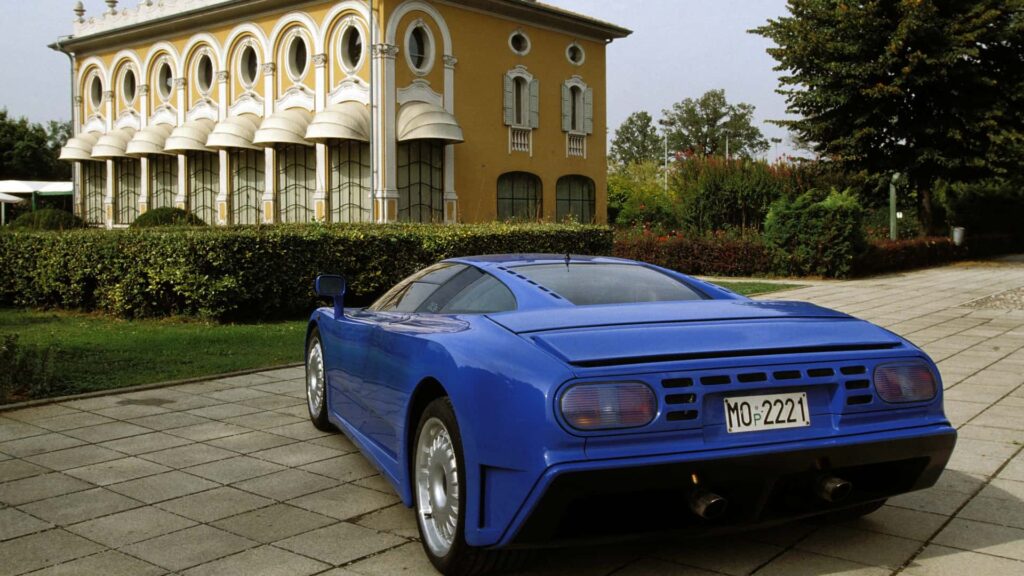
The EB110 debuted in Paris on September 14, 1991, during Ettore Bugatti’s 110th birthday celebration.
Actor Alain Delon drove the car at La Défense — and struggled with the heavy clutch, nearly hitting photographers.
Later, guests enjoyed a grand banquet at Versailles.
🔥 Engineering Masterpiece: Specs That Shocked the World
🧠 Powertrain Overview
| Component | Specification |
|---|---|
| Engine | 3.5L V12, 60 valves |
| Induction | 4 IHI turbochargers |
| Drive | All-wheel drive (AWD) |
| Transmission | 6-speed manual (mounted beside engine) |
| Power | 560 hp (GT) / 611 hp (SS) |
| 0–100 km/h | 3.2 s (SS) |
| Top Speed | 351 km/h (record, 1993) |
At the time, it beat:
- 🐆 Jaguar XJ220 (347 km/h)
- 🐎 Ferrari F40 (324 km/h)
The record stood until 1998 when the McLaren F1 hit 386 km/h.
📉 The Fall: A Brilliant Idea That Became a Financial Disaster
Despite critical acclaim, Bugatti faced multiple blows:
- Early 1990s recession shrank the supercar market
- Fabbrica Blu consumed massive capital
- The EB110 cost $350k–$450k, pricier than a Ferrari F40
- Only 139 units sold
- Artioli unwisely bought Lotus in 1993, overstretching finances
By 1995, Bugatti Automobili SpA collapsed. Employees and suppliers were left unpaid. Artioli lost most of his fortune, his Suzuki dealership, and eventually Lotus.
Bugatti died again.
🐉 Rebirth Under Volkswagen (1998)
Volkswagen purchased the brand in 1998, studied the EB110 deeply, and revived Bugatti in Molsheim.
The EB110’s DNA — quad turbos, AWD, pursuit of top speed — directly inspired:
- Veyron 16.4
- Chiron
The EB110 failed commercially, but gave birth to the hypercar era.
Meanwhile, Fabbrica Blu was abandoned, becoming a haunting monument for car enthusiasts.
🇧🇷 The Only Brazilian EB110
Only one EB110 reached Brazil: Chassis #091, a 1994 EB110 GT in light gray.
Originally owned by Alcides Diniz, later acquired by Natalino Bertin Junior, it eventually underwent a transformation to mimic an EB110 Super Sport:
- Painted Blu Bugatti
- New front bumper, fenders, side windows
- Carbon-fiber interior pieces
- Rear wing locked in high-downforce mode
- Updated ID plate marking it as an “EB110 SS”
This is the very car shown at the 2025 São Paulo Auto Show.
Leave a Reply