
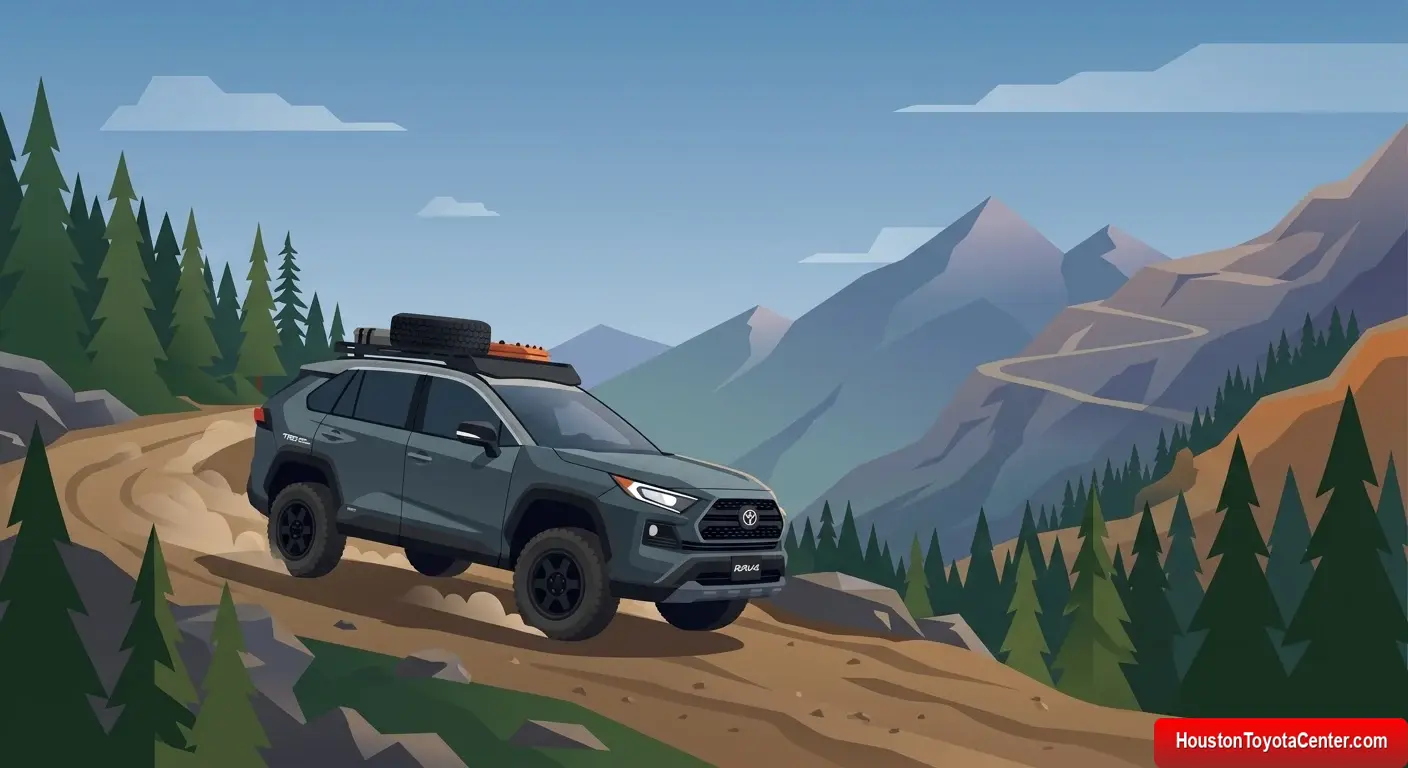
When Toyota launched the RAV4—short for “Robust Accurate Vehicle with 4-Wheel Drive”—in the mid-1990s, few could have predicted the sheer magnitude of its global impact. It effectively created the compact crossover segment, combining the unibody comfort of a passenger sedan with the practical utility and elevated driving position of a traditional SUV. For years, critics labeled early crossovers as “soft-roaders,” suggesting they were far better suited for suburban mall parking lots and school pickup lanes than rugged dirt trails or snowy mountain passes.
However, as outdoor recreation exploded in popularity over the past decade, automotive buyers demanded significantly more than mere everyday practicality. Drivers wanted genuine adventure readiness without giving up fuel efficiency, daily comfort, or city-friendly maneuverability. Toyota listened attentively and systematically transformed the RAV4 from a gentle urban commuter into a capable, trail-ready companion.
Today, through a combination of robust mechanical engineering, intelligent electronic controls, and specialized overland trims, the RAV4 holds its ground with confidence when the pavement ends. This comprehensive guide explores the full spectrum of the Toyota RAV4’s off-road capabilities, detailing its all-wheel-drive systems, trim configurations, suspension geometry, real-world performance, and practical limitations.
🛠️ The Architecture of Capability: Under the Hood and Chassis
To truly understand how a crossover performs off-road, one must look beneath the sheet metal. Off-road capability is never just about sending engine power to all four wheels; it relies on a delicate balance of physical clearance, structural rigidity, suspension articulation, and thermal management.
FREE: Quickly identify and understand problems with your vehicle 🚘
CLICK HERE+-----------------------------------------------------------------------+
| TOYOTA RAV4 OVERLAND MATRIX |
+------------------------------------+----------------------------------+
| Mechanical Architecture | TNGA-K Unibody Platform |
| Peak Ground Clearance | Up to 8.6 inches (TRD Off-Road) |
| Engine Options | 2.5L 4-Cylinder / Hybrid / PHEV |
| Max Towing Capacity | 3,500 lbs (TRD Off-Road / Adventure)|
| Primary AWD Technologies | Standard AWD, Dynamic Torque Vectoring, e-AWD |
+------------------------------------+----------------------------------+
1. TNGA-K Platform and Structural Rigidity
The modern fifth-generation RAV4 rides on the Toyota New Global Architecture (TNGA-K) platform. This platform brings a significantly lower center of gravity and a 57 percent increase in overall body rigidity compared to previous generations. High-rigidity steel chassis design provides two crucial advantages on uneven terrain:
- It prevents unwanted body flex when crossing diagonal ruts or mounting large boulders.
- It maintains consistent wheel contact with the surface, enabling suspension components to work as intended.
2. Clearance and Geometry Metrics
Off-road capability begins with physical geometry. If a vehicle’s bumpers strike an obstacle before the tires do, no amount of power will help.
- Ground Clearance: Standard RAV4 models sit at a respectably elevated 8.4 inches, while dedicated trail-focused models (such as the Adventure and TRD Off-Road) bump that figure up to 8.6 inches.
- Approach Angle: Approaching roughly 19 degrees on off-road trims, allowing the front end to climb over steep inclines, tree roots, and rocks.
- Departure Angle: Rated at approximately 21 degrees, preventing the rear bumper from dragging or catching when descending steep ledges.
- Breakover Angle: Designed to minimize the risk of high-centering when cresting sharp hills or crossing elevated mounds.
⚙️ Decoding Toyota’s Three Distinct AWD Systems
Not all Toyota RAV4 models feature the exact same all-wheel-drive setup. Depending on whether you select a standard gas model, an adventure trim, or a hybrid variant, Toyota utilizes three distinct AWD technologies.
+------------------------------------------------------------------------------------+
|                             AWD SYSTEM COMPARISON                                  |
+-----------------------+-----------------------------+------------------------------+
| System Name           | Powertrain Type             | Key Advantage                |
+-----------------------+-----------------------------+------------------------------+
| Standard AWD          | Gas (2.5L)                  | Simple, reliable traction    |
| Dynamic Torque Vectoring| Gas (Adventure / TRD)     | Rear driveline disconnect & rear split |
| Electronic AWD (e-AWD)| Hybrid / Prime (Plug-in)    | Instant electric motor torque|
+-----------------------+-----------------------------+------------------------------+
System 1: Standard Mechanical All-Wheel Drive
Found on basic gas trim levels, this system operates primarily as a front-wheel-drive platform during highway cruising to conserve fuel. When slip is detected at the front tires, a electromagnetic coupling engages to route up to 50 percent of engine torque to the rear axle. It works seamlessly for light snow, wet pavement, and flat gravel roads.
System 2: Dynamic Torque Vectoring AWD with Rear Driveline Disconnect
Standard on the Adventure and TRD Off-Road trims, this is Toyota’s flagship mechanical AWD system. It offers two distinct technological advantages:
- Independent Rear Wheel Distribution: It can direct up to 50 percent of total engine torque to the rear wheels, and then split 100 percent of that rear power to either the left or right wheel independently. If the rear right tire is suspended in mid-air over a trench, the system directs all available rear torque to the rear left tire resting on solid ground.
- Rear Driveline Disconnect: When cruising on smooth highways, dog-clutches physically disengage the driveshaft entirely, eliminating rotational drag and improving fuel economy.
System 3: Electronic All-Wheel Drive (e-AWD)
Equipped on RAV4 Hybrid and RAV4 Prime models, e-AWD eliminates the physical driveshaft running from the front engine to the rear wheels entirely. Instead, a dedicated electric motor sits directly on the rear axle.
- Instant Torque Response: Because electric motors generate instant torque without waiting for engine RPMs to build, the rear wheels react in milliseconds when slipping occurs on mud or loose gravel.
- Trail Mode Integration: An electronic limited-slip differential function brakes spinning wheels and redirects electric power instantly to wheels with firm traction.
🛞 Multi-Terrain Select (MTS): Electronic Brains for Tough Trails
Hardware provides the muscle, but software controls the momentum. Standard on gas AWD models, the Multi-Terrain Select system allows drivers to tune engine throttle mapping, automatic transmission shift points, and brake force distribution to match specific surface conditions.
          +-------------------------------------------------------+
          |               MULTI-TERRAIN SELECT (MTS)              |
          +-------------------------------------------------------+
                                     |
         +---------------------------+---------------------------+
         |                                                       |
  [ MUD & SAND ]                                           [ ROCK & DIRT ]
  * Maximizes wheel slip                                    * Minimizes wheel slip
  * Delays throttle response                                * Applies firm individual braking
  * Keeps momentum through slush                            * Directs power to planted tires
🧠 How the Modes Operate in Real-World Conditions
- Mud & Sand Mode: On soft surfaces like deep beach sand or sticky mud, stopping momentum means getting stuck. Mud & Sand mode permits a higher degree of tire spin, allowing the tire tread to fling away packed mud and maintain continuous momentum.
- Rock & Dirt Mode: When crawling over loose rocks, uneven ledges, or exposed tree roots, tire spin causes loss of control and chassis damage. This mode restricts wheel spin immediately. The computer applies braking force to any free-spinning wheel while sending engine power to wheels with firm grip.
- Snow Mode: Calibrates throttle response to be ultra-smooth, preventing initial wheel spin when accelerating from a complete stop on icy surfaces.
- Downhill Assist Control (DAC): Acts as a low-speed off-road cruise control during steep, technical descents. It automatically manages individual brake calipers so the driver can focus entirely on steering down steep drops without locking up tires.
🏕️ Comparing Trims: Standard vs. Adventure vs. TRD Off-Road
If your goal is regular off-highway exploration, choosing the right trim level makes a noticeable difference in performance and durability.
+-------------------------------------------------------------------------------------------+
|                              OFF-ROAD TRIM COMPARISON TABLE                               |
+-----------------------+-----------------------+-----------------------+-------------------+
| Feature / Attribute   | Standard RAV4 (LE/XLE)| RAV4 Adventure        | RAV4 TRD Off-Road |
+-----------------------+-----------------------+-----------------------+-------------------+
| Ground Clearance      | 8.4 inches            | 8.6 inches            | 8.6 inches        |
| AWD System            | Standard AWD          | Dynamic Torque Vector.| Dynamic Torque V. |
| Suspension Setup      | Standard Tuned        | Standard Tuned        | TRD Red Springs & |
|                       |                       |                       | Twin-Tube Shocks  |
| Wheels & Tires        | 17" or 19" All-Season| 19" Alloy All-Season  | 18" Matte Black / |
|                       | Tires                 | Tires                 | Falken Wildpeak A/T|
| Towing Capacity       | 1,500 lbs             | 3,500 lbs             | 3,500 lbs         |
| Skid Plate Protection | Standard Plastic Guard| Enhanced Engine Guard | Red Front Skid    |
|                       |                       |                       | Plate (Steel)     |
+-----------------------+-----------------------+-----------------------+-------------------+
🏎️ The Standard RAV4 (LE, XLE, Limited)
These trims excel at daily commuting, highway trips, and light dirt road access to campgrounds or boat launches. While capable in rain and light snow, their lower bumper profiles and street-oriented tires limit performance on technical trails.
🌄 The RAV4 Adventure
Designed for weekend warriors who haul gear into remote areas.
- Standard Dynamic Torque Vectoring AWD.
- Increased towing capacity up to 3,500 pounds for small camper trailers or dirt bike trailers.
- High-rise roof rails capable of holding heavy cargo boxes, kayaks, or rooftop tents.
- Aggressive front grille and rugged body cladding for enhanced protection against brush scratch.
🏔️ The RAV4 TRD Off-Road
Tuned directly by Toyota Racing Development, this is the ultimate factory-built trail version of the RAV4.
- Specialized TRD Suspension: Features unique red coil springs with custom valved twin-tube shock absorbers designed to absorb large dips and bumps while controlling body roll.
- Falken Wildpeak A/T Trail Tires: Severe-snow-service rated all-terrain tires featuring reinforced sidewalls, open shoulder blocks, and unique tread compound resistant to sharp rock punctures.
- Rugged Aesthetics & Armor: Includes lightweight matte-black TRD alloy wheels, a stamped steel front skid plate, and custom rubber floor liners designed to hold mud, sand, and water.
🏔️ Real-World Performance: What the RAV4 Can (and Cannot) Do
Honesty is vital when discussing crossover capabilities. Understanding both strengths and physical limitations ensures safe and enjoyable adventures.
🌟 Where the RAV4 Excels
- Forest Service Roads & Fire Trails: Navigates unpaved, rutted dirt roads effortlessly, maintaining high cabin comfort over washboard gravel.
- Deep Snow & Winter Storms: Excellent weight distribution, high clearance, and fast AWD engagement make it an absolute winter vehicle.
- Sand Dunes & Beach Driving: Light overall curb weight prevents the RAV4 from sinking as easily as heavy full-size trucks when driving on soft beach sand.
- Light Overland Camping: Exceptional fuel efficiency coupled with 3,500 lbs of towing capacity makes it an ideal rig for long distance cross-country road trips with light off-grid camping.
⚠️ Real-World Limitations to Remember
- No Low-Range Transfer Case: Unlike traditional body-on-frame SUVs (like the Toyota 4Runner or Tacoma), the RAV4 lacks a 4-Low gear setting. Ultra-slow rock crawling over large boulders will slip the torque converter and overheat components.
- Limited Suspension Articulation: Being an independent suspension unibody vehicle, wheels will lift off the ground sooner than on vehicles with solid live rear axles.
- Underbody Clearance: While 8.6 inches is impressive for a crossover, deep rock gardens or tall stumps require careful line selection to avoid damaging oil pans or exhaust pipes.
🧭 Essential Modifications for Overland Enthusiasts
For drivers planning to take their RAV4 deeper into remote wilderness areas, simple aftermarket upgrades can greatly elevate trail confidence.
                  +----------------------------------------------+
                  |         RECOMMENDED OVERLAND UPGRADES        |
                  +----------------------------------------------+
                                         |
     +-------------------+---------------+---------------+-------------------+
     |                   |                               |                   |
[ All-Terrain Tires ] [ Aluminum Skid Plates ]   [ Small Suspension Lift ] [ Recovery Gear ]
* Falken / BFGoodrich * Engine & tank armor      * 1.5 to 2.0 inch lift   * Traction boards
* Better sidewall     * Replaces plastic guards  * Increases clearance    * Tow straps & shackles
- All-Terrain Tires: Upgrading standard all-season rubber to purpose-built A/T tires (like Falken Wildpeak A/T Trail or BFGoodrich Trail-Terrain) provides the single biggest jump in off-road grip and puncture resistance.
- Underbody Armor: Replacing factory plastic splash shields with heavy-duty aluminum or steel skid plates protects vulnerable engine pans, rear differentials, and exhaust pipes.
- Mild Suspension Lift Kits: Installing a quality 1.5-inch to 2.0-inch strut-spacer or spring lift increases ground clearance further and improves approach/departure angles.
- Recovery Essentials: Carrying traction boards (such as Maxtrax), a tire pressure deflator, a portable air compressor, and rated recovery straps ensures you can recover safely if stuck.
💡 Conclusion: The Ideal Balance of Daily Utility and Trail Adventure
The Toyota RAV4 does not claim to be an extreme rock-crawler or a dedicated desert racer, nor was it ever designed to be. Instead, it strikes a remarkably sweet spot that very few vehicles achieve.
It provides exceptional fuel economy, industry-leading reliability, daily driving comfort, and high safety scores during the work week. Yet, when the weekend arrives and the paved road ends, models equipped with Dynamic Torque Vectoring AWD or e-AWD deliver genuine off-road performance capable of taking families far off the beaten path. For modern adventurers seeking one vehicle to handle both city traffic and rugged mountain trails, the RAV4 remains a benchmark of balanced capability.
Leave a Reply