In the high-stakes arena of compact crossover SUVs, two names consistently tower over the competition: the Toyota RAV4 and the Nissan Rogue. Both models have earned their spots as runaway sales champions in North America and around the globe, offering suburban families, commuter professionals, and weekend adventurers a blend of practicality, comfort, and advanced safety technology.
However, as automotive engineering shifts rapidly toward electrification, digital cockpit experiences, and enhanced efficiency, these two rivals approach the market with distinct philosophies. Toyota relies heavily on proven durability, robust hybrid powertrains, and high resale values. Meanwhile, Nissan focuses on premium cabin aesthetics, cutting-edge turbocharger technology, and smooth highway cruising capabilities.
Understanding which vehicle deserves a place in your driveway requires a close look at how they perform across vital categories: powertrain performance, interior luxury, technology integration, safety credentials, and long-term value retention.
🚘 Design and Exterior Aesthetics
The visual language of modern crossovers has evolved significantly from the basic utility boxes of the past. Today, both automakers aim to make a strong visual statement on the road, though their design teams took strikingly different paths.
FREE: Quickly identify and understand problems with your vehicle 🚘
CLICK HERE TOYOTA RAV4 NISSAN ROGUE
+--------------------+ +--------------------+
| Aggressive Grille | | V-Motion Grille |
| Angular Wheel Arches| | Split LED Lights |
| Off-Road Stance | | Sleek, Urban Profile|
+--------------------+ +--------------------+
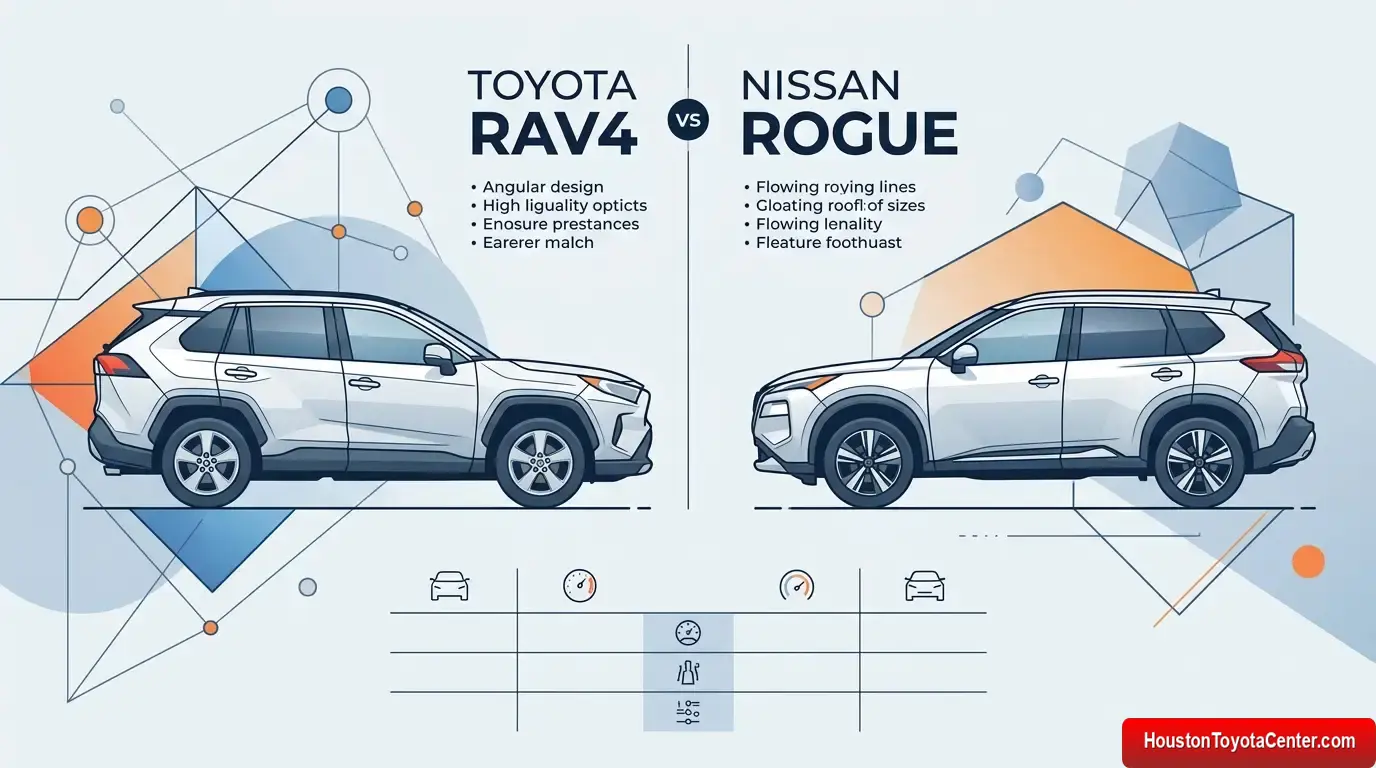
Toyota RAV4: Rugged and Angular
The Toyota RAV4 embraces an aggressive, truck-inspired aesthetic derived from Toyota’s larger off-road heritage. Sharp geometric angles, prominent squared-off wheel arches, and a prominent front grille give it an adventurous look. Trims like the Woodland Edition and TRD Off-Road accentuate this rugged personality with dirt-ready tires, roof rails, and specialized suspension tuning.
Nissan Rogue: Urban Sophistication
By contrast, the Nissan Rogue presents a sleeker, more refined visual signature. Featuring Nissan’s signature V-Motion front grille, split-level LED headlights, and a floating roof effect created by blacked-out pillars, the Rogue looks every bit the modern city cruiser. It favors smooth curves and aerodynamic lines over rugged body cladding, appealing to buyers looking for upscale street presence.
⚡ Engine Performance and Driving Dynamics
Under the hood, these two crossovers showcase fundamentally different mechanical approaches. Toyota emphasizes hybrid efficiency and traditional atmospheric power, while Nissan bets big on variable compression turbocharging.
Mechanical Specifications Comparison
| Feature / Spec | Toyota RAV4 (Standard / Hybrid) | Nissan Rogue (Standard VC-Turbo) |
| Engine Type | 2.5L 4-Cylinder / 2.5L Hybrid | 1.5L 3-Cylinder VC-Turbo |
| Horsepower | 203 hp (Gas) / 219 hp (Hybrid) | 201 hp |
| Torque | 184 lb-ft (Gas) / 163 lb-ft (Hybrid) | 225 lb-ft |
| Transmission | 8-Speed Automatic / e-CVT | Xtronic CVT |
| Drivetrain Options | FWD / AWD (Dynamic Torque Vectoring) | FWD / Intelligent AWD |
| EPA Fuel Economy (Combined) | 30 MPG (Gas) / 39-40 MPG (Hybrid) | 33 MPG |
Driving Experience
- Toyota RAV4: Driving the standard gas RAV4 delivers predictable, honest dynamic behavior. The 8-speed automatic transmission avoids the high-rpm rubber-band effect often felt in older CVTs. Choosing the RAV4 Hybrid unlocks seamless electric torque, faster acceleration off the line, and impressive efficiency across both city traffic and open highway stretches.
- Nissan Rogue: The Rogue relies on Nissan’s innovative Variable Compression Turbo (VC-Turbo) technology. This small 1.5-liter engine alters its compression ratio continuously to balance maximum power with low fuel consumption. With 225 lb-ft of torque available low in the RPM band, the Rogue feels snappy during city driving and effortless when passing slower traffic on highway ramps.
🛋️ Interior Comfort, Materials, and Cargo Space
Step inside both cabins, and the difference in interior styling priorities becomes immediately apparent.
  +-----------------------------------------------------------+
  |              CABIN FOCUS & INTERIOR HIGHLIGHTS           |
  +-----------------------------+-----------------------------+
  |        Toyota RAV4          |        Nissan Rogue         |
  +-----------------------------+-----------------------------+
  | * Durable, utilitarian trim | * Zero Gravity front seats  |
  | * Physical rubber knobs     | * Quilted semi-aniline leather|
  | * Tactical storage cubbies  | * Ultra-quiet cabin glass   |
  | * 37.6 cu. ft. rear cargo   | * 36.5 cu. ft. rear cargo   |
  +-----------------------------+-----------------------------+
Nissan Rogue: A Touch of Luxury
Nissan made significant investments in cabin refinement for the latest Rogue generation. Top-tier Platinum models feature soft-touch materials, wood-tone trim, and optional quilted semi-aniline leather seating that rivals entry-level luxury SUVs. Nissan’s proprietary Zero Gravity seats provide exceptional ergonomic support, reducing fatigue during long-distance trips. Furthermore, the rear doors open nearly 90 degrees, making child seat installation exceptionally easy.
Toyota RAV4: Practical and Durable
The RAV4 cabin prioritizes utility, ergonomics, and long-term durability. Chunky rubberized climate control knobs are easy to operate even while wearing gloves. While lower trim levels utilize hard plastics in high-wear areas, upper trims like the Limited offer SofTex synthetic leather upholstery. Rear passenger headroom is generous, and the overall layout feels built to handle dirty outdoor gear, pets, and family road trips without showing immediate wear.
📱 Infotainment and Digital Technology
Modern SUV buyers demand effortless smartphone integration, intuitive navigation screens, and clear digital driver instrumentation.
                  DIGITAL INTERFACE COMPARISON

       [ Toyota Audio Multimedia ]        [ NissanConnect System ]
       +-----------------------+          +--------------------+
       |  8.0" or 10.5" Display|          | 8.0" or 12.3" Screen|
       |  Wireless Apple/Android|         | Google Built-In    |
       |  Cloud Navigation     |          | 12.3" Driver Cluster|
       +-----------------------+          +--------------------+
Connectivity Features
- Toyota Audio Multimedia: Toyota’s system features clean graphics, over-the-air update capability, and rapid wireless connectivity for Apple CarPlay and Android Auto. Voice recognition responds quickly to natural spoken commands, allowing drivers to adjust temperature or change music tracks hands-free.
- NissanConnect with Google Built-In: The Rogue takes digital integration a step further on higher trims by offering an expansive 12.3-inch touchscreen alongside a fully digital 12.3-inch instrument display. With Google Built-In integrated directly into the infotainment OS, drivers can access Google Maps, Google Assistant, and app downloads straight from the dashboard interface without relying solely on smartphone mirroring.
🛡️ Driver Assistance and Safety Standards
Safety remains a top priority for crossover shoppers, and both manufacturers pack their models with comprehensive suites of driver-assist technologies as standard equipment.
Standard Safety Technologies
- Toyota Safety Sense (TSS): Includes Pre-Collision System with Pedestrian Detection, Full-Speed Range Dynamic Radar Cruise Control, Lane Departure Alert with Steering Assist, Lane Tracing Assist, and Road Sign Assist.
- Nissan Safety Shield 360: Includes Automatic Emergency Braking with Pedestrian Detection, Blind Spot Warning, Rear Cross Traffic Alert, Lane Departure Warning, High Beam Assist, and Rear Automatic Braking.
Advanced Highway Assistance
- Nissan ProPILOT Assist: Available with Navi-link, this system links adaptive cruise control directly to navigation data. The vehicle automatically slows down for upcoming freeway curves, off-ramps, and speed limit changes, delivering one of the most natural semi-autonomous highway driving experiences in this price bracket.
- Toyota Lane Tracing Assist: Works in tandem with dynamic radar cruise control to keep the vehicle centered in its lane on marked highways. While effective and reliable, it lacks the proactive map-based speed adjustments found in Nissan’s top system.
💰 Ownership Costs, Fuel Economy, and Value Retention
When evaluating long-term value, purchase price is only part of the equation. Maintenance demands, fuel economy, and depreciation play massive roles in determining total cost of ownership.
Total Ownership Factors
- Fuel Efficiency: The Toyota RAV4 Hybrid leads the category with up to 40 MPG combined, saving owners substantial money at the gas pump over a multi-year ownership period. The Nissan Rogue VC-Turbo delivers an impressive 33 MPG combined for a gas-only vehicle, outperforming the non-hybrid RAV4.
- Resale Value: Toyota consistently holds industry-leading resale values. Thanks to Toyota’s reputation for bulletproof reliability, a RAV4 generally depreciates at a significantly slower rate than most competitors in the compact crossover market.
- Complementary Maintenance: Toyota includes ToyotaCare with every new purchase, covering factory-scheduled maintenance for 2 years or 25,000 miles. Nissan offers select complimentary maintenance programs through participating dealerships, though coverage varies by region and promotion.
🏁 Final Verdict: Which SUV Should You Buy?
Both the Toyota RAV4 and the Nissan Rogue deserve their best-seller status, yet they cater to slightly different buyer priorities.
Choose the Toyota RAV4 if your priorities include maximum fuel economy via hybrid technology, outdoor capability, bulletproof long-term reliability, and top-tier resale value retention. It is the ultimate pragmatic tool for daily transportation and outdoor recreation.
Choose the Nissan Rogue if you prefer a modern cabin with luxury-level materials, superior seating comfort for daily commuting, intuitive digital technology with Google integration, and smooth highway driver-assistance features. It provides an elevated, comfortable daily driving experience at a accessible price point.
Leave a Reply