
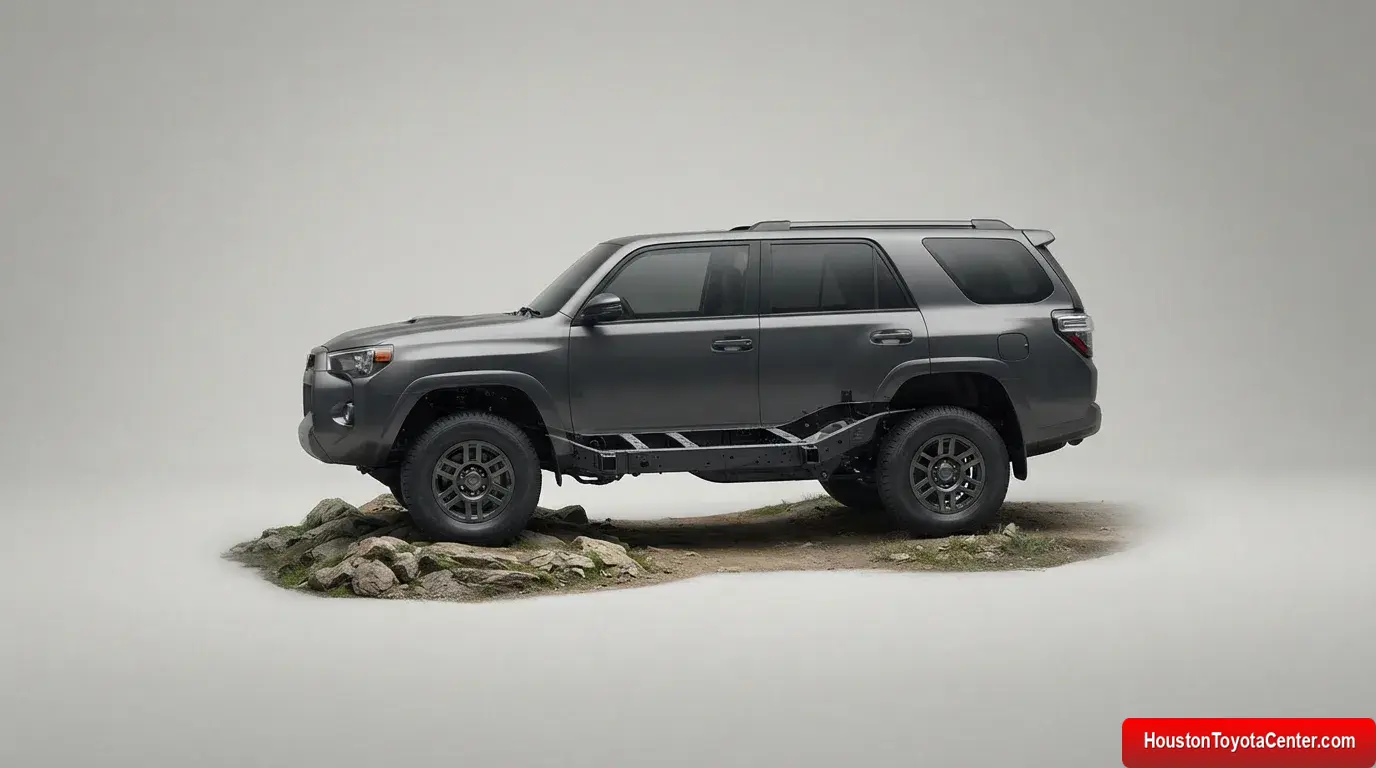
The Toyota 4Runner has never tried to hide what it is. While much of the modern SUV market has moved toward car-based platforms designed around comfort, efficiency, and everyday practicality, the 4Runner has preserved a fundamentally different engineering philosophy: body-on-frame construction.
That distinction is more than a technical specification. It is one of the defining characteristics of the 4Runner, shaping how the SUV handles rough terrain, carries heavy loads, tows, and responds to the demands of drivers who expect their vehicle to work beyond paved roads.
With the sixth-generation 4Runner, Toyota did not abandon that formula. Instead, the automaker modernized it. The latest 4Runner is built on Toyota’s TNGA-F global truck platform, the same basic architecture used by models including the Tacoma, Tundra, Sequoia, and Land Cruiser. The result is a vehicle that combines traditional truck-based construction with modern suspension engineering, turbocharged power, hybrid technology, and a significantly more sophisticated cabin.
What Does Body-on-Frame Actually Mean?
At its simplest, body-on-frame construction separates the vehicle’s body from its structural frame.
FREE: Quickly identify and understand problems with your vehicle 🚘
CLICK HEREThe frame is the foundation. It carries major mechanical components and provides the underlying structure needed to handle loads and stresses. The body, meanwhile, is mounted onto that frame.
This is fundamentally different from a unibody SUV, where the body and structural chassis are largely integrated into a single structure.
For most drivers, the distinction may sound academic. On difficult terrain, however, it can become much more meaningful.
A body-on-frame vehicle is engineered with the expectations of a truck. It is designed to cope with significant vertical movement, uneven surfaces, towing loads, impacts from rough terrain, and the repeated stresses that come with driving away from smooth pavement.
The 4Runner’s sixth-generation architecture takes this concept further with a high-strength boxed steel ladder frame. Toyota says the TNGA-F chassis increases toughness and rigidity, while the boxed design also contributes to rust protection.
That provides the 4Runner with a structural foundation designed for demanding environments rather than simply optimized for urban transportation.
The Frame Is the Foundation of the 4Runner’s Character
The importance of the ladder frame becomes particularly clear when looking at what the 4Runner is expected to do.
Consider a trail covered in rocks, ruts, mud, sand, and steep transitions. The vehicle is rarely sitting perfectly level. Individual wheels can encounter dramatically different surfaces at the same time, creating forces that travel through the suspension and chassis.
This is where the 4Runner’s truck-based architecture becomes part of its identity.
Toyota has strengthened the TNGA-F platform with high-strength steel, additional frame reinforcement, and stronger crossmembers. The sixth-generation 4Runner also uses a double-wishbone front suspension and a multi-link coil rear suspension. According to Toyota, the new architecture was designed not only to increase strength but also to improve ride comfort and on-road behavior.
That last point is important.
Body-on-frame construction has historically involved compromises. Truck-based SUVs can feel heavier and less agile than unibody crossovers, particularly when driven on smooth pavement. The modern 4Runner does not eliminate those compromises, but Toyota has worked to make them less noticeable.
Independent front suspension provides controlled wheel movement and helps improve steering and ride behavior, while the rear multi-link setup adds another layer of refinement without abandoning the solid-axle philosophy that has long defined the 4Runner’s off-road character.
Why Body-on-Frame Matters Off-Road
The biggest argument for the 4Runner’s architecture appears when the road ends.
Off-road driving puts different demands on a vehicle than highway driving. Instead of simply absorbing small imperfections, the suspension may need to deal with deep holes, abrupt ledges, loose surfaces, and significant changes in wheel position.
A strong frame provides the backbone for those situations.
But the frame alone does not make a vehicle capable. The real advantage comes from the combination of the frame, suspension, drivetrain, ground clearance, traction systems, and vehicle geometry.
The 4Runner brings those elements together in a package deliberately designed around off-road use.
Certain four-wheel-drive configurations offer a two-speed transfer case, while off-road-oriented grades add equipment such as electronically controlled systems, locking differentials, specialized shocks, and terrain-management technology. Toyota’s higher-performance versions go considerably further, with the TRD Pro and Trailhunter receiving hardware specifically engineered for more demanding environments.
This is one reason the body-on-frame architecture remains relevant. It gives Toyota a structural platform capable of supporting the hardware required for serious off-road applications.
Strength Is Also About Towing
The advantages of the 4Runner’s architecture are not limited to trails.
A truck-based SUV also makes sense for drivers who regularly tow.
The 2025 4Runner can tow up to 6,000 pounds when properly equipped, a substantial improvement over the outgoing generation. Toyota attributes part of this capability to the strengthened platform and the available i-FORCE MAX powertrain.
The distinction between a crossover and a truck-based SUV becomes particularly obvious here.
A crossover may be perfectly capable of carrying passengers, luggage, bicycles, and camping equipment. But towing a substantial trailer introduces another set of demands. The vehicle has to manage additional weight, longitudinal forces, braking loads, and changes in handling.
The 4Runner’s ladder-frame foundation is designed with those stresses in mind.
That does not mean every 4Runner is automatically the perfect tow vehicle, nor does it mean buyers should ignore payload limits, hitch specifications, trailer brakes, or configuration-specific ratings. It means the underlying architecture gives the vehicle a fundamentally truck-oriented foundation.
The Sixth Generation Makes the Formula More Modern
Perhaps the most interesting aspect of the latest 4Runner is that Toyota has not simply preserved an old design.
The fifth-generation 4Runner remained on the market for roughly 15 years. When the sixth generation arrived for 2025, Toyota retained the fundamental body-on-frame concept while replacing the underlying architecture with TNGA-F.
That change matters because it demonstrates that body-on-frame construction does not necessarily mean outdated engineering.
The new platform brings higher-strength materials, revised suspension geometry, improved chassis rigidity, and modern powertrains. The standard engine is now a turbocharged 2.4-liter four-cylinder producing 278 horsepower and 317 lb-ft of torque, paired with an eight-speed automatic transmission. An available hybrid system increases output to 326 horsepower and 465 lb-ft of torque.
In other words, Toyota has modernized almost everything surrounding the basic architecture while keeping the architecture itself.
That is an important distinction.
The 4Runner does not need to become a crossover to become more comfortable or technologically advanced.
A Better Balance Between Trail and Highway
One of the most significant changes brought by the TNGA-F platform is not necessarily something visible from the outside.
It is how the 4Runner behaves when it is not off-road.
Previous generations were famously rugged, but their age was increasingly obvious on pavement. Modern competitors had become quieter, more refined, and easier to live with on a daily basis.
The sixth-generation model was developed to address that gap.
Toyota specifically says the new platform improves ride comfort and on-road manners. Independent testing has also found the new 4Runner considerably more composed than its predecessor, although reviewers continue to note that its truck-based nature remains obvious.
That is perhaps the most honest way to understand the 4Runner.
It is not pretending to be a sedan-based crossover.
There is still weight. There is still body movement. There is still a sense that the vehicle was designed around a robust chassis rather than optimized exclusively for city driving.
For many owners, that is precisely the appeal.
The Trade-Off: Body-on-Frame Is Not Magic
The body-on-frame advantage comes with compromises.
A ladder-frame SUV generally cannot match a comparable unibody crossover for efficiency, packaging, or car-like handling. The additional structural hardware and truck-oriented design contribute to weight, and the vehicle’s tall stance and rugged equipment can further affect fuel economy.
The 4Runner also retains a solid rear axle, a feature that contributes to its traditional off-road credentials but can produce more noticeable movement over rough pavement. Car and Driver’s testing of the new model found substantial improvements over the previous generation while still describing the vehicle as unmistakably truck-based.
That is the fundamental trade-off.
If the priority is maximum fuel economy, effortless urban maneuverability, and the smoothest possible ride, a unibody crossover may make more sense.
If the priority includes difficult trails, towing, rugged durability, and the ability to handle conditions where pavement quality is no longer a concern, the 4Runner’s architecture becomes much more compelling.
More Than a Marketing Term
“Body-on-frame” can sound like an old-fashioned engineering term, particularly at a time when the automotive industry is increasingly focused on electrification, efficiency, software, and aerodynamic optimization.
But the concept remains relevant because different vehicles have different missions.
A vehicle designed primarily for commuting does not need the same structural philosophy as one designed to cross a rocky trail with camping equipment in the cargo area and a trailer behind it.
The 4Runner occupies the second category.
Its body-on-frame construction is not simply a nostalgic reference to the SUV’s past. It is part of the reason Toyota can continue to position the 4Runner as an adventure-oriented vehicle while adding modern technology around it.
The latest model proves that Toyota does not see the ladder frame as an obstacle to modernization.
Instead, the frame is the starting point.
The Real Advantage Is the Entire Package
Ultimately, the 4Runner’s body-on-frame advantage cannot be reduced to the frame alone.
The real strength comes from the way everything works together.
The TNGA-F architecture provides a rigid, high-strength foundation. The suspension allows the wheels to deal with uneven terrain. Available four-wheel-drive systems provide additional traction. Specialized off-road trims add upgraded shocks and other hardware. Turbocharged and hybrid powertrains provide substantially more torque than the previous generation’s naturally aspirated V6. And the strengthened chassis contributes to the vehicle’s towing capability.
That combination gives the 4Runner a clear identity in an increasingly crossover-heavy SUV market.
It is an SUV that still thinks like a truck.
And that may be the most important reason the body-on-frame architecture matters.
For a buyer who spends almost all of their time on pavement, the difference may be difficult to justify. But for someone who sees a rough trail as an invitation rather than an obstacle, the underlying architecture can become one of the vehicle’s most valuable attributes.
The sixth-generation 4Runner shows that rugged construction does not have to mean primitive engineering. Toyota has taken the traditional body-on-frame formula and built it onto a modern global truck platform, adding more power, more technology, improved suspension tuning, and greater refinement without abandoning the structural philosophy that made the 4Runner famous.
That is the real body-on-frame advantage.
The 4Runner is not rugged because it looks rugged. It looks rugged because its engineering was built around the idea that the road does not have to be the end of the journey.
Leave a Reply