
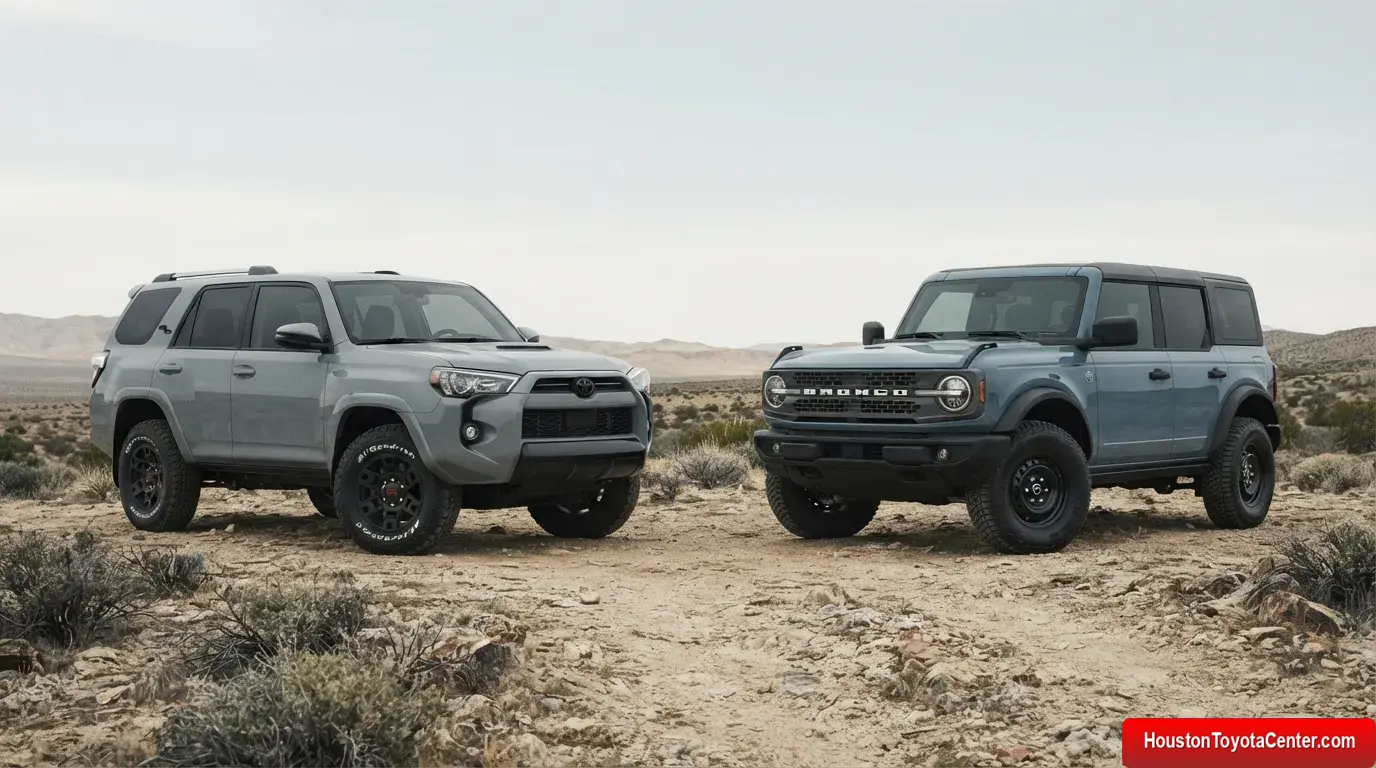
When the trail gets rough, few midsize SUVs carry as much off-road credibility as the Toyota 4Runner and the Ford Bronco. Both are built around traditional four-wheel-drive hardware, high ground clearance and suspension systems designed to handle terrain that would stop an ordinary crossover in its tracks. Yet they approach the off-road mission from different directions.
The 2026 Toyota 4Runner combines its latest turbocharged powertrains with a familiar body-on-frame architecture and a broad selection of off-road equipment. The 2026 Ford Bronco, meanwhile, puts trail capability at the center of its identity, with removable body panels, multiple drive modes, available 35-inch tires and specialized systems such as Trail Turn Assist and a disconnecting front stabilizer bar.
So, which one wins off-road?
The answer depends heavily on the kind of trail being discussed. The Bronco has some significant advantages when the terrain becomes highly technical, while the 4Runner offers a compelling combination of off-road hardware, power, practicality and everyday usability.
FREE: Quickly identify and understand problems with your vehicle 🚘
CLICK HERETwo Different Interpretations of an Off-Road SUV
The Toyota 4Runner and Ford Bronco may occupy a similar segment, but they are not identical concepts.
The 4Runner has long been associated with the traditional SUV formula. Its body-on-frame construction, available four-wheel drive and strong off-road trims make it suitable for everything from dirt roads and camping trips to demanding trails. For 2026, Toyota continues that philosophy while adding modern turbocharged and hybrid powertrains.
The Bronco takes a more specialized approach. Ford designed it to compete directly in the modern off-road SUV market, and its engineering reflects that goal. The Bronco is available in two-door and four-door configurations, offers multiple roof choices and can be equipped with the Sasquatch package, which adds hardware specifically intended for difficult terrain.
That distinction becomes important once the pavement ends.
Power and Torque
The 2026 Toyota 4Runner uses a 2.4-liter turbocharged four-cylinder engine as its standard powerplant. Toyota rates the gasoline version at 278 horsepower and 317 lb-ft of torque. The available i-FORCE MAX hybrid powertrain increases output to 326 combined horsepower and 465 lb-ft of torque.
That hybrid system gives the 4Runner an impressive torque figure, particularly useful when climbing steep surfaces, navigating loose terrain or carrying additional equipment.
The Ford Bronco offers several powertrain choices. Its standard 2.3-liter EcoBoost four-cylinder produces 300 horsepower and 325 lb-ft of torque, while the available 2.7-liter EcoBoost V6 produces 330 horsepower and 415 lb-ft. At the top of the range, the Bronco Raptor uses a 3.0-liter EcoBoost V6 producing 418 horsepower and 440 lb-ft of torque.
On paper, the 4Runner’s hybrid has a major torque advantage over the Bronco’s mainstream engines. However, maximum engine output is only one part of off-road performance. Tire size, gearing, suspension articulation and electronic traction systems can be just as important once the trail becomes difficult.
Ground Clearance and Approach Angles
Ground clearance determines how much room an SUV has to clear rocks, ruts and other obstacles underneath the vehicle.
The Bronco offers up to 11.6 inches of ground clearance in certain configurations with the Sasquatch package. Ford also lists a maximum approach angle of 43.3 degrees, a departure angle of 36.9 degrees for the four-door configuration and maximum water-fording capability of 33.5 inches on applicable models.
Those numbers are important because approach and departure angles determine how aggressively a vehicle can attack an obstacle without contacting the front or rear bodywork.
Toyota’s 4Runner also has a strong set of off-road dimensions, although the exact specifications vary by trim and configuration. More importantly, Toyota has equipped its serious off-road versions with hardware designed to maximize traction and suspension movement.
The comparison therefore goes beyond a single clearance figure. A vehicle may have excellent ground clearance, but it still needs appropriate suspension articulation and traction management to keep moving when the wheels encounter uneven terrain.
Suspension Articulation Matters
One of the most interesting features available on the 2026 4Runner is Toyota’s Stabilizer Disconnect Mechanism. It is standard on the TRD Pro and Trailhunter models and allows the front stabilizer bar to disconnect, increasing front suspension articulation. Toyota says the system helps keep all four wheels in contact with the ground over challenging terrain.
That is a significant development for the 4Runner because suspension articulation can be critical on rocky trails. When one wheel drops into a hole while another climbs over an obstacle, additional articulation can help maintain traction.
The Bronco offers a similar concept in an even more trail-focused package. The Badlands model features a front stabilizer bar disconnect, while the Sasquatch package adds additional off-road hardware and 35-inch tires.
For drivers who regularly encounter steep rocks, deep ruts and uneven surfaces, these systems can make a noticeable difference.
The Tire Advantage
Tires are among the most important pieces of hardware on any off-road vehicle.
The Ford Bronco’s available Sasquatch package is particularly aggressive in this area. It includes 35-inch all-terrain tires, electronic-locking front and rear axles, a 4.7 final-drive ratio and upgraded HOSS suspension components with Bilstein position-sensitive dampers.
Large tires can improve obstacle clearance and help the vehicle roll over rocks and other obstacles. They can also provide a larger contact patch when properly aired down for suitable off-road conditions.
The 4Runner has its own serious tire and suspension configurations, particularly in TRD Pro and Trailhunter form. However, the Bronco’s Sasquatch setup gives it an unusually aggressive factory configuration without requiring the owner to immediately turn to the aftermarket.
That matters for buyers who want a vehicle that arrives from the factory already prepared for demanding trails.
Traction Control and Locking Differentials
When one or more wheels lose traction, electronic systems and locking differentials can determine whether the vehicle continues forward or stops.
The 4Runner offers A-TRAC, a two-speed transfer case on four-wheel-drive variants and an electronic locking rear differential on the TRD Off-Road, TRD Pro and Trailhunter trims. Toyota also offers Multi-Terrain Select and CRAWL Control, which can help manage traction and low-speed movement on difficult surfaces.
Ford takes a similarly sophisticated approach. Depending on configuration, the Bronco can be equipped with electronic-locking front and rear axles, Trail Control and Trail Turn Assist. The Sasquatch package combines locking axles with a shorter final-drive ratio and larger tires.
Trail Turn Assist is particularly interesting. By reducing the turning radius in certain low-speed situations, the system can make tight trail obstacles easier to negotiate.
For technical off-roading, these electronic aids are not simply gadgets. They can reduce the amount of wheelspin and make difficult obstacles more manageable for drivers with varying levels of experience.
Manual Transmission vs. Hybrid Power
There is another major difference between the two SUVs.
The Bronco remains available with a seven-speed manual transmission paired with the 2.3-liter EcoBoost engine. The transmission includes a crawler gear, giving the vehicle a very low overall gearing ratio that can be useful during slow-speed technical driving.
The 4Runner, by contrast, uses an eight-speed automatic transmission across its current powertrain lineup.
For enthusiasts who enjoy directly controlling clutch engagement and engine speed, the Bronco’s manual transmission gives it a distinctive advantage. It also reinforces the Bronco’s traditional off-road character.
The 4Runner’s automatic transmission, however, has its own benefits. The hybrid powertrain’s substantial torque output can make slow climbs and difficult surfaces easier to manage without requiring constant manual gear changes.
Everyday Driving Changes the Equation
Off-road capability is important, but most owners will spend far more time on pavement than on a trail.
This is where the comparison becomes more complicated.
The Bronco’s removable doors and roof options contribute to its adventurous character, but they also reinforce its purpose as a lifestyle-oriented off-road SUV. Road noise, ride quality and the general feel of the vehicle can vary significantly depending on tires and configuration.
The 4Runner is also designed around adventure, but its traditional SUV layout makes it particularly appealing to drivers who need one vehicle for commuting, family use, road trips and weekend exploration.
Toyota also gives the 4Runner a maximum towing capacity of 6,000 pounds, adding another dimension to its utility.
That does not automatically make it the better vehicle for every buyer. It simply means the 4Runner’s strengths extend beyond the trail.
Which Is Better for Serious Off-Roading?
If the question is specifically about technical off-road capability, the Ford Bronco has a strong case.
Its available Sasquatch package brings 35-inch tires, locking front and rear differentials, specialized suspension hardware and substantial ground clearance. The Badlands adds a disconnecting front stabilizer bar, while the Bronco’s drive modes and available trail technologies give drivers a wide range of tools for challenging terrain.
The 4Runner is far from a soft alternative. The TRD Pro and Trailhunter trims feature serious off-road equipment, including Toyota’s stabilizer disconnect mechanism, while the available i-FORCE MAX powertrain produces 465 lb-ft of torque. Its electronic traction systems, locking rear differential and CRAWL Control also make it a highly capable trail vehicle.
The difference is more about emphasis than capability.
The Bronco is engineered around the idea that the trail itself is the main event. The 4Runner is engineered as a highly capable SUV that can also serve as a daily driver, road-trip vehicle and outdoor adventure platform.
The Verdict
There is no single specification that settles the 4Runner versus Bronco debate.
For buyers focused primarily on rock crawling, deep ruts, steep obstacles and maximum factory off-road equipment, the Bronco’s available Sasquatch and Badlands configurations offer an exceptionally purpose-built package. Its large tires, locking axles, high clearance, disconnecting stabilizer bar and available manual transmission give it a distinctly technical personality.
For drivers who want serious off-road ability combined with strong torque, towing capability, everyday practicality and Toyota’s established adventure-oriented SUV formula, the 4Runner remains a compelling alternative. The available i-FORCE MAX hybrid system is especially notable, producing 326 combined horsepower and 465 lb-ft of torque.
Ultimately, the answer depends on what happens after the pavement ends.
If the priority is building the most trail-focused factory configuration possible, the Bronco’s hardware gives it a clear argument. If the goal is a versatile SUV that can commute during the week, tow on the weekend and still tackle demanding trails, the 4Runner brings a different balance to the table.
Both prove that modern body-on-frame SUVs can still be serious off-road machines. The more interesting question may not be which one is universally better, but which type of adventure the driver plans to pursue.
Leave a Reply