
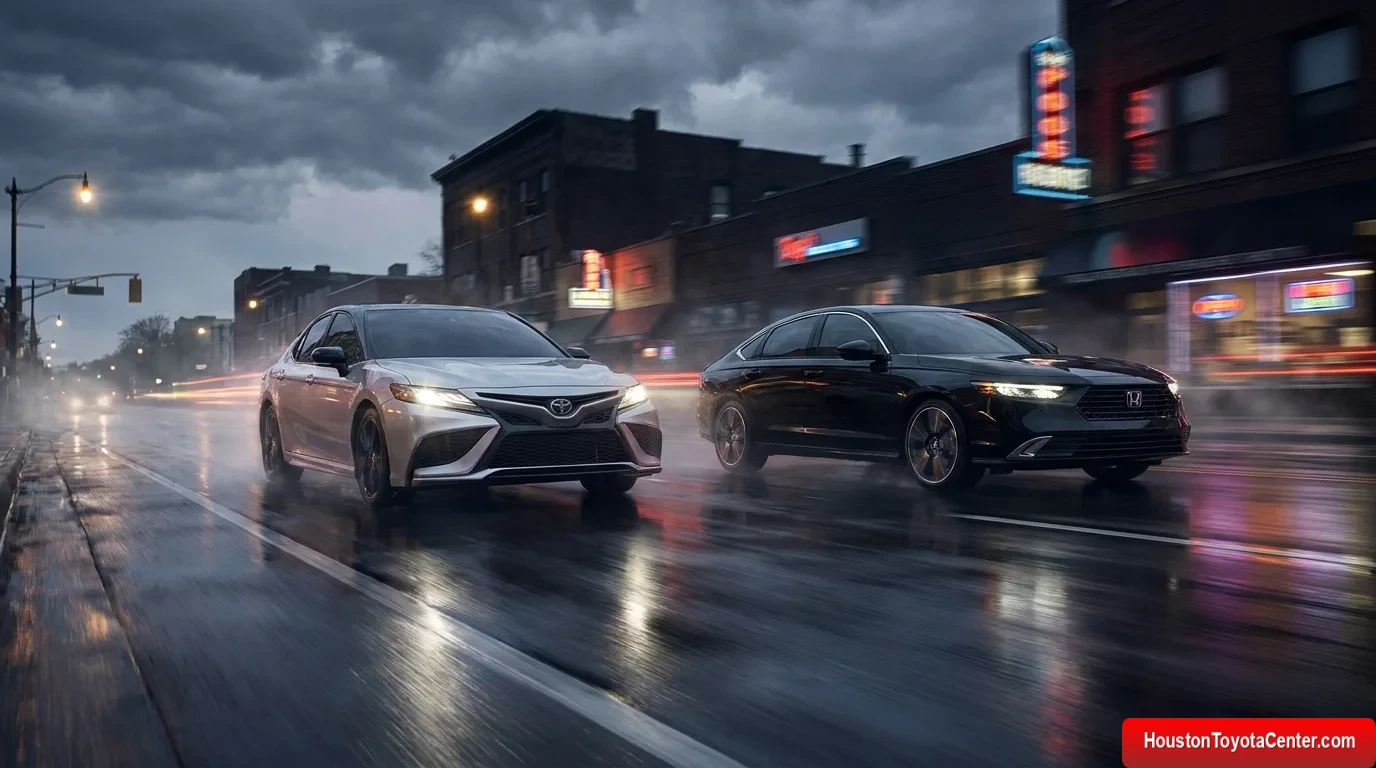
For decades, the Toyota Camry and Honda Accord have stood at the center of the midsize sedan world. They are two of the most recognizable cars ever built, and for many buyers, choosing between them feels less like selecting a vehicle and more like joining a philosophy.
The Camry represents comfort, consistency, smooth ownership, and a reputation for durability that stretches across generations. The Accord, meanwhile, has built its identity around driving refinement, clever engineering, cabin versatility, and a slightly sportier personality.
Both cars dominate conversations among commuters, families, students, rideshare drivers, retirees, and practical enthusiasts. Both are known for reliability. Both offer strong resale value. Both deliver modern safety technology and fuel-efficient powertrains. Yet despite all their similarities, they approach the midsize sedan formula differently.
So which one actually comes out on top?
FREE: Quickly identify and understand problems with your vehicle 🚘
CLICK HEREThe answer depends on what matters most to you.
This in-depth comparison explores performance, ride comfort, interior quality, technology, reliability, maintenance costs, fuel economy, hybrid systems, safety, resale value, ownership experience, and long-term practicality. By the end, you should have a clear understanding of which sedan best fits your lifestyle.
The Legacy Behind the Rivalry
The rivalry between the Camry and Accord is one of the most important battles in automotive history.
Toyota and Honda spent decades refining these models into benchmarks for mainstream transportation. At different points in time, each car has led the segment in sales, owner satisfaction, reliability ratings, or driving dynamics.
The reason these cars became icons is simple: they consistently delivered exactly what everyday drivers wanted.
That formula includes:
- Dependable engineering
- Comfortable interiors
- Strong fuel economy
- Affordable maintenance
- Excellent resale value
- High safety ratings
- Practical passenger space
- Easy drivability
Many competitors entered the midsize sedan category over the years, but few maintained the same level of trust among consumers.
Even as SUVs grew in popularity, the Camry and Accord remained relevant because they solve everyday transportation needs extremely well.
The modern versions of both vehicles are more advanced than ever before. They now include sophisticated driver-assistance systems, hybrid technology, premium infotainment features, upscale interior materials, and refined powertrains.
Yet they still preserve the core strengths that made them successful.
Exterior Design: Conservative Confidence vs. Sporty Sophistication
One of the biggest differences between the Camry and Accord is personality.
Toyota redesigned the Camry over recent generations to look far more aggressive than older models. Sharp lines, large grilles, sculpted bodywork, and athletic proportions give the Camry a stronger visual presence than many people expect from a practical sedan.
Honda took a cleaner and more mature approach with the Accord. The current Accord emphasizes elegance and simplicity rather than visual aggression. It looks streamlined, refined, and understated.
Toyota Camry Design Characteristics
The Camry tends to appeal to buyers who want:
- A bold front fascia
- Sportier styling cues
- Distinct trim personalities
- More visual drama
- A youthful appearance
Certain Camry trims, especially sport-oriented versions, look surprisingly athletic.
Honda Accord Design Characteristics
The Accord appeals to buyers who prefer:
- Minimalist styling
- Executive-sedan influences
- Clean body lines
- A mature appearance
- Timeless proportions
The Accord often feels slightly more premium from a design standpoint because of its restraint.
Which Looks Better?
This category is entirely subjective.
If you want a sedan that looks energetic and assertive, the Camry likely wins.
If you prefer something elegant and sophisticated, the Accord may age better visually.
Interestingly, younger buyers often gravitate toward the Camry’s aggressive styling, while older professionals frequently appreciate the Accord’s cleaner presentation.
Interior Quality and Cabin Experience
Inside the cabin, both sedans deliver impressive quality for their class.
However, they create different moods.
The Camry focuses heavily on comfort and ease of use. Controls are intuitive, seats are supportive, and visibility is generally excellent.
The Accord emphasizes openness and refinement. Honda’s interior design philosophy leans toward horizontal layouts, slim dashboard integration, and a more airy feeling.
Cabin Space Comparison
The Accord traditionally offers slightly better rear-seat room, particularly for legroom.
Families with taller passengers may notice the difference on long trips.
The Camry still provides generous seating space, but the Accord often feels larger inside due to its packaging efficiency.
Front Seat Comfort
The Camry’s seats tend to feel softer and more comfort-oriented.
The Accord’s seats are usually firmer and more supportive during spirited driving or longer journeys.
Material Quality
Both cars offer:
- Soft-touch materials
- Available leather upholstery
- Modern dashboard layouts
- Quality switchgear
- Well-insulated cabins
In higher trims, both sedans approach entry-level luxury territory.
Some reviewers give the Accord a slight edge for interior sophistication, while others prefer the Camry’s comfort-first philosophy.
Noise Isolation
Toyota has invested heavily in cabin quietness.
The Camry often feels exceptionally isolated from road and wind noise, especially in hybrid and higher trims.
The Accord is also quiet, but some drivers perceive slightly more tire and road feedback.
For commuters who prioritize serenity, the Camry may feel more relaxing.
Technology and Infotainment
Modern midsize sedans must compete not only on comfort and reliability but also on technology.
Both Toyota and Honda have improved dramatically in this area.
Standard Technology Features
Most versions of the Camry and Accord include:
- Apple CarPlay
- Android Auto
- Touchscreen infotainment systems
- Bluetooth connectivity
- USB charging ports
- Advanced safety systems
- Digital driver displays
- Voice assistant compatibility
Infotainment Philosophy
Honda generally prioritizes simplicity and responsiveness.
The Accord’s infotainment system is often praised for:
- Logical menus
- Fast responses
- Clean interface design
- Easy learning curve
Toyota’s systems have improved substantially in recent years, though some users still find Honda’s interface slightly more intuitive.
Premium Features Available
Higher trims can include:
| Feature | Toyota Camry | Honda Accord |
|---|---|---|
| Ventilated seats | Available | Limited availability |
| Heated seats | Available | Available |
| Head-up display | Available | Available |
| Wireless charging | Available | Available |
| Premium audio | JBL option | Bose option |
| Large digital gauges | Available | Available |
| Panoramic-style cabin feel | Moderate | Strong |
Driver Assistance Technology
Toyota Safety Sense and Honda Sensing are both excellent suites.
Features commonly included:
- Adaptive cruise control
- Lane-keeping assist
- Automatic emergency braking
- Blind-spot monitoring
- Traffic sign recognition
- Rear cross-traffic alert
In real-world use, both systems perform well.
Some drivers find Honda’s lane-centering behavior smoother, while Toyota’s adaptive cruise control often feels more conservative.
Performance and Driving Dynamics
This is where the Camry and Accord begin to separate philosophically.
The Camry focuses more on relaxed confidence.
The Accord leans toward driver engagement.
Toyota Camry Driving Character
The Camry is smooth, composed, predictable, and comfortable.
Its steering is light, the suspension absorbs bumps effectively, and the power delivery feels calm and refined.
Toyota engineered the Camry to reduce stress during daily driving.
The result is a sedan that excels in:
- Highway cruising
- Daily commuting
- Urban comfort
- Relaxed long-distance travel
Honda Accord Driving Character
The Accord feels more athletic.
Honda traditionally tunes steering, suspension, and chassis behavior to create stronger driver connection.
Compared with the Camry, the Accord often feels:
- More agile
- More responsive
- Better balanced in corners
- Slightly more engaging
Drivers who enjoy handling precision frequently prefer the Accord.
Engine Options
Historically, both cars offered multiple engines.
The modern market increasingly emphasizes efficiency and hybridization.
Toyota has aggressively embraced hybrids, while Honda has focused on refined turbocharged and hybrid systems.
Camry Strengths
- Smooth hybrid operation
- Excellent fuel economy
- Available all-wheel drive in some versions
- Comfortable ride quality
Accord Strengths
- Responsive acceleration
- More connected steering feel
- Strong chassis tuning
- Excellent powertrain refinement
The Sporty Factor
Neither vehicle is a sports car.
However, the Accord usually delivers a more enjoyable driving experience for enthusiasts.
The Camry can still be entertaining in sport-oriented trims, but the Accord consistently feels more cohesive dynamically.
Fuel Economy and Hybrid Excellence
Fuel economy is one of the biggest reasons people shop in this category.
Both the Camry and Accord offer highly efficient hybrid variants.
Toyota’s Hybrid Leadership
Toyota has decades of hybrid experience.
Its systems are known for:
- Proven durability
- Exceptional efficiency
- Smooth operation
- Low maintenance concerns
The Camry Hybrid is one of the best fuel-efficient midsize sedans available.
Many owners regularly achieve impressive real-world mileage.
Honda’s Hybrid Strategy
Honda’s hybrid systems are also excellent.
The Accord Hybrid is particularly praised for:
- Smooth power delivery
- Strong low-end torque
- Quiet operation
- Natural driving feel
Some drivers actually prefer the Accord Hybrid’s driving behavior over Toyota’s setup.
Real-World Fuel Economy
While exact numbers vary by trim and driving style, both cars can deliver remarkable efficiency.
Typical hybrid ownership benefits include:
- Lower fuel costs
- Reduced emissions
- Quiet city driving
- Less frequent fuel stops
Which Hybrid Is Better?
If pure reliability reputation and efficiency matter most, many buyers lean toward the Camry Hybrid.
If you want a more refined and responsive hybrid driving experience, the Accord Hybrid may feel more satisfying.
Reliability and Long-Term Ownership
This category defines the reputation of both models.
The Camry and Accord are among the most trusted vehicles in automotive history.
Yet there are subtle differences.
Toyota Camry Reliability Reputation
The Camry has become almost synonymous with durability.
Owners routinely keep Camrys for:
- 200,000 miles
- 300,000 miles
- Even longer with proper maintenance
Toyota’s conservative engineering philosophy contributes heavily to this consistency.
The company often prioritizes proven systems over risky experimentation.
Honda Accord Reliability Reputation
The Accord is also extremely dependable.
Honda engines and transmissions have historically earned strong reputations for longevity.
However, Honda occasionally pursues more ambitious engineering solutions than Toyota.
That innovation can produce exciting results but may sometimes introduce slightly more variability across generations.
Maintenance Costs
Both vehicles are relatively affordable to maintain.
Common ownership advantages include:
| Ownership Factor | Camry | Accord |
| Parts availability | Excellent | Excellent |
| Independent mechanic familiarity | Excellent | Excellent |
| Routine maintenance costs | Low | Low |
| Reliability reputation | Outstanding | Outstanding |
| Long-term durability | Excellent | Excellent |
| Unexpected repair frequency | Generally low | Generally low |
Which Lasts Longer?
Both cars can last an exceptionally long time.
If forced to choose purely on historical durability perception, the Camry often edges ahead slightly.
Toyota’s reputation for conservative engineering gives many buyers additional confidence.
Still, the difference is smaller than many internet debates suggest.
A well-maintained Accord can easily provide decades of dependable service.
Safety and Crash Protection
Safety has become a major selling point in the midsize sedan segment.
Both Toyota and Honda prioritize occupant protection heavily.
Standard Safety Features
Modern versions of both vehicles typically include:
- Forward collision warning
- Automatic emergency braking
- Lane departure warning
- Adaptive cruise control
- Traffic sign recognition
- Rearview cameras
- Stability control systems
Crash-Test Performance
The Camry and Accord consistently perform well in crash-testing evaluations.
Their strong safety scores contribute significantly to family appeal.
Real-World Confidence
Parents frequently choose these vehicles because they inspire confidence.
Both sedans combine:
- Predictable handling
- Strong braking performance
- Excellent visibility
- Reliable safety technology
Which Feels Safer?
Objectively, both are excellent.
Subjectively, some drivers prefer the Camry’s insulated and substantial feeling, while others trust the Accord’s responsive handling during emergency maneuvers.
Either choice represents a high standard of modern automotive safety.
Ride Comfort and Daily Livability
A midsize sedan succeeds or fails based on how pleasant it feels every day.
This category matters more than performance figures for most buyers.
Camry Comfort Focus
The Camry shines during:
- Long highway drives
- Heavy traffic commuting
- Smooth cruising
- Relaxed urban travel
Its suspension tuning prioritizes comfort.
The steering effort remains light and easy.
The cabin isolation reduces fatigue during long journeys.
Accord Daily Personality
The Accord remains comfortable but communicates more of the road surface.
Its suspension tuning balances comfort with responsiveness.
Drivers who enjoy engagement appreciate this balance.
Commuter Experience
If your daily driving involves:
- Stop-and-go traffic
- Long freeway commutes
- Frequent road trips
- Prioritizing relaxation
The Camry may feel slightly better suited.
If you value:
- Steering precision
- Better cornering feel
- A more connected driving experience
The Accord may prove more rewarding.
Interior Storage and Practicality
Both sedans are practical family vehicles.
However, Honda has historically excelled at packaging efficiency.
Accord Practical Advantages
The Accord often offers:
- Excellent rear-seat legroom
- Clever storage placement
- Large trunk capacity
- Spacious cabin layout
Honda engineers are known for maximizing interior usability.
Camry Practical Advantages
The Camry counters with:
- Comfortable seating
- Easy ingress and egress
- User-friendly controls
- Strong cabin ergonomics
Family Use
For families with children, both sedans perform very well.
They can comfortably handle:
- Child seats
- Grocery runs
- Weekend travel
- Airport pickups
- School commuting
Trunk Space
Both trunks are large enough for typical family needs.
The Accord occasionally holds a slight advantage in usable shape and overall packaging.
Resale Value and Depreciation
Resale value strongly affects the real cost of ownership.
Both the Camry and Accord perform exceptionally well in this area.
Why They Hold Value
These cars retain value because buyers trust them.
Used-car shoppers actively seek:
- Reliable transportation
- Affordable maintenance
- Strong fuel economy
- Proven longevity
The Camry and Accord consistently deliver all four.
Toyota’s Resale Strength
Toyota vehicles often achieve especially strong resale values.
The Camry’s reliability reputation helps preserve demand in the used market.
Honda’s Resale Strength
The Accord also depreciates slowly.
Its appeal among commuters, students, and practical buyers keeps resale values healthy.
Which Is Better Financially?
The difference may be relatively small depending on:
- Mileage
- Condition
- Market timing
- Trim level
- Hybrid demand
Historically, Toyota sometimes edges ahead slightly in resale performance.
Still, both rank among the safest automotive purchases from a long-term financial perspective.
All-Wheel Drive Availability
One major distinction is all-wheel drive.
Toyota offers AWD on certain Camry models.
Honda generally focuses on front-wheel-drive configurations for the Accord.
Why AWD Matters
Drivers in regions with:
- Snow
- Ice
- Heavy rain
- Mountain roads
May appreciate the added traction confidence.
Camry Advantage
The Camry’s AWD availability broadens its appeal significantly.
For some buyers, this feature alone decides the competition.
Accord Limitation
The Accord’s lack of AWD may disappoint shoppers in colder climates.
However, many drivers still find modern front-wheel-drive systems perfectly adequate with quality tires.
Insurance and Ownership Costs
Insurance rates vary by:
- Age
- Location
- Driving history
- Trim level
- Coverage type
Generally, both sedans are affordable to insure compared with luxury or performance vehicles.
Camry Ownership Economics
The Camry often appeals strongly to:
- Conservative buyers
- Families
- Fleet owners
- Retirees
- Rideshare drivers
Its ownership experience is famously predictable.
Accord Ownership Economics
The Accord appeals to buyers who want:
- Practicality with personality
- Strong driving dynamics
- Refined daily usability
- Slightly sportier character
Long-Term Financial Value
Both vehicles excel in:
- Fuel efficiency
- Maintenance affordability
- Durability
- Resale value
That combination creates a very low total cost of ownership relative to many alternatives.
Hybrid vs. Non-Hybrid Decisions
Many modern buyers struggle with one important question:
Should they choose the hybrid?
Why Hybrids Make Sense
Hybrid variants offer:
- Better fuel economy
- Lower fuel expenses
- Quieter operation
- Reduced emissions
- Excellent urban efficiency
Potential Concerns
Some buyers worry about:
- Battery longevity
- Repair costs
- Complexity
However, Toyota and Honda both have extensive hybrid experience.
Modern hybrid systems have become extremely durable.
Best Choice for High Mileage Drivers
If you drive frequently, especially in urban traffic, hybrid versions usually make tremendous financial sense.
Best Choice for Simplicity Seekers
Some buyers still prefer traditional gasoline models because they value:
- Mechanical familiarity
- Simpler ownership perception
- Lower initial purchase price
Both approaches remain valid.
Trim Levels and Buyer Personalities
One fascinating aspect of this rivalry is how different trims target different personalities.
Camry Buyer Types
The Camry often attracts:
- Comfort-focused commuters
- Reliability-first shoppers
- Families prioritizing smoothness
- Drivers seeking stress-free ownership
Sport trims additionally attract younger buyers.
Accord Buyer Types
The Accord often attracts:
- Driving enthusiasts
- Professionals
- Buyers wanting understated sophistication
- Drivers seeking engagement without sacrificing practicality
Luxury-Like Variants
Higher trims in both models become surprisingly upscale.
Features may include:
- Leather interiors
- Premium audio systems
- Advanced driver aids
- Heated and ventilated seats
- Large displays
- Ambient lighting
At the upper end, these sedans can challenge entry-level luxury vehicles in comfort and features.
The Emotional Side of Ownership
Car buying is not entirely rational.
People develop emotional relationships with vehicles.
Why People Love the Camry
Owners often describe the Camry as:
- Dependable
- Relaxing
- Easy to live with
- Predictable
- Reassuring
It creates confidence through consistency.
Why People Love the Accord
Owners frequently praise the Accord for being:
- More engaging
- More refined dynamically
- Spacious
- Smartly designed
- Fun without being impractical
It balances responsibility with personality.
Which Creates More Attachment?
Enthusiasts often feel stronger emotional connection toward the Accord.
The Camry tends to earn admiration through reliability and comfort.
Both create loyal owners.
How They Compare Against SUVs
One reason midsize sedans lost market share is the rise of SUVs.
However, the Camry and Accord still offer major advantages.
Sedan Advantages
Compared with many SUVs, these sedans typically provide:
- Better fuel economy
- Lower purchase prices
- Better handling
- Lower center of gravity
- Easier parking
- More efficient aerodynamics
Why Sedans Still Matter
For buyers who rarely need:
- Off-road capability
- Tall cargo areas
- Third-row seating
A midsize sedan can be the smarter choice.
The Camry and Accord prove that sedans remain highly relevant.
Best for Different Types of Buyers
To simplify the decision, here is a practical breakdown.
| Buyer Type | Better Choice |
| Comfort-focused commuter | Camry |
| Driver enthusiast | Accord |
| Maximum reliability reputation | Camry |
| Sportier handling | Accord |
| Quiet highway cruiser | Camry |
| Spacious rear seat | Accord |
| AWD shopper | Camry |
| Conservative ownership experience | Camry |
| Sophisticated interior feel | Accord |
| Engaging hybrid experience | Accord Hybrid |
| Proven hybrid reputation | Camry Hybrid |
| Long-distance road trip comfort | Camry |
| Dynamic steering feel | Accord |
Common Myths About the Camry and Accord
“The Camry Is Boring”
Older generations reinforced this stereotype.
Modern Camrys are far more stylish and dynamic than many people expect.
“The Accord Is Unreliable”
This claim is largely exaggerated.
The Accord remains one of the most dependable sedans available.
“Sedans Are Dead”
SUVs dominate sales, but midsize sedans continue serving millions of drivers effectively.
“Hybrids Are Too Expensive to Maintain”
Modern hybrid systems from Toyota and Honda have demonstrated impressive durability.
Ownership Satisfaction and Brand Trust
Toyota and Honda both benefit from extraordinary consumer trust.
That trust was earned over decades.
Toyota Brand Identity
Toyota emphasizes:
- Reliability
- Durability
- Efficiency
- Conservative engineering
- Consistency
Honda Brand Identity
Honda emphasizes:
- Engineering creativity
- Driver engagement
- Packaging efficiency
- Refinement
- Intelligent design
These philosophies directly influence the Camry and Accord.
Which Brand Creates Happier Owners?
Both enjoy high satisfaction rates.
The difference often comes down to personality fit rather than objective superiority.
Which One Is Better for Young Drivers?
Young professionals and first-time buyers frequently compare these sedans.
Camry Advantages for Younger Buyers
- Excellent reliability
- Strong resale value
- Available sporty styling
- Great fuel economy
- Lower stress ownership
Accord Advantages for Younger Buyers
- More engaging handling
- Sophisticated design
- Spacious interior
- Premium feel
- Driver-focused personality
Insurance Considerations
Sport-oriented trims may increase insurance costs slightly.
Still, both cars remain relatively affordable compared with luxury vehicles.
Which One Is Better for Families?
Families prioritize:
- Safety
- Reliability
- Comfort
- Space
- Fuel efficiency
Both sedans succeed here.
Camry Family Strengths
- Relaxing ride quality
- Quiet cabin
- Strong reliability reputation
- AWD availability
Accord Family Strengths
- Exceptional rear-seat room
- Practical interior layout
- Refined cabin atmosphere
- Excellent visibility
Parents honestly cannot go terribly wrong with either option.
Which One Is Better for Road Trips?
Road trips reveal a car’s true character.
Camry on Long Drives
The Camry excels at reducing fatigue.
Its quiet cabin and smooth ride create a relaxed experience over hundreds of miles.
Accord on Long Drives
The Accord remains comfortable but feels more engaging.
Drivers who enjoy active steering and responsive handling may prefer it.
Verdict for Travel
For pure comfort, the Camry usually wins.
For balancing comfort with engagement, the Accord stands out.
The Future of the Camry and Accord
The automotive world is changing rapidly.
Electrification, stricter emissions standards, and evolving consumer preferences continue reshaping the market.
Toyota’s Direction
Toyota is investing heavily in:
- Hybrid expansion
- Electrification
- Efficiency improvements
- Long-term durability
Honda’s Direction
Honda is focusing on:
- Advanced hybrid systems
- Refinement
- Smart packaging
- Future electrified platforms
Will Sedans Survive?
The Camry and Accord likely will.
They remain too important globally to disappear anytime soon.
As SUVs become more expensive and fuel costs fluctuate, efficient midsize sedans may even regain popularity.
Final Verdict: Which Comes Out on Top?
After comparing comfort, reliability, performance, practicality, fuel economy, technology, and ownership experience, one thing becomes obvious:
There is no universally perfect winner.
Instead, the Camry and Accord succeed by serving slightly different priorities.
Choose the Toyota Camry If You Want:
- Maximum comfort
- Stress-free daily driving
- Outstanding reliability reputation
- Exceptional hybrid efficiency
- Quiet cruising
- Available all-wheel drive
- Conservative long-term ownership confidence
The Camry feels like a carefully engineered appliance in the best possible sense. It minimizes friction, maximizes predictability, and delivers dependable transportation year after year.
Choose the Honda Accord If You Want:
- More engaging driving dynamics
- Sophisticated styling
- Spacious interior packaging
- Sharper steering feel
- Balanced ride and handling
- A more premium-feeling driving experience
The Accord proves practicality does not need to feel dull.
So Which One Truly Wins?
For buyers prioritizing reliability, comfort, and ownership simplicity above everything else, the Camry may have a slight overall advantage.
For buyers who still care deeply about driving enjoyment and refinement while maintaining practicality, the Accord may be the more satisfying choice.
In reality, the winner depends on your personality.
The Camry is the dependable marathon runner.
The Accord is the polished athlete.
Both are exceptional.
And that is exactly why this rivalry continues to define the midsize sedan category generation after generation.
Leave a Reply