
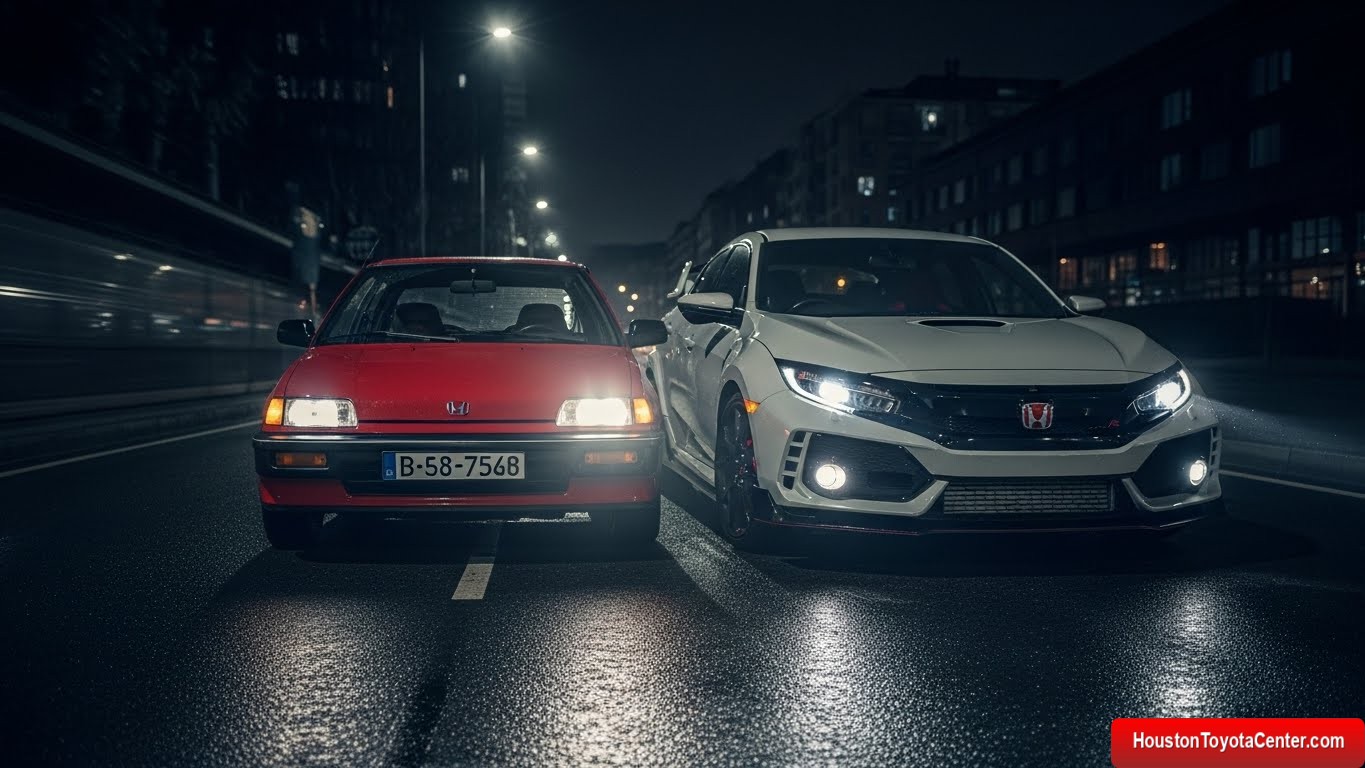
When the Honda Civic debuted in the early 1970s, few could have predicted that it would become one of the most influential automotive nameplates in history. Originally conceived as a small, fuel-efficient car for a rapidly changing global market, the Civic evolved over five decades into a platform that balances affordability, reliability, performance, motorsport pedigree, and cultural relevance. It is a car that has transcended its humble beginnings, becoming equally beloved by commuters, tuners, racers, and collectors.
The story of the Honda Civic is not merely about engineering—it is about adaptability, innovation, and understanding drivers’ needs across generations. From oil crises to emissions regulations, from analog simplicity to turbocharged digital sophistication, the Civic has continuously reinvented itself while maintaining a recognizable identity.
This article explores the complete evolution of the Honda Civic, examining how it grew from a basic economy car into a genuine enthusiast icon.
1. The Birth of a Global Economy Car (1972–1979)
Context: A World in Transition
The early 1970s marked a turning point for the global automotive industry. Rising fuel prices, increasing environmental awareness, and tighter emissions standards—especially in the United States—created demand for smaller, more efficient vehicles.
FREE: Quickly identify and understand problems with your vehicle 🚘
CLICK HEREHonda, then primarily known for motorcycles, entered this space with the 1972 Honda Civic.
Engineering Philosophy
Honda’s approach was radical for its time:
- Lightweight construction
- High-revving small-displacement engines
- Front-wheel drive layout
- Focus on mechanical efficiency
One of the Civic’s most revolutionary features was CVCC (Compound Vortex Controlled Combustion) technology. This allowed the car to meet strict emissions standards without the need for catalytic converters—a major advantage in the 1970s.
Why It Mattered
- Affordable to buy and maintain
- Exceptional fuel economy
- Reliable compared to many American and European competitors
The Civic quickly gained traction in North America, Europe, and Asia, laying the foundation for Honda’s global reputation.
2. Growing Up: Refinement and Practicality (1980–1987)
As the Civic gained popularity, Honda faced a new challenge: evolving the car without losing its core appeal.
Second and Third Generations
These generations introduced:
- More interior space
- Improved ride comfort
- Hatchback, sedan, and wagon variants
- Five-speed manual transmissions becoming common
The Birth of Sportiness
The early 1980s also saw Honda experimenting with performance-oriented trims:
- Higher-revving engines
- Sport suspension tuning
- Tighter steering
While still economy-focused, the Civic was beginning to appeal to drivers who enjoyed being behind the wheel.
Motorsport Influence
Honda’s success in motorsports—including Formula 1—started to influence its road cars. Lessons learned from racing gradually filtered into engine design, suspension geometry, and aerodynamics.
3. The Enthusiast Awakening (1988–1995)
This era marked a turning point in Civic history.
The Fourth Generation (EF)
The late 1980s Civic became:
- Lighter
- Lower
- More aerodynamic
Honda introduced double-wishbone suspension, dramatically improving handling.
The Rise of VTEC
Perhaps the most important development was the introduction of VTEC (Variable Valve Timing and Lift Electronic Control) in the early 1990s.
VTEC allowed:
- Fuel efficiency at low RPM
- High power at high RPM
- A unique engine character unlike anything else in the segment
This technology transformed the Civic from a practical commuter into a legitimate performance platform.
EG and EH Civics (1992–1995)
These models are now legends:
- Lightweight chassis
- Incredible engine-swapping potential
- Simple electronics
- Excellent balance
They became staples of:
- Autocross
- Track days
- Street tuning
- Drag racing
This generation cemented the Civic’s place in car culture.
4. The Civic Type R Is Born (1997–2000)
Japan-Only Performance Revolution
Honda introduced the Civic Type R in Japan in 1997.
Key features:
- Hand-assembled engines
- Limited sound deadening
- Reinforced chassis
- Close-ratio manual gearbox
- Redline-focused driving experience
The Type R philosophy was simple: maximum driver engagement.
Cultural Impact
Although initially unavailable in many markets, the Type R became legendary through:
- Import culture
- Racing games
- Automotive magazines
This was the moment the Civic officially entered the enthusiast elite.
5. The Golden Age of Tuning (1996–2000)
The late 1990s saw the Civic dominate tuner culture worldwide.
Why Tuners Loved It
- Affordable used prices
- Massive aftermarket support
- Engine interchangeability
- Lightweight chassis
Iconic Engines
| Engine Code | Displacement | Notable Trait |
|---|---|---|
| B16A | 1.6L | High-revving VTEC |
| B18C | 1.8L | Type R performance |
| D-Series | 1.5–1.6L | Budget-friendly |
Media Influence
Movies, magazines, and video games showcased Civics as customizable performance machines, further expanding their appeal beyond practicality.
6. Modernization and Mixed Reception (2001–2005)
Seventh Generation
This era introduced:
- Increased safety features
- Heavier curb weight
- Softer suspension tuning
While more comfortable, some enthusiasts criticized the reduced emphasis on driving dynamics.
Nevertheless…
Honda maintained:
- Strong reliability
- Excellent fuel economy
- Affordable ownership
The Civic remained a top seller globally.
7. Reclaiming Performance Identity (2006–2011)
Eighth Generation Design Shift
Honda took risks with futuristic styling:
- Digital dashboards
- Aggressive body lines
- More powerful engines
Si and Type R Models
Performance variants reintroduced excitement:
- High-revving naturally aspirated engines
- Limited-slip differentials
- Track-ready suspension
The Civic began reconnecting with its enthusiast roots.
8. Turbocharging and Global Performance (2012–2019)
The Turbo Era Begins
Facing stricter emissions regulations, Honda transitioned from naturally aspirated engines to turbocharged powerplants.
Benefits:
- Increased torque
- Better fuel efficiency
- Easier tuning potential
Global Civic Type R
The Type R became globally available, boasting:
- Extreme aerodynamics
- Nürburgring lap records
- Advanced cooling systems
This was no longer just a hot hatch—it was a world-class performance car.
9. The Modern Civic: Balance Perfected (2020–Present)
Refinement Meets Performance
The latest generations combine:
- Mature styling
- High-quality interiors
- Advanced safety tech
- Turbocharged performance
Enthusiast Credibility
Despite increased size and complexity, the Civic remains:
- One of the best-handling front-wheel-drive cars
- A benchmark for reliability
- Highly modifiable
The modern Civic proves that economy roots and enthusiast aspirations can coexist.
10. Why the Honda Civic Endures
The Civic’s longevity is no accident.
Key Reasons for Its Success
- Consistent innovation
- Respect for driver engagement
- Accessibility across income levels
- Strong motorsport heritage
Few cars manage to appeal to such a wide audience without losing their identity.
Conclusion: From Humble Beginnings to Icon Status
The evolution of the Honda Civic is a story of transformation without betrayal. It began as a solution to economic and environmental challenges and evolved into a global symbol of performance, reliability, and individuality.
Whether as a daily commuter, a weekend track weapon, or a carefully preserved classic, the Civic continues to adapt—just as it has for more than 50 years.
In an automotive world increasingly dominated by SUVs and electrification, the Honda Civic stands as proof that thoughtful engineering and driver-focused design never go out of style.
Leave a Reply