
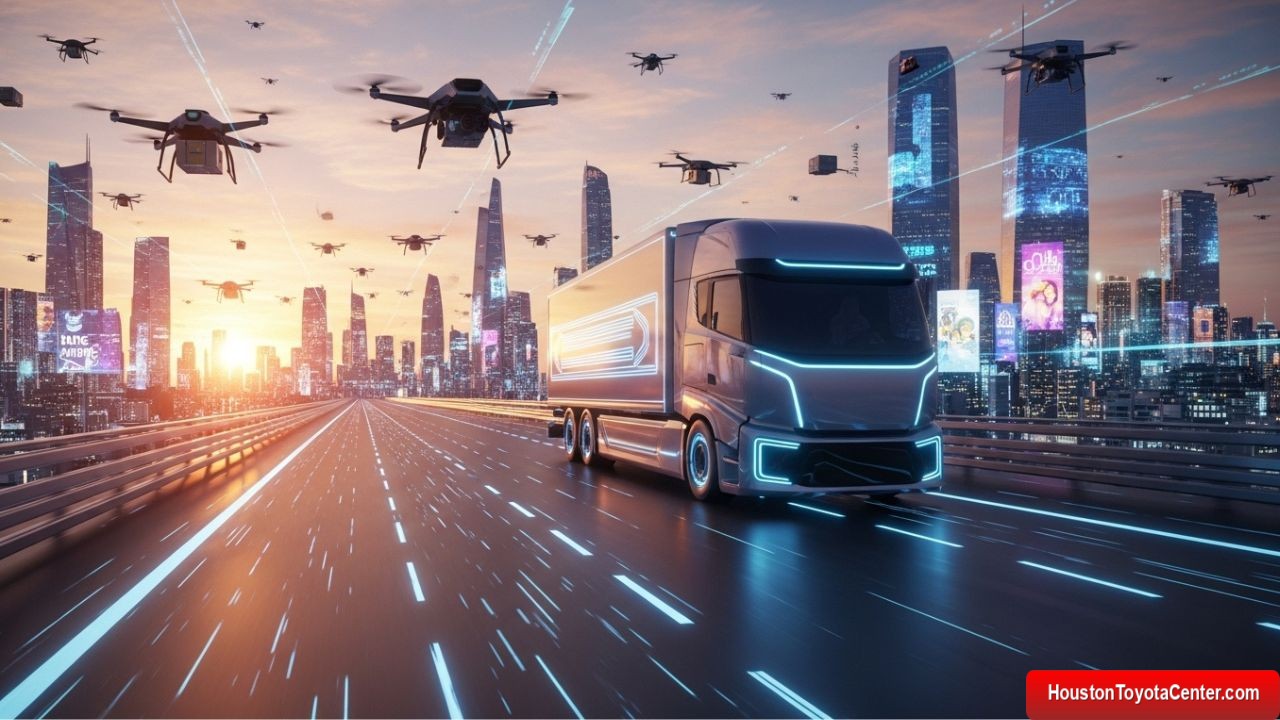
In a world where logistics underpins global trade, innovation is the beating heart that keeps goods flowing efficiently from manufacturers to consumers. One of the most transformative innovations of our time — autonomous trucking — stands on the verge of completely redefining the logistics landscape.
Self-driving trucks, equipped with cutting-edge sensors, artificial intelligence (AI), and advanced navigation systems, promise to revolutionize how we move freight, minimize operational costs, and optimize supply chains.
But how far are we from this revolution? What are the potential benefits, risks, and implications for drivers, companies, and economies worldwide? Let’s explore the road ahead.
🚛 The Rise of Autonomous Trucking
The concept of autonomous vehicles isn’t new, but its practical application in heavy freight logistics has gained serious momentum in the past decade.
FREE: Quickly identify and understand problems with your vehicle 🚘
CLICK HERECompanies like TuSimple, Embark Trucks, Aurora, Waymo Via, and Tesla are at the forefront of developing self-driving truck technologies designed to handle long-haul routes with minimal human input.
These trucks are not science fiction — they already exist. Prototypes have completed thousands of miles on American highways, proving that the technology is not just possible but increasingly reliable.
Key Technological Foundations
Autonomous trucks rely on a complex suite of technologies, including:
| Technology | Function | Example |
|---|---|---|
| Lidar (Light Detection and Ranging) | Scans the environment with lasers to create 3D maps | Velodyne Lidar |
| Radar Systems | Detects obstacles, vehicles, and distances | Continental Radar |
| Computer Vision | Cameras interpret road markings, signs, and vehicles | Nvidia Drive Platforms |
| AI Algorithms | Make real-time driving decisions | Waymo’s AI Stack |
| V2X Communication | Vehicle-to-everything connectivity enhances awareness | Qualcomm 5G Systems |
Each of these components works together to enable the truck to “see,” “think,” and “react” — mimicking, and in some cases surpassing, human reflexes.
🌎 Why Logistics Needs Automation
The logistics industry is massive, but it’s also under strain.
- Driver shortages plague the sector, especially in the U.S. and Europe.
- Rising fuel and labor costs reduce margins for carriers.
- Increased demand for fast shipping (thanks to e-commerce) adds pressure.
- Environmental regulations demand more efficient transport solutions.
According to the American Trucking Associations (ATA), the U.S. alone faces a shortage of over 80,000 drivers, projected to rise above 160,000 by 2030.
Autonomous trucks offer a potential lifeline — a way to keep freight moving without depending solely on human drivers.
⚙️ How Autonomous Trucks Work
While the public often associates “autonomous” with “driverless,” the reality is more nuanced. Autonomous trucks operate on a spectrum of automation, defined by the SAE International (Society of Automotive Engineers).
| Level | Description | Human Role |
|---|---|---|
| Level 0 | No automation | Full control |
| Level 1 | Driver assistance (cruise control) | Mostly human |
| Level 2 | Partial automation (lane-keeping, braking) | Human supervises |
| Level 3 | Conditional automation | Human ready to take control |
| Level 4 | High automation | Human optional in specific zones |
| Level 5 | Full automation | No human required |
Most autonomous trucks today operate at Level 4, meaning they can drive themselves under specific conditions, like on interstate highways with clear weather.
These trucks use AI-based decision-making systems trained on millions of miles of real-world and simulated data. The trucks can detect objects, predict traffic behavior, and adjust speed or lane position accordingly — all within milliseconds.
🧠 The Role of Artificial Intelligence
AI is the brain behind the machine. In autonomous trucking, it performs several critical roles:
- Perception – Recognizing surroundings through cameras, radar, and Lidar.
- Prediction – Anticipating what nearby vehicles and pedestrians will do.
- Planning – Deciding how to drive safely and efficiently.
- Control – Executing those decisions through steering, throttle, and braking.
Deep learning models enable the truck to continuously improve, learning from mistakes and environmental variables.
Moreover, cloud-based systems allow fleets of trucks to share data — creating a collective intelligence network where each vehicle benefits from the experience of all others.
💰 Economic Benefits
Autonomous trucking isn’t just a technological marvel — it’s a business revolution.
1. Cost Reduction
Driver wages and benefits account for nearly 40% of total trucking costs. Removing or reducing human labor could save billions annually.
2. Fuel Efficiency
AI-driven trucks can maintain optimal speeds and avoid inefficient idling or braking, improving fuel efficiency by up to 15%.
3. 24/7 Operation
Unlike human drivers, autonomous trucks don’t need rest breaks or sleep. They can operate non-stop, increasing delivery speed and reducing downtime.
4. Fewer Accidents
Over 90% of accidents on highways are caused by human error. Removing fatigue and distraction from the equation could drastically lower accident rates and insurance costs.
5. Supply Chain Optimization
Predictable, round-the-clock transport creates smoother supply chains. AI can even coordinate routes with warehouse schedules, minimizing idle time.
🌿 Environmental Impact
The environmental implications of autonomous trucking are significant.
Smarter driving algorithms reduce fuel consumption and emissions, while future fleets powered by electric or hydrogen fuel cells could make freight transport nearly carbon-neutral.
Moreover, route optimization minimizes traffic congestion, further cutting emissions and urban air pollution.
The synergy between autonomous technology and sustainable powertrains could redefine “green logistics.”
🏭 Industry Applications
Autonomous trucks are being integrated into various segments of the logistics chain:
1. Long-Haul Freight
The most obvious application — autonomous trucks excel on long, monotonous highway routes between distribution hubs.
2. Hub-to-Hub Operations
Many companies are focusing on hub-to-hub automation, where a truck drives autonomously between logistics centers, with human drivers managing the “last mile” deliveries.
3. Mining and Construction
Autonomous haul trucks are already operating in controlled environments like mines, reducing workplace accidents and boosting productivity.
4. Port Logistics
Automated port trucks can efficiently move containers between ships and storage areas, cutting delays in global shipping.
🧍♂️ The Human Element: What About Drivers?
One of the biggest concerns surrounding autonomous trucking is job displacement.
Truck driving is one of the most common professions in the world, employing millions. As automation advances, what happens to those livelihoods?
Experts suggest a gradual transition rather than an abrupt replacement. Autonomous systems will initially focus on specific, repetitive routes — augmenting human labor, not eliminating it.
Humans will still be needed for:
- Last-mile delivery
- Vehicle maintenance
- Remote monitoring
- Supervision and intervention in complex conditions
The industry may see a shift from “drivers” to logistics operators and technicians, requiring retraining but still offering employment opportunities.
🧩 Challenges and Barriers
Despite its promise, autonomous trucking faces several obstacles.
1. Regulation
Different states and countries have inconsistent laws governing self-driving vehicles. Creating a unified legal framework is critical for large-scale deployment.
2. Safety and Public Trust
Even one high-profile accident could erode public confidence. Transparency in safety testing and data sharing will be key.
3. Infrastructure
Autonomous trucks need well-marked roads, reliable GPS, and dedicated lanes or hubs. Infrastructure upgrades take time and investment.
4. Cybersecurity
Connected trucks could be targets for hacking or data theft. Ensuring secure communication systems is vital.
5. Weather and Terrain
Heavy rain, snow, or poor lighting can interfere with sensors. Until AI systems can handle all environmental variables, human oversight remains necessary.
📊 Comparing Human-Driven vs. Autonomous Trucks
| Category | Human-Driven Truck | Autonomous Truck |
|---|---|---|
| Operational Hours | 11 hours/day (due to regulations) | 24/7 continuous |
| Error Rate | High (fatigue, distraction) | Low (AI precision) |
| Fuel Efficiency | Variable | Optimized algorithms |
| Maintenance Costs | Moderate | Higher (advanced systems) |
| Insurance Premiums | High | Potentially lower |
| Employment Impact | Labor-intensive | Tech-driven roles |
🛰️ The Road Ahead: Integration with Smart Infrastructure
The future of logistics isn’t just autonomous trucks — it’s smart ecosystems.
Imagine highways embedded with sensors that communicate directly with vehicles, updating them about traffic, weather, and road conditions in real-time.
In cities, smart intersections could prioritize freight traffic during low-demand hours, while digital twins of transport networks could simulate and optimize logistics flow continuously.
This vision aligns with Industry 4.0, where automation, IoT, and AI converge to create a fully interconnected supply chain.
🔄 Real-World Testing and Pilot Projects
Autonomous trucking isn’t a distant dream — it’s already happening.
- TuSimple completed a driverless test run in Arizona, covering 80 miles without human intervention.
- Embark Trucks has partnerships with major carriers like Knight-Swift and Werner Enterprises.
- Aurora Innovation, backed by Amazon, is testing its Aurora Driver platform in Texas.
- Waymo Via (Google’s sibling company) continues to test routes between California and Arizona.
These early trials show promising results in terms of efficiency, safety, and cost reduction.
🧭 Global Perspective
While the U.S. leads in testing, countries like China, Germany, and Japan are rapidly developing their own autonomous freight programs.
China’s WeRide and Inceptio Technology are expanding pilot projects across major freight corridors.
In Europe, Daimler Trucks and Volvo Group collaborate on autonomous systems designed for cross-border logistics.
The international competition will likely accelerate technological maturity — and lower costs for adoption.
📦 How Businesses Can Prepare
For logistics companies, the transition to autonomous trucking will require strategic adaptation:
- Invest in Data Infrastructure – Fleet management systems must be ready to integrate with autonomous software.
- Retrain the Workforce – Shift drivers toward supervisory, maintenance, and tech-support roles.
- Form Partnerships – Collaborate with tech companies, regulators, and universities.
- Start Small – Pilot hub-to-hub automation before full rollout.
- Plan for Redundancy – Maintain hybrid fleets (human + autonomous) during the transition phase.
🔐 Ethics and Accountability
Autonomous systems raise difficult ethical questions.
- Who is responsible if an autonomous truck causes an accident — the manufacturer, the software provider, or the fleet owner?
- How do we ensure transparency in AI decision-making?
- What happens to data privacy when vehicles constantly share location and performance data?
Regulators and companies will need to establish clear ethical and legal frameworks to address accountability in autonomous operations.
🧱 The Transitional Decade
The 2020s will likely be the transitional decade for autonomous trucking — a hybrid era where human drivers and AI coexist.
By the early 2030s, experts predict that autonomous trucks could handle up to 30% of all freight miles in the U.S.
By 2040, full-scale deployment could reshape global supply chains entirely.
This shift won’t just change how we move goods — it will redefine logistics as an intelligent, predictive, and sustainable ecosystem.
🌐 Conclusion: Driving into the Future
Autonomous trucks are not merely vehicles — they represent a technological revolution on wheels.
From cutting costs to reducing emissions, enhancing safety, and solving driver shortages, the benefits are transformative.
The challenges — regulatory, ethical, and technical — are real but surmountable.
As AI, infrastructure, and public trust evolve, self-driving trucks will become not just a logistical innovation, but a symbol of human ingenuity: machines carrying the weight of progress across every mile.
The journey has already begun — and the destination is a smarter, faster, greener logistics future.
Leave a Reply