
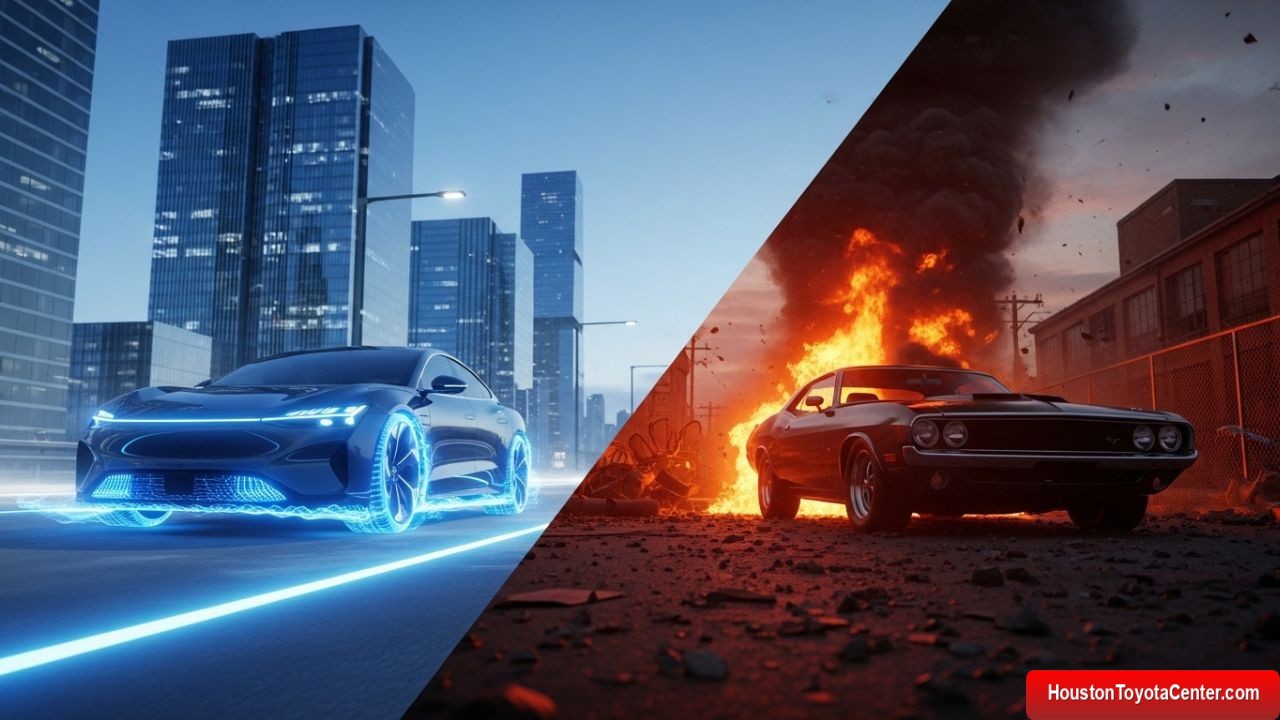
The debate over electric vehicles (EVs) versus gasoline-powered cars is often framed as a simple question: Which one is cleaner? While tailpipe emissions provide an easy comparison—electric cars produce none, gasoline cars do—the real answer is far more complex. To understand the true environmental impact of each vehicle type, it is essential to analyze lifecycle emissions, a comprehensive assessment that accounts for emissions from raw material extraction, manufacturing, operation, maintenance, and end-of-life disposal or recycling.
Lifecycle emissions analysis reveals that no vehicle is entirely emission-free. Instead, environmental impact is distributed across different phases of a vehicle’s life, with electric and gasoline cars concentrating emissions in different stages. This article explores those stages in depth, clarifies common misconceptions, examines regional differences, and evaluates how future technological changes may shift the balance even further.
Understanding Lifecycle Emissions
Lifecycle emissions refer to the total greenhouse gas (GHG) emissions associated with a product from “cradle to grave.” For vehicles, this includes:
- Raw material extraction and processing
- Vehicle manufacturing
- Fuel or electricity production
- Vehicle operation
- Maintenance and repairs
- End-of-life disposal or recycling
This approach is essential because focusing on a single phase—such as tailpipe emissions—can be misleading. Electric vehicles eliminate emissions during driving, but their batteries require energy-intensive production. Gasoline vehicles, on the other hand, may have lower manufacturing emissions but generate significant emissions throughout their operational lifetime.
FREE: Quickly identify and understand problems with your vehicle 🚘
CLICK HERERaw Material Extraction: The Starting Point
Gasoline Vehicles
Gasoline cars primarily rely on materials such as:
- Steel and aluminum for the body and engine
- Plastics for interior and exterior components
- Copper for wiring
- Precious metals (platinum, palladium, rhodium) for catalytic converters
The environmental impact of extracting these materials is substantial but relatively well-established. Mining iron ore, bauxite, and copper generates emissions through heavy machinery use, fossil fuel consumption, and land disturbance. However, these processes are mature, and efficiency improvements have reduced emissions intensity over time.
Electric Vehicles
Electric vehicles require many of the same materials as gasoline cars, but they also depend heavily on battery-specific minerals, including:
- Lithium
- Cobalt
- Nickel
- Manganese
- Graphite
The extraction of these materials has drawn significant attention due to both environmental and ethical concerns. Lithium mining can be water-intensive, particularly in arid regions. Cobalt mining, often concentrated in the Democratic Republic of Congo, raises concerns about labor practices and ecosystem damage.
From an emissions perspective, battery mineral extraction is energy-intensive and contributes significantly to the upfront carbon footprint of EVs. However, it is important to note that these emissions occur once, at the beginning of the vehicle’s life, rather than continuously during use.
Manufacturing Emissions
Gasoline Car Manufacturing
Manufacturing a gasoline car typically generates between 5 and 7 metric tons of CO₂-equivalent emissions, depending on vehicle size, materials, and production efficiency. The engine and transmission are complex mechanical systems requiring precise machining and energy-intensive processes.
Because internal combustion engine (ICE) technology is mature, manufacturers have optimized production lines, reducing waste and improving energy efficiency over decades.
Electric Car Manufacturing
Electric vehicle manufacturing usually results in higher initial emissions, largely due to battery production. Depending on battery size and manufacturing location, producing an EV can generate 7 to 12 metric tons of CO₂-equivalent emissions.
Battery production involves:
- High-temperature processing
- Energy-intensive chemical reactions
- Extensive material purification
However, battery manufacturing emissions are highly sensitive to the electricity mix used at factories. A battery produced in a region powered by renewable energy can have dramatically lower emissions than one produced using coal-heavy electricity.
Manufacturing Emissions Comparison Table
| Vehicle Type | Average Manufacturing Emissions (CO₂e) |
|---|---|
| Gasoline Car | 5–7 metric tons |
| Electric Car | 7–12 metric tons |
While EVs start with a “carbon debt,” this initial disadvantage must be evaluated in the context of lifetime operation.
Fuel and Energy Production
Gasoline Production
Gasoline is not simply pumped from the ground and poured into a tank. The fuel lifecycle includes:
- Oil extraction
- Transportation (pipelines, tankers, trucks)
- Refining
- Distribution to gas stations
Each step generates emissions. Refining crude oil into gasoline is particularly energy-intensive, releasing large quantities of CO₂ and other pollutants. On average, 20–30% of gasoline’s total lifecycle emissions occur before it ever reaches the vehicle.
Electricity Production
Electric vehicles rely on electricity, and the emissions associated with that electricity depend entirely on the energy mix of the grid. Electricity can be generated from:
- Coal
- Natural gas
- Nuclear
- Hydropower
- Wind
- Solar
- Geothermal
In regions with coal-heavy grids, EV charging can produce significant emissions. In regions dominated by renewables or nuclear energy, charging emissions are minimal.
Crucially, electricity grids tend to decarbonize over time, while gasoline combustion does not. This means that an EV purchased today becomes cleaner automatically as the grid improves.
Operational Emissions
Gasoline Cars in Operation
Gasoline vehicles emit CO₂ directly from their tailpipes. On average:
- A gasoline car emits approximately 2.3 kg of CO₂ per liter of gasoline burned
- Over a typical lifetime of 200,000 km, a gasoline car can emit 40–50 metric tons of CO₂
These emissions are unavoidable and fixed by the chemistry of combustion. Efficiency improvements can reduce emissions per kilometer, but they cannot eliminate them.
Electric Cars in Operation
Electric vehicles produce zero tailpipe emissions. However, indirect emissions from electricity generation still apply.
Depending on the grid:
- Coal-heavy grid: EV emissions may approach those of efficient gasoline cars
- Mixed grid: EV emissions are typically 30–60% lower
- Renewable-heavy grid: EV emissions can be 70–90% lower
Even in the worst-case scenarios, EVs rarely exceed gasoline cars in operational emissions over the long term.
Maintenance and Repairs
Gasoline Cars
Gasoline vehicles have many moving parts that wear over time:
- Oil changes
- Spark plugs
- Exhaust systems
- Transmissions
- Catalytic converters
Each replacement part carries its own manufacturing emissions. Over a vehicle’s lifetime, maintenance-related emissions can be significant.
Electric Cars
Electric vehicles are mechanically simpler:
- No oil changes
- Fewer moving parts
- Regenerative braking reduces brake wear
Battery degradation remains a concern, but modern EV batteries are lasting longer than initially expected, often exceeding 300,000 km with acceptable capacity loss.
Overall, EVs tend to have lower maintenance-related emissions.
End-of-Life Emissions and Recycling
Gasoline Cars
End-of-life processing for gasoline cars involves:
- Dismantling
- Metal recycling
- Disposal of fluids and hazardous materials
Steel and aluminum recycling is well-established and relatively efficient. However, catalytic converters contain precious metals that require specialized recycling processes.
Electric Cars
Electric vehicle recycling is more complex due to batteries. However, battery recycling technology is advancing rapidly, with processes capable of recovering:
- Lithium
- Nickel
- Cobalt
- Copper
Recycling batteries reduces the need for new mining and significantly lowers emissions for future battery production. As EV adoption increases, economies of scale are expected to improve recycling efficiency and reduce costs.
Total Lifecycle Emissions Comparison
When all phases are combined, numerous independent studies reach similar conclusions:
- Electric vehicles have lower total lifecycle emissions than gasoline vehicles
- The difference grows larger as electricity grids become cleaner
Illustrative Lifecycle Emissions Table (Average Global Conditions)
| Vehicle Type | Total Lifecycle Emissions (CO₂e) |
|---|---|
| Gasoline Car | 55–60 metric tons |
| Electric Car | 30–40 metric tons |
This represents a 30–50% reduction in emissions for EVs over their full lifecycle.
Regional Differences and Their Impact
The environmental advantage of electric vehicles varies by location:
- Europe: Strong advantage for EVs due to cleaner grids
- United States: Moderate to strong advantage, improving annually
- China: Advantage varies by region but improving rapidly
- Coal-dependent regions: Smaller advantage, but still present over long lifetimes
Importantly, gasoline cars do not benefit from grid improvements, while EVs do.
Common Myths About Electric Vehicle Emissions
“EVs are worse because of batteries”
This is only true if considering manufacturing alone. Over the full lifecycle, EVs outperform gasoline cars.
“EVs just move emissions from tailpipes to power plants”
Power plants are generally more efficient and easier to decarbonize than millions of individual engines.
“Battery replacement cancels out benefits”
Most EV batteries last the lifetime of the vehicle, and second-life applications further reduce environmental impact.
Future Improvements and Trends
Several developments will further reduce EV lifecycle emissions:
- Cleaner electricity grids
- Improved battery chemistry
- Higher energy density batteries
- Increased recycling rates
- More efficient manufacturing processes
Gasoline vehicles, by contrast, face physical and chemical limits to efficiency improvements.
Policy and Economic Implications
Understanding lifecycle emissions has direct implications for:
- Climate policy
- Vehicle regulations
- Consumer incentives
- Infrastructure investment
Policies that accelerate grid decarbonization amplify the benefits of EV adoption.
Final Verdict
When evaluated through a lifecycle emissions lens, electric vehicles consistently outperform gasoline cars in terms of greenhouse gas emissions. While EVs begin their lives with higher manufacturing emissions, they quickly offset this disadvantage through cleaner operation and lower maintenance emissions. As electricity grids become cleaner and battery technology improves, the environmental gap will continue to widen.
The transition to electric mobility is not a perfect solution, but it is a substantial and necessary step toward reducing transportation-related emissions and mitigating climate change.
Leave a Reply